Every long-running AI workflow eventually hits a snag: an API times out, a model call fails, a step breaks halfway through.
Right now the default response is to restart from zero. That's wasted compute, wasted time, and wasted context.
As agent workflows get longer and more complex, that cost only grows.
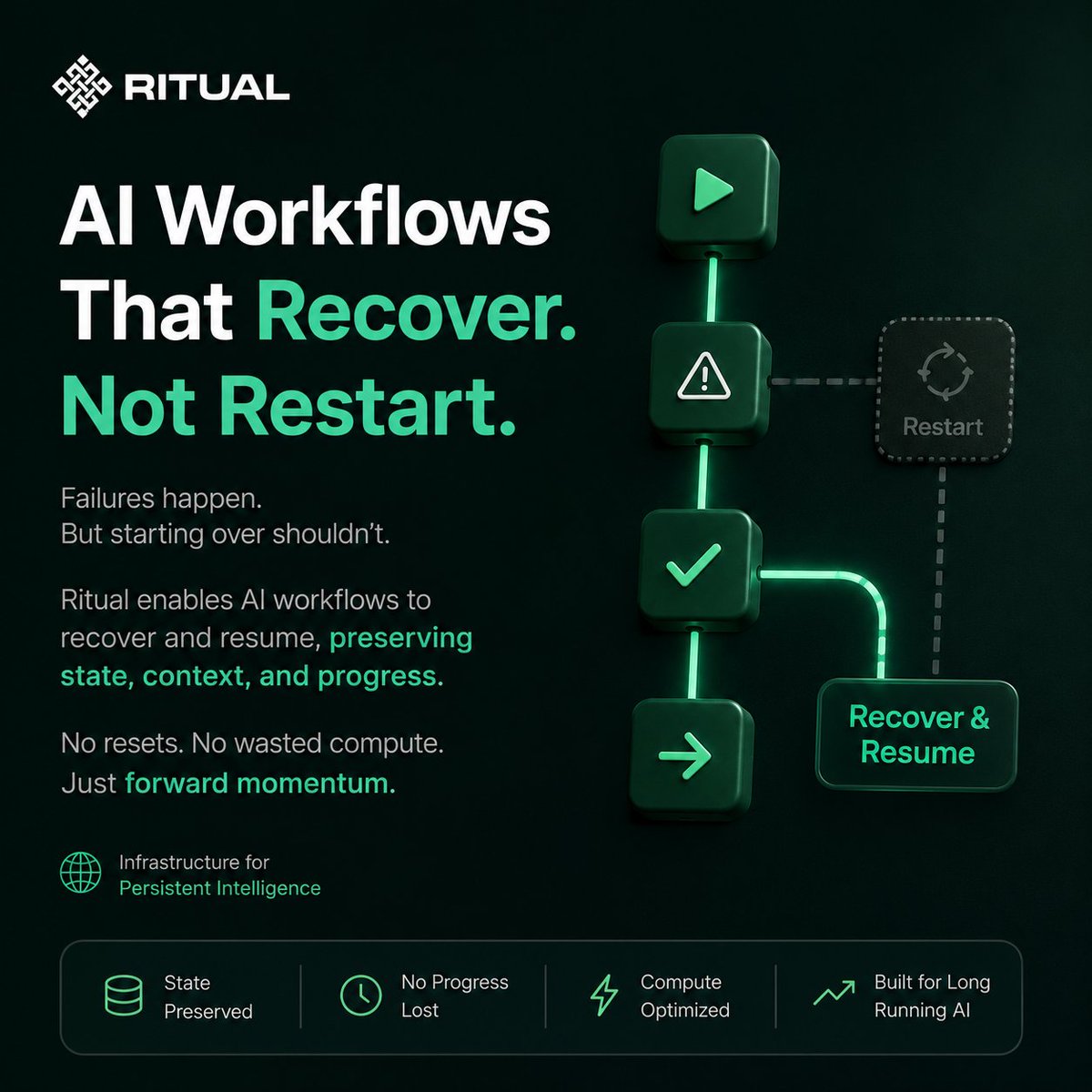
@ritualnet is building the infra layer to fix this: workflows that can recover and resume instead of resetting. State gets preserved, progress isn't lost, and execution just picks up where it left off.
This is the kind of unglamorous infrastructure that becomes essential once AI systems stop being single API calls and start being real, multi-step pipelines.
Underrated for now.
Won't stay that way.
Long-running AI is only as good as its ability to recover.
Most AI workflows today are built for short bursts: run, finish, done. But real intelligence, the kind that handles complex, multi-day tasks, needs to survive failure, not just avoid it.
That's what makes @ritualnet interesting. It's not only about executing AI workflows efficiently. It's about designing systems that can break, recover, and keep moving without starting over from scratch every time something goes wrong.
Because the future of reliable AI won't be measured by uptime alone. It'll be measured by resilience: how well a system adapts when things don't go as planned.
Every long-running AI workflow eventually hits a snag: an API times out, a model call fails, a step breaks halfway through.
Right now the default response is to restart from zero. That's wasted compute, wasted time, and wasted context.
As agent workflows get longer and more complex, that cost only grows.
@ritualnet is building the infra layer to fix this: workflows that can recover and resume instead of resetting. State gets preserved, progress isn't lost, and execution just picks up where it left off.
This is the kind of unglamorous infrastructure that becomes essential once AI systems stop being single API calls and start being real, multi-step pipelines.
Underrated for now.
Won't stay that way.
Long-running AI is only as good as its ability to recover.
Most AI workflows today are built for short bursts: run, finish, done. But real intelligence, the kind that handles complex, multi-day tasks, needs to survive failure, not just avoid it.
That's what makes @ritualnet interesting. It's not only about executing AI workflows efficiently. It's about designing systems that can break, recover, and keep moving without starting over from scratch every time something goes wrong.
Because the future of reliable AI won't be measured by uptime alone. It'll be measured by resilience: how well a system adapts when things don't go as planned.
Long-running AI is only as good as its ability to recover.
Most AI workflows today are built for short bursts: run, finish, done. But real intelligence, the kind that handles complex, multi-day tasks, needs to survive failure, not just avoid it.
That's what makes @ritualnet interesting. It's not only about executing AI workflows efficiently. It's about designing systems that can break, recover, and keep moving without starting over from scratch every time something goes wrong.
Because the future of reliable AI won't be measured by uptime alone. It'll be measured by resilience: how well a system adapts when things don't go as planned.
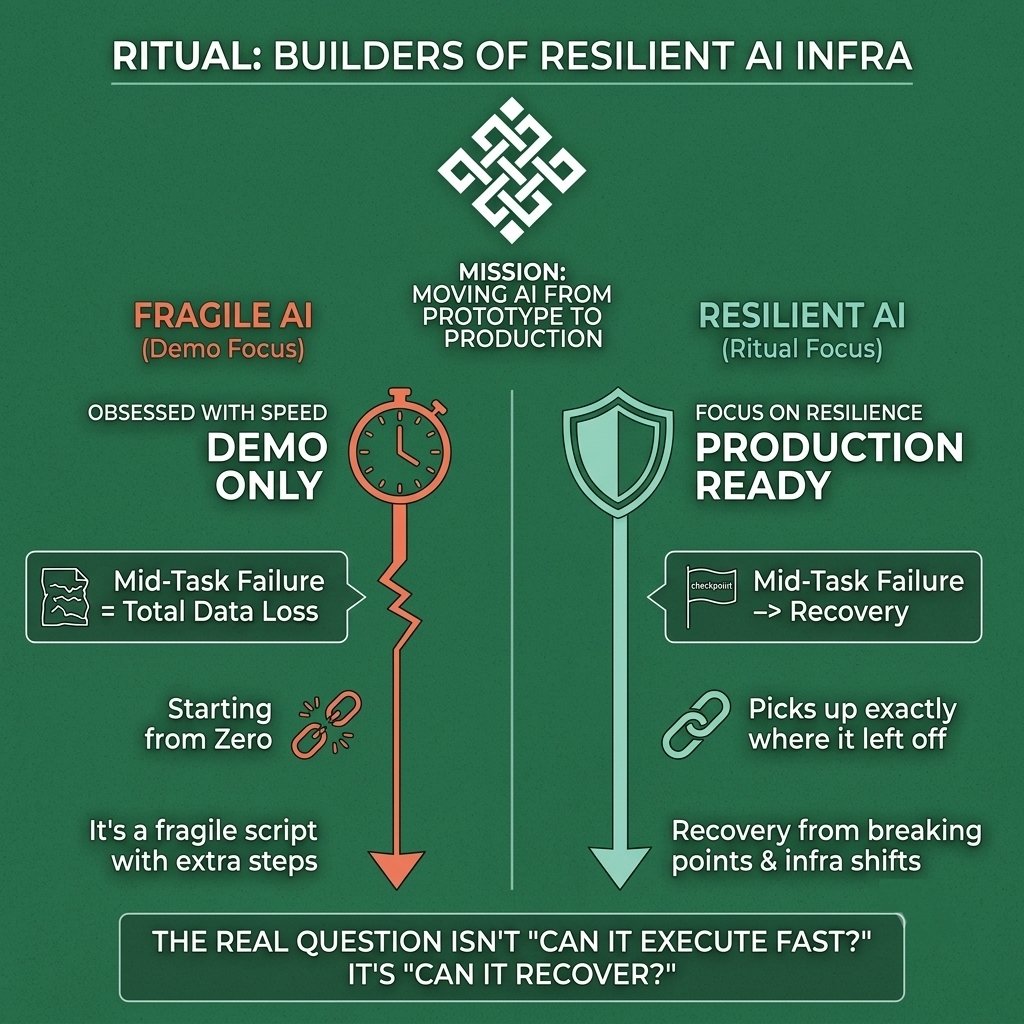
Everyone's obsessed with how fast AI can execute. Nobody talks about what happens when it fails mid-task.
Speed is easy to demo. Resilience is what actually matters in production. If your workflow crashes and the only option is starting from zero, you don't have an AI system, you have a fragile script with extra steps.
This is where @ritualnet is building something different.
The real question isn't can it execute fast. It's can it recover. Can the workflow pick up exactly where it left off, even if the underlying infra shifts underneath it, even if something breaks halfway through a multi-step task. That's the difference between a demo and infrastructure people can actually depend on.
AI infra that only works on good days isn't infra. It's a prototype wearing a production costume.