School Mental Health, Belonging, Social & Emotional Intelligence Change Agent. Working to ensure all kids are engaged, supported, empowered & successful.
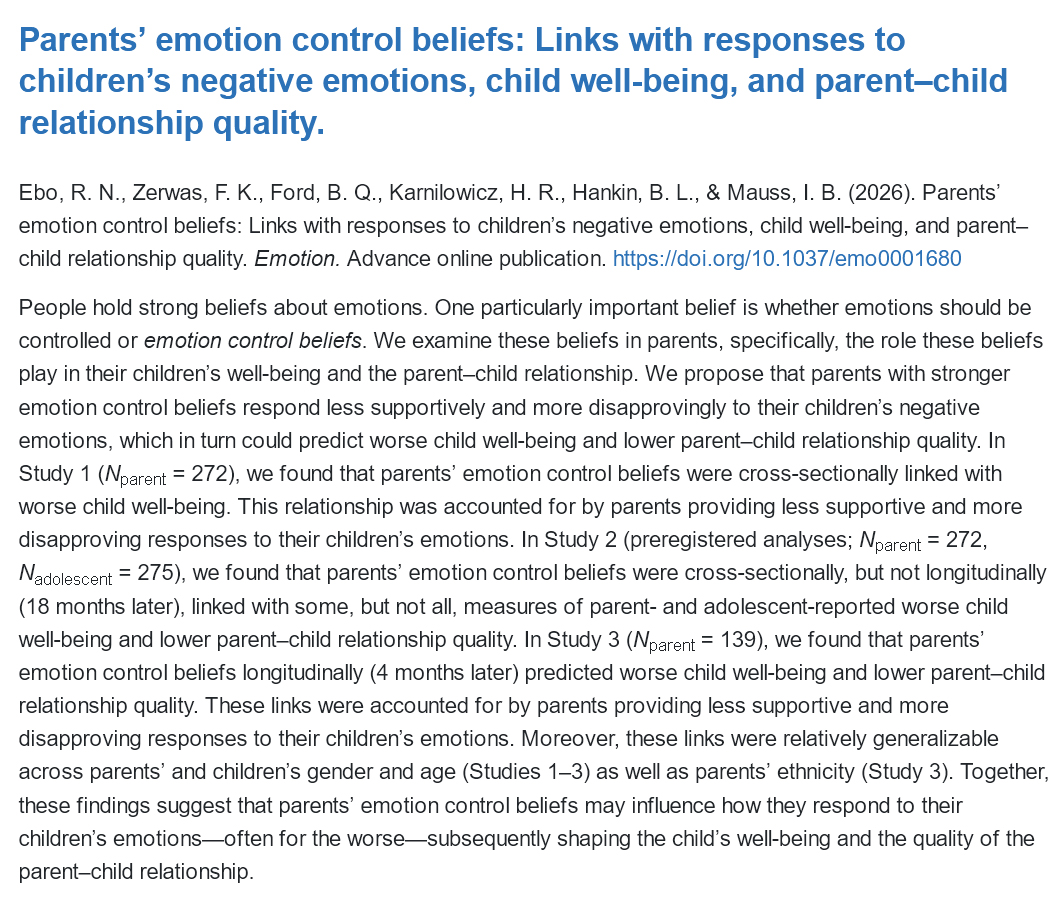
Expecting kids to control their emotions is not good for their well-being.
When parents believe in suppressing feelings, they respond with more disapproval. Their kids are more likely to become anxious and depressed.
Emotion regulation improves with practice, not punishment.
Trauma doesn’t just affect emotions,it impacts how the brain functions. It can change the way the brain responds to stress,impulse control,safety & memory.
Three areas most affected are the cortex,amygdala & hippocampus.These changes are not a weakness but survival adaptations.
Neuroscience shows us that co-regulation is established through connection & connection is established through felt safety. It’s not just emotional,it’s biological.
In a nutshell,”regulation is relational,” & you need to build the relational bridge to make it possible.
A Harvard professor proved 6-hour sleep can trigger your body toward heart disease & cancer in 1 week.
On Jay Shetty's podcast, he revealed 10 "normal" habits that destroys your sleep, mood, and brain:
1) Checking your phone right after waking.
Read a note from our Faculty Director, Dr. Stephanie Jones, in our new newsletter: https://t.co/8Ujqfx1gbQ
Dr. Jones reflects on what she’s learned since joining the Center and marks Mental Health Awareness Month by discussing the importance of mental health in early childhood.
After our physiological needs are met,we need to biologically attach. We have brain circuitry wired for attachment (limbic).Within schools, attachment should come before everything. It's all about attachment. For pupis, it's an absolute necessity. Everything else will follow.
A major new study reveals that adults with ADHD who tap into their strengths—such as creativity, spontaneity, and deep focus—tend to feel happier and mentally healthier.
https://t.co/MhpEiEzPIn
Screens are robbing Australian toddlers of sleep.
A new study of over 3,000 kids found that for every hour a 2-year-old spends on a device, their sleep gets delayed by nearly 30 minutes — creating “social jetlag” and putting their development at risk.
Excessive early screen time disrupts melatonin production and delays sleep onset, which is critical because deep sleep in early childhood supports brain development, memory consolidation, and emotional regulation.
Early childhood is when brains develop fastest. Replacing sleep, movement, and real human connection with screens could have serious long-term consequences for an entire generation.
Toddlers becoming screen-dependent is abysmal. Parents need real boundaries instead of letting devices raise their kids.
What do you think — are we being too lax with screen time for toddlers, or do you think the benefits outweigh the risks?
A group of UC Berkeley students did a 9-week digital detox… and the results were striking.
Cognitive neuroscientist Dr. Sahar Yousef (UC Berkeley Haas) found that participants experienced less anxiety, less depression, and more mindfulness. Some students said they suddenly started noticing all the positive things in their real life once the constant scrolling stopped.
Dr. Yousef also raised a concern, noting that heavy daily tech habits may be linked to brain changes: “We’re actually seeing brain atrophy… degradation of certain brain areas related to self-awareness [and] cognitive control.” (Note: This is an emerging area of research — more long-term studies are needed.)
This feels very relatable. The longer I step away from endless scrolling, the clearer and calmer my mind seems to get.
Our digital habits have become so automatic that we rarely stop to consider their impact on mental health and focus.
Have you ever tried even a short digital detox? What difference (if any) did you notice?
Brain scans are revealing early dementia-like changes in kids and teens from heavy screen use.
60 Minutes Australia reported toddlers spending just 2–3 hours daily on devices already show abnormal white matter development. Teens averaging 6–8 hours display widened brain ridges and thinning in key areas — patterns that mirror early Alzheimer’s.
Excessive screens appear to weaken neural pathways that normally strengthen through real-world movement, play, and face-to-face interaction.
We’re also seeing the first IQ drops in recorded history, plus a nearly 400% rise in early-onset dementia signs among 35–44 year olds. Correlation, not proven causation — but devices are the major new variable.
This is one of those reports that makes you rethink default habits. The convenience of screens is undeniable, but the potential long-term brain impacts on developing kids are hard to ignore.
We may be unintentionally running a massive experiment on the next generation’s cognitive health.
Are we underestimating the risks of heavy screen time, or is this concern overblown?
“Every school division in the world will tell you that since the pandemic, absenteeism has been an issue,” said Tracy Vaillancourt, an education professor at the University of Ottawa and an expert on the topic.
https://t.co/0HjMaRYVI2 via @torontostar
Young men are spending more time on video games & tv and less time working, exercising & sleeping. (Chart @bloomberg with edits for clarity, red=decreases.) We need more categories — assuming much of the “socializing & communicating” here is on phones and not in person.
Robert Sapolsky is a Stanford neuroscientist who proved chronic stress is the silent killer doctors ignore.
On Chris Williamson's podcast, he revealed 10 "normal" habits you do every day that wreck your sleep, mood, and nervous system:
1) Replay conversations in your head