Stop letting your locked assets sit idle.
@VestExchange new Locked Collateral Margin feature lets you use them as margin now.
Here's how:
1. Navigate to the 'Portfolio' page.
2. Click 'Locked Asset Collateral'.
3. Provide the necessary information about your locked assets.
> @TheFlowHorse's original blockroots course
(now defunct and he has a phenomenal workshop in place which is that course on steroids),
> @TraderMagus's YT channel and threads
> @abetrade's blog & videos
are three resources which accelerated my understanding of the market and growth as a trader tremendously.
Met up with a friend recently. We always end up in deep convos about life, work, relationships.
Next day, he sends me a bullet-point summary of everything I said I was gonna do.
I was like, “Damn… this mf took meeting minutes on me?”
Most people just talk to hear themselves. He turned words into accountability. It hit different because he actually listened and cared.
That’s elite behavior.
No emotions. No hand-holding. Just:
“You said this. So do it.”
I got to work immediately.
Tiny gesture. Massive impact.
I’m stealing the move.
So if we link and have a real convo, expect a summary the next day.
Seeing ppl on this app debate whether $1m is or isn't a lot of money for someone in their 30's
My take: anyone saying $1m isn't a lot of money *full stop* is delusional and out of touch
With current rates, you could stick it into a MMF or long term bond and passively earn more than the average US/UK salary annually.. for doing nothing
Could stick it into property and get 5-8% yield or the S&P500 for a long term 8% yearly return
99% of the world do not have and will never have $1m, something like 40% of Americans don't have $1000 in savings
Stay grounded
Most exchanges are designed to fail from day one.
Exchanges don’t control their own liquidity. Instead, they outsource pricing to third-party market makers—firms with no loyalty to the exchange and every incentive to do what’s best for them: when volatility hits, they pull liquidity, widen spreads, and let traders eat the cost. Traders get liquidated by bullshit scam wicks, they leave, and the exchange slowly dies.
The only way to win is to be your own market maker.
FTX had Alameda.
Hyperliquid has Chameleon / HLP.
Binance had Merit Peak and Sigma Chain—firms secretly controlled by CZ, who got sued by the SEC for trading against Binance users.
This raises ethical concerns. If the exchange needs to trade against their users, how do traders know they’re getting fair execution? The exchange sets the prices, decides when liquidity is available, and who gets liquidated. If they want to tighten spreads to attract volume, they can. If they want to widen them to extract more from traders, they can.
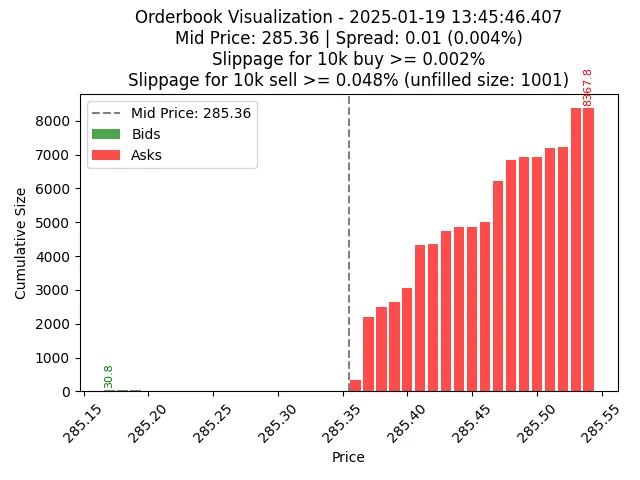
Below is a SOL visualization of a very popular orderbook exchange that has an internal MM...
They are the judge, jury, and executioner. They are the house, and the house always win.
The future of exchanges will break this tradeoff - ones that combine cutting-edge market making with provable guarantees of fair pricing. Liquidity will be always be ensured for traders without reliance on parties who have conflicts of interest of them.
We're building this at Vest.
If I step back, I think the moment that will be remembered as the crucial turning point for markets (and for history) is that Oval Office meeting with Trump and Zelensky. It was at that moment that the world realized the Bretton Woods system and post BW system of the US providing military assistance, safe shipping lanes and security in exchange for using the US$ and reinvesting excess trade balances in Us$ assets (bonds and stocks) was over.
The rest of world has finally figured out that the US/Trump team had destroyed that social contract, forcing our allies to understand that they are now going to exist in a world where the US military is in retreat (it can no longer afford to be the global police) and where the word of the US on assisting its allies with military support was no longer good.
Defense budgets have to explode globally and the only way to fund this buildout is to bring home the capital from abroad back home to buy the government bonds of your own sovereign (Europe, China, Japan, etc) who will be budget deficit spending on defense (and infrastructure) for the next decade or more.
That meeting in the Oval was the rip the bandaid off moment that may have broke the system and the US exceptionalism story. These repatriation flows have started to weaken the US$ and there is plenty more to come.
And what the US (Trump/Bessent/Miran) seems to have miscalculated is that by having a Net international investment position of -75% of GDP, a bit of foreign selling is going to have massively tragic implications for US asset prices. The rest of the world can fight back against the US tariff regime by selling down assets rather than trying to weaken their currencies. And it seems like the wealth destruction that is coming from this selling during Trump's Phase 1 of his transition plan to move away from public govt deficit growth (the "detox period") to private growth is going to come too quick and be too painful before we get the benefits from Phase 2 of his plan (tax cuts, deregulation, supply side reform, energy/infrastructure buildout).
Trump has limited ability to speed up the transition from phase 1 to phase 2 because his majority in Congress is too small and he doesn't have the support of the Fed yet to start adding liquidity because the Fed now will be more fearful that US$ weakness could add to imported inflation such that a cutting cycle could lead to a selloff in the long end again. The Fed has to be late.
They are going to have to see this thing thru in order to break the back of inflation but they may wind up with 30-50% correction in stocks and home prices very soon on the path to get there. At that point, it will be more challenging for the Admin to dictate terms to the rest of the world on how the global monetary system reset is going to work.
The Trump Admin is trying to thread the needle here. I hope they are good at sewing.
@Convertbond@LukeGromen@Kathleen_Tyson_@balajis
@Stoiiic@docXBT how he found his edge in the beginning
his opinion on the influence of social media (twitter, news other traders) to a newbie, is it helpful? bad? should one rather not listen to too many opinions
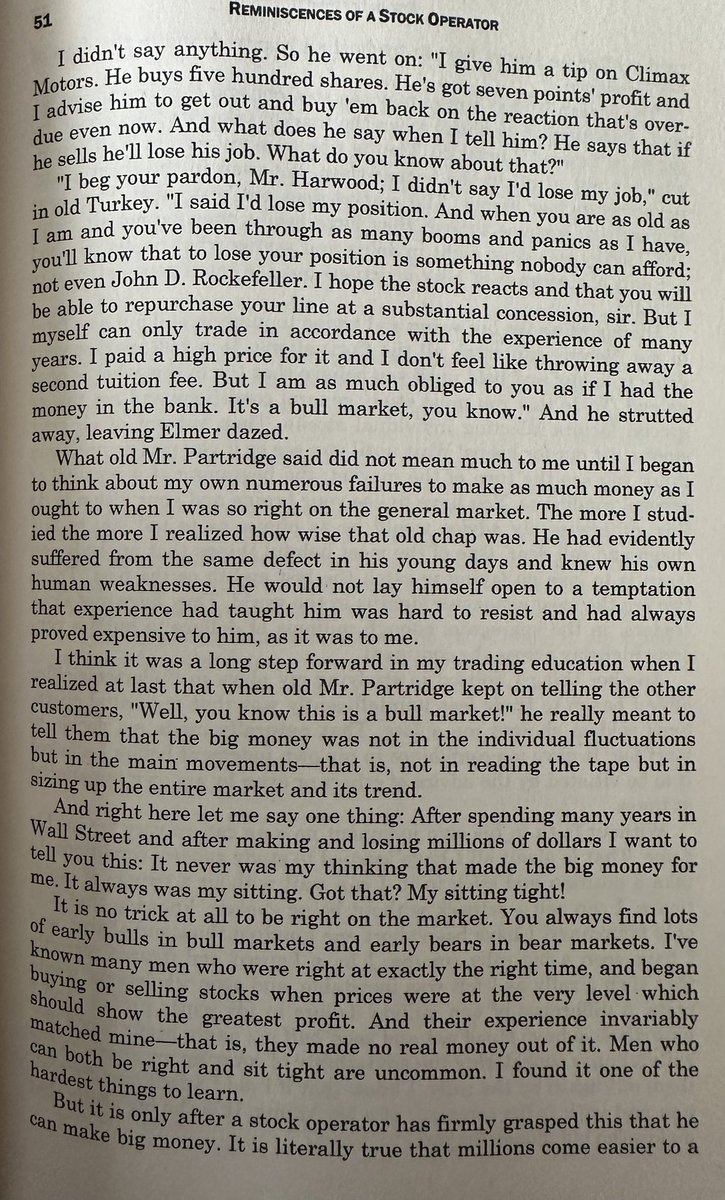
“It never was my thinking that made the big money for me. It always was my sitting. Got that? My sitting tight!
It is no trick at all to be right on the market.
You always find lots of early bulls in bull markets and early bears in bear markets.
I've known many men who were right at exactly the right time, and began buying or selling stocks when prices were at the very level which should show the greatest profit. And their experience invariably matched mine—that is, they made no real money out of it.
Men who can both be right and sit tight are uncommon. I found it one of the hardest things to learn.
But it is only after a stock operator has firmly grasped this that he can make big money.”
-Jesse Livermore, Reminisces of a Stock Operator
“Older I get the more skeptical I become of most things. When you first start out in an industry / endeavor you're bright-eyed and bushy tailed thinking it's this wonderful thing.
Then you start getting fucked. You get fucked enough times and slowly realize that 95%+ of things people shill you are simply bullshit.
You slowly learn how not to get fucked. Then you slowly become consistently profitable.
There's still good stuff out there. You just come across it once every few years as opposed to every other day (which is what beginners think).
That's why I'm so bullish hyperliquid. First thing I've seen since first coming across BTC / ETH 5 years ago that gives me the same feeling.”
My decision to all in $HYPE at launch was made before a single chart was printed.
Mostly because of how many times I’ve been burned by bullshit in the space that when you find something as special as @HyperliquidX you kinda are compelled to make an outsized bet with conviction.
“Precompiles collects information and includes it in each block, allowing requesters in HyperEVM to selectively utilize needed information, minimizing network load at the EVM level.
This enables direct querying of liquidity, oracle, vault, staking, and other information from Hyperliquid L1 in HyperEVM.
While centralized exchanges like @binance have no way to utilize large orderbook liquidity in external DeFi protocols, Hyperliquid makes this possible through its liquidity program.”