We have officially launched our 18th summer of
@Truenorthcamps! Join us for baseball, basketball, soccer, flag football, and multi-sport in Toronto and Etobicoke #playallday
https://t.co/9MJrumieOc
https://t.co/Hozs6Y8b1R
I know I shouldn’t keep commenting on this, but it really blows my mind.
$1.45M per unit for 2,200 units that would have already been on the market, and at likely sold at lower prices than we’re buying them, had we not intervened.
It’s a an absolutely wild trade off.
With $3.2B, we could be capitalizing 6,000+ new “affordable builds”. More if we fixed how our housing system works.
This would have added even more affordable supply, helping more people while leading to more affordable market for everyone in general.
Given the scale of the homelessness/addictions issues we’re seeing in urban centers across the country, it’s just an unbelievable prioritization of public money.
If I had that money for Ontario, I’d be dedicating it to housing and treating those suffering on our streets, and giving people of this province their urban centers back. And I think the vast majority of people would prefer this use of money over a developer bailout.
It really tells us that this decision was not about creating affordable housing… because it is doing the opposite.
Wow Rachel, you’re genius super-sleuth!
Nobody knew before you discovered it, that I chaired Build Toronto before starting my campaign.
I was so afraid people would find out. This will surely be a career ending controversy.
It would be absolutely awful if people read some of the memos I co-wrote on topics like:
- Dynamic signaling for traffic lights to reduce congestion by 20-30%
- Congestion pricing to keep highways moving at 50km/h to give people back their time
- Simpler rules for creating multiplex units for ownership, to facilitate more housing for middle class families
- Better public incentive compensation for top bureaucrats to improve state capacity and delivery
- How better rules on park conservancies could make many public spaces more animated and better
- How platform screen doors could make Toronto’s subway system safer and up to 30% faster
These are just some of the many far-right policies we championed, of course.
Honestly don't think it would be this crazy today if:
1. We didn't just get eight weeks of non-Toronto people scolding Leafs fans for running him out of town after they spent years ripping him as just as much or more
2. Mitch didn't tease his "Dark Times" speech after the WCF
Interesting storyline for NHL Finals: Carolina Hurricanes GM Eric Tulsky has a PhD in Chemistry from Berkeley.
Before joining them in 2014, he was offered a job with Apple to work on battery tech (but turned it down).
Started in the analytics department and since hired neuroscientists and mechanical engineers for the NHL team.
The Athletic profile has this anecdote:
➡️ “In 2021, Tulsky was the Carolina Hurricanes assistant GM and had built a small analytics department in the organization, with a web developer, a data engineer and a neuroscientist helping him lead the team’s push into new frontiers for the sport.
But because of what he saw in the tracking data, Tulsky believed his next addition needed to be someone who was working on autonomous vehicles — perhaps “a robot submarine,” he says now — and had an advanced mechanical engineering background.
“I knew that that was the kind of problem that put people thinking about the kinds of data that we had and the kinds of problems we faced,” Tulsky explained.
It goes without saying that there aren’t many robot submarine engineers working in NHL front offices. So Tulsky began a deep search through universities’ mechanical engineering departments.
He would scour the faculty listing and professors’ research interests to see if they might align with what he was looking for, then reach out to learn more about their work. He started with the top schools in Canada, reasoning that there was a greater chance he would find someone interested in working on a hockey problem.
And that was how an NHL team came to fund the PhD research of a young engineering student named Jonathan Arsenault at McGill University in Montreal.
His thesis, the first to be backed by a professional hockey team? “Quantitative Analysis of Hockey Using Spatiotemporal Tracking Data.” ⬅️
***
NYT/The Athletic: https://t.co/EgO3Qoo6Wq
You don’t have to love Elon Musk to recognize what this headline says about us.
A country that spends more time criticizing wealth creation than encouraging it sends a clear message to builders: your success is tolerated, not celebrated.
Canada should be the best place in the world to build ambitious companies. Headlines like this make us look like we’re not quite ready for that.
The next trillionaire will undoubtedly get there by solving some very important problems (like advancing electrification of global personal transportation by a decade or more, dramatically cutting the $/kg of taking stuff to orbit, or supplying wireless broadband internet to the entire planet).
I want to live in the world that person will help create.
Can I just point out how funny this is, given the paper is owned by Canada’s wealthiest billionaire family, all of whom inherited their wealth.
Should we hate them for that? Of course not, because that would be gross.
But, it reflects our tall-poppy syndrome at its finest.
Personally, I’m glad that the Ontario Teachers Pension Plan is getting a nice payout, as will many others who took a big risk investing in SpaceX.
I wish we had more audacious entrepreneurs making big bets and generating great jobs and wealth here in Ontario. I want to create an environment that makes it even more likely.
The world is not zero sum. The size of the pie is not fixed. If we make more, everyone can get a big piece.
Imagine saying this like it’s a bad thing.
Shopify is one of the greatest success stories in Canadian business history and we need entrepreneurs like them more than ever.
It is so refreshing to hear politicians like Eric push back on this anti-builder nonsense
Can I just point out how funny this is, given the paper is owned by Canada’s wealthiest billionaire family, all of whom inherited their wealth.
Should we hate them for that? Of course not, because that would be gross.
But, it reflects our tall-poppy syndrome at its finest.
Personally, I’m glad that the Ontario Teachers Pension Plan is getting a nice payout, as will many others who took a big risk investing in SpaceX.
I wish we had more audacious entrepreneurs making big bets and generating great jobs and wealth here in Ontario. I want to create an environment that makes it even more likely.
The world is not zero sum. The size of the pie is not fixed. If we make more, everyone can get a big piece.
This is the wildest World Cup story yet. If someone in Toronto sells a ticket above face value they get fined $25,000 yet the city of Toronto bought 3,500 World Cup tickets early and then sold them to taxpayers at a markup as a “revenue generation strategy.” What the hell man.
What every voter and apparently, the NY Times Editorial Board, should know about housing policy:
1. Rents reflect the balance of supply of apartments and demand for those apartments in a given area. That’s it; there’s no magic. If you want lower rents, you can hope for a recession that destroys jobs and, therefore, demand. Or you can add supply.
2. There is no amount of money that any big city government could feasibly spend that would add materially to supply. This is because, depending on the location, new apartments cost $250,000-1,000,000 to develop… building even a few hundred of those starts to stress any city budget, and many big cities need tens or hundreds of thousands.
3. On the other hand, investors (including pension funds and endowments, insurance companies, rich families, etc.) can collectively **easily** provide enough capital to build as much housing as we need **so long as they are confident they can get a reasonable return**.
To get those investors to fund the creation of the housing our society needs, we must do two things:
1. Dramatically reduce the time & complexity associated with securing governmental permission to develop housing. This means reviewing and simplifying the overlapping regulations that constrain housing production: zoning codes, building codes, parking, ADA, etc. But it also means changing the cultures within the relevant governmental agencies from “default no” to “how can we help you?”.
2. Provide certainty around on-going regulation of apartment operations.
The way investors get a return from building rentals is as follows: They hire managers to lease the apartments, collect the rents, pay operating expenses and any mortgage payments, and then send the investors the cashflow that remains.
But governments all over the country have been restricting the manner in which apartment buildings can be operated in all kinds of ways.
For example: Cities have been making it harder to screen tenants, while also making it much harder to evict tenants who don’t pay. You can see why both of those measures are politically popular. After all, who doesn’t want people to get second chances? And who wants anyone to get evicted? But, as a manager, the combination of those two regulations makes it much harder to predict, with any certainty, that the rent will get paid… and that makes it very difficult to get investors to provide capital to create more housing.
Another example: Rent control. Again, I understand why renters love rent control and why politicians want to give it to them. But, if, as has been the case in NY, LA and San Francisco, city governments hold annual rent increases below the rate of growth in the operating expenses of the buildings, the cashflow payable to the investors shrinks… making them much less likely to invest capital in building more apartments.
In conclusion: For ~every other good or service in the economy, we allow the market to function, and the result is that we have a surplus of choice at all price points (think of food or clothes or cars), which is spectacular for the consumer. If we want a surplus of choice at all price points in housing, we need to get comfortable with the idea of allowing the market to provide it.
And that means allowing investors to build rental apartments *and* allowing them to operate those apartments in a manner consistent with making a reasonable profit.
Remember: Every developer of rentals is either a landlord-in-waiting or hoping to sell to one.
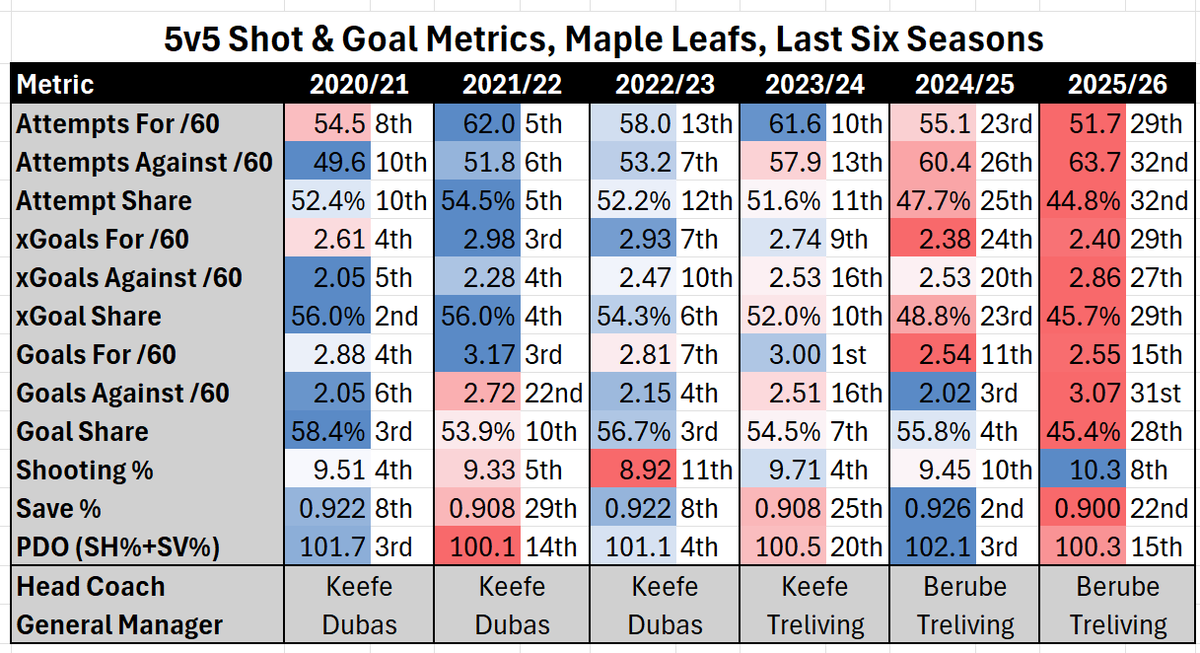
100% the right call. No knocks on Berube as a person, but the team's control of play had become significantly worse under his time here, with a play style that didn't fit their best players and somehow got even worse as they added more complimentary parts.
Kudos to @ChrisSpoke and @MattSpoke for building the perfect ‘’middle’ size conference.
Great speaker lineup and 10 minute presentations keeps it on point 👏👏👏
One of the largest owners of retail real estate in Canada, RioCan, just reported Q1 2026 earnings and the numbers tell a story every retail landlord in Canada should be paying attention to.
Retail occupancy sitting at 99%. Renewal rents up 20.1% in the quarter. New tenant rents up 58.5% over prior rates. That last number is not a typo.
But the most interesting part of the story isn’t the headline rent growth. It’s what RioCan is embedding into their new leases annual rent escalations of 2% to 4% on almost every deal they sign. This is something landlords have been pushing for in leases for a long time but it looks like RioCan is using its strength in the market to successfully execute on the strategy. This will pay dividends for both cash flow and long-term value.
Here’s why. A flat lease and an escalating lease might look similar in year one. By year five they are very different assets. Embedded rent growth compounds. It builds value quietly and consistently in the background whether the market is hot or cold.
The reason RioCan can do this is simple. High construction costs, lack of land, and zoning constraints mean new retail supply is essentially off the table. As RioCan’s CEO Jonathan Gitlin put it, if RioCan can’t find viable land to build new sites, it’s likely others face the same challenges.
No new supply. 99% occupancy. Tenants competing for space. That’s the formula for pricing power. And pricing power is exactly what RioCan is using to reshape their lease structures for the next decade.
With 1.7 million square feet of lease maturities still remaining in 2026, the mark-to-market opportunity is far from over.
The Canadian retail market was written off a decade ago. The landlords who held their assets and stayed patient are now collecting.