I just upgraded my annual blood test with FOXO Primer and got more than I imagined.
Because of an autoimmune issue, I’ve had to do more “understanding” of my blood tests than most people, who often look at ranges, underlines, and move on. My annual tests were already more than standard packages, and I had learned to understand inflammation trackers and other markers earlier than I would have liked :)
But I knew there was more to know.
The challenge was that going beyond standard or expanded tests was either too expensive, too fragmented, or missing the most important layer: someone looking at everything holistically and giving advice that worked across systems.
Over the last few years, this has changed globally. Access to extensive biomarker testing has become easier, cheaper, and increasingly paired with medical professionals who know how to correlate results.
FOXO brought this to India with FOXO Primer, a comprehensive 200+ biomarker assessment that combines clinical history, system-level analysis, and practical guidance to help you understand how your body is functioning and what you can do to improve it.
I was genuinely impressed by the overall experience.
We invested in FOXO at the founding stage because we had been clear on this opportunity for a while. But hearing founder Subhendu’s personal journey of “fixing his health”, the journey that led to FOXO, made the mission feel even more real. Nothing drives mission orientation like a personal story, and I could relate to his too.
I believe the future of preventive healthcare will be driven by companies like FOXO: helping us understand our health earlier, act sooner, and hopefully avoid many reactive doctor visits later.
Think of them as our future “pre-GPs.”
Worth exploring if you’ve been curious but sitting on the sidelines:
https://t.co/Rvf2XP9RuG
🧤 82-year-old goalkeeper Lamberto Boranga is training to make a comeback in the Italian 7th tier with Trevi
He played 250 games in Serie A/B during the 1960/70s and puts his longevity down to a good diet & regular exercise (specifically including s*x!)
What a force of nature
In traditional healthcare, if your test results aren’t too high or too low, you’re told you’re fine. We equate ‘normal range’ with ‘healthy’, assuming all is well. But ‘normal’ is a statistical construct. It reflects the middle 95% of values from a reference population.
Attention Founders!
Your biology is your biggest performance edge.
We at @FOXOclub are hosting an exclusive 100-minute longevity workshop in @peakbengaluru
Only 5 spots.
Register today.
URL to Register: https://t.co/gFjucJyD9F
@BlumeVentures@gehani@jatinmadhra
Often when I feel that I don't have time for something, I realise that I actually don't have the space for it.
And while I may never understand it, it helps me grasp a bit of the space-time theory.
@mikebeckhamsm@bryan_johnson Agree on the future being hyper personalised, super excited about it.
But 5k IU of Vitamin D3 is a lot, and can lead to toxicity.
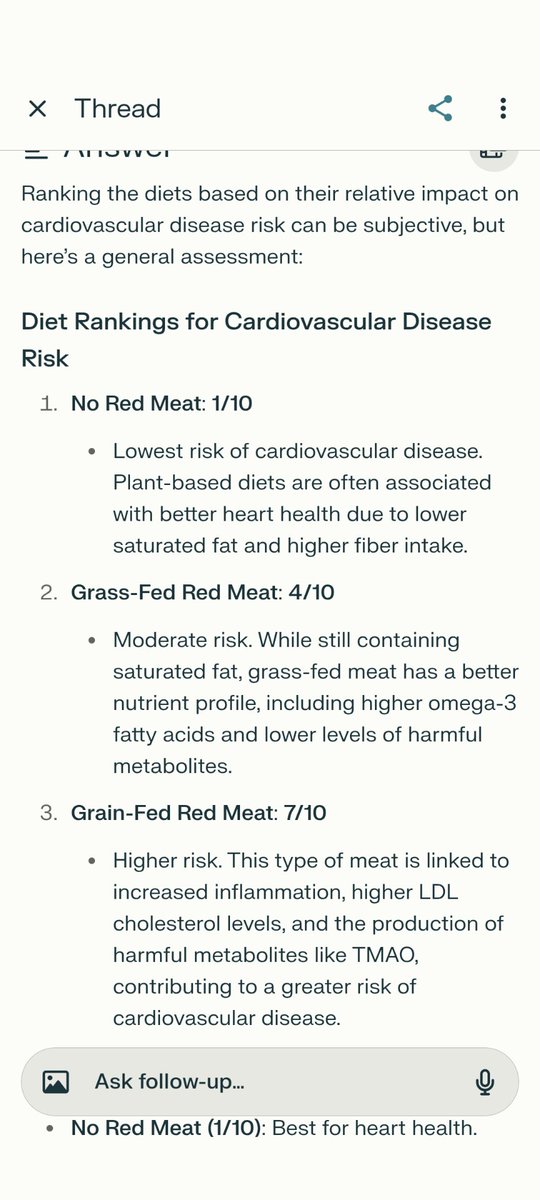
One more factor to consider is the source of red meat, or what it was fed.
A big problem with our food (meat or vegetables, milk or eggs) is how it is grown.
Hi friends, I am again posting about red meat and I come in peace.
Last week I shared why I don’t eat red meat. I did this because people have been asking me about this topic for 3.5 years and I’ve responded neutrally saying...here is what I do, but you do you. Just be sure to measure your biomarkers. It's also what I said last week.
That didn’t stop many people from losing their minds. It’s legit an interesting psychological phenomenon.
Let me be clear: if you like red meat, eat red meat. I choose not to and am providing you an explanation why. You can agree or disagree.
My team and I are conducting an experiment and are following the evidence as we understand it and transparently sharing my biomarkers.
Nutrition is not a solved science so there will inevitably be disagreement. I’m being transparent about our research, reasoning and measurement.
Whatever you decide, I'm wishing you the best.
The primary reasons I don’t eat red meat:
1) My goal is longevity and other foods (outlined in my Don’t Die nutrition guide) have more robust evidence for longevity
2) Is red meat good or bad? The evidence tilts towards red meat possibly creating health risks which is enough of a reason to exclude it from the protocol.
3) The foods we’ve selected to consume have me maintaining world leading biomarkers.
🧵