The greatest geopolitical miscalculation of our age: believing that transferring industrial know-how to a one-party state would make it a stakeholder in the free world. Jesus…
In Berlin it was called Wandel durch Handel — change through trade. I almost throw up writing it. What a world-class delusion that was. And not just Merkel’s. Does @Siemens_Energy still try to teach the Chinese how to manufacture gas turbines?
Give Me A Break.
Decades later, that same Wandel turns on us. The supply chains we built are now instruments of pressure for the CCP. Historians will call it the betrayal of the century; realists will call it self-inflicted through greed and short-termism.
For 30 years we Europeans, Americans, Canadians, Japanese, Koreans, and Australians offshored knowledge, refining, training, and IP to the CCP, thinking integration would bring openness and fair trade. @BillClinton and the WTO, anybody? What on rare earth were they thinking?
We — the collective West (in the political, not geographical, sense) — literally taught them everything. Now comrade Xi uses that mastery to choke our supply chains, forcing us to absorb his overcapacity and, effectively, his unemployment.
Who could have thought? As historian Stephen Kotkin likes to say: you can’t be half-communist. Exactly.
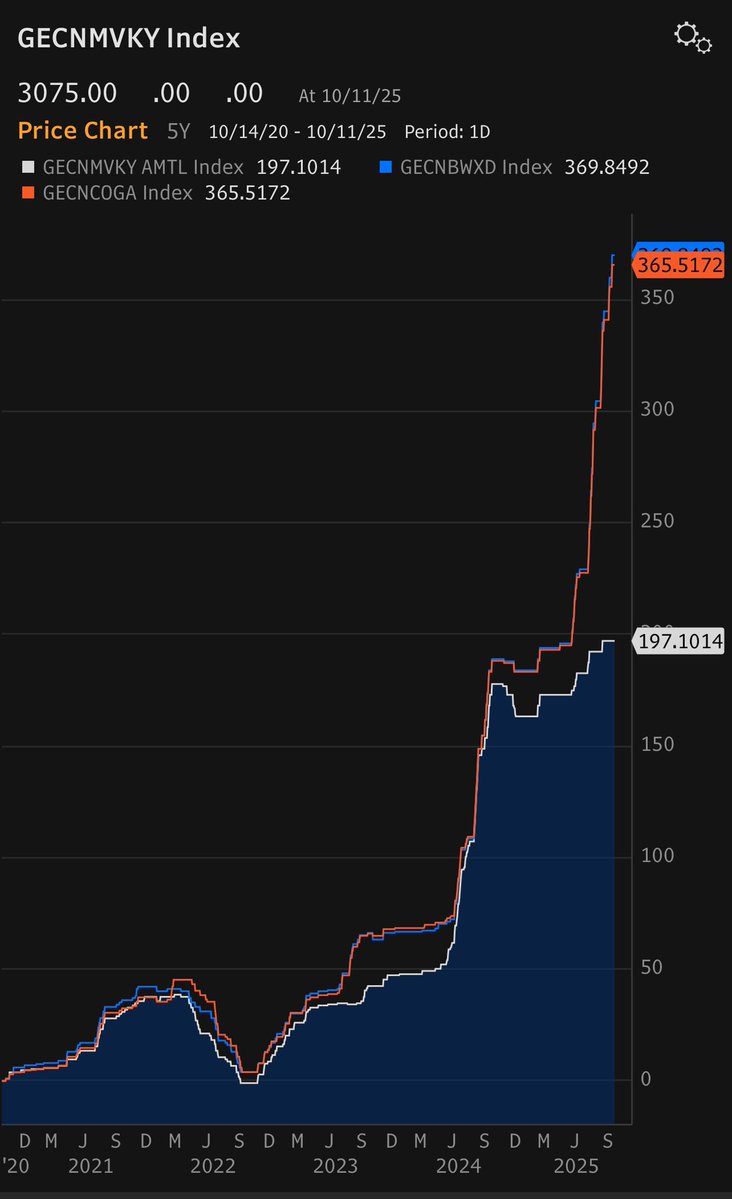
The price explosion of germanium below is just one symbol of the lesson ahead.
The blue and red lines show % appreciation for germanium delivered to Europe & the US versus the domestic Chinese price. A kilo now trades at USD 623 (¥4672) for Europe — about twice what Chinese manufacturers pay.
In Europe and the US we pay double for what we taught China to refine and scale for thirty years — the price of assuming Marxism could play by free-market rules.
Among other uses, germanium powers high-end optics such as the Leopard 2 thermal imaging system (Wärmebildgerät, WBG). Not sure if the M1 Abrams uses it too; I never liked that tank. A Ford with a turbine — silly.
Anyway, this isn’t academic. The element — Germanium — is a semiconductor, a kind of metallic chameleon used across high-tech equipment. Not easy to engineer around it. Has a cool name, too.
So China’s export leverage is strategic and real. Meanwhile, the 100 million members of the CCP are, by definition, communists. And for any communist regime, the free world is the enemy. Simple as that.
To a communist, nothing is more dangerous than a free-thinking teenager. One good Netflix series, one spark of criticism, and the streets might fill with people wanting change. Better create an enemy abroad before that happens — that’s the stage of the movie we’re in now.
Enough appeasement. FAFO.
@POTUS@vonderleyen@_FriedrichMerz@Keir_Starmer@EmmanuelMacron@GiorgiaMeloni@alexstubb@SwissGov@nfergus
NOTE: Using OpenAi Operator at your bank in EU is illegal by law! Web access for assistants was banned years ago as part of “Open banking”
Here is the story of why:
15 years ago I stumbled into Sofort in Germany. A company with the idea to build a digital assistant that would interact with your banks poor UI, so you as a user could avoid it. Just like operator. Back then it was script based, not AI but it worked.
I was so impressed Klarna bought the company. It has since then processed billions of dollars.
But of course banks got scared! What happens if people use the digital assistant only, instead of their bank. And what if the assistant says, stop paying those fees to your bank and let me help you switch?
So German banks sued. They claimed privacy concerns. It went to Brussels and a long lobbying and legal fight pursued. This was the beginning of what we today call open banking!
I and others spent years fighting over consumers right to use digital assistants, when accessing their banks. We knew this was critical to create real competition, in an industry that has been plagued by excess profits for years.
At first Jonathan Hill from UK was responsible and very supportive. But then he left and a German guy came onboard. He was 100% aligned with incumbent banks and we thought the case was lost. However he did a mistake and let some Russian oligarchs take him for a ride on their private jet. And so he was out.
Finally @VDombrovskis stepped in. He was smart and supportive but pressure from banks was intense. There was rumors that they were funding privacy groups in Germany, to have them use privacy concerns to kill Open Banking. What if the digital assistant accessed some of your private data?
We were about to loose the vote, when the competitive authorities of EU started getting interested. They suspected the banks were lobbying and pursuing this matter for profit reasons to reduce competition(really…). A few weeks before the vote in parliament they raided the offices of some Dutch and Polish banks. Everyone got super nervous and the Open Banking regulation was passed!
Almost…
A small technical detail was left to EBA (European banking authorities). Should your digital assistant use an API for access to your bank account or the standard web UI you use yourself for accessing your bank?
We pushed as hard as we could. We highlighted and said, if your assistant is mandated to use the API that your bank supplies. What if the API don’t support all the same features. Or the API is broken?
Don’t worry said regulators. You can complain with authorities 😂
We said at least let the digital assistant, as fall back, use the web UI. Then banks cant cheat, as they will know we can always use the same UI as their human customers. It’s called self regulation. But EBA ignored us.
Today web UI access for digital assistants as ChatGPT Operator is illegal by law.
And surprise, surprise the open banking API of European banks, continue to be broken, lack functionality and banks add as much friction as they can. We report and see thousands of issues with these APIs every year.
And people ask me why open banking has not become a larger success…
What do you say @donaldtusk time for a change? Jest potrzebne!
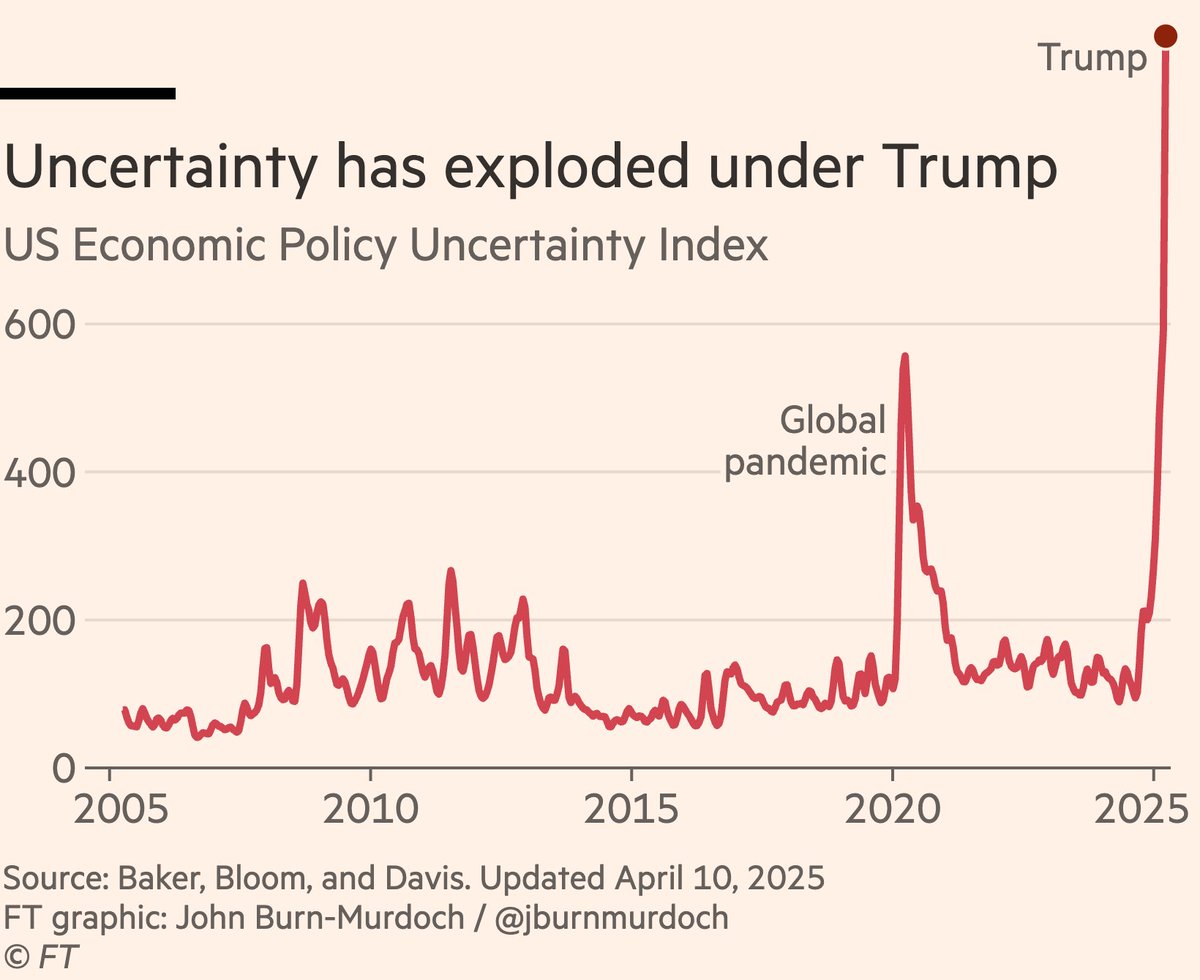
Economic uncertainty update:
The thing about veering wildly between policy positions, favouring a new maverick advisor each week, and using contradictory justifications at every turn, is that even if one particular pivot is in the direction of sanity, chaos is the constant.
At least 2 of these people are lying since their stories are all different:
1) Trade Rep Jamieson Greer (the guy who executes trade strategies) today:
“I understood the decision (to lift the tariffs) was made a few minutes ago.”
2) Secretary of the Treasury Scott Bessent:
“[Trump] and I had a long talk on Sunday (3 days ago) and this was his strategy all along.”
3) President Trump on why he lifted the tariffs today:
“I thought that people were jumping a bit out of line. They were getting a little bit yippy and a little bit afraid.”
So which is it? A split-second decision? A secret master plan from Sunday? Or just a response to "yippy" people?
🧠 Pro tip: When all the alibis contradict each other, someone’s not telling the truth.
Stop making excuses for these people. The gaslighting only works if we let it.
Scott Bessent says tariffs are good for the US economy
Scott Bessent: We were on track for a financial crash. Government spending was out of control. It felt like 1998 or 2007. We’ve pulled off that path and set up long-term growth instead [by imposing tariffs]. 1/
Lutnick: "Let Donald Trump run the global economy. He's knows what he's doing. He's been talking about it for 35 years. You gotta trust Donald Trump in the White House ... it's broken. Let him fix it ... Let Donald Trump fix the American economy."
8/ A temporary ceasefire could give Russia time to regroup militarily, but its peace terms would be extremely harsh. Unless Trump fully meets Putin’s demands, Russia won’t agree to peace.
1/ A ceasefire is a big economic problem for Russia. Before the war, its budget was 20T rubles, with 3T (14%) for defense. By 2025, the budget will be 41.5T rubles, with 13.5T (32.5%) on military—7% of GDP. War spending has skyrocketed.
7/ Continuing the war means a slow, controlled decline, letting Putin's group stay in power. A ceasefire, however, could cause immediate political collapse, that is why, despite the costs, Russia is unlikely to stop the war.