Right now, there is a trial happening in Boston that is being televised where a mother with postpartum psychosis killed her 3 young children before slashing her own wrists and jumping out of a second floor window, which ended up paralyzing her from the waist down.
Her psychosis took off after the birth of her 3rd child, right before she was scheduled to return to work as a labor and delivery nurse. She was being treated with medication, daily appointments with her doctors and a stint at McLean Psychiatric Hospital. She is the one who begged for help. She committed this crime on the day her husband left the house for 1/2 hour to get groceries because she seemed to be doing better.
The fact that this woman is on trial when she was clearly out of her mind is unconscionable. The fact that she, her husband and even the first responders are being forced to relive the event is also unconscionable. One of the jurors asked to be removed because he couldn’t handle it.
Out of all the things though, the most unconscionable of unconscionable things is the way we treat mothers and their babies in this country.
From @taprootbirth
“Postpartum depression is a condition affecting the neurotransmitters in a person's brain. It is also caused by lack of presence, care and community. In many traditional cultures it is taught that a new mother should never be left alone with her babies. She needs the co-regulation of wise women/people. She needs grounded humans who feed her, make sure she is hydrated, clean her sink, brew her tea, ladle her soup, and play with her other children. Someone to sit with her, share stories, and make her laugh. Help her remember she is human.
A mother who is left alone with her babies postpartum has the cognitive impact of a person who has survived war. Her body thinks she has been abandoned by her community.”
If there is something good to come out of this, let it be the end of the expectation that caregiving is something that we consider as a last priority after all the other things. Because it’s fucking time.
"Hay una especie de tristeza que viene de saber demasiado, de ver el mundo como realmente es. Es la tristeza de entender que la vida no es una gran aventura, sino una serie de pequeños, insignificantes momentos, que el amor no es un cuento de hadas, sino una emoción frágil y fugaz, que la felicidad no es un estado permanente, sino una rara y fugaz vista de algo que nunca podremos sostener. Y en ese entendimiento, hay una profunda soledad, una sensación de estar aislado del mundo, de otras personas, de uno mismo".
"El faro, Virginia Woolf
Esta mañana he encontrado una nómina vieja de mi padre revisando papeles de casa.
Marzo de 1992, ingeniero jovencito con 6 años de experiencia. Casado, con dos hijos e hipoteca en Madrid.
Por curiosidad me he puesto a hacer cálculos, y me ha dado permiso para compartirlos.
El bruto del mes eran 615.704 pesetas. Ajustando a IPC, hoy serían 120.000 € brutos al año equivalentes. Un ingeniero con ese mismo perfil cobra ahora entre 35.000 y 45.000 €.
Un tercio. Un puto tercio del sueldo real que tenía mi padre con su edad.
Pero donde la trampa se ve más clara es en la fiscalidad.
Mi padre, sumando IRPF y Seguridad Social, soportaba una carga fiscal efectiva del 27% sobre su bruto (24% IRPF + 2,7% SS, porque cotizaba al tope máximo). Le quedaban netos el equivalente a 87.000 €.
Un ingeniero hoy con 40.000 € brutos soporta una carga total del 22% (16% IRPF + 6,5% SS) y le quedan apenas 31.000 € netos.
Mi padre vivía con casi tres veces más renta disponible.
En el mismo país. En la misma ciudad.
¿Que hoy se paga menos porcentaje? Lógico, ganando un tercio, claro que el porcentaje baja.
Por el camino, eso sí, se cargaron las deducciones que protegían a la clase media como por ejemplo la deducción por vivienda habitual que desapareció para nuevas compras en 2013.
Y si por algún milagro alcanzas hoy los 120k equivalentes que cobraba mi padre, soportarías un 35% de carga fiscal total en vez de su 27%.
Ocho puntos más por el mismo sueldo real.
¿De verdad vivimos mejor?
Los datos dicen una cosa. La narrativa que nos venden, otra.
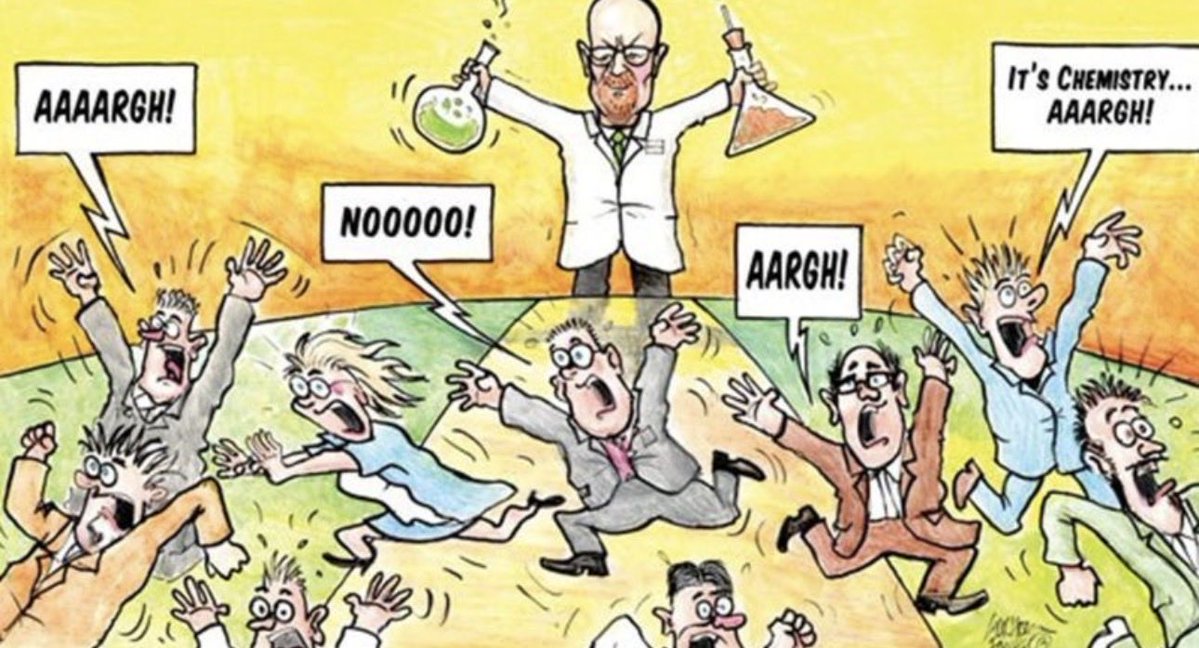
I’m a chemist. I need to say this - because it’s getting dangerous out there. The biggest health myth in the world isn’t about vaccines.
Or GMOs. Or fluoride.
It’s the root of all of them.
It’s called chemophobia - and it’s killing science.
Fear of “chemicals” now drives vaccine rejection, GMO bans, food hysteria, and entire political movements.
From tampons to tap water, people have been taught to fear chemistry - the very thing that keeps us alive.
Chemophobia tells us:
“Natural is good.”
“Synthetic is bad.”
That’s a lie.
Botulinum toxin is 100% natural and one of the deadliest molecules known.
Aspirin is synthetic and life-saving.
We’ve gone from banning harmful substances for good reason…to banning safe, well-tested molecules for emotional reasons.
You’ve seen the slogans:
“If you can’t pronounce it, don’t eat it.”
“Paraben-free.”
“Clean beauty.”
They sound empowering. But they’re not science - they’re marketing.
And they’re making the world dumber, poorer, and sicker.
Your body doesn’t care if a molecule comes from a plant or a lab.
Vitamin C is vitamin C.
Formaldehyde is formaldehyde and your body makes more of it every day than any vaccine ever could.
Dose matters. Source doesn’t.
This fear isn’t harmless.
It shapes public policy.
It blocks innovation.
It raises food prices.
It slows down cancer treatments.
Chemophobia is now mainstream and it’s costing lives.
Scientists aren’t losing because we’re wrong. We’re losing because fear spreads faster than facts.
Because influencers sell fear for clicks. Because lawyers monetize doubt.
And because scientists are too tired to fight back. So here’s my message, as a chemist and as a citizen:
Learn how toxicology works.
Call out chemical fear-mongering.
Support policies based on evidence, not emotion.
Chemistry isn’t the enemy.
It’s the reason you have clean water, safe food, and modern medicine.
If we let fear win, we lose all of it.
The science of fetal microchimerism should have broken the internet by now.
It hasn’t.
When I read about a research I was so curious to know what’s actually happening.
Fetal cells — carrying the child’s own DNA — cross into the mother’s bloodstream during pregnancy and never fully leave. They embed into her organs. Her heart muscle. Her brain tissue.
Researchers have found a child’s living cells inside mothers in their 90s, from pregnancies six decades old. The child left the womb. The cells didn’t.
And they don’t just sit there. They migrate toward damage. Women with heart injuries show fetal cells concentrated at the wound site. Women with thyroid disease show their children’s cells inside the affected tissue.
The body that built the child gets tended to, in return, by the child’s own cells. Nobody designed this consciously. Evolution quietly built a repair system out of the mother-child bond itself.
The brain side of this is equally staggering. Pregnancy triggers gray matter reorganization — a structural rewiring that sharpens threat detection, deepens empathy, fundamentally alters how a mother processes the world. These changes persist for years after birth.
Possibly permanently. A mother’s nervous system doesn’t return to its factory settings. It was updated by the experience of carrying another person, and that update sticks.
The part worth sitting with longest — women who experienced pregnancy loss carry fetal cells too. The cellular merging doesn’t require a birth. It doesn’t require years of raising someone. Those cells remain regardless of what happened after. A mother grieving a child she never brought home is grieving someone biologically still present inside her. The world consistently underestimates that grief. The science says we have no business doing that.
Mothers always knew the connection didn’t end at birth.
Turns out it doesn’t end at the cellular level either.
What we call the "Epstein scandal" is not a moral catastrophe. It is an administrative error of history: for a brief moment, a structure normally operating in darkness became visible.
Epstein was not a center.He was a node. A node connecting money, symbolic capital, and what elites have always considered their private entitlement: access to the bodies of others. Not out of passion. Out of proof of power. Power does not desire, it consumes. There is no "fall" here. A fall presupposes height. There is continuity. From antiquity onward, elites have never been a moral vanguard. They have been an anthropological vanguard, the first to test how far human impunity can extend. Roman emperors, Byzantine courts, papal families of the Renaissance, the French aristocracy before 1789, Victorian gentlemen with double lives all are variations of the same model: the right to transgress because one stands above the law.
Epstein merely offered convenient infrastructure. The West responded with noise. Noise is its way of simulating morality. Investigations, media cycles, half-confessions, calibrated outrage. This is not justice, it is damage control.
The East responded with silence.
And that silence is more honest. Because there is no illusion there that elites owe a moral explanation. Power does not pretend to be ethical. It is simply power.
The real philosophical irony lies elsewhere.
Ayn Rand unintentionally provided the language for this world.
Not as a defense of reason, but as an aestheticization of chosenness. From the "rational egoist" to "I am above you" the distance is short when inner discipline is absent. Philosophy thus became not a system of thought, but an exculpatory document for instinct.
This "chosen society" is not hedonistic. It is boring.
Boredom is the most underestimated engine of cruelty. When everything is permitted, only one pleasure remains: crossing a boundary others cannot.
Children and the vulnerable are not "objects of desire".
They are proof of asymmetry.
And that is precisely what attracts elites: not sex, but absolute imbalance of power. There is no conspiracy here.
There is a structure. And if this fair disgusts us, it is not because it is new, but because for a moment we saw our civilization without makeup. Without narrative. Without justification.
The question is not who was there.
The question is why such places always exist. And why, after every exposed island, the world rushes to build the next one.
Hiroyuki Sanada dijo una vez: "Hay quienes desean una piscina en su casa, mientras que aquellos que la tienen apenas la usan. Quienes han perdido a un ser querido lo extrañan profundamente, mientras que otros que los tienen cerca a menudo se quejan de ellos. Quien no tiene pareja la anhela, pero quien la tiene, a veces no la valora. El que pasa hambre daría todo por un plato de comida, mientras que quien tiene de sobra se queja del sabor. El que no tiene coche lo sueña, mientras que quien lo tiene siempre busca uno mejor. La clave está en ser agradecido, en detenerse a mirar lo que poseemos y comprender que, en algún lugar, alguien daría todo por lo que tú ya tienes y no aprecias".
Noam Chomsky was not just any public intellectual. He literally incarnated a thinker who built his entire moral authority on opposing oligarchy, corporate power, and the ways wealth captures the state. That is why this is not a trivial lapse in judgment.
Epstein was not an ambiguous figure. When Chomsky continued his friendship with him, he was already a convicted sex offender who had solicited a minor. Beyond, Epstein was a living example of the very structure Chomsky spent decades denouncing. Wealth shielding and elites protecting their own.
You cannot denounce oligarchic power in theory while extending empathy, legitimacy, and personal friendship to one of its most grotesque embodiments. That is a grave moral contradiction.
A cambio te devuelve algo que habías perdido: ser necesario. No para una causa abstracta. No para tu ego. No para un público. Para alguien que sin ese trabajo, no existe " @RevSupernova_@PanamaRevista
https://t.co/7slvbQSZyG
Erica Komisar on the hidden cost of sleep training babies
"Having a child is much harder than we tell them — you will not sleep for five years, period.
Sleep training can devastate a child's emotional & neurological development.
If you saw an adult hysterically crying and terrified, you would never shut the door on them — yet we tell parents to do that with babies, letting them cry to vomiting, raising cortisol past processing capacity.
We value parents' comfort over children's in the first year — when children's comfort must come first."
Powerful reminder from a child psychologist.
0:59 clip inside — raw truth every new parent needs to hear.
It finally happened. Some readers had asked for a concise, peer-reviewed critique of The Body Keeps the Score. 🔥🔥It’s open access, so everyone can read it — even people who think trauma made them do it. You’re welcome, science.
Evaluating evidence behind popular trauma narratives: neurobiological and treatment claims in The Body Keeps the Score | BJPsych Bulletin | Cambridge Core - https://t.co/Yn6A6mWMPN
La obsesión por "dejar ir" y "soltar" nos está volviendo incapaces de sostener nada. Ni el dolor, ni un compromiso, ni una mala racha. Hay cosas que no se sueltan, se atraviesan. Y huir de todo lo que pesa solo te deja vacío.
Mankeeping: Women's emotional labor in heterosexual relationships. Being their partner’s sole support. Managing his stress. Interpreting his moods. Holding his hand through feelings he won’t share with anyone else. Unpaid, unacknowledged, unreciprocated. https://t.co/Gt3BBNoKZI
No, Eduardo. Las feministas sostenemos que las mujeres que trabajan en las labores del hogar, los cuidados y la crianza también son sujetas de derecho y que todo lo que hacen ES TRABAJO; trabajo que sostiene el capital mundial, sin remuneración, sin vacaciones, sin posibilidad de jubilación, sin prestaciones de ley, sin descansos ni días libres, de doble y hasta triple jornada y muchas veces sin un peso a su nombre, muchas veces sin siquiera la mínima consideración ni agradecimiento más allá de un post cursi en redes sociales el 10 de mayo mientras los demás días del año las llaman “mantenidas” cuando irónicamente son ellas quienes mantienen hogares y familias enteras. Trabajar por techo y comida es esclavitud, dificulta y en ocasiones imposibilita poder salir de espacios violentos. Lo que está mal es creer que este es el rol que sólo las mujeres debemos atender, lo que está mal es no reconocer la desigualdad, violencia e injusticia que conlleva ese rol. Las feministas no tenemos que convencer a las mujeres de elegir otros caminos, de elegirnos a nosotras mismas y responder a nuestros sueños y deseos porque nosotras mismas lo hemos visto con nuestros propios ojos, hemos visto a nuestras madres y abuelas, las hemos escuchado. Muchas de ellas el primer consejo que dan a sus hijas y nietas es: Estudia, trabaja, viaja, ten tu propio dinero, no te cases. Es todo un sistema, más viejo que la rueda, que nos quiso convencer de que fregar pisos, parir hijos y planchar las camisas del marido era nuestro “destino biológico” para que los hombres tuvieran acceso a servidumbre gratuita, que ya no les creamos tan fácilmente es distinto. No va de ideologías, va de las memorias y vivencias de las mujeres. Si las escucharas lo sabrías.