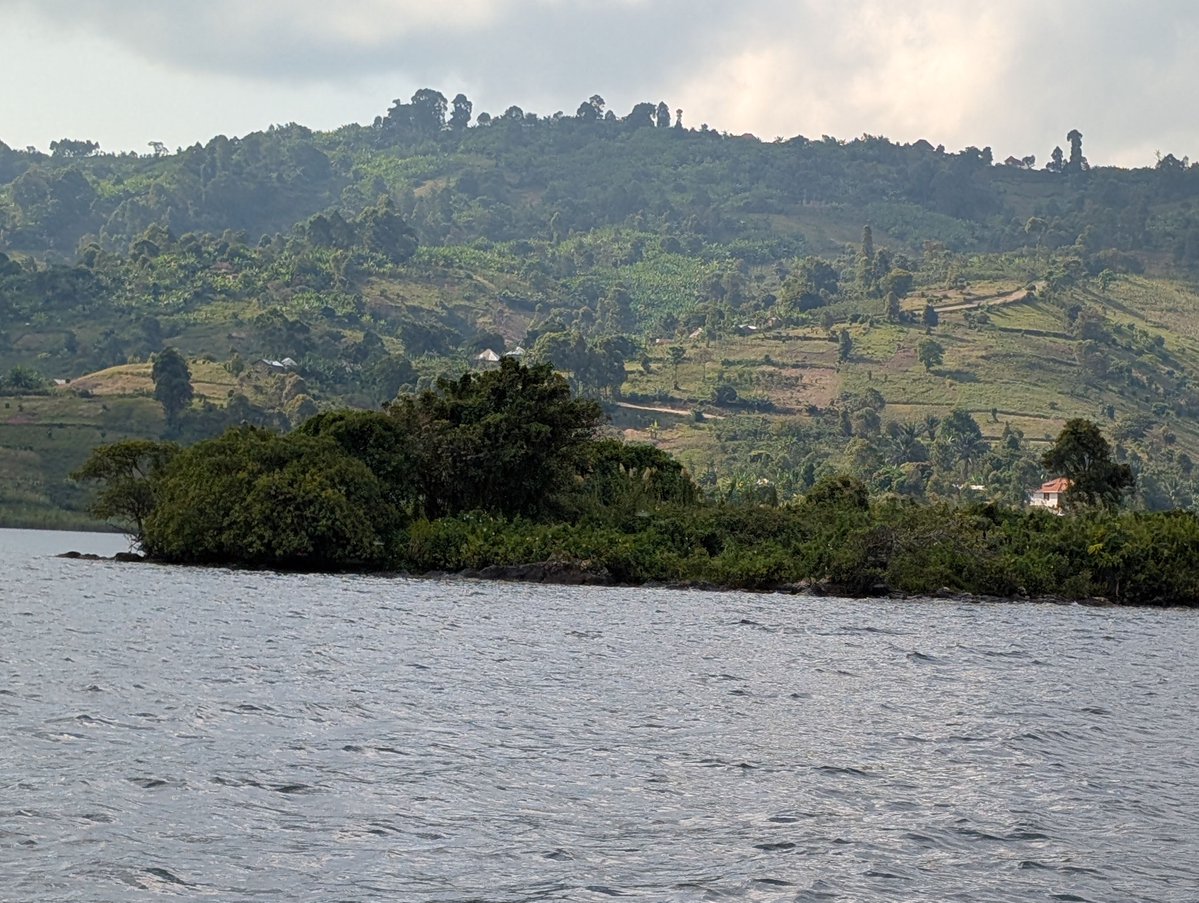
Les eaux profondes du Lac #Kivu stockent des milliards de mètres cubes de dioxyde de carbone (CO₂) et de méthane (CH₄). Il est aussi réputé pour ses sambaza, de petits poissons qui constituent la base de l'économie locale de pêche pour les populations riveraines.
🇨🇩Le Lac #Kivu est un joyau naturel. C'est un lac de la vallée du Rift mesurant environ 89 km de long sur 48 km de large. Le lac est niché dans une région montagneuse. Il abrite de nombreuses îles, la plus grande étant l'île d'Idjwi. Ses rives ont des paysages magnifiques.
A Goma, James Swan réaffirme l'engagement de la MONUSCO en faveur du cessez-le-feu au Nord-Kivu, Au cours de son séjour, le chef de la MONUSCO a rencontré séparément des représentants de l’AFC/M23 et les responsables du Mécanisme conjoint élargi de vérification Plus. https://t.co/b7BSnmvlB6
📊 #EbolaBundibugyo : 📍 Aucune nouvelle zone de santé touchée au 11 juin 2026. Le nombre de ZS affectées reste stable à 29/104.
Le Sud-Kivu est silencieux depuis le 26 mai — aucun nouveau cas depuis 16 jours. Un signal encourageant.
@Dr_JeanKaseya@_AfricanUnion "@AfricaCDC is moving with urgency to stop Ebola at its source, protect communities, prevent further spread and keep borders open through science-based public health measures."
👍🏾Good move, Sir! Wishing you all success🙏🏾
Actualités sur l'épidémie d'#Ebola causée par le virus #Bundibugyo en RDC 🇨🇩 et en Ouganda 🇺🇬. - Mise à jour au 6 juin, publiée le 8 juin 2026 https://t.co/8G90993BCM
The director-general of the World Health Organization said on Monday that Uganda should reconsider its decision to close its border with Democratic Republic of Congo because of an Ebola outbreak. https://t.co/SXdk1k0zmK
Chers amis, Dear friends,
- Prévention de l’Ebola : des informations qui peuvent sauver des vies
- Ebola Prevention: Information that can save lives
Face à la menace de l’Ebola, l’information et la prévention sont essentielles.
Cette courte vidéo de 3 minutes présente des informations simples, fiables et scientifiquement fondées pour aider les individus, les familles et les communautés à se protéger.
Merci de la regarder et de la partager.
----
In the face of Ebola, public awareness and prevention are essential.
This short 3-minute video provides simple, reliable and evidence-based information to help individuals, families and communities protect themselves.
Thank you for watching and sharing.
"Vaccines and medicines are important, yet they are not the only tools that stop Ebola."
Yesterday, Africa CDC and @WHO launched the Continental Preparedness and Response Plan for Bundibugyo Virus Disease, bringing together governments, communities and partners around a shared goal: stopping the outbreak through coordinated action, trust and solidarity.
Africa is leading. Partners are supporting. Communities are at the centre.
---
« Les vaccins et les médicaments sont importants, mais ils ne sont pas les seuls moyens de mettre fin à l’épidémie d’Ebola. »
Hier, nous avons lancé aujourd’hui le Plan continental de préparation et de réponse à la maladie à virus Bundibugyo, qui rassemble les gouvernements, les communautés, l’OMS, Africa CDC et leurs partenaires autour d’un objectif commun : mettre fin à l’épidémie grâce à une action coordonnée et à la solidarité.
L’Afrique montre la voie. Les partenaires apportent leur soutien. Les communautés sont au cœur de l’action.
🔗 https://t.co/5kcfKVLq0u
#AfricaResponds
@Dr_JeanKaseya@Pandemic_Fund Dépistage et surveillance efficaces aux frontières, en lieu et place de la fermeture des frontières, SVP! Pour les populations de Bukavu, Goma, Butembo, Beni, Bunia, etc., c'est un calvaire, qui ne devrait pas durer davantage. Please!
#Ebola : l'OMS demande la levée des restrictions de voyage jugées contre-productives
Le directeur général de l'OMS a mis en garde contre les restrictions de voyage généralisées imposées par certains pays, qu'il juge contre-productives. Selon Tedros Adhanom Ghebreyesus, ces mesures perturbent les chaînes d'approvisionnement et entravent directement les opérations de riposte.
L'OMS recommande plutôt la mise en place de contrôles sanitaires aux sorties des aéroports, ports et postes-frontières pour prévenir l'exportation de cas, et appelle les pays concernés à lever sans délai leurs restrictions généralisées.
Bonne nouvelle depuis Bunia. Cinq patients guéris du virus Ebola Bundibugyo : quatre sont sortis aujourd'hui du centre de traitement, un autre avait déjà regagné son domicile.
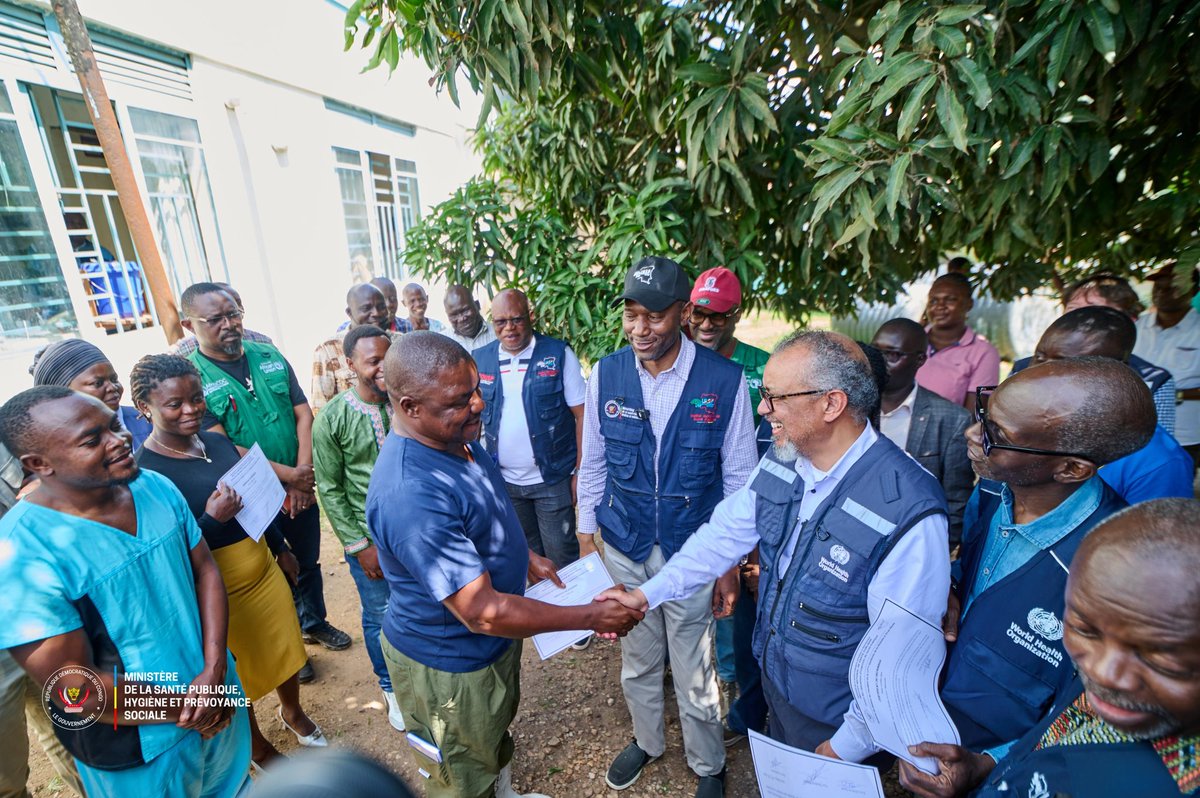
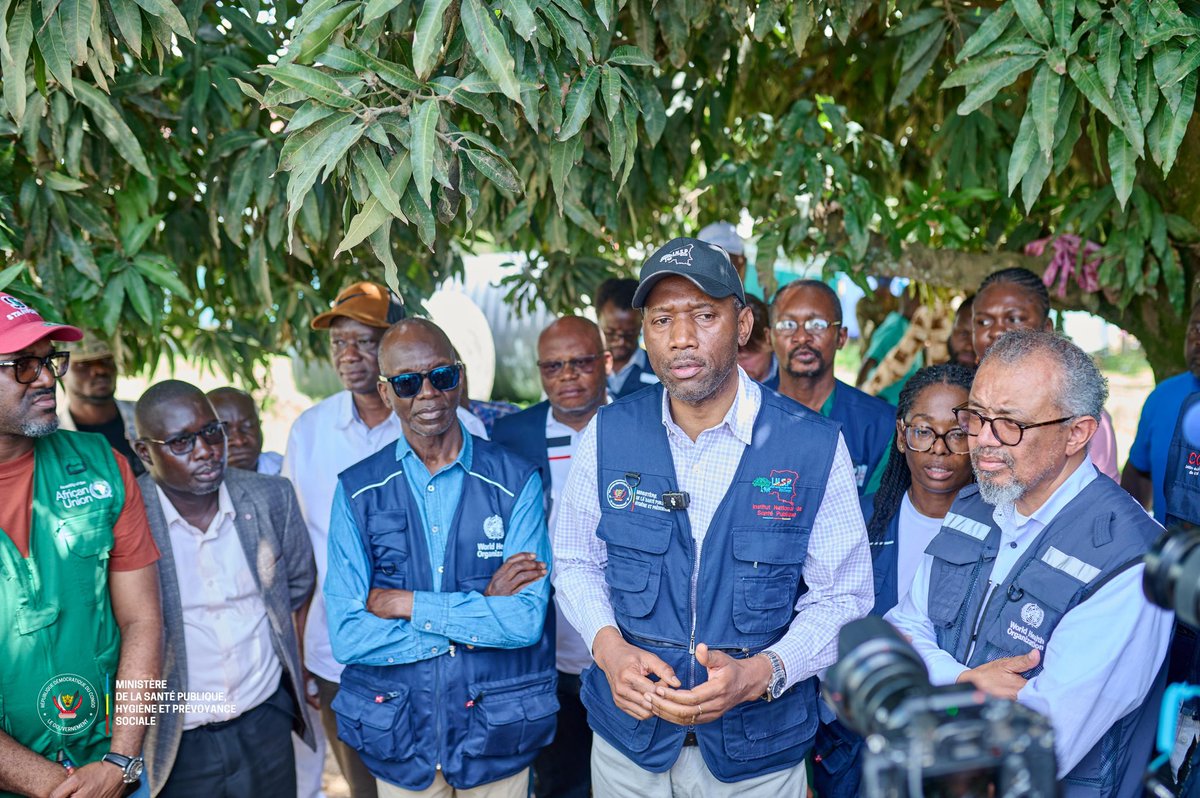
Le DG de l'@OMS Dr Tedros était présent ce jour à Bunia aux côtés du DG de l’INSP @MwambaKazadiOff pour l'inauguration du nouveau Centre de Traitement Ebola. Un signal fort de la solidarité internationale avec la RDC.
La guérison est possible. La riposte avance. 🇨🇩 #EbolaBundibugyo #RiposteEbola #SantéRDC
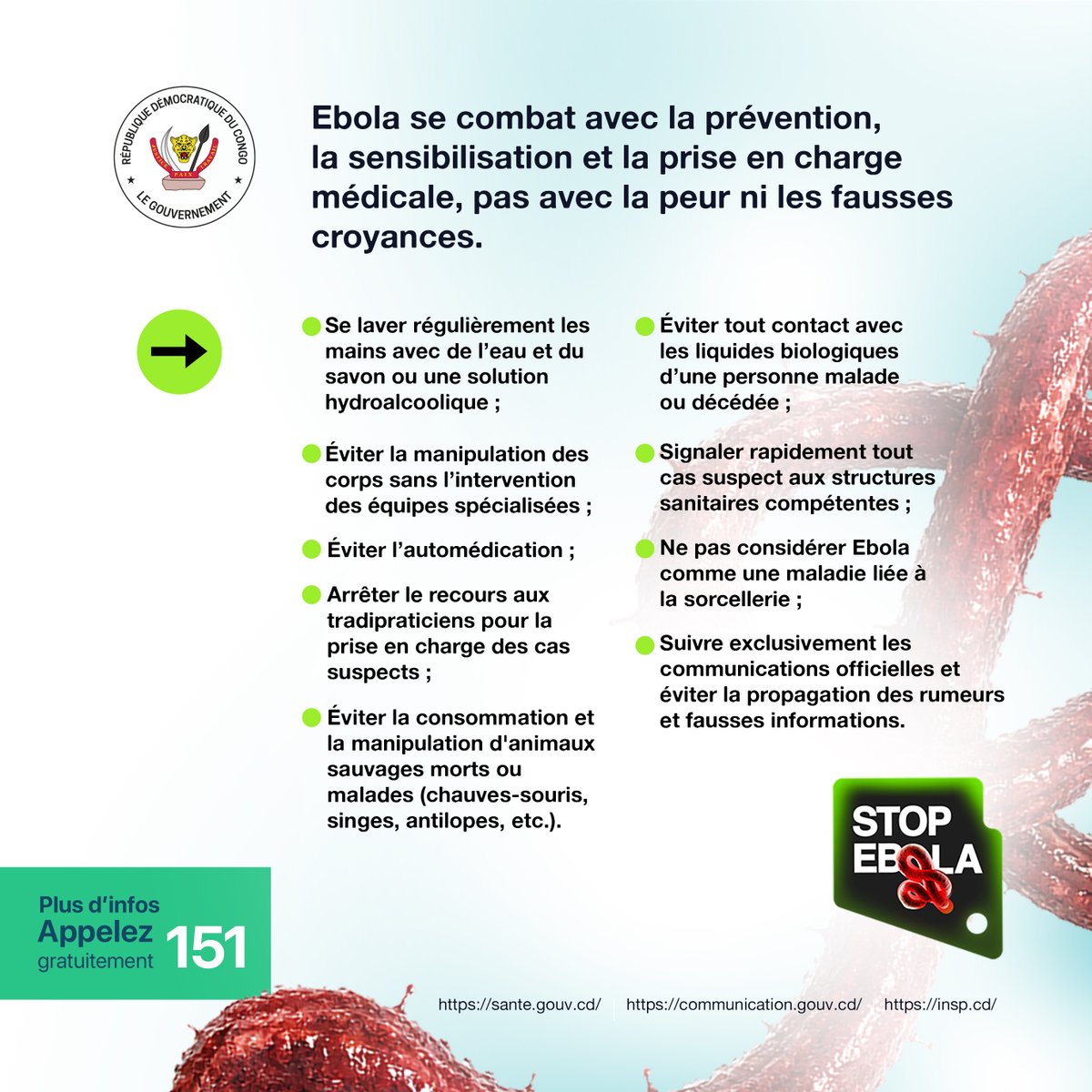
Vaincre définitivement le virus Ebola repose sur la stricte mise en œuvre des mesures barrières telles que : Le lavage régulier des mains, éviter les contacts physiques, bien cuire la viande et d'autres aliments, signaler automatiquement dans les centres de traitement d'Ebola le malade ou la personne susceptible d’atteindre le virus, etc…
Évitez toutes pratiques ou médecines dites "traditionnelles" qui peuvent mettre en danger les malade ou personnes susceptibles d'atteindre le virus.
Les personnes habitant dans les zones touchées doivent impérativement se rendre dans les centres de traitement d'Ebola ou appeler le 151.
#Ituri #StopEbola
#GuideDePrévention
#BonnesPratiques #RDC
We have deployed a Disaster Assistance Response Team and are setting up an Ebola Treatment Center in the Democratic Republic of the Congo (DRC). We airlifted tons of supplies and personal protective equipment. Would you pray as we go to help in Jesus’ Name?
@SamaritansPurse
https://t.co/hYeAnUGlpX
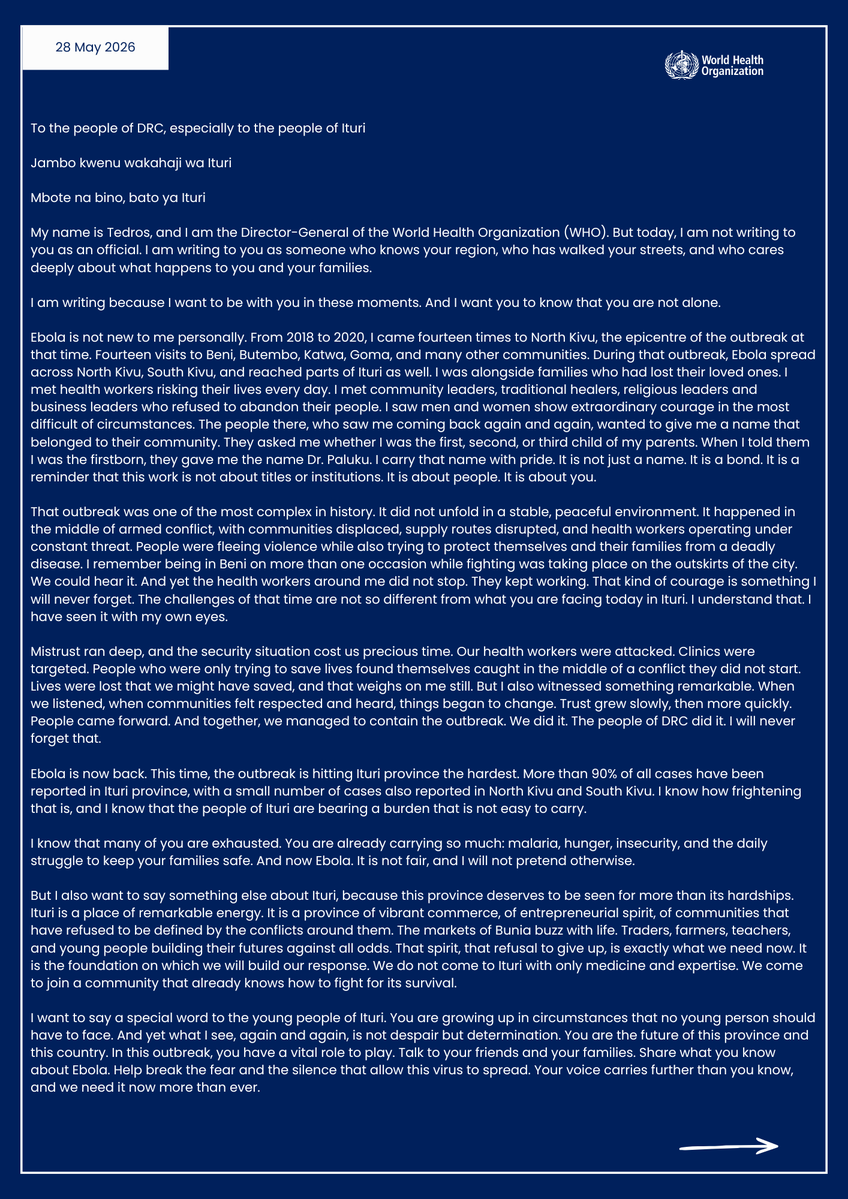
To the people of DRC, especially to the people of Ituri
Jambo kwenu wakahaji wa Ituri
Mbote na bino, bato ya Ituri
My name is Tedros, and I am the Director-General of the World Health Organization (@WHO). But today, I am not writing to you as an official. I am writing to you as someone who knows your region, who has walked your streets, and who cares deeply about what happens to you and your families.
I am writing because I want to be with you in these moments. And I want you to know that you are not alone.
#Ebola is not new to me personally. From 2018 to 2020, I came fourteen times to North Kivu, the epicentre of the outbreak at that time. Fourteen visits to Beni, Butembo, Katwa, Goma, and many other communities. During that outbreak, Ebola spread across North Kivu, South Kivu, and reached parts of Ituri as well. I was alongside families who had lost their loved ones. I met health workers risking their lives every day. I met community leaders, traditional healers, religious leaders and business leaders who refused to abandon their people. I saw men and women show extraordinary courage in the most difficult of circumstances. The people there, who saw me coming back again and again, wanted to give me a name that belonged to their community. They asked me whether I was the first, second, or third child of my parents. When I told them I was the firstborn, they gave me the name Dr. Paluku. I carry that name with pride. It is not just a name. It is a bond. It is a reminder that this work is not about titles or institutions. It is about people. It is about you.
That outbreak was one of the most complex in history. It did not unfold in a stable, peaceful environment. It happened in the middle of armed conflict, with communities displaced, supply routes disrupted, and health workers operating under constant threat. People were fleeing violence while also trying to protect themselves and their families from a deadly disease. I remember being in Beni on more than one occasion while fighting was taking place on the outskirts of the city. We could hear it. And yet the health workers around me did not stop. They kept working. That kind of courage is something I will never forget. The challenges of that time are not so different from what you are facing today in Ituri. I understand that. I have seen it with my own eyes.
Mistrust ran deep, and the security situation cost us precious time. Our health workers were attacked. Clinics were targeted. People who were only trying to save lives found themselves caught in the middle of a conflict they did not start. Lives were lost that we might have saved, and that weighs on me still. But I also witnessed something remarkable. When we listened, when communities felt respected and heard, things began to change. Trust grew slowly, then more quickly. People came forward. And together, we managed to contain the outbreak. We did it. The people of DRC did it. I will never forget that.
Ebola is now back. This time, the outbreak is hitting Ituri province the hardest. More than 90% of all cases have been reported in Ituri province, with a small number of cases also reported in North Kivu and South Kivu. I know how frightening that is, and I know that the people of Ituri are bearing a burden that is not easy to carry.
I know that many of you are exhausted. You are already carrying so much: malaria, hunger, insecurity, and the daily struggle to keep your families safe. And now Ebola. It is not fair, and I will not pretend otherwise.
But I also want to say something else about Ituri, because this province deserves to be seen for more than its hardships. Ituri is a place of remarkable energy. It is a province of vibrant commerce, of entrepreneurial spirit, of communities that have refused to be defined by the conflicts around them. The markets of Bunia buzz with life. Traders, farmers, teachers, and young people building their futures against all odds. That spirit, that refusal to give up, is exactly what we need now. It is the foundation on which we will build our response. We do not come to Ituri with only medicine and expertise. We come to join a community that already knows how to fight for its survival.
I want to say a special word to the young people of Ituri. You are growing up in circumstances that no young person should have to face. And yet what I see, again and again, is not despair but determination. You are the future of this province and this country. In this outbreak, you have a vital role to play. Talk to your friends and your families. Share what you know about Ebola. Help break the fear and the silence that allow this virus to spread. Your voice carries further than you know, and we need it now more than ever.
And to the health workers of Ituri, I want to say this: you are seen, and you are not alone. Every day you go to work knowing the risks, and you go anyway. You do it for your patients, for your communities, for your families. You are the backbone of this response. Without you, none of this is possible. I know the conditions are hard. I know the resources are often not enough. I know that fear and exhaustion are real. Please know that WHO stands with you, that we are working to get you the support you need, and that your courage and dedication are known and deeply valued far beyond the borders of this province.
I also know that the security situation in parts of this region remains very difficult. Conflict and displacement make everything harder, including reaching people who need care and keeping health workers safe. I want to be honest: this is one of our greatest challenges. We cannot do this work if those who are trying to help are prevented from doing so or put in danger. We are working closely with all relevant partners to ensure that the response can reach every community that needs it, and that no one is left behind because of where they live or what is happening around them.
That is why today I am making a direct appeal to all warring parties in this region: please, declare a ceasefire. Even briefly. Even just enough to let health workers through. People are dying from Ebola who do not have to die. Children are sick. Families are suffering. No cause, no conflict, no grievance is worth condemning innocent people to death from a preventable disease. A ceasefire, even a temporary one, would save lives. I urge you, I implore you: give us the space to help the people who need it most.
I also know that there is anger and mistrust in some communities, and I understand why. Trust must be earned, it cannot be assumed. We have not always done things correctly. But I promise you, we are here to learn as much as we are here to help.
I need to be honest with you about something important. Most previous Ebola outbreaks in DRC were caused by a virus called Ebola Zaire, for which we have vaccines and treatments. This outbreak is caused by a different virus called Ebola Bundibugyo. There are currently no approved vaccines or treatments for it. This is serious, and you deserve to hear that plainly. But I also want you to know this: while there are no specific treatments for Bundibugyo, there is much we can do together to prevent the spread of this virus and save lives. Early supportive care in our treatment centers can make a real difference. If you or someone you know falls ill, please do not wait. Coming forward early can make the difference between life and death. And everything we do, we will do with you. We will listen to you, we will share information with you, and we are here to help. And for those we cannot save, we will mourn with you. We will help you grieve your lost loved ones with safe and dignified burials.
We are working under the leadership of the Government of DRC, together with all relevant partners, united around one goal: to stop this outbreak and protect your communities. No one is working alone. No one is working at cross purposes. We are coordinated, we are committed, and we are here.
That is why I am coming to Bunia. I will be there in person, alongside my colleagues, meeting your leaders, listening to your concerns, and doing everything in my power to help you. I will not be managing this from a comfortable office far away.
This is the 17th Ebola outbreak in DRC. Together, you have overcome every single one before. That is not a small thing. That is a testament to the strength and resilience of your communities. I have seen that strength with my own eyes.
My brothers and sisters of Ituri, I want you to know that the world is watching your courage. You are not forgotten. Together, we will overcome this outbreak, as you have overcome every challenge before. Your resilience is the light that guides us all.
We will get through this one too. Not because of anyone, but because of you.
Our teams are already on the ground, and they will stay for as long as necessary. And when this outbreak is over, we will not quietly disappear. We will not forget you. We will stay, and we will keep working with you to build health systems that protect every person in every community.
I look forward to seeing you in Bunia soon. Until then, please know that you are in my thoughts.
With respect and solidarity,
Paluku
Tedros Adhanom Ghebreyesus
Director-General, World Health Organization