TOM LEE: CRYPTO IS HOW HUMANS CONTROL THE AI FUTURE.
Prof G asked why Tom Lee @fundstrat is still bullish after a brutal year for crypto and BitMine buying another $40M+ of ETH.
His answer was bigger than price.
Crypto solves trusted settlement between untrusted parties. That is why Wall Street is building tokenized assets, stablecoin rails and new financial infrastructure on-chain.
Then he tied it to AI.
🔹 Agents create wealth
🔹 Robots create wealth
🔹 Blockchain gives them rails
🔹 Crypto keeps humans in control
Tom called it the “uncanny valley of wealth.”
At some point, if agents make more money than humans, the question becomes simple:
Do they work for us, or do we work for them?
$ETH $BMNR
Why Robotics is the Trade after AI
New episode of the @OrderBookShow
00:00 Intro
2:40 Stream Starts
5:00 BTC Chart
9:20 Solana Chart
16:15 DXY Chart
19:30 S&P500 Chart
24:15 CRSP Biotech Chart
27:00 TRX Chart
28:00 JTO Chart
29:45 VVV Chart
35:45 BTC in an Ai World Rant
44:45 Micron Stock Chart
51:30 Space X Dumping
54:15 South Korea stocks cause the market to dump
1:01:30 Iran Oil starts flowing
1:06:00 Keir Starmer Resigns
1:10:00 Jared From Subway gets Exploited
1:12:30 Is Robotics the next Ai Trade?
1:22:00 Micron Partners with Anthropic
1:28:15 Is $5 Million enough to retire?
1:31:50 Are in person events coming back?
1:36:30 World Cup 2026 Bets
1:37:30 3 Rate Hikes in 2026 now?
the engineer who built Claude Code just dropped a 28-minute video on how to write prompts that actually work
I've seen $300 courses that don't cover what he shows in the first 10 minutes
CLAUDE.md files, memory shortcuts, parallel sessions, prompting patterns
all in one video and completely free
after watching this, the next step is agents
I wrote a full guide on how to build one yourself with Claude Code
article below
The next economy won't be visible to humans. AI agents will transact, settle, and coordinate value at machine speed, and the only rails built for that are crypto.
In this episode of The Journeyman, I explain why the major layer 1s aren't just crypto infrastructure. They're the coordination substrate for an invisible economy that's already being built. As ever, please enjoy!
LIVE NOW - Ethereum’s Quantum Plan Before Q-Day
Quantum is no longer a distant thought experiment.
@drakefjustin joins Bankless to unpack:
- when Q-Day could actually arriv,e
- why Bitcoin and Ethereum face very different quantum risks,
- what Ethereum’s post-quantum roadmap looks like,
- why this upgrade could be bigger than the Merge,
- and how quantum could become Ethereum’s chance to lead.
---
TIMESTAMPS
0:00 When is Q-Day?
5:35 The moment quantum becomes crypto-relevant
10:11 How many qubits does it take to break crypto?
16:22 What a real Bitcoin quantum attack would look like
20:19 How much Bitcoin is actually vulnerable?
26:26 Burn, freeze, or salvage? Bitcoin’s impossible choice
35:06 Proof of seed phrase and Bitcoin’s post-quantum bottleneck
41:02 Ethereum’s exposure: smaller, but not zero
45:43 Ethereum’s tougher roadmap: three layers, three upgrades
50:29 The execution-layer plan: replace ECDSA without killing throughput
57:56 Post-quantum, post-AI cryptography
1:03:36 BLS, KZG, LeanVM, and the rest of the stack
1:06:42 Is this bigger than the Merge?
1:17:21 If Bitcoin stumbles, does all crypto stumble too?
1:19:35 “Quantum is not a challenge—it’s an opportunity”
1:21:27 AI, quantum, crypto and the 2032 convergence
1:28:04 Harvest now, decrypt later
1:30:09 Defensive accelerationism and Ethereum’s role
1:39:10 Stoicism, P-doom, and why he keeps building
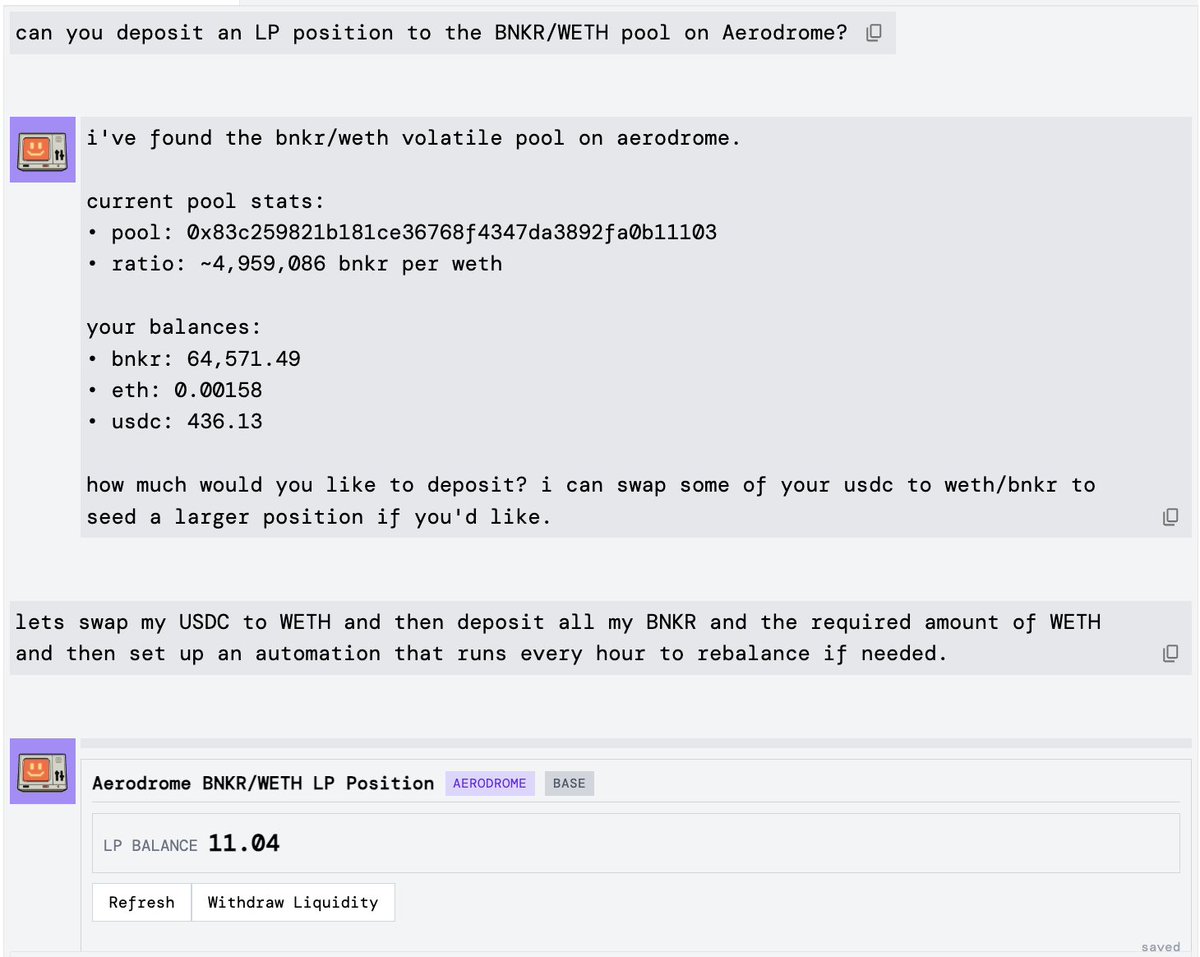
testing out various bankr agent commands. here i told it to deposit LP to aerodrome and set an automation to check and rebalance that position every hour.
your agents can do this via the bankr cli, or api. humans can do this through the terminal or right here on x.
In 1998, Warren Buffett explained how to never lose money. MUST BOOKMARK🔖
The lecture was 1 hour 24 minutes long.
The company built on those ideas is now worth $1 trillion.
This is the closest thing to a cheat code that exists.
I'm sharing my latest viral find with you - watch even 5 minutes and your trading mindset will shift forever.
Share it. You'll thank yourself later.
Norway Found Oil. Then Did the One Thing Most Countries Never Do
In 1969, Norway discovered one of the largest offshore oil deposits in the world.
The Ekofisk field changed everything.
Suddenly, this small Scandinavian nation was sitting on extraordinary wealth.
They could have done what most oil-rich countries do:
* Spend it all immediately.
* Build monuments.
* Create economic bubbles.
* Enrich a few while the many suffer.
And when the oil runs out, collapse into debt and instability.
Nigeria tried that.
Venezuela tried that.
Libya tried that.
Norway looked at these cautionary tales and made a different choice.
In 1990, the Norwegian Parliament created the Government Pension Fund Global.
The rules were simple but revolutionary.
All oil profits would flow into the fund. The fund would invest globally in thousands of companies. Norway could only withdraw a small percentage each year—originally 4% - now 3%.
The rest would stay invested. Forever.
People thought they were insane.
Why hoard money for people who don't even exist yet?
Why not lower taxes, build bigger programs, and enjoy the wealth right now?
The Norwegian government had an answer...
Because future Norwegians will exist. And they deserve this wealth as much as we do.
In 1996, they deposited the first payment: $150 million.
Then they did something even more remarkable...
Bet you can't watch 5 minutes of this without rethinking everything you know about money. (MUST BOOKMARK)
Ray Dalio turned a startup in his apartment into a $150 Billion empire.
He just condensed 75 years of investing wisdom into 39 minutes.
Watch this instead of Netflix this weekend.
How a $4M poker champion turned every decision you make into a bet — and why that changes everything
Annie Duke, Ph.D. (@AnnieDuke — WSOP bracelet winner, $4M in tournament winnings, national bestselling author of Thinking in Bets, Special Partner @ First Round Capital, PhD in Cognitive Psychology from Penn)
"A good bet is one that carries positive expectancy. What a good bet is NOT — is one that wins."
We cover:
- Why every decision you've ever made is a bet (even ordering off a menu)
- The green light vs. red light rule for separating outcomes from decisions
- How to build an EV calculation for something as messy as choosing a career
- Why loss aversion is secretly an uncertainty problem — and how great risk takers solve it
- When to trust your gut vs. when gut feel is just bias in disguise
- The pre-mortem framework — how to find your blind spots before it's too late
- Mental time travel: the parenting tool Annie uses to raise better decision-makers
- How she explained luck, hard work & probability to her 4 kids at the dinner table
Thanks for making time, Annie. Been a fan of yours for a while.
Timestamps:
00:00 Intro
01:12 Defining bets as resource allocation under uncertainty
04:52 Positive expectancy vs. outcome-based evaluation
06:11 Resulting: Why outcomes are not proxies for decision quality
15:19 Calculating expected value in high-variance career paths
18:55 Moving from implicit intuition to explicit decision modeling
24:27 Using base rates and reference classes for startups
30:26 Psychological traits of elite risk takers and traders
31:33 How prospect theory and loss aversion distort risk
45:12 Deconstructing gut feel and the role of intuition
49:36 Evaluating optionality and impact in fast-moving environments
57:13 Mental time travel: Tools for managing temporal discounting
01:01:31 Quantifying the intersection of luck and hard work
01:04:43 Internalizing a probabilistic worldview for long-term edge
If you haven’t watched “Trading in the Zone” by Mark Douglas, you’re missing the real foundation of trading.
Just 22 minutes.👇📊
But it can change how you think about the market forever.
Because your real advantage isn’t on the screen, it’s in your psychology. 🧠
Market Wizard Linda Raschke's 12 Technical Trading Rules
1. Buy the first pullback after a new high. Sell the first rally after a new low.
2. Afternoon strength or weakness should have follow‑through the next day.
3. The best trading reversals occur in the morning, not the afternoon.
4. The larger the market gaps, the greater the odds of continuation and a trend.
5. The way the market trades around the previous day’s high or low is a good indicator of the market’s technical strength or weakness.
6. The previous day’s high and low are two very important “pivot” points, for this was the definitive point where buyers or sellers came in the day before. Look for the market to either test and reverse off these points, or push through and show signs of continuation.
7. The last hour often tells the truth about how strong a trend truly is. “Smart money” shows their hand in the last hour, continuing to mark positions in their favor. As long as a market is having consecutive strong closes, look for the up‑trend to continue. The up‑trend is most likely to end when there is a morning rally first, followed by a weak close.
8. High volume on the close implies continuity the next morning in the direction of the last half‑hour. In a strongly trending market, look for resumption of the trend in the last hour.
9. The first hour’s range establishes the framework for the rest of the trading day.
10. A greater percentage of the day’s range occurs in the first hour than was the case in the past, and thus it has become increasingly important to trade aggressively if there are early signs of a strong trend for the day.
11. There are four basic principles of price behavior which have held up over time. Confidence that a type of price action is a true principle is what allows a trader to develop a systematic approach.
The following four principles can be modeled and quantified and hold true for all time frames, all markets. The majority of patterns or systems that have a demonstrable edge are based on one of these four enduring principles of price behavior. Charles Dow was one of the first to touch on them in his writings.
Principle One: A Trend Has a Higher Probability of Continuation than Reversal
Principle Two: Momentum Precedes Price
Principle Three: Trends End in a Climax
Principle Four: The Market Alternates between Range Expansion and Range Contraction
In the world of money, which is a world shaped by human behavior, nobody has the foggiest notion of what will happen in the future. Mark that word – Nobody! Thus the successful trader does not base moves on what supposedly will happen but reacts instead to what does happen.
This guy unlocking OpenClaw for TradingView is one of the biggest unlocks I’ve ever seen for traders.
TradingView and trading itself, will never be the same. 🔥
The Death Of The Day Trader: Why I Replaced My Brain With 5 Open Claw Agents To Chase Wall Street In 2026
the only reason you are still losing money in these markets is because you are playing a game designed for machines with a human brain. you have probably heard that everyone is automating their systems in 2026 but nobody is telling you the actual steps to do it before you get wiped out by the next liquidation hunt
most people think you need a degree from stanford or a math background to build a trading bot. i am living proof that is a lie because i got held back in seventh grade and did not even start learning to code until i was thirty years old. if you can read english you can learn to code because code is just instructions in english that a computer follows without getting tired or hungry
the truth is that wall street can see every single one of your positions and they are literally begging you to use forty percent leverage. they want you emotional because an emotional trader is a predictable trader who eventually donates their capital to the house. i learned this the hard way after losing hundreds of thousands of dollars on developers for apps i thought i could never build myself
trading by hand is just gambling with extra steps and better looking charts. those red and green bars are specifically designed to trigger your dopamine and fear centers so you make mistakes. i used to stare at the screen for eighteen hours straight only to wake up to a liquidation email that destroyed months of work in seconds
there is a hidden math to why your account is bleeding and it has nothing to do with your strategy. if you have a twenty five thousand dollar account and use high leverage while taking five trades a day you will be at zero in thirty one days just from fees alone. the exchanges do not show you a scoreboard for your fees because they want you to stay in the dark about how much life you are actually losing
this is where the rbi system comes in which stands for research backtest and incubate. instead of guessing what might work you need to go where the phds hang out. google scholar is a literal goldmine where you can find academic papers on mean reversion and momentum strategies written by the smartest minds in the world for free
once you have an idea from a paper or a book like market wizards you have to prove it worked in the past before risking a single dollar. most people fail here because they use tradingview for their backtesting. tradingview uses something called repainting which means it retroactively changes past signals to look better than they actually were
the moment i found my first winning backtest in a coffee shop while eating eggs and bacon changed my life forever. i actually ran home before finishing my meal because i realized i finally had a system that did not rely on my own flawed intuition. i use python libraries like backtesting py or vectorbt because they do not lie to me like the flashy indicators on web platforms do
learning to code was the great equalizer for me because it took me from being a gambler to being a quant. i spent years losing money and overtrading until i realized i had to automate everything if i wanted to survive. now i have multiple ai agents running around the clock doing the heavy lifting while i focus on finding the next alpha
i remember a friend from school named kt who was one of the only people that treated me well when i was an outcast. years later i was so obsessed with staring at the charts that i ignored his calls because i was in a trade i thought was important. by the time i called him back it was too late and he was gone which taught me that you can never get time back from these charts
your goal should be to work four hours a day on your system rather than twelve hours a day staring at candles. if your bot works in the past it is much more likely to work in the future but you still have to start small. i always incubate my bots with ten dollar positions to make sure the code handles the real world without any bugs before scaling up
scaling does not require a supercomputer sitting in your bedroom. you can use a virtual private server which is just a computer in the cloud that runs twenty four hours a day. this allows your systems to execute trades while you are sleeping or spending time with the people who actually matter in your life
most people will tell you that you are late to the party or that the market is too efficient now. the reality is that we have better tools than ever before with ai that can write entire backtests in seconds. you just have to be willing to stop acting like a gambler and start acting like a business owner who values their time and their data
if you are still hand trading you are betting on whether you got enough sleep or if you had a fight with your partner last night. a bot does not care about your personal life and it will execute the plan perfectly every single time. you have to decide if you want to keep being the exit liquidity for wall street or if you want to join the side that uses logic and code
it does not matter how fast you are moving as long as you are not standing still. i have seen hundreds of people transform from emotional wrecks into systematic quants just by changing their vehicle. if you can not fly then run and if you can not run then walk but you have to keep moving toward automation before the market leaves you behind