I rarely comment on posts like this, but this one needs a correction.
The Ennezat et al. meta-analysis (J Cardiovasc Pharmacol 2023) of 60 trials and ~324,000 patients does not show that “nobody lived longer.” It shows that active or more intensive lipid-lowering therapy reduced all-cause mortality (RR 0.92). What it did not find was an additional mortality benefit from more intensive LDL reduction beyond standard therapy.
More importantly, lack of a large mortality benefit in modern trials is not the right test of whether lipid-lowering (or other interventions) works.
Today, case fatality for acute myocardial infarction is under 4% thanks to primary PCI and modern acute care. The vast majority of patients survive an acute event. We are also very good at preventing recurrent events with secondary prevention. When acute events are highly treatable and further events are largely preventable, it becomes statistically very difficult to show large differences in total mortality.
In a recent study from our group of nearly 19,000 first-time STEMI patients treated with primary PCI, those who survived the first 90 days and received high rates of guideline-directed preventive therapy (including statins) had a 10-year mortality only 2 percentage points higher than an age- and sex-matched general population (HR 1.04).
https://t.co/nM9lDbCt3S
Patients who were not well treated had higher mortality. Unless one believes that a STEMI does not identify someone at high long-term risk, this is hard to interpret as anything other than evidence that modern secondary prevention (including LDL lowering) largely eliminates the excess mortality that would otherwise be expected.
Not everyone needs lipid-lowering therapy. Not at all. The same applies to blood pressure–lowering treatment. One could even argue that many people with type 2 diabetes or who smoke will never develop cardiovascular disease, even without intervention. But that does not mean these risk factors should be ignored. This is precisely why absolute risk matters: the absolute benefit of treatment is small in people at very low risk. However, claiming that substantial LDL-C reductions do not reduce mortality, based on a selective interpretation of a single meta-analysis, is simply not supported by the totality of evidence.
Clinical practice & decision making depend on causality, which depends on design.
Great threads here. If only #MedEd w’d know this= worth teaching. Too many think research's hard bcz 'math'. It’s primarily language that makes it hard for those not investing the necessary time
Where P(causal|assoc) is near 1 (randomization, sharp RDD, valid instruments, overwhelming mechanism), the credit goes to the design, not the estimator. Without a design, the formalism gives you vocabulary, not evidence.
@JonathanShedler I wish this were true for psychotherapy only. It is true in my own backyard/ preventive medicine and research. While some fields are harder hit than others, this is perhaps a sign of ‘our times’. The optimistic part is that the needed change needs voices like yours.
Truncation by death in RCTs:
Causal formalists: assume deaths away in an attempt to isolate the main response from death, usually while acting as if survival is predestined and that clinicians treating patients know which of their patients are predestined to survive
Biostatistician RCT modelers: death is an outcome; treat it as one; use models likely to reflect the data generating process; model multivariate outcomes and get an intent-to-treat estimand having all assumptions out in the open that matches the clinical decision process at time zero
Naive researchers: analyze results on survivors and don't think about any of this
https://t.co/cglzeHvlso
@venkmurthy Academic theater is such a symptom of institutional exhaustion. AI could help to the degree it can (re)establish corrective feedback loops to uncouple, if possible, individual & institutional ego from knowledge generation.
Lots of debate this week on whether journals should ban AI in peer review.
We actually tested this in our new preprint, and the results were pretty clear to me.
For context, I've reviewed for most of the big journals and evaluated 1,000 human reviews as an editor. I love to read and evaluate science.
TLDR: From now on I won't do any peer review without AI. For clinical trials, I'd even call human-only review dangerous 🧵
Good read. It's like the saying...we have met the enemy and they are us.
"Perhaps the most under-discussed challenge in translational AI is the logistical burden of generating rigorous prospective evidence, ...the ‘infrastructure of evidence’."
https://t.co/qIFavBcAzo
When attempts to find solutions to peer review backfire...
Paid to peer review: firms are paying researchers to assess manuscripts for journals https://t.co/veVyCizUT2
@SripalBangalore@drjohnm@SVRaoMD Conformity and convenience are sabotaging creativity, and ultimately core message delivery.
I am back to my artisanal slides. More fun, more creative, more efficient.
@georgeta Some very good points here. Perhaps the biggest abomination I see in #meded is emphasis on specificity and sensitivity; this is highly bizarre stuff, and I share Moon’s and Frank’s piece as much as I can https://t.co/PadxEollcc
"It's time to stop celebrating resilience"
Excellent piece here.
This is why any 'Resilience workshop' should come together with accountability and an institutional plan of action.
https://t.co/GpwuA6LG8A
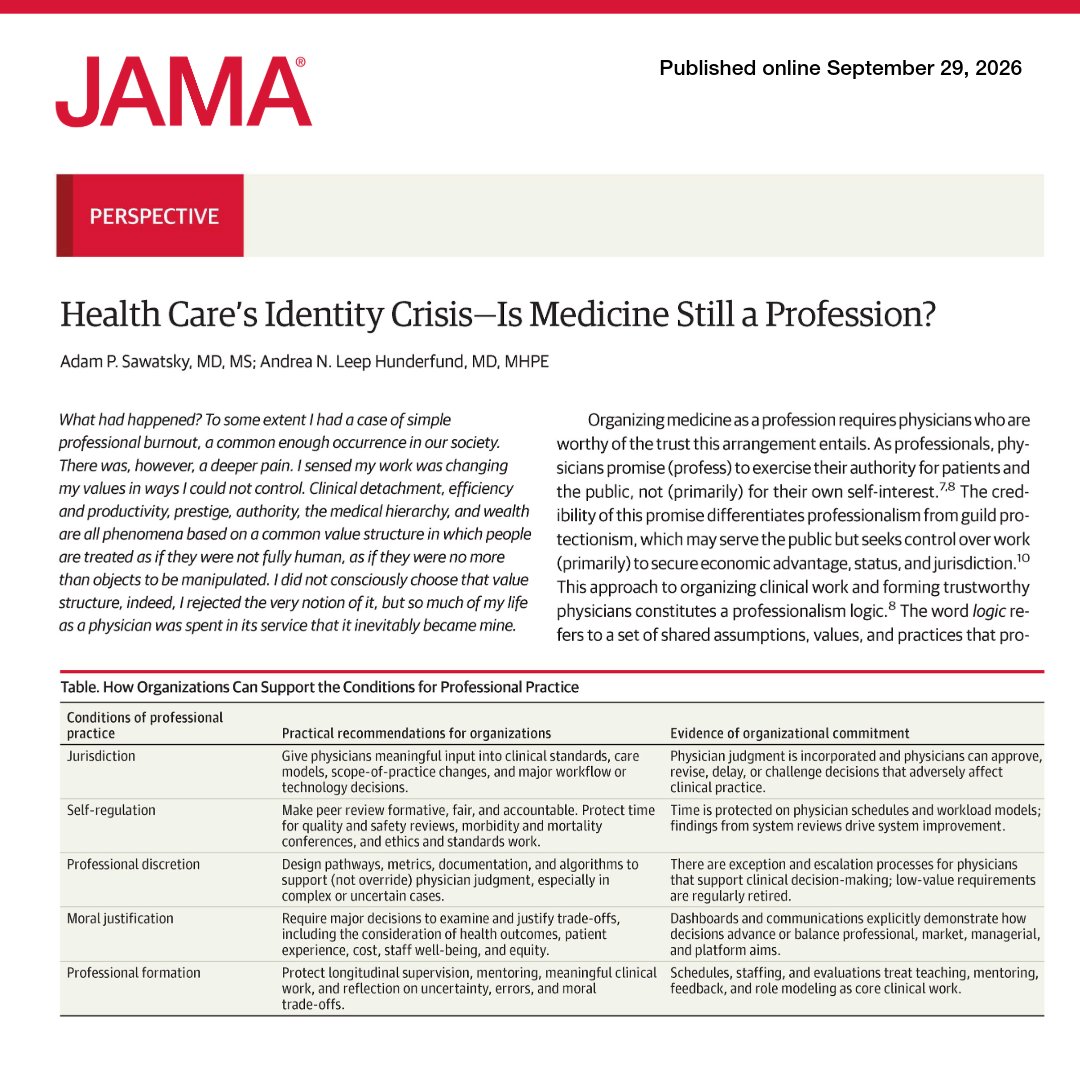
💬 Perspective by Adam Sawatsky, MD, MS, and Andrea Leep Hunderfund, MD, MHPE: #PhysicianBurnout may reflect more than overwork. #Burnout can also indicate an identity crisis in #Medicine when market, managerial, and platform priorities conflict with professional commitments to patients and public trust.
Addressing burnout may therefore require structural changes in workflows, metrics, and technologies so that practice conditions support patient-centered care and professional judgment.
https://t.co/DP8aQlG9Ts
How a click bait'y title can be counter 2 the message.
2 progenitor pop is not 2 organs
The heart has multiple progenitor pop during cardiogenesis. So how many hearts do we have?
Research here is fascinating but hyped framing takes away the very coolness it hoped to highlight
@5_utr ERAS recent changes perhaps in the right direction, fwiw.
Also, if #MedEd actually taught methodology seriously, reading research before ‘doing’ it, and integrating clinical & research reasoning, we w’d be in a better world
@5_utr Funders as gatekeepers OK but risks conformity/bureaucracy/NIH-like; yes,reform w’d be nice.
Promotion cmt w’d req lots external blinded methods experts; perhaps if all ivy league decide to cap to 5? major papers on a CV ?
Journals=no incentive to reject 85% their golden geese
@f2harrell@yudapearl This w'd be great in #meded as well. The way 'stats' and 'ebm' are addressed (on average) should be a 5-level alarm in med school edu