Thrilled to share the successful conclusion of our 21-days Summer school on Glaciers #CBPG. 21 days, 20 participants from 20 Institutions, 1 goal: Advancing Glacier Training and Research #glaciology#cryosphere#iacscryo#ICCInet#CBPG2025
Under the leadership of Hon’ble PM Shri @narendramodi , India’s science and technology ecosystem has advanced with strategic reforms and focused R&D, earning global recognition.
DST’s Centre of Excellence at the University of #Kashmir is addressing glacial depletion in the Western Himalayas, using cutting-edge research to track climate impacts and drive sustainable solutions.
Science is reaching every region — building resilience, powering innovation, and shaping a Viksit, #AtmanirbharBharat2047.
#ClimateAction #GlacialResearch #DSTIndia #11YearsOfSeva
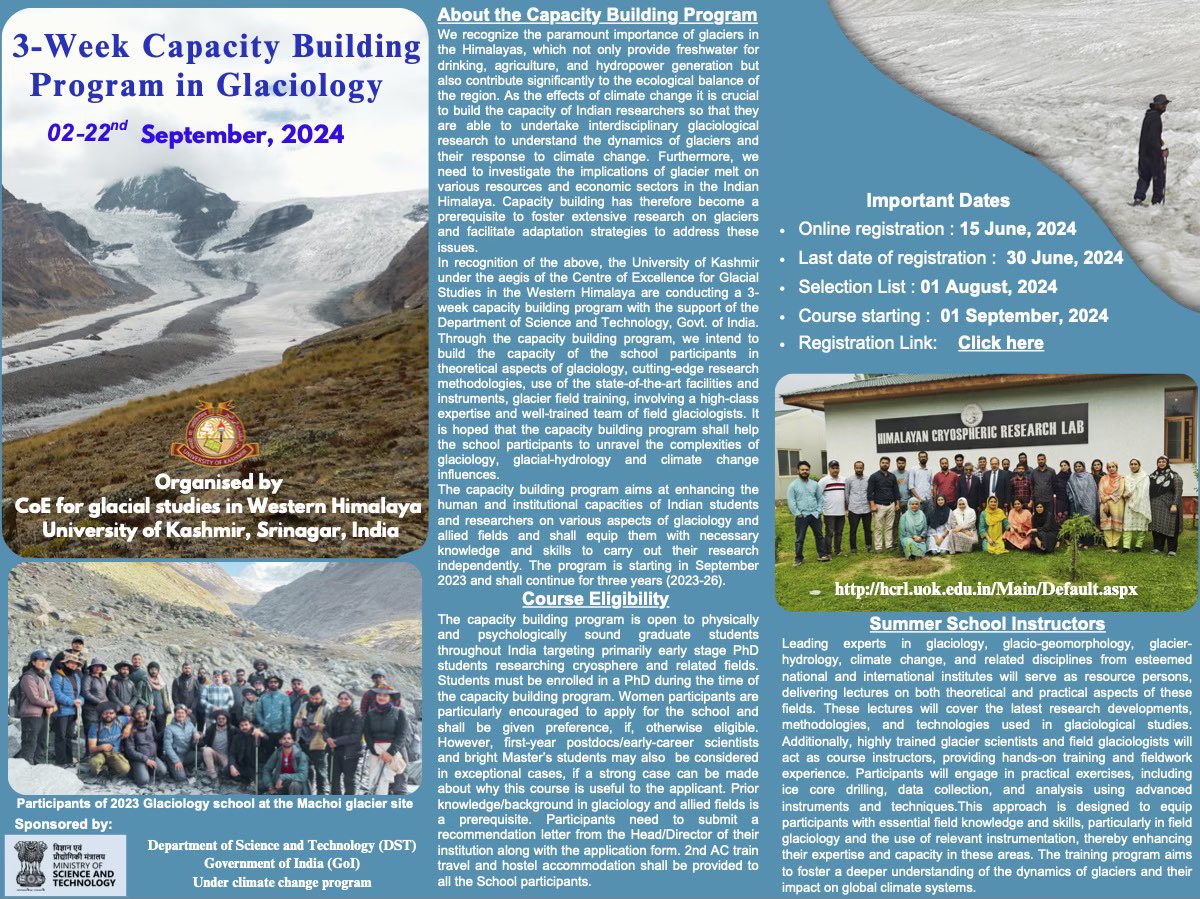
Sharing 3rd exciting Capacity Building Program in glaciology by the Centre of Excellence at @kashmirUni! A great opportunity for early career researchers and students to upskill this summer. Don’t miss out!
#CoE#capacityBuildingProgram#summerSchool#DST
Centre of Excellence Lab #CoE is proud to announce its 3rd 3-week Capacity Building Program at @kashmirUni!
Check out the brochure and link for program details, curriculum and registration information ( https://t.co/Xule4l3xfk…) #capacityBuildingProgram#summerSchool#dst
Our new paper published in #Applied_Geochemistry on how stream hydrochemical composition and hydrodynamics inform our understanding of stream water sources and flow path dynamics in high altitude catchments.
#Hydrology#HimalyanCatchments#UJB#Research
https://t.co/GQ1qjTCOnd
We at @CoE_glaciology are investigating the underlying drivers and processes contributing to spring drying, with the aim of developing effective mitigation and management strategies for these vital freshwater resources
Springs are deteriorating due to multiple factors, including excessive GW pumping, reduced GW levels, land use changes through unregulated constructions, and climatic interventions marked by alterations in precipitation & temp patterns, which decreases the GW recharge & storage
Surprisingly, springs protected with concrete walls are among the most affected by drying, possibly due to disruption of the natural recharge pathways.
Our new Paper in #JoH explores the role of saturated hydraulic conductivity and topography in shaping baseflow generation in high altitude aquifers of Western Himalayas #UIB. It further envisages about fractured and krastified bedrock’s crucial role in GW flow.
The @COE_Glaciology at @UnivofKashmir is hosting 2nd 3-Week Capacity Building Program in Glaciology from Sep 1, 2024. Supported by @IndiaDST, the program offers glacier field training, theoretical learning, hands-on on cutting-edge research methods/instruments at Machoi glacier
New paper: Is it practical to build a national groundwater model without calibration? How well does it work? How do you keep the computational cost low? First steps along this pathway, led by #NoTwitter Shams Rahman, with Francesca Pianosi and me. https://t.co/axHvgEzoy1
Today,groundwater is the only source of water for most of Indian people,providing the bulk of water for farming and domestic use.if groundwater is managed carefully, it can help to mitigate the far-reaching impacts of climate change on India https://t.co/9AjvUhp7nH via @worldbank