Hot take: the community keeps asking whether diffusion LLMs can beat AR. That's the wrong question. Diffusion is a sampling method, and it can sit on top of an AR model to make it faster instead of replacing it.
Speculative decoding already speeds up AR, but it has two long-standing problems. Training a drafter takes a long time, and you have to build a complete pretraining corpus for it. Even then, token acceptance drops sharply on out-of-domain data.
Uno @ssahoo_ offers an elegant way out: it decouples sampling training from capability training. There's no separate drafter. The model itself, plus one LoRA, drafts several tokens in a single forward pass, and the LoRA learns to match the model's own next-token distribution, so there's no drafter corpus to build and no labels to collect.
We applied this to the Looped Transformer Nanbeige4.2-3B: 1 hour of LoRA training gives a lossless 2× speedup on agentic task. We haven't optimized anything yet, and we believe the acceleration can go much further.
The takeaway: diffusion doesn't need to beat AR. Any model that can score its next token can get a fast diffusion mode in an hour.
Page: https://t.co/SCkbkrtf2z
Lora Adapters: https://t.co/Awks2jdkx0
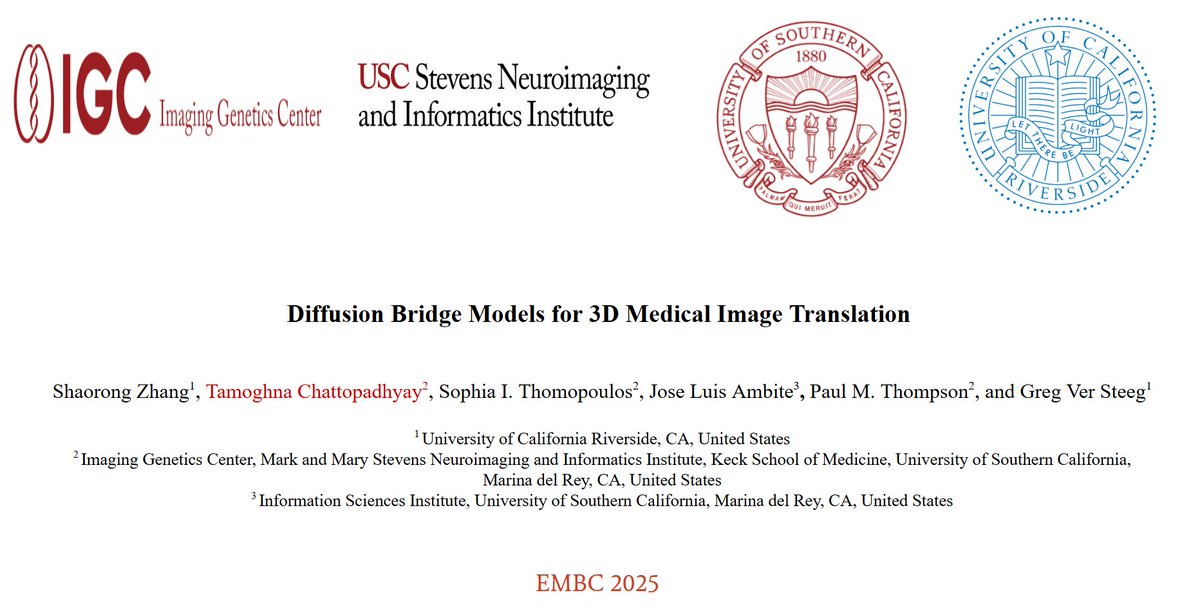
✨🧠Excited to have had the opportunity to present our work titled 'Diffusion Bridge Models for 3D Medical Image Translation' in IEEE #embc2025 conference. Some of the important points of discussion from the paper are in this 🧵
https://t.co/bi9lCu6YvT Nice work on latent space learning with biomedical data by amazing PhD student Myrl Marmarelis, who is working at the intersection of causality and machine learning. He's defending soon, so you should move fast if you want to lure him somewhere!
1/8
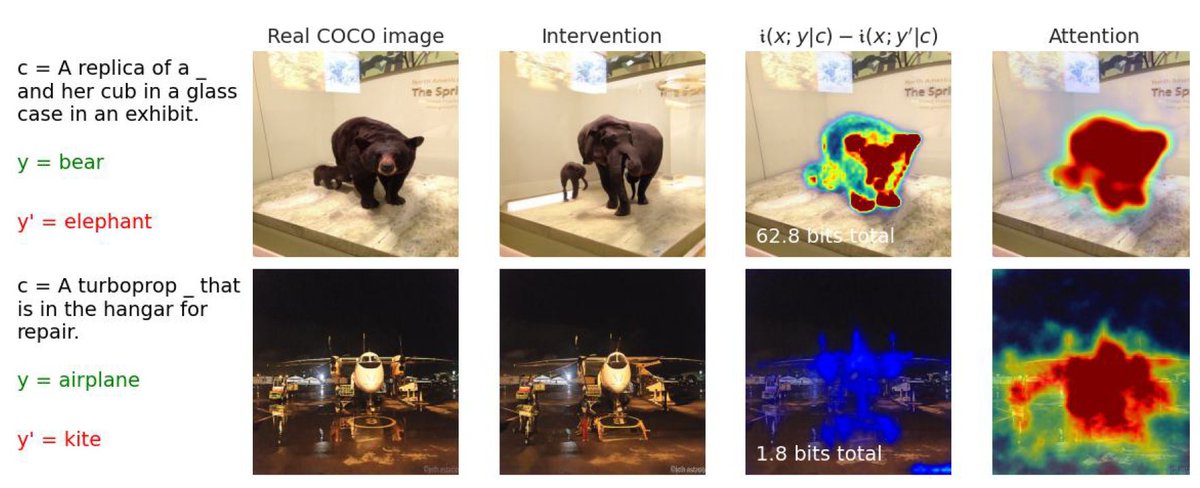
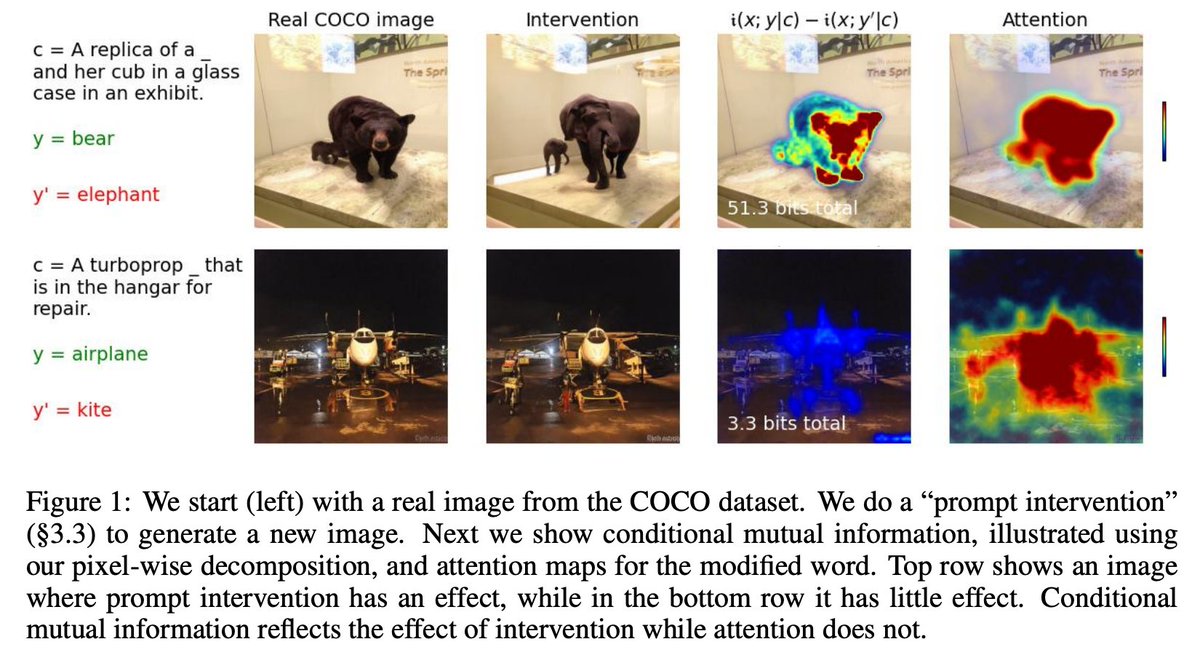
🚀 AI Breakthrough: "Interpretable Diffusion via Information Decomposition" 🧠
- Quantitative understanding of conditional diffusion models.
- Align text-image data using mutual information.
- Goes beyond "attention".
🎉 Accepted at #ICLR2024!
MI + diffusion! two new papers calculating (pointwise) mutual information as a difference of scores
cool experiment by @xxk0ng @gesteller identifying areas of an image relevant to changing a prompt
https://t.co/1IwW17DXhj
see also @michiard https://t.co/8mxxBzuL0L
What are the #histopathology image #WSI patterns associated with gene expression in cancer? Can we discover them with #AI and use them for spatial profiling and #precision medicine?
Our preprint explores limitations & possibilities of #cpath for this.
https://t.co/F0FbLVmPnw
@elan_learns Interesting! It looks like openai uses trained classifiers to cut off some problematic statements. By using secrecy/subtlety it’s much harder to trip those safeguards.
Robnik et al's Micro-canonical Langevin Monte Carlo https://t.co/lObx74FjWH sets a new standard for sampling. Elegant energy preserving dynamics that sample from a target distribution faster and with less bias!
AM is a general approach for learning CNFs or SDEs, w/o backdrop thru dynamics in training
-natural for trajectory inference in biology, w/time snapshots given
-or generative modeling w/flexible endpoint dists or interpolating processes
(learned a ton from @k_neklyudov here :)
@adad8m@aram_galstyan Thanks for the pointer, I'm very excited about this paper. Solving the ergodicity issue is the main obstacle in making deterministic samplers practical and useful in many applications!
**AI can detect new materials**
New paper with Marcin Abram, @DingrevilleRemi, and @gesteller just published in NPJ Computational Materials https://t.co/bUxO4J6Hy7
Slides borrowed from a GREAT talk @DingrevilleRemi will be presenting at a SIAM DS https://t.co/1GWza66UI5
🧵1/6
Pattern formation is key in many physical and biological systems, but it can be hard to discern when transitions occur. We solve this challenge with self-supervised learning and neural nets to detect hierarchies of topological transitions. Details: https://t.co/OXNLvZ2Qo7
I'm happy to announce that I'm joining @Vanderbilt_CS this fall as an Assistant Prof, building a Machine Learning and Medical Imaging group (alongside some truly wonderful faculty already there).
Please reach out if you want to collab!
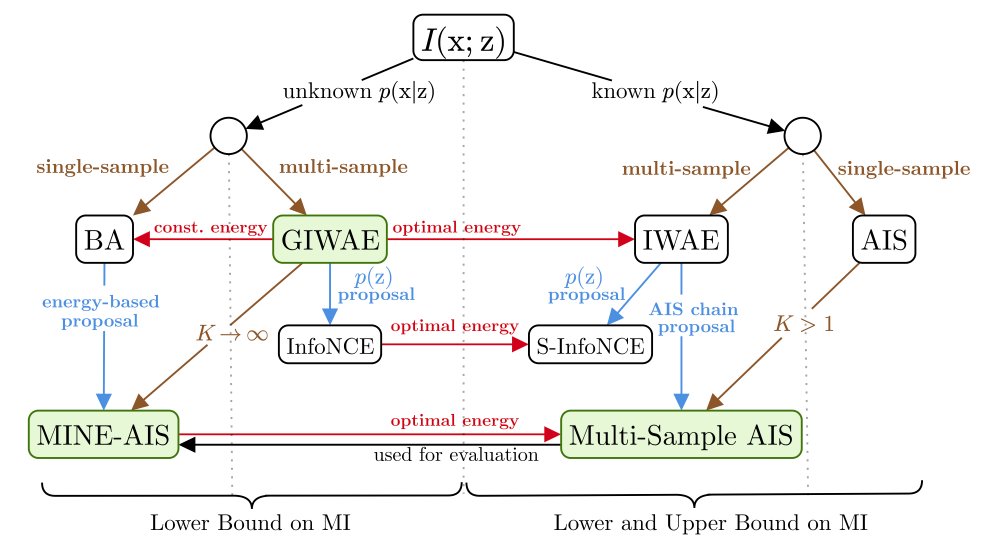
We’ll be presenting our ICLR paper “Improving Mutual Information Estimation using Annealed and Energy-Based Bounds”, Tues @ 10:30am PDT/17:30 GMT
Talk: https://t.co/CxQJVKGV0N
Paper: https://t.co/ITPQoQfoDc
w/@sicong_huang@MarzyehGhassemi@gesteller@RogerGrosse@AliMakhzani