Read it later app graveyard? How to import 1,000 saved links into your second brain and actually use them.
Watch how Nicole brought her dead links back to life in Recall. She chatted with all of them at once, compared them against the latest research on the web, spotted which ones were out of date, and found connections she'd missed: https://t.co/SRYAwlspfF
The Japanese have a word for buying books and letting them pile up unread. Tsundoku (積ん読).
Most of us have the digital version. Years of articles saved in Readwise, Pocket, Raindrop, Instapaper or a bookmarks folder, all waiting for a "later" that never comes.
We just launched bulk URL imports, so you can bring up to 1,000 links into Recall at once. But moving links from one app to another isn't the point.
The point is finally being able to use them.
In Recall, that means three things:
1. You can talk to all of them
As soon as the import finishes, every link can be chatted with. You don't have to tag, sort or read anything first. Ask a question and get an answer pulled from everything you've saved, with sources, so you can see which links it came from.
2. You can compare them to what's on the web
Saved links get old. Research moves on, advice changes, and the article you saved three years ago might be wrong now. Your pile stops being a time capsule and becomes something you can keep up to date.
3. They get organized for you
Once something is in Recall, it's connected to related content you already have. You don't have to build a folder system and hope you remember it later.
How to import
- Get your links into a CSV file (basically a list of links)
- Open Recall and drop the file into "upload or drop anywhere"
- Recall pulls them all in and skips anything you already have
That's all it takes. A pile you felt guilty about turns into something you can ask questions, check against the web, and find your way around.
What would you ask your saved links first?
#readitlater #secondbrain
Chip stocks can fall while AI demand rises. Demand, financing costs and expected returns answer different questions. Save the Reuters, ASML and TSMC sources in Recall, then compare the evidence. Sources dated Oct 14–15, 2026. #AI#ChipStocks
Three AI models. The same prompt. Three very different horses.
Fireship asked Gemini 4 Argon, GPT-6 Astra and Claude Opus 5.5 to build a realistic interactive 3D horse. The results make a useful point about choosing a model: a benchmark score only tells you about the task being measured.
In the comparisons shown in the video:
• Gemini leads the long-video-understanding test.
• Claude Opus beats Gemini on tasks in a computer terminal.
• GPT Astra beats Gemini on the FrontierSWE v2 software-engineering test.
Then the horse demo tells a different story. Claude and GPT produce more convincing shapes, while Gemini's result looks more like a blocky game character. One example gives you something to investigate, not a permanent ranking.
Start with what you need the model to do. Run the same realistic task across the models you're considering, then compare output quality, the fixes needed and how easily you can use the result.
Save the video in your second brain in Recall. When a real task comes up, ask: “Based on this comparison, which model should I try for my task, and why?”
Return to the source, check the evidence and build your own recommendation for when to use each model.
Source: Fireship, “Did Google just dethrone OpenAI and Anthropic?” (20 October 2026)
https://t.co/Oo88YKSyEB
#AIModels #SecondBrain
Most ADHD apps try to fix your schedule.
Mine was never the problem, information overload was.
Here's what finally worked after years of apps that didn't stick.
For ADHD Awareness Month, I filmed my real daily workflow: https://t.co/Dq9wS8IScu
#ADHD#ADHDApps
Try this with a question you’re working on:
Ask your library.
Read the relevant original sources.
Write down what you can apply.
What would you ask the knowledge you’ve already collected?
How do people return to their saved knowledge?
Among paying Recall users who saved content and returned, 81% used chat, 54% reopened a source, and 15% used search.
Methods overlap. Chat was the most common route back.
Get all of the details about how people use their second brain, how frequently they come back, which features are the stickiest, and which are not, in the second brain report: https://t.co/7XlTIX1Z5d
#SecondBrain
These methods can work together.
Ask a question across your library. Open a relevant source to check the context. Search for a specific term when you need it.
The figures describe usage. They don’t tell us which method produced better understanding.
AI can generate code. You still need to check what it does and how it could fail. Our takeaway from Fireship’s AI coding debate: practise reviewing an output, not just producing it.
Save the video in your second brain in Recall.
#Programming#SecondBrain
Chip stocks slip, a flying Roadster is a striking demo and iPhone Duo delivery estimates moved into January.
Bloomberg Tech’s October 16 episode puts three different technology stories under that lens:
• US chip stocks faced their longest losing streak since 2008. Investors are questioning the debt financing the AI buildout and whether the returns will justify the spending.
• Apple’s iPhone Duo shipping estimates slipped into January within minutes of preorders opening. Early buyers face a longer wait.
• Tesla demonstrated a Roadster prototype with air thrusters. Production is not expected until 2028, so the demonstration and a delivered product remain different milestones.
The episode is over 40 minutes long. Share it with Recall for a quick summary, skim the key points, then jump to the part you want to watch.
Stay informed with a quick summary, then go deeper where it matters.
Source: https://t.co/hztAmxjYX1
#TechNews #AI #Summarizer
When everything needs doing, even choosing where to start can feel like another task.
Cal Newport's two + five plan starts with two daily practices that matter to you and five small projects you can finish.
The distinction is useful: a practice is something you return to, such as reading at lunch. A project has a finish line, such as booking the appointment you have been putting off.
Choose actions small enough to make progress while also addressing the workload behind the overwhelm. The useful part is the finish line. A daily practice has a place in your day, and a small project has a point where you can say it is done. That gives progress a shape you can actually see.
His full conversation is about an hour long. Save the video in your second brain in Recall, read the summary, then ask it to explain the plan. Focus on one useful idea before exploring the rest.
Source: https://t.co/a0d8xndkaS
#Focus #CalNewport #SecondBrain
Tesla’s Roadster reveal included a car doing a kickflip. Here’s what was behind the spectacle.
Fans underneath the car create suction to help it grip the road. Compressed-air thrusters provide extra force and make those wild maneuvers possible. During the acceleration demo, Tesla reported 0–60 mph in 0.81 seconds.
The full event runs 23 minutes. That doesn’t mean every minute needs the same attention.
With Recall, open the video, click the browser extension, and skim the summary. Then click a timestamp to jump straight to the demonstration worth seeing for yourself.
Get the gist. Watch what matters.
#TeslaRoadster #TechNews
AI makes it easier to build things nobody wants.
Robby Stein has helped build products used by billions, and products nobody uses. In his conversation with Lenny, he comes back to the person’s underlying need: people “hire” a product to do a job.
To uncover that job, reconstruct a real moment in their life. What was happening when they decided to buy or use something? What were they trying to get done? What made their existing approach inadequate?
That gives you something more useful than a list of requested features: the situation your product needs to improve.
A practical next step: ask a potential user about the last time they faced the problem. Look for the trigger, the workaround, and the outcome they wanted before proposing your solution.
Save the video in your second brain in Recall. Ask how to test whether people actually want what you are building.
#ProductDevelopment #Startups #SecondBrain
You sit down to do one thing, then spend an hour absorbed in something else.
In his Diary of a CEO interview, Trevor Noah describes getting absorbed in something he did not mean to focus on, while struggling to focus on the thing he intended to do. His account puts words to a frustrating experience: having attention, but finding it difficult to direct it. It is a conversation worth hearing during ADHD Awareness Month.
A two-and-a-half-hour interview can feel like another large task. A smaller starting point is one question: What does Trevor say about directing his attention?
Save the interview in your second brain in Recall. Read the summary, ask that question, and jump to the relevant moment. One question gives you somewhere concrete to start.
Source: https://t.co/BCqiWJQWOK
#ADHDAwareness #SecondBrain
The next AI model announcement arrives before you have finished understanding the last one.
In this Fireship video, releases from France, the US and China sit alongside a bigger question: why does every government want an open model of its own, and which one should people actually use?
When the names and benchmarks start blending together, a few consistent questions help: what changed, who can use it, and why might it matter for your work?
That gives each new story a place in the picture. It also gives you a reason to return to a source beyond simply keeping up with the feed.
Save your AI videos and articles to Recall. Then ask for a quick summary of what you have saved, with the original explanations there when you want to go deeper.
The next release can wait a moment. Your second brain gives you somewhere to keep the context and come back when you are ready.
Source: Fireship, https://t.co/mMElwmXluQ
#AI #SecondBrain
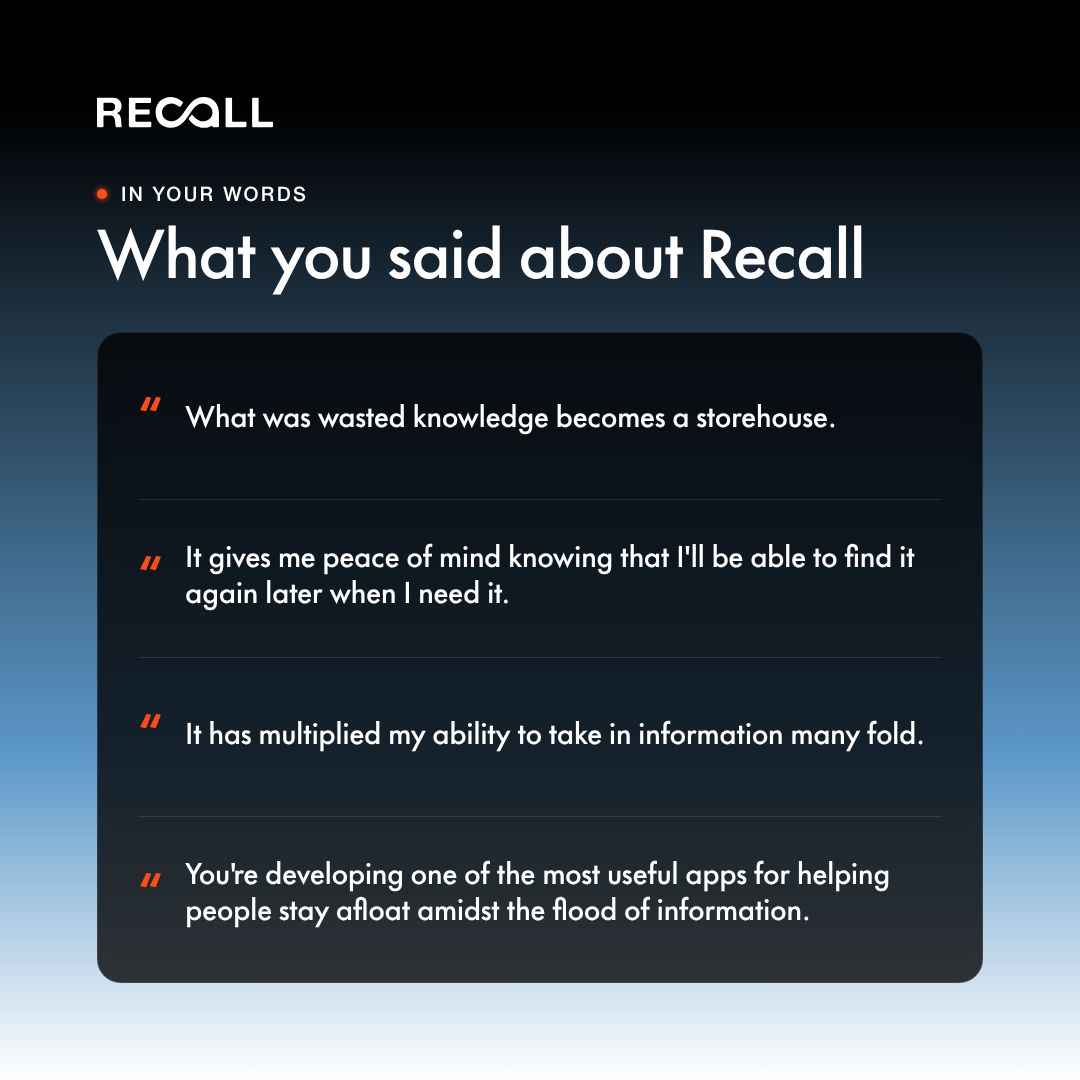
What features do you want added to your second brain?
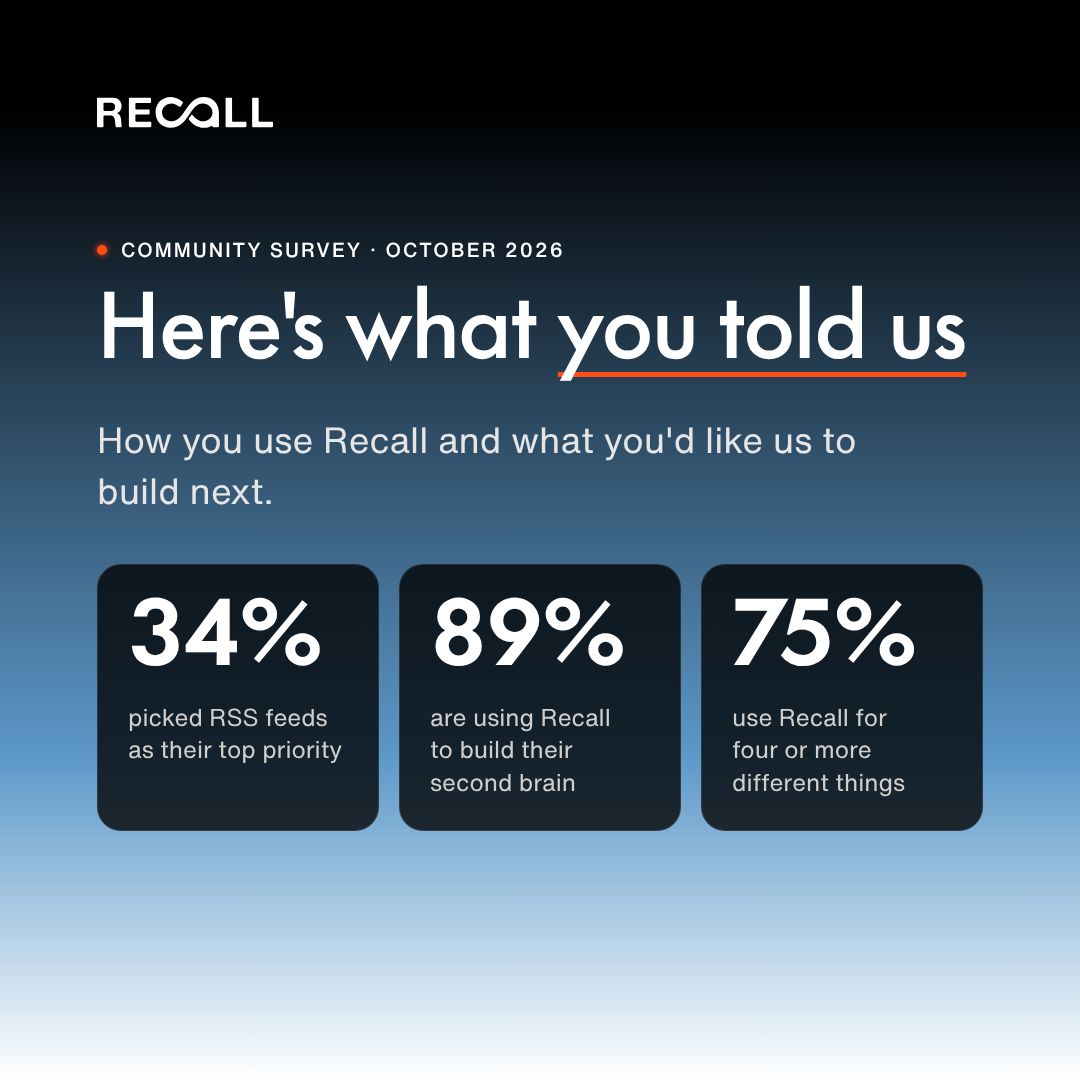
Last week we asked our community how you use Recall and where the team should focus next. Here's what you told us.
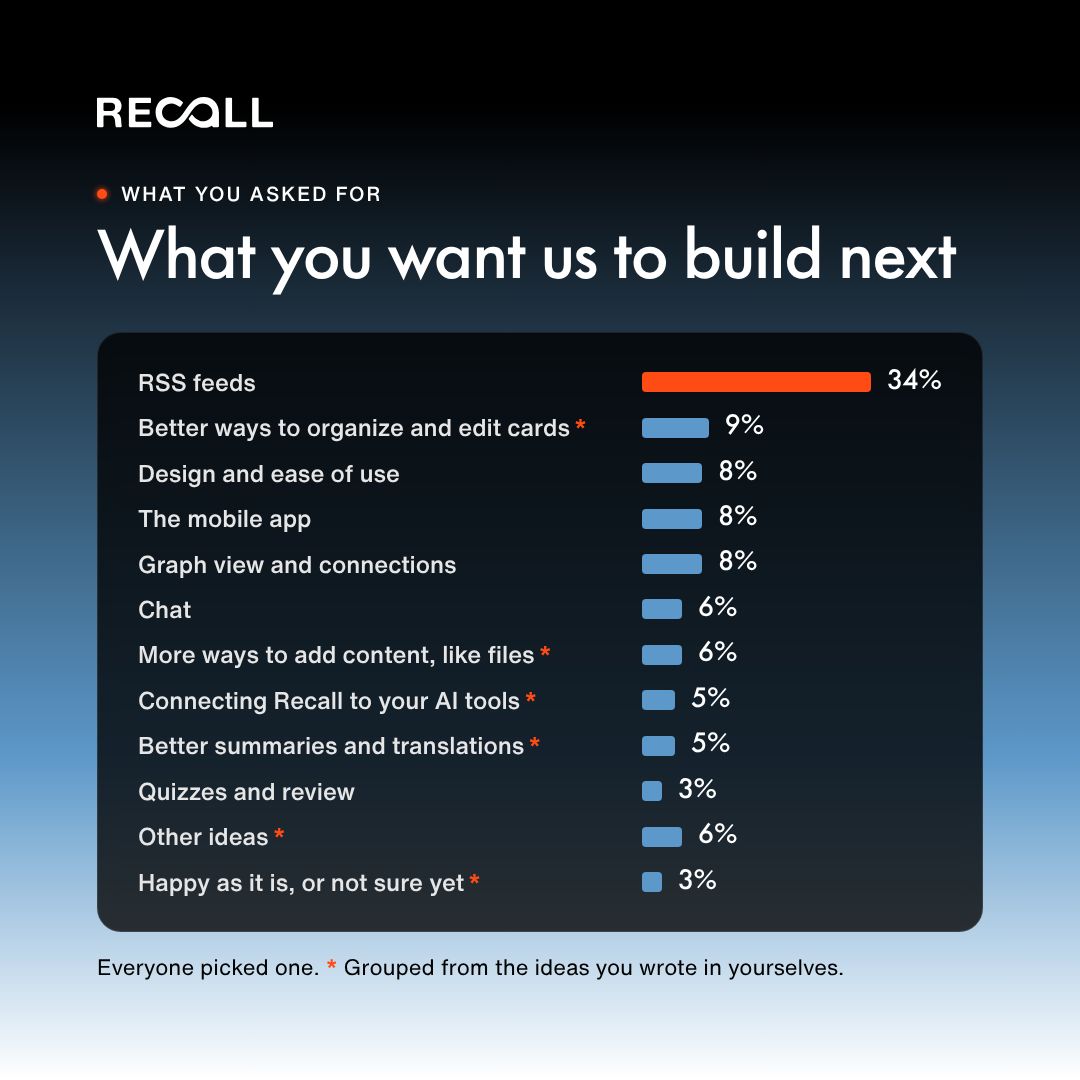
What you asked for:
- RSS feeds came out on top with 34% of the vote.
- A third of you wrote in your own ideas, and the biggest theme was better ways to organise and edit your cards.
- Uploading more file types and connecting Recall to your AI tools came up a lot too.
A few highlights
89% of you use Recall to build a personal knowledge base, and the average member uses it for nearly 5 different things.
Every response has gone to the team, and we're reading them all as we plan what's next.
Didn't get to fill it in, or thought of something since? Join our discord and share it: https://t.co/WWaaPBKhAW
Big thanks to all of you for helping shape Recall.
#knowledgemanagement #productivity #notetaking #secondbrain