Everyone is talking about agent loops.
My take: a loop without state is just a retry.
For coding agents, the useful loop is:
goal → context → run → receipt → repair → patch → integration → state
The model is stateless.
The lane is stateful.
That’s CodeLanes.
This matches what I’m seeing with coding agents.
More memory ≠ better learning.
The useful unit is structured workflow state: what changed, what evidence exists, what failed, and what should carry forward.
// Continual Learning Bench //
One of the research areas with lots of investments is continual learning.
While there are many efforts, there is very little progress in measuring it.
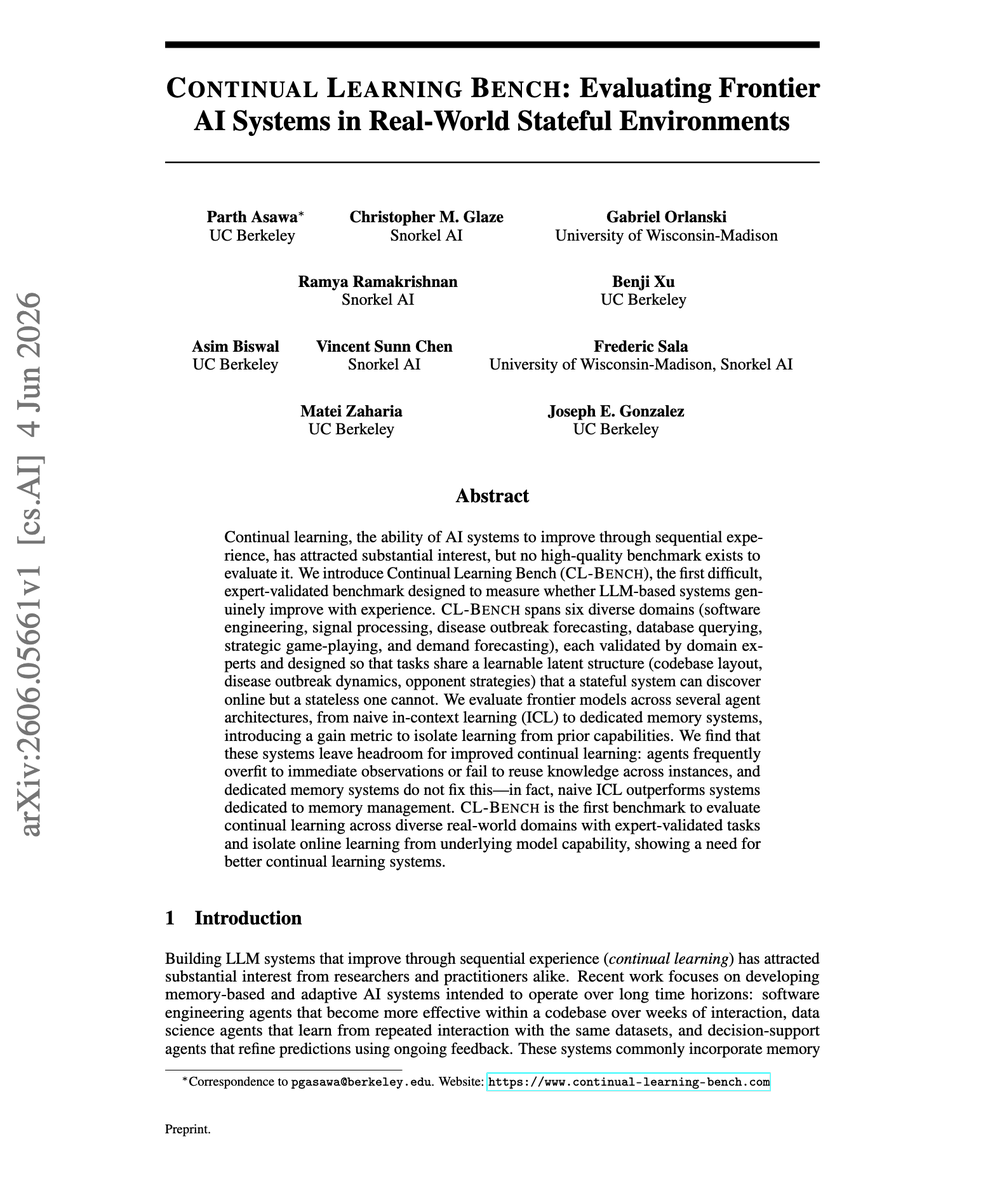
So the big question is, do dedicated memory systems actually make agents learn from experience?
Continual Learning Bench says not yet. Across six expert-validated domains with shared learnable structure, naive in-context learning outperforms systems purpose-built for memory management.
CL-Bench introduces a gain metric that isolates genuine learning from prior capability, then shows agents frequently overfit to immediate observations or fail to reuse knowledge across instances.
If a plain ICL baseline beats your memory architecture, the architecture is adding overhead rather than learning.
Paper: https://t.co/iFd5SZFe3O
Learn to build effective AI agents in our academy: https://t.co/1e8RZKs4uX
Before the week ends, let's acknowledge one of the most INSANE week ever for open AI, with 25+ notable open-weight drops across every modality:
🧠 LLMs
→ NVIDIA Nemotron 3 Ultra: 550B hybrid Mamba-MoE, only 55B active, 1M context, MMLU 89.1. NVFP4 variant claims ~5x throughput on Blackwell. First openly-weighted 550B hybrid Mamba-Transformer, closing the gap with frontier closed models.
→ Google Gemma 4 12B: fully open dense any-to-any (text/image/audio/video), 256k context, encoder-free, 140+ languages, AIME 2026 at 77.5. Shipped with a 23-checkpoint QAT wave (mobile ONNX + MLX). Most deployable model of the week.
→ StepFun Step-3.7-Flash: 198B sparse MoE VLM, ~11B active, SWE-Bench PRO 56.3. Apache 2.0.
→ Liquid AI LFM2.5-8B-A1B: edge MoE, just 1.5B active, 128k ctx, MATH500 88.8, MLX-ready. Best on-device option this week.
→ JetBrains Mellum2-12B-A2.5B-Thinking: their first open MoE, near-Qwen3-14B coding at 2.5B active. Apache 2.0.
🎨 Image gen (the surprise of the week)
→ Ideogram 4: their FIRST-EVER open weights. 9.3B flow-matching DiT trained from scratch. #2 overall behind GPT Image 2, top open-weight model on Design Arena + LMArena. Strongest open checkpoint for text-rich images, full stop. It has taste. Still can't believe this is open weights.
🔊 Audio & Speech (a breakout week for open TTS, 4 labs shipped)
→ Boson Higgs Audio v3 4B: 102 languages, 21 emotions, singing/whispering/shouting, sub-second TTFA.
→ RedNote dots.tts: the only fully continuous (no codec) open TTS pipeline, Apache 2.0.
→ Google Magenta RealTime 2: real-time music gen, <200ms latency, text+audio+MIDI. multimodalart ported it to PyTorch within hours with live ZeroGPU demos.
→ NVIDIA Nemotron-3.5 ASR: 600M streaming, 17x more concurrent streams vs Parakeet RNNT 1.1B.
👁️ Vision & VLMs
→ PaddleOCR-VL-1.6: SOTA document parsing at 1B params, Apache 2.0.
→ Baidu NAVA: 6.3B joint audio-video gen, best-in-class A/V sync, Apache 2.0.
🎬 Video, 3D & World Models
→ NVIDIA Cosmos3-Super: 64B omnimodal world model coupling action trajectories with video+audio gen, for Physical AI.
→ JD JoyAI-Echo: up to 5-min multi-shot text-to-video on LTX-2.3.
→ ByteDance Bernini-R + VAST TripoSplat (single-image-to-3D Gaussian splats, MIT).
@ship_temp_md@sprkhost_austin Exactly. The hard part isn’t spawning more agents.
It’s giving each one enough state, boundaries, and receipts that you can trust the work when they come back.
I open-sourced CodeLanes.
A multi-agent auto-build harness for running many AI coding agents across separate lanes and tasks simultaneously — w/o losing state, mixing branches, or drown in logs.
Core idea:
The model is stateless.
The lane is stateful.
https://t.co/qrAHf2Ng6I