Request a pilot: https://t.co/5sAoQvkptq
Rolling out early access to a few select companies who want to work alongside us to perfect the tool
Then we will open it to every company
Our @ycombinator cofounder video!
In 6 weeks, we built state-of-the-art (SOTA) chip design agents, and caught 5 bugs in a certain company's next AI chip (saving an estimated $5M)
Check us out: https://t.co/mG73u7oVQZ
@Etched
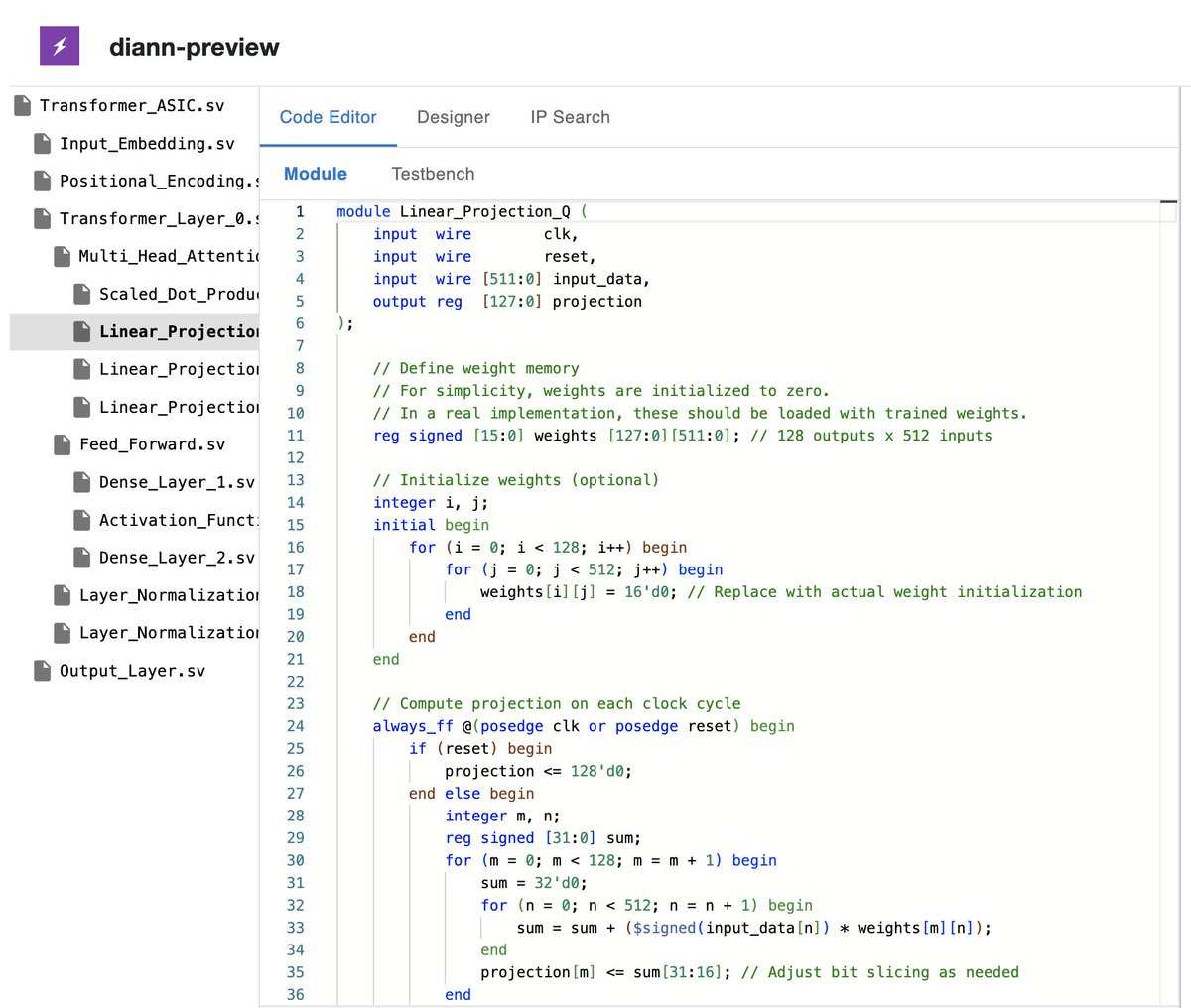
Prompt: "design an ASIC chip that perfectly implements a transformer architecture, with minimal underutilized resources"
Our agent took ~45 mins!
Tbh I cannot speak to the quality of this one as I don't know what goes into a production grade transformer ASIC.
But I'm gonna try to put this onto an FPGA because I'm extremely curious to play around with it, and to see how it actually works
Chip designers have been forwarding requests to our agents, even before being publicly available!
What's a SystemVerilog task you'd like to see completed?
This is an interesting demo because it pushes the LLMs to solve problems closer to actual digital logic, instead of the typical BS boilerplate implementation from chatgpt
you've heard of software agents, but have you ever seen a hardware agent?
at @getinstachip, our hardware agents can design complex circuits autonomously.
on a whim, I asked one of our agents to solve Problem 155 from HDLBits 👇
got back from @openai just now—really excited to see o1 improve drastically.
also excited to announce that @getinstachip's circuit design capabilities are now powered by the o1 series!
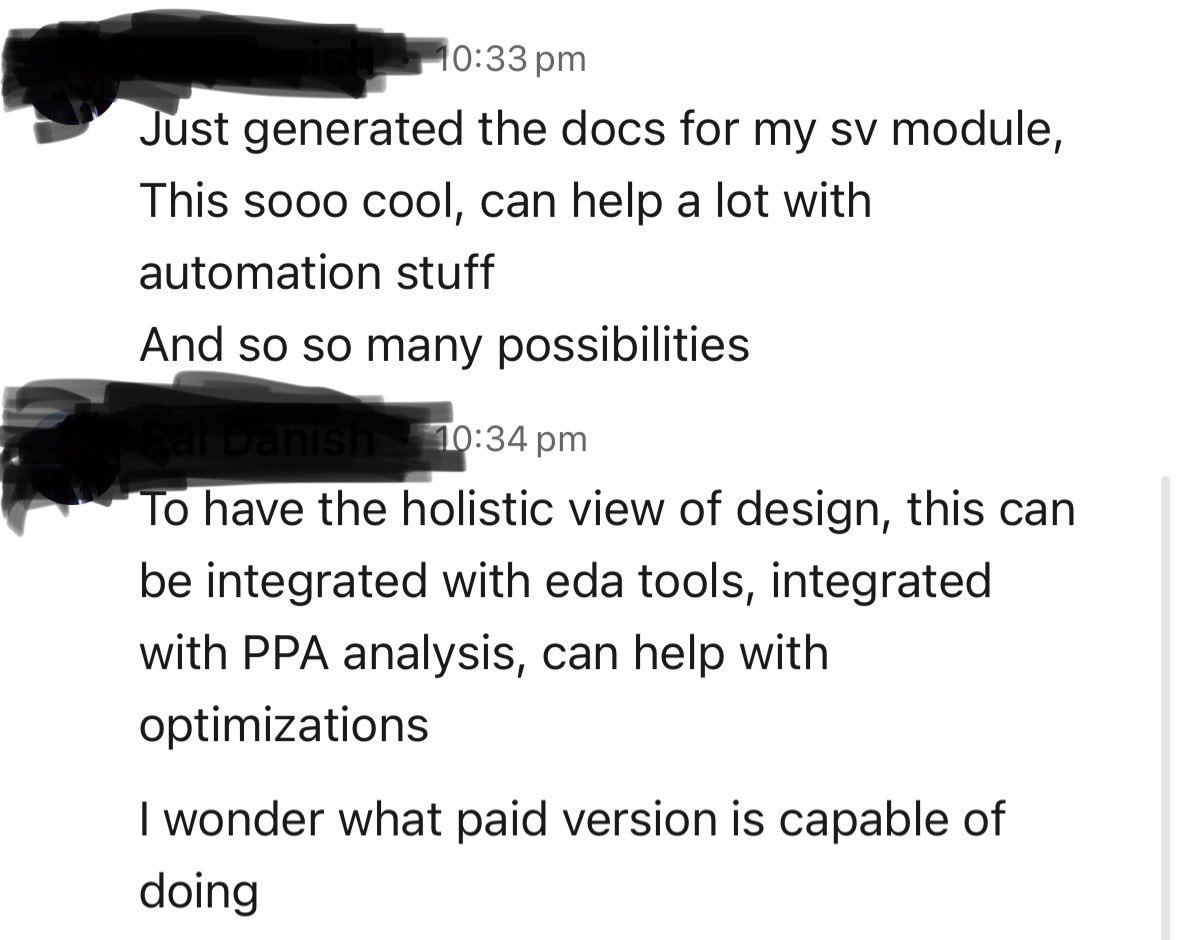
an example: generating a README for your .v or .sv module 👇👇 (https://t.co/nQpp67N4LH)
Recently, @evanlin designed an open-source TPU (from scratch).
With @getinstachip, YOU can "pip install" Evan's TinyTPU into your own project!
How? Check it out 👇
In the future, running software will have one additional step:
Booting up custom hardware for your program.
1. vpm load // load custom hardware
2. vpm build // build program.cpp on hardware
3. vpm run // run program.cpp