We @GydeAI are bullish on “Specific Intelligence”. Worldview intelligence is valuable, yes! But it can’t mean worldwide convergence of how we do things.
Today we share the worldview behind our mission.
Human values don't average out. Local knowledge can't be centralized. The good future has many AIs, raised in different places, shaped by the people they serve, disagreeing with each other the way we do.
https://t.co/A14SurOM2K
Here is my AI investing guide.
Sitting here August 2026, my current best thoughts are as follows:
1. LPS (Land Power Shell) is still the most obvious and fastest path to cash on cash returns. Lots of value can be assembled and traded quickly at this layer. And as data centers get more pushback, energized land can explode in value. Very bullish here.
I’ve stepped into this layer very aggressively. My partner @anitavlallian and I have acquired almost 6GW coming online in a ramp from today thru 2029 of grid power and behind the meter.
2. Silicon - I helped get @GroqInc off the ground in 2015 and we licensed it to @nvidia for $20B Dec2025. I won’t invest or incubate anything in this layer now. The perf demands of the chips are too high, manufacturing precision is too complex and supply chain influence to get adjacent components like memory isn’t possible for a startup anymore. Lots of capital will be wasted here chasing Groq and Cerebras’ success. Note that both startups made sense a decade ago when these constraints were much more modest.
3. Clouds - Clouds are very very lucrative but very hard to build and very expensive and technically complicated to maintain. And as alignment becomes a more important issue, I expect the clouds will be asked to build robust KYC and attest to it. This makes the risk:reward ratio skewed. I don’t want to be responsible when the USG says a cloud allowed a bad actor to do something bad because of poor KYC.
4. Models are complicated. The big open question is how much of the revenue being generated by them today is because of tokenmaxxing and poor model behavior. If it’s a lot, then the annualized revenues will diminish meaningfully even as token consumption inflects upwards. This is the big economic question at this layer.
5. Harnesses are where the action is and why I started @8090solutions two years ago. In a nutshell, the harness helps enterprises owns their proprietary context (what Alex Karp calls their ‘alpha’). This is an enterprise’s data, workflows, evals, and business rules. A harness that gives this to an enterprise is what creates very low model-agnostic switching costs, which further reinforces my views of #4 above.
6. Applications will be another long term winner along with harnesses. This is where the differentiation between “off the shelf” and “custom time and materials” melts away. Every company, with the right harness, can now imbue their alpha into the software that runs their company. I expect this to mean that “off the shelf” is largely replaced with custom software creating a huge opportunity to write these solutions for companies. Build once and sell repeatedly is a laggard GTM motion for a SaaS world that isn’t needed here. Think custom by design, alpha embedded, proprietary by nature.
Fin.
Good luck to all the players!
Last Saturday, I spent half a day with the leadership team at VideoCX talking about AI.
I walked in thinking teaching AI fundamentals would be easy, and finding AI opportunities would be the hard part.
It turned out to be the opposite.
Once leaders across finance, sales, technology, legal, and product understood concepts like LLMs, agents, tokens, evals, and quantization, the ideas started flowing.
Everyone could immediately identify where AI could make their work better.
They already knew their business. They just needed a clear mental model of what AI can and cannot do.
AI literacy is quickly becoming a leadership skill.
I ask ChatGPT to create a "Car Narration" while preparing for important meetings and then use "read aloud" feature. It should have pause and resume functionality. Currently it always starts from the top.
Few things that are pushing the ecosystem towards Open Weight models.
- Not getting locked in to a particular lab when the winner keeps changing every few months.
- Labs have not been particularly helpful to build trust. It might be about using data to train models or launching somewhat competing products and more.
- The feeling of, I share data. Model gets better. I get a bigger bill.
- And most importantly, data privacy. I have not dared to share my bank statement with the models to do some analysis. If it is self-hosted, I can share anything and everything. Applies to individuals and businesses both.
What you think?
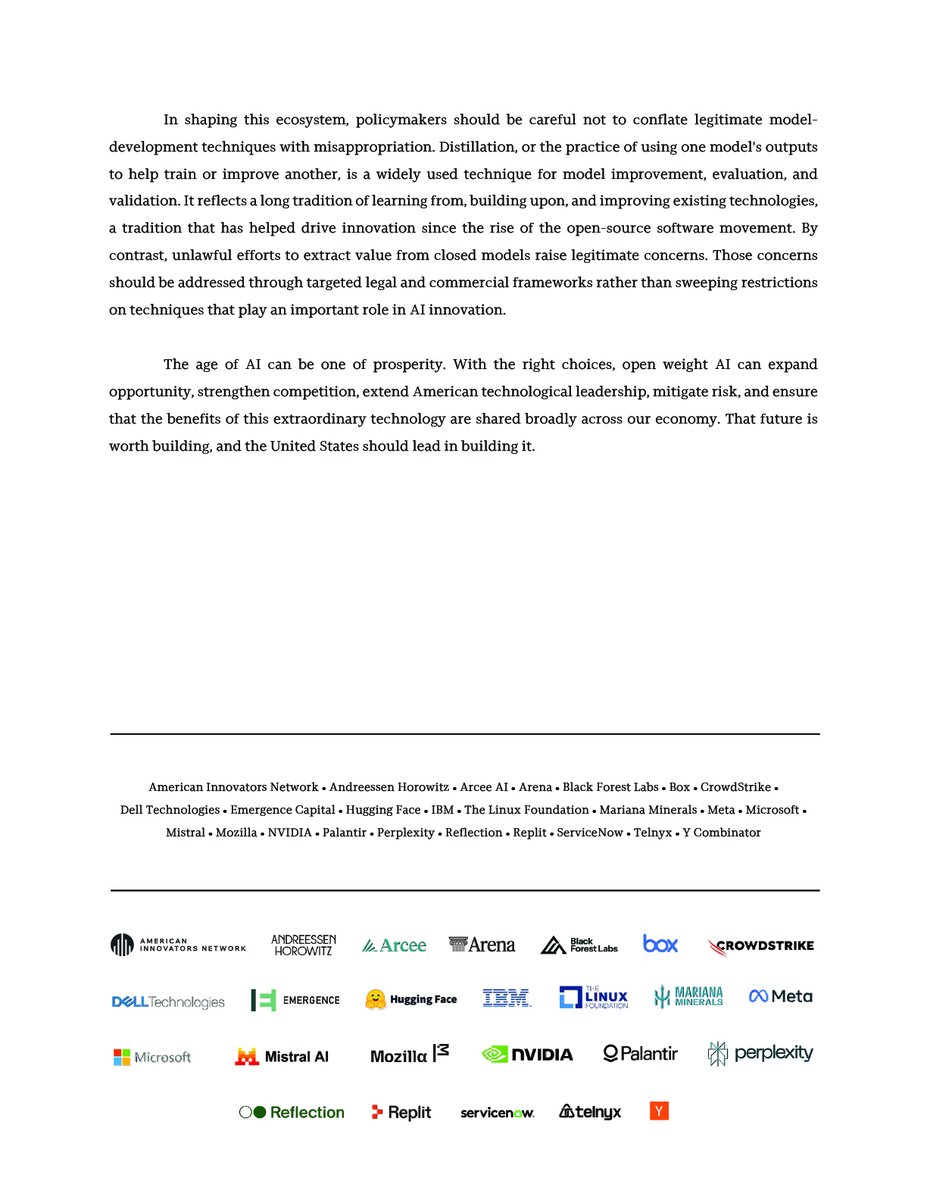
Open-weight models are essential to a healthy AI ecosystem. Together with others across our industry, we are outlining a path for open-weight models to strengthen American competitiveness and expand economic opportunity, while protecting national security. https://t.co/Tr0sAzAxTD
Are people really switching between Fable, Grok & GPT Sol for say building a feature?
Someone with Claude Code would do this instead.
Plan with Fable.
Execute with Opus.
Review with Opus or Fable depending on the complexity (in new session).
Am I missing something?