The CHI Community Sale is officially SOLD OUT!
Thank you to everyone who registered, verified and committed our Community Sale on Sonar, powered by @echodotxyz × @coinbase
Your support helps carry Gotchi from one live vertical to a full Consumer AI ecosystem, with CHI as the shared layer across it: access, rewards, AI experiences, partner campaigns, governance and commerce.
Same Dino. Much bigger world. 🦖
Commitments are now open for the $ CHI Community Sale on Sonar, Powered by @echodotxyz × .@coinbase
Tranche 1 is officially sold out.
$199.1K committed toward the $500K sale, with Tranche 2 now open.
https://t.co/91zSoFsH0W
.@a16z's Consumer AI Study Signals: Consumer AI is moving from general-purpose tools toward daily, specialized and context-rich experiences.
The Top 100 Gen AI Consumer Apps — 7th Edition (a16z) https://t.co/L1y3JiFMzb
The latest edition of Andreessen Horowitz’s Top 100 Gen AI Consumer Apps, published in October 2026, provides a useful lens on that transition. Nearly half of U.S. consumers now report using AI, yet only 25% use it daily. As of August, just 4.5% of U.S. consumers had an active paid personal subscription to ChatGPT, Gemini or Claude.
That market structure closely aligns with the thesis behind Gotchi Labs: the next phase of Consumer AI will increasingly be built around specialized agents, persistent personal context, high-frequency use cases and business models that extend beyond subscriptions.
Gotchi Labs is building a multi-vertical Consumer AI platform for everyday life. Its first live vertical, Health & Wellness through Sleepagotchi, gives the platform an existing consumer base, live AI product and real-world behavioral data from which to expand into Fitness, Nutrition, Shopping & Commerce, Productivity & Daily Life and Personal AI.
The relevance of the a16z data is structural rather than an endorsement of Gotchi specifically: many of the market shifts it identifies are the same ones Gotchi Labs is being designed around.
The next Consumer AI challenge is depth of usage
A16z describes Consumer AI usage as broad but still relatively shallow for most users. Nearly half of American consumers have adopted AI, but only one in four use it daily.
The first phase of Consumer AI was largely about demonstrating that millions of consumers would interact with AI. The next phase is likely to be about building products with enough recurring utility to become part of everyday behavior.
This favors categories where consumer context changes continuously and where there is a natural reason to return frequently.
Health and wellness is one such category.
Sleepagotchi already operates as Gotchi Labs’ first live vertical, with an AI Sleep Coach that converts sleep, activity and recovery signals into personalized intelligence and recommendations. It is device-agnostic, with integrations spanning Apple Watch, Fitbit, Oura, WHOOP, Xiaomi and Mi Band, while also supporting phone-only tracking.
That creates a fundamentally different relationship between a consumer and AI.
A general-purpose assistant typically begins when the user submits a prompt. A health agent connected to real-world signals can begin with context: how the user slept, how active they were, how recovery is changing and how those patterns evolve over time.
The opportunity is therefore not simply to answer more questions. It is to make AI increasingly relevant because it understands more about what is actually happening in a consumer’s life.
A16z is seeing the emergence of the personal-agent layer
The second important signal in the latest a16z research is the acceleration of personal agents. Six months ago, a16z argued that many agent products were still too technical for mainstream consumers. Its latest data shows meaningful movement: multiple consumer and prosumer agent startups now report hundreds of thousands of users, while major technology platforms have also launched personal-agent products.
A16z notes an important product distinction. More specialized consumer agents increasingly have their own mobile or web experiences, allowing them to go deeper into a specific use case rather than trying to solve every problem through one universal interface.
That is closely aligned with Gotchi Labs’ multi-vertical architecture. Gotchi is not being built around the assumption that one generic assistant should perform every consumer task equally well. The platform model is based on specialized agents serving distinct areas of everyday life, while benefiting from a broader layer of consumer context.
Sleepagotchi establishes the first part of that model in Health & Wellness. From there, Gotchi Labs is designed to extend into Fitness & Exercise, Nutrition, Shopping & Commerce, Productivity & Daily Life and Personal AI.
A sleep agent can understand recovery and sleep patterns. A fitness agent can understand activity and training. A nutrition agent can build around dietary behavior and goals. A commerce agent can eventually use relevant context to improve discovery and recommendations.
The strategic value comes not simply from operating several AI applications, but from building multiple specialized consumer experiences around an increasingly rich understanding of the user.
Persistent context may become one of Consumer AI’s most important advantages. Context becomes particularly important as AI moves from answering questions toward helping consumers make decisions.
A16z’s work on AI and commerce identifies identity and memory as core infrastructure for useful consumer agents. Agents that understand previous behavior, preferences and changing needs can make materially better recommendations than systems starting from zero each time.
The same principle extends well beyond commerce.
Gotchi Labs already begins with a source of persistent real-world context through Sleepagotchi’s wearable and phone integrations. Sleep, recovery and activity signals are generated continuously, rather than only when a user decides to interact with an AI interface.
That matters because the quality of a specialized agent is increasingly a function not only of the underlying model, but also of the context available to that model.
As Gotchi expands across additional verticals, the potential context becomes broader. Health can inform fitness. Fitness can inform nutrition. Preferences and recurring behavior can inform commerce. Individual agents can remain specialized while the broader platform develops a more complete understanding of the consumer.
This is where a multi-vertical model becomes materially different from a portfolio of disconnected AI applications.
Gotchi begins with distribution already in place
Distribution remains one of the hardest problems in consumer technology, and Consumer AI is no exception.
Gotchi Labs begins with an existing audience rather than having to build the platform first and acquire consumers later.
Sleepagotchi has 600,000+ registered users and 144,000+ monthly active users. It has distribution across 500,000+ Jambo phones, more than 28,500 Solana Seeker installs, and has generated approximately $951,000 in historical product and partnership revenue.
This gives the broader Gotchi platform an important starting advantage: a live specialized AI product, an existing consumer network, real-world data inputs and embedded device distribution.
Sleepagotchi has aised more than $8 million from institutional investors including 6th Man Ventures, Collab+Currency, 1kx, AllianceDAO, Sfermion, GSR, Signum Capital, Everyrealm, Primal Capital and Ghaf Capital.
For a multi-vertical strategy, that existing distribution is especially relevant. New verticals do not necessarily begin from a zero-user cold start. They can be introduced into an ecosystem that already has consumer relationships and behavioral context.
The current Consumer AI business model is heavily concentrated around subscriptions
The latest a16z data also highlights how early Consumer AI monetization remains.
Among the 44 AI-native products in a16z’s top web rankings, 84% offer paid subscriptions and 64% monetize through usage charges or additional credits. Only 14% monetize through advertising, while just 2% generate revenue through transaction or platform fees.
That distribution is revealing.
The dominant Consumer AI business model today largely asks users to pay directly for access to intelligence. That works particularly well for power users who receive measurable economic or productivity value from AI, but it may be less effective as the market expands toward mainstream everyday use.
A16z’s spending data reinforces the point. The top 1% of AI payers account for 19.5% of all observed Consumer AI spending, more than the bottom 50% of spenders combined. Those top users spend an average of $903 per month, compared with approximately $25 per month for the median AI payer. Andreessen Horowitz
In other words, Consumer AI has built an extremely valuable power-user market, particularly around productivity, coding and creation.
The next opportunity is reaching consumers whose use of AI is tied to everyday activities rather than primarily work. A16z explicitly points toward personal agents as one potential path to a different economic model. As AI begins to generate attributable purchases, monetization can expand toward affiliate economics, transaction fees and take rates, rather than requiring every user to maintain another software subscription.
This is highly relevant to Gotchi Labs’ broader platform design.
Gotchi is built to support monetization across subscriptions, AI credits, partner campaigns, marketplace economics, affiliate commerce and, over time, agent-mediated commerce. GOTCHI LABS
That creates a progression in which commercial opportunity can expand alongside the capability and context of the agents.
A health agent may begin by helping a consumer understand sleep and recovery. A nutrition or fitness agent adds additional high-frequency utility. A commerce layer can eventually connect relevant consumer needs with products and services.
The monetization surface therefore becomes broader as the platform becomes more useful.
From general-purpose AI to Consumer AI infrastructure
The latest a16z data does not suggest that general-purpose AI is becoming less important. The leading foundation-model products remain extraordinarily large.
What it does show is that the Consumer AI market still has substantial room to deepen.
Nearly half of U.S. consumers use AI, but only 25% use it daily. Just 4.5% maintain a paid personal subscription to one of the three leading general AI assistants. Personal-agent products are beginning to reach meaningful consumer scale. And while 84% of leading AI-native web products rely on subscriptions, only 2% currently monetize through transaction or platform fees.
Together, those numbers point toward several emerging opportunities: more frequent use, more specialized experiences, deeper personal context and new business models built around what AI helps consumers actually do.
These are the same structural shifts Gotchi Labs is building around.
Sleepagotchi provides the first live vertical: specialized AI operating against continuously changing real-world consumer signals. Its 600,000+ registered users, 144,000+ monthly active users, 500,000+ Jambo distribution and 28,500+ Seeker installs provide an existing base from which the platform can expand.
The broader Gotchi Labs strategy is to build from that foundation across multiple high-frequency areas of consumer life, with specialized agents that can become more relevant as the platform develops deeper context.
Sleepagotchi is the first operating proof point. Gotchi Labs is the multi-vertical Consumer AI platform being built from that foundation.
The market data increasingly supports the underlying thesis: the next stage of Consumer AI will be defined not simply by access to intelligence, but by how frequently, personally and meaningfully that intelligence becomes integrated into everyday life.
The $ CHI Community Sale is coming to Sonar 🦖
We're opening the next chapter of Gotchi Labs: a multi-vertical Consumer AI ecosystem,
built on an established consumer platform and powered by specialized AI agents.
Powered by @echodotxyz × @coinbase
Register now → https://t.co/zrLmFG7gqO
Consumer AI needs context. It doesn’t need all of it, everywhere.
The more an agent understands about you, the more useful it can become. The challenge is giving it the right context without giving everything away.
That’s a big part of the Gotchi thesis: personal AI built around context, usefulness and user control.
Something real changed in how AI gets funded this year, and it tells you where the category is heading.
Vertical AI agents, built to solve one specific problem really well rather than attempt everything, are pulling the biggest checks right now [PYMNTS, Apr 2026]. Factory, an AI engineering platform used by Nvidia and Adobe, just raised $150M at a $1.5B valuation after doubling revenue every month for six straight months. Slash Financial hit unicorn status on a $100M round after growing from $10M to $250M in revenue in 24 months.
Capital is increasingly backing depth over breadth: pick a problem, understand its context and solve it properly.
That's the architecture behind Gotchi: specialized agents for different parts of everyday life, connected through one Consumer AI ecosystem. 🦖
Consumer AI needs context. It doesn’t need all of it, everywhere.
The more an agent understands about you, the more useful it can become. The challenge is giving it the right context without giving everything away.
That’s a big part of the Gotchi thesis: personal AI built around context, usefulness and user control.
AI agents won’t just shop for us.
They’ll consume services, coordinate tasks, manage capital, and transact with each other.
On @ycombinator, @jerallaire explains why the agentic economy needs infrastructure for contracts, payments, governance, and economic execution at machine scale.
This is the direction we’re building toward at Gotchi.
AI agents that don’t just advise: they act, coordinate, transact, and increasingly power everyday consumer experiences.
Consumer AI is becoming an economy.
Sleep is just the easiest place to start.
The same model could eventually understand how you eat, work, exercise, spend, travel, and recover.
@sleepagotchi
Wellness data is already valuable to pharma, insurers and researchers.
Agentic AI makes it valuable to you first.
Sleepagotchi is where Gotchi starts: turning personal context into intelligence agents can understand and act on.
Now imagine that model across more of everyday life. 🦖
🚨 SIXR GEMS SALE IS LIVE! 🏏🔥
Round 1 is officially OPEN.
🎁 10% extra $SIXR for waitlist members
⚡ 5% extra $SIXR for everyone else
This is your one chance to get into SIXR early.
👉 Join the sale:
https://t.co/oMmdm5mTwW
Round 1 is LIVE. 🏏💎
Gotchi Labs has a clear starting point: @sleepagotchi.
Health & Wellness today, with more AI powered consumer experiences potentially coming next.
One ecosystem, many possibilities.
Gotchi starts with Health & Wellness. It doesn’t stop there.
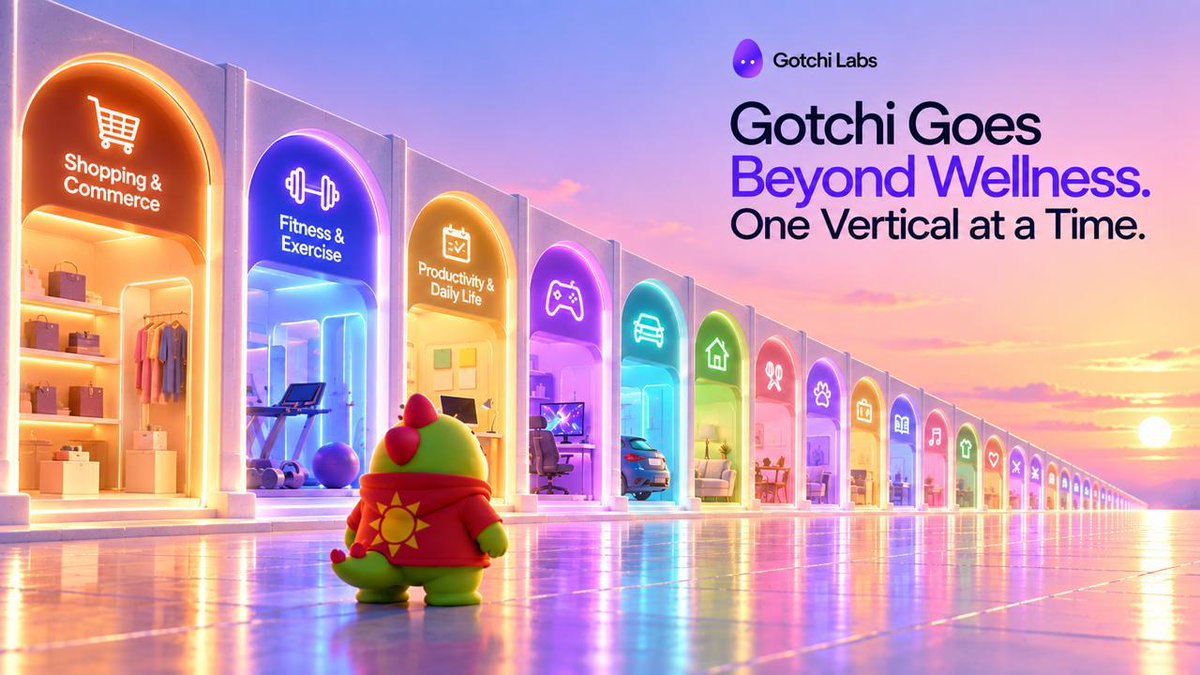
Sleepagotchi is our first live vertical. Next: Shopping & Commerce, Fitness & Exercise, Productivity & Daily Life, with more to follow.
But we’re not building everything at once. Gotchi expands where real user demand and engagement take us.
One vertical at a time. 🦖
New USD.infra Vault Loan 🏢
Value - $100,000
APY - 16%
Located in - New Jersey
Units connected - 165
This loan funds Internet infrastructure delivering high-speed connectivity to residents in New Jersey.
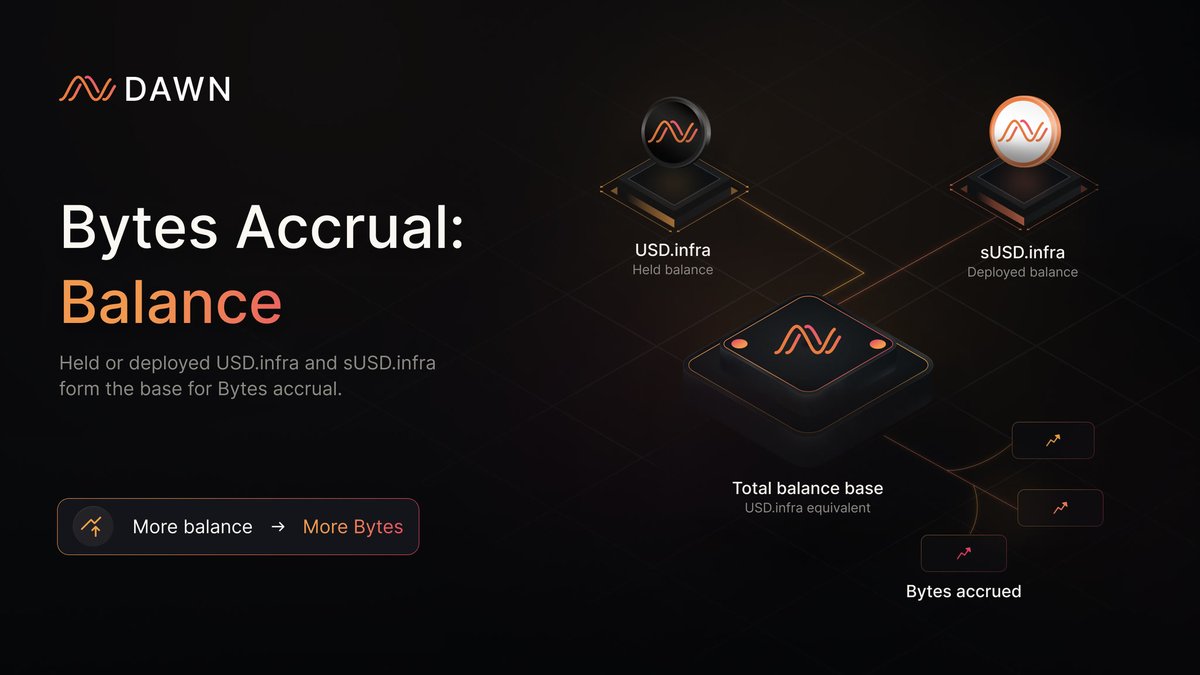
DAWN Bytes Accrual: Balance
One method of earning Bytes is determined by your total balance of USD.infra or sUSD.infra held or deployed, denominated in USD.infra equivalent value.
This means that you can earn Bytes simply by holding a balance within the DAWN ecosystem.
Gotchi starts with Health & Wellness. It doesn’t stop there.
Sleepagotchi is our first live vertical. Next: Shopping & Commerce, Fitness & Exercise, Productivity & Daily Life, with more to follow.
But we’re not building everything at once. Gotchi expands where real user demand and engagement take us.
One vertical at a time. 🦖
Capital markets didn’t have an efficient process for funding and accessing returns from the next generation of digital infrastructure.
We created the solution.
The Vault is where this becomes a reality.
The interesting part is that @sleepagotchi isn’t trying to build just one AI product.
It’s building a whole consumer ecosystem around things people already do every day.
Gotchi Labs is building a connected Consumer AI ecosystem around everyday life.
It starts with Sleepagotchi, our live Health & Wellness vertical, and expands over time into Shopping & Commerce, Fitness & Exercise, Productivity & Daily Life, and eventually other consumer categories.
Dinogotchi brings the characters and consumer IP that give the ecosystem personality.
$CHI connects the ecosystem through access, rewards and commerce.
Different products. Different specialized agents. One Gotchi ecosystem built around real consumer utility.
Introducing the DAWN Liquidity Vault on @Loopscale, powered by USDG from @Paxos
Paxos is a regulated, established stablecoin dollar partner joining the DAWN ecosystem.
The vault gives eligible non-U.S. USDG users a new way to participate in the DAWN ecosystem, subject to applicable restrictions.
Sleep happens every night, giving @sleepagotchi a natural daily input. Check ins capture it, wearables add context, and Sleep Coach makes it useful. If agents tap into that loop, $CHI gets a much bigger opportunity.
Oura reported $1.21B in nine-month revenue, up 74% year over year.
The wearable market is scaling, and so is the health data people generate every day.
That expanding data layer is exactly what Sleepagotchi's AI agents are built to use.
Wearables track → Sleepagotchi acts. 🌙




![sleepagotchi's tweet photo. Something real changed in how AI gets funded this year, and it tells you where the category is heading.
Vertical AI agents, built to solve one specific problem really well rather than attempt everything, are pulling the biggest checks right now [PYMNTS, Apr 2026]. Factory, an AI engineering platform used by Nvidia and Adobe, just raised $150M at a $1.5B valuation after doubling revenue every month for six straight months. Slash Financial hit unicorn status on a $100M round after growing from $10M to $250M in revenue in 24 months.
Capital is increasingly backing depth over breadth: pick a problem, understand its context and solve it properly.
That's the architecture behind Gotchi: specialized agents for different parts of everyday life, connected through one Consumer AI ecosystem. 🦖](https://pbs.twimg.com/media/HUCBbd2W4AAakee.jpg)