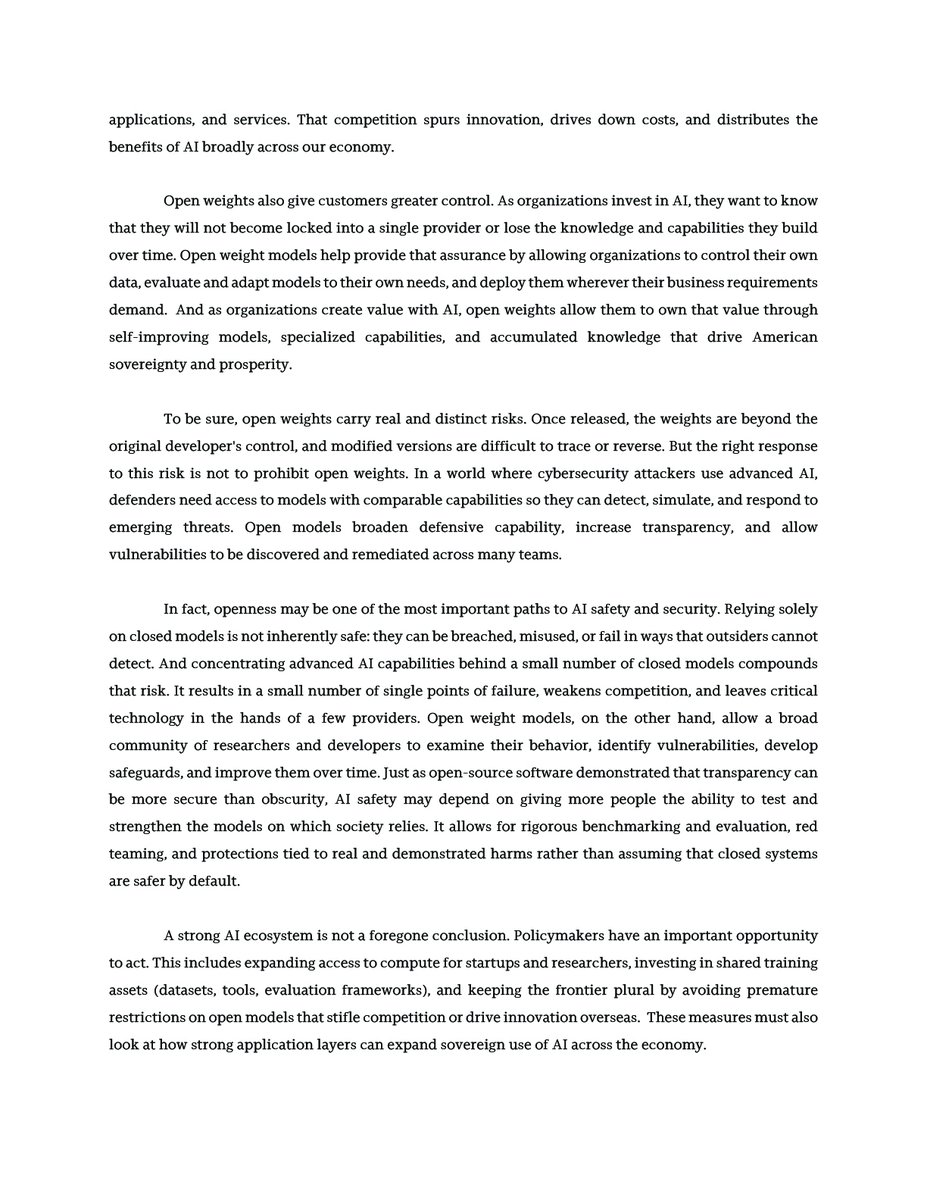
Open-weight models are essential to a healthy AI ecosystem. Together with others across our industry, we are outlining a path for open-weight models to strengthen American competitiveness and expand economic opportunity, while protecting national security. https://t.co/Tr0sAzAxTD
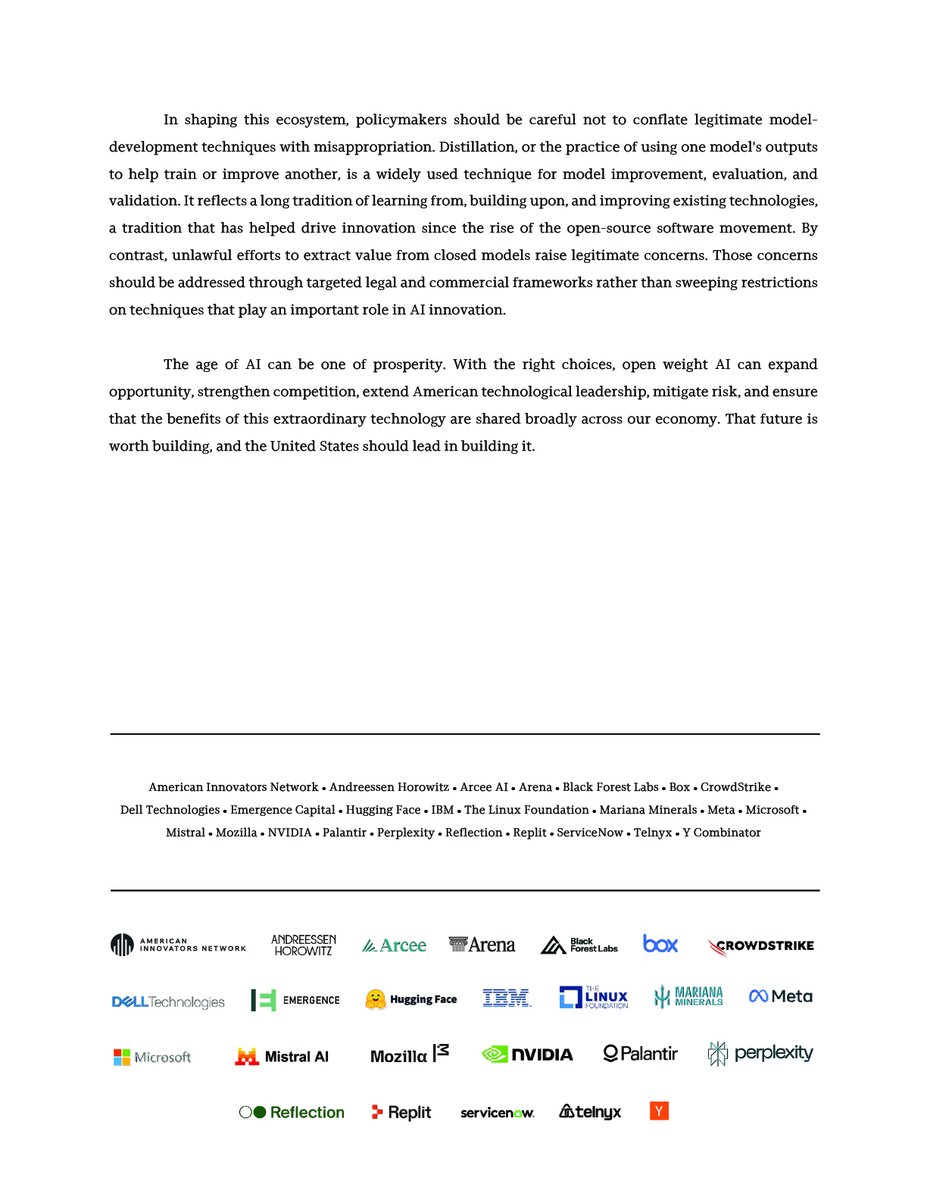
Boris Cherny just dropped 7-page PDF on Graph Engineering - how 4 Claude prompts replace 4 trained ML models
The twist: your agent's memory dies with the context window. A knowledge graph makes it permanent - and now you build one with prompts, not ML engineers.
here's 4 prompts, step by step:
prompt 1 → extraction - Haiku pulls entities + relations - one call per doc - no NER, no labeled data
prompt 2 → resolution - Sonnet merges duplicates string matching will never catch - two different names, same person
prompt 3 → summarization - Sonnet builds profiles from multiple sources - facts that never appeared in the same document
prompt 4 → querying - feed the graph to Sonnet - every answer cites a specific edge - no hallucination
how to wire this into agents today:
step 1 → shared memory for multi-agent teams - workers read/write one graph - orchestrator's context stays clean
step 2 → grounding layer for eval loops - evaluator checks facts against graph edges, not vibes
the result: one Pydantic schema replaces weeks of ML training per domain - precision 1.00 - 10k docs cost under $10
this 7-page PDF is what comes after loop engineering
bookmark this, then read the article below ↓
Start with this 3-hour course by Andrej Karpathy. 👇
It covers the complete LLM pipeline—from fundamentals to scaling.
What's inside:
⏱️ 00:00 — Introduction to LLMs
⏱️ 12:41 — LLM Training Pipeline
⏱️ 31:58 — LLM Tools & Plugins
⏱️ 41:14 — Transformer Architecture
⏱️ 2:19:02 — Scaling Large Language Models
If you're learning:
• AI Engineering
• LLMs
• Transformers
• Generative AI
This is one of the best free resources available.
📌 Bookmark it for later.
📖 Read the accompanying article for a deeper understanding.
What's the hardest part of learning LLMs—transformers, training, or scaling? 👇
#AI #LLM #MachineLearning #DeepLearning #GenerativeAI #AndrejKarpathy
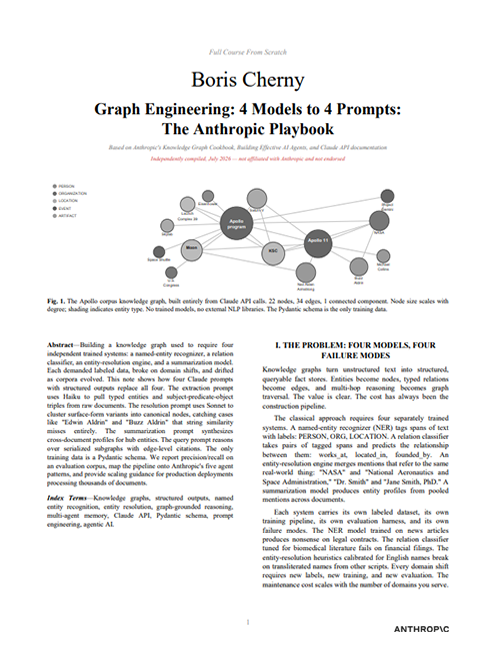
Google just killed the agent framework industry.
ADK 2.0: Open-source. Free. Better than $50K enterprise tools.
What it does:
→ Graph-based execution with routing, fan-out/fan-in, loops, retry
→ Structured agent-to-agent delegation via Task API
→ State management, dynamic nodes, human-in-the-loop, nested workflows
→ Interactive CLI (adk run) and Web UI (adk web) for local dev
→ Multi-turn task mode with single-turn controlled output
→ Works with Gemini 2.5 Flash, extensions via pip
What it replaces:
→ LangChain orchestration boilerplate
→ LangGraph state machines
→ Vertex AI Agent Builder lock-in
→ Custom agent-to-agent delegation code
Define your Agent class with instructions and tools.
Compose a Workflow class as a graph.
Run it locally with adk run or adk web.
No hosted platform. No vendor lock-in.
Customer support bots, research agents, multi-agent pipelines - same library.
This is what open-source from Google looks like.
→ https://t.co/SSQnZZ94w6
Google just killed the document extraction industry.
LangExtract: Open-source. Free. Better than $50K enterprise tools.
What it does:
→ Extracts structured data from unstructured text
→ Maps EVERY entity to its exact source location
→ Handles 100+ page documents with high recall
→ Generates interactive HTML for verification
→ Works with Gemini, Ollama, local models
What it replaces:
→ Regex pattern matching
→ Custom NER pipelines
→ Expensive extraction APIs
→ Manual data entry
Define your task with a few examples.
Point it at any document.
Get structured, verifiable results.
No fine-tuning. No complex setup.
Clinical notes, legal docs, financial reports, same library.
This is what open-source from Google looks like.
How to setup your Claude code project?
TL;DR
Most developers skip the setup and just start prompting. That's the mistake.
A proper Claude Code project lives inside a .𝗰𝗹𝗮𝘂𝗱𝗲/ folder. Start with 𝗖𝗟𝗔𝗨𝗗𝗘.𝗺𝗱 as Claude's instruction manual. Split it into a 𝗿𝘂𝗹𝗲𝘀/ folder as it grows. Add 𝗰𝗼𝗺𝗺𝗮𝗻𝗱𝘀/ for repeatable workflows, 𝘀𝗸𝗶𝗹𝗹𝘀/ for context-triggered automation, and 𝗮𝗴𝗲𝗻𝘁𝘀/ for isolated subagents. Lock down permissions in 𝘀𝗲𝘁𝘁𝗶𝗻𝗴𝘀.𝗷𝘀𝗼𝗻.
There are two .𝗰𝗹𝗮𝘂𝗱𝗲/ folders: one committed with your repo, one global at ~/.𝗰𝗹𝗮𝘂𝗱𝗲/ for personal preferences and auto-memory across projects.
The .𝗰𝗹𝗮𝘂𝗱𝗲/ folder is infrastructure. Treat it like one.
The article below is something I wrote three months ago, and it is still very much relevant.
It is a complete guide to 𝗖𝗟𝗔𝗨𝗗𝗘.𝗺𝗱, custom commands, skills, agents, and permissions, along with how to set them up properly.
“Loop engineering” is a hot buzzphrase after mentions of it by Boris Cherny (Claude Code’s creator) and Peter Steinberger (OpenClaw's creator) went viral on social media. Loops are now a key part of how we get AI agents to iterate at length to build software. In this letter, I’d like to share my 3 key loops, shown in the image below, for building 0-to-1 products. These loops guide not just how I build software, but also how I decide what software to build.
Agentic coding loop: Given a product specification and optionally a set of evals (that is, a dataset against which to measure performance), we can have an AI agent write code, test its work, and keep iterating until the code is bug-free and meets its specification. This idea of closing the loop took off around the end of last year, and it has been a game changer in enabling coding agents to work longer productively without human intervention. For example, over the weekend, I was building an app for my daughter to practice typing, and my coding agent could easily work for around an hour, using a web browser to check what it had built multiple times before getting back to me, without needing my intervention.
The engineering loop executes quickly. Every few minutes, the coding agent might build and test a new version of the software. I hear frequently from developers who are finding new ways to engineer more effective engineering loops. This is an active area of invention!
Developer feedback loop: In this loop, a developer examines the current product and steers the coding agent to improve it. Last year, a lot of developers (including me) were acting as the QA (quality assurance) function for our coding agents, manually finding bugs and then asking the agent to fix them. But with coding agents much more able to test their own code, the amount of time we need to spend on this function has decreased significantly. This allows us to make higher-level product decisions, such as what key features to offer, where the UI needs improvement, and so on.
The developer-feedback loop operates over time intervals between tens of minutes and hours — that's how frequently a developer might review a product and give feedback. In the case of the typing app, I changed my mind a few times about the visual design, what cat costumes she can unlock as she learns (she loves cats), and the user flow for a grown-up to log in and steer the child's learning experience.
When a developer has a clear vision for what to build, it is still a lot of work to translate that vision into a specification for a coding agent to implement. Further, after the developer has seen an implementation, they might update (or perhaps clarify) the spec to steer it toward what they want. If you find that the system repeatedly runs into certain problems, building a set of evals for the agent becomes useful.
AI-native teams are increasingly using AI to help shape product direction, for example, automating the gathering and analysis of usage data, summarizing written and verbal customer feedback, or carrying out competitive analysis. However, for pretty much all the products I’m involved in, I see humans as having a significant context advantage over current AI systems — we know a lot more than the AI system about the users and the context the product has to operate in — and thus humans play a critical role. Many people describe this human contribution as “taste,” but I prefer to think of it as humans having a context advantage, since that gives us a clearer path to helping AI systems get better. This also speaks to why this step can’t be automated: So long as the human knows something the AI does not, human-in-the-loop is needed to to inject that knowledge into the system.
External feedback loop: This includes a wide range of tactics like asking a few friends for feedback, launching to alpha testers, or putting the code into production with A/B testing. These tactics are usually slow, rarely taking less than hours and sometimes taking days or even weeks. This data informs the developer vision, which in turn continues to drive the detailed product spec, which in turn drives the coding agent.
With coding agents speeding up software development, more engineers are starting to play a partial product management role. For many engineers who are growing into this role, the hardest part is shaping the product vision and striking a balance between building (bridging the gap between vision and spec) and getting user feedback to evolve the vision. It is important to do both!
I will write more about how to do this in future posts, but for now, I find it encouraging that engineers are playing an expanded role (just as product managers and designers now do more engineering).
[Original text: The Batch]
Karpathy's prediction about RL is coming true now!
He called reward functions unreliable and argued that a single reward number is too low-dimensional to teach an agent what "good" means for complex tasks. To solve this, Agents need a knowledge-guided review as a higher-dimensional feedback channel.
Every major AI lab trains models with RL today (OpenAI, Anthropic, DeepSeek).
And their key bottleneck has always been the reward functions.
GRPO by DeepSeek worked well for math and code because the environment gave a binary signal.
But for real agent tasks, someone still has to hand-code the scoring function. That takes days and breaks every time the pipeline changes.
RULER (implemented in OpenPipe ART, 10k stars) addresses the exact problem Karpathy identified.
The reward criteria are defined in plain English, and an LLM evaluates each trajectory against that description to provide feedback for training.
I trained a Qwen3 1.4B agent that plays 2048 using GRPO with this exact workflow.
In this case, the agent saw the board, picked a direction, and RULER evaluated the outcome, all from this natural language definition.
You can see the full implementation on GitHub and try it yourself.
Here's the ART Repo: https://t.co/XeTppNyX9p
(don't forget to star it ⭐ )
Just like RLHF replaced manual rankings and GRPO replaced the critic model, natural language rewards are replacing hand-coded scoring functions.
RL reward engineering is now prompt engineering.
I wrote a full walkthrough on OpenPipe's ART, the agent RL trainer built on GRPO, including how RULER replaces manual reward engineering with automatic LLM-graded rewards.
The article is quoted below.
🤖 RAG gives LLMs access to your data. Agentic RAG gives them judgment about what to do with it.
The difference shows up in how each system handles uncertainty. Standard retrieval-augmented generation runs a fixed pipeline: encode the query, search the vector database, retrieve similar documents, generate a response. It works well when the query is well-formed and the right context already exists in one place.
Agentic RAG adds a layer of reasoning at almost every step — rewriting the query before retrieval, deciding whether the initial results are actually sufficient, choosing between multiple source types (vector DB, APIs, live web), and evaluating whether the final answer is relevant before surfacing it. If any of those checks fail, it loops back rather than proceeding.
That feedback loop is what makes it genuinely different, not just incrementally better. A standard RAG pipeline doesn't know when it's about to give a bad answer. An agentic one can at least ask the question.
If you want to understand how to design systems that reason through retrieval rather than just execute it, we cover this in depth at our Agentic AI Bootcamp starting May 5th, 2026 → https://t.co/ncYjC21wNy
#agenticai #agenticaibootcamp #aibootcamps #rag #agenticrag #aiengineering
INSTEAD OF WATCHING NETFLIX TONIGHT
Spend 30 minutes with this.
A speech by the Head of Anthropic's Coding Agents research team that teaches you more about vibe coding than 100 paid courses ever could.
This is not a tutorial.
This is the person who actually builds the system explaining how it works from the inside.
Most people learning to vibe code are learning the surface.
This goes underneath it.
30 minutes tonight.
The people who watch this will build differently tomorrow.
Completely free.
Bookmark this before you open Netflix 👇
🚨 Anthropic's own team just showed how to actually use Claude Code properly.
25 minutes. free. from the people who built it.
watch the workshop. bookmark it.
you've been using Claude for months without knowing the commands.
Then read the guide below.
🚨 Anthropic's CEO: "software engineering will be fully automated in 12 months."
two types of people right now:
type 1: uses Claude Code with basic prompts. scared about the future.
type 2: knows all 35 commands, tricks, and workflows. ships faster than a team of 5.
type 1 gets replaced in 12 months.
type 2 does the replacing.
I wrote a full guide on how to start. zero experience needed.
Dario is wrong.
He knows absolutely nothing about the effects of technological revolutions on the labor market.
Don't listen to him, Sam, Yoshua, Geoff, or me on this topic.
Listen to economists who have spent their career studying this, like @Ph_Aghion , @erikbryn , @DAcemogluMIT , @amcafee , @davidautor
I was in class last week. One of my students raised their hand mid-lecture and asked something that stopped me for a second.
"Why is every AI tool built on Python? C++ is faster. Rust is faster. Even Java is faster. So why Python?"
Honestly it’s a fair question. And the answer reveals something really interesting about how the AI industry actually works.
Let me explain this properly. 🧵






![AndrewYNg's tweet photo. “Loop engineering” is a hot buzzphrase after mentions of it by Boris Cherny (Claude Code’s creator) and Peter Steinberger (OpenClaw's creator) went viral on social media. Loops are now a key part of how we get AI agents to iterate at length to build software. In this letter, I’d like to share my 3 key loops, shown in the image below, for building 0-to-1 products. These loops guide not just how I build software, but also how I decide what software to build.
Agentic coding loop: Given a product specification and optionally a set of evals (that is, a dataset against which to measure performance), we can have an AI agent write code, test its work, and keep iterating until the code is bug-free and meets its specification. This idea of closing the loop took off around the end of last year, and it has been a game changer in enabling coding agents to work longer productively without human intervention. For example, over the weekend, I was building an app for my daughter to practice typing, and my coding agent could easily work for around an hour, using a web browser to check what it had built multiple times before getting back to me, without needing my intervention.
The engineering loop executes quickly. Every few minutes, the coding agent might build and test a new version of the software. I hear frequently from developers who are finding new ways to engineer more effective engineering loops. This is an active area of invention!
Developer feedback loop: In this loop, a developer examines the current product and steers the coding agent to improve it. Last year, a lot of developers (including me) were acting as the QA (quality assurance) function for our coding agents, manually finding bugs and then asking the agent to fix them. But with coding agents much more able to test their own code, the amount of time we need to spend on this function has decreased significantly. This allows us to make higher-level product decisions, such as what key features to offer, where the UI needs improvement, and so on.
The developer-feedback loop operates over time intervals between tens of minutes and hours — that's how frequently a developer might review a product and give feedback. In the case of the typing app, I changed my mind a few times about the visual design, what cat costumes she can unlock as she learns (she loves cats), and the user flow for a grown-up to log in and steer the child's learning experience.
When a developer has a clear vision for what to build, it is still a lot of work to translate that vision into a specification for a coding agent to implement. Further, after the developer has seen an implementation, they might update (or perhaps clarify) the spec to steer it toward what they want. If you find that the system repeatedly runs into certain problems, building a set of evals for the agent becomes useful.
AI-native teams are increasingly using AI to help shape product direction, for example, automating the gathering and analysis of usage data, summarizing written and verbal customer feedback, or carrying out competitive analysis. However, for pretty much all the products I’m involved in, I see humans as having a significant context advantage over current AI systems — we know a lot more than the AI system about the users and the context the product has to operate in — and thus humans play a critical role. Many people describe this human contribution as “taste,” but I prefer to think of it as humans having a context advantage, since that gives us a clearer path to helping AI systems get better. This also speaks to why this step can’t be automated: So long as the human knows something the AI does not, human-in-the-loop is needed to to inject that knowledge into the system.
External feedback loop: This includes a wide range of tactics like asking a few friends for feedback, launching to alpha testers, or putting the code into production with A/B testing. These tactics are usually slow, rarely taking less than hours and sometimes taking days or even weeks. This data informs the developer vision, which in turn continues to drive the detailed product spec, which in turn drives the coding agent.
With coding agents speeding up software development, more engineers are starting to play a partial product management role. For many engineers who are growing into this role, the hardest part is shaping the product vision and striking a balance between building (bridging the gap between vision and spec) and getting user feedback to evolve the vision. It is important to do both!
I will write more about how to do this in future posts, but for now, I find it encouraging that engineers are playing an expanded role (just as product managers and designers now do more engineering).
[Original text: The Batch]](https://pbs.twimg.com/media/HMEtxp3bsAARJdi.jpg)