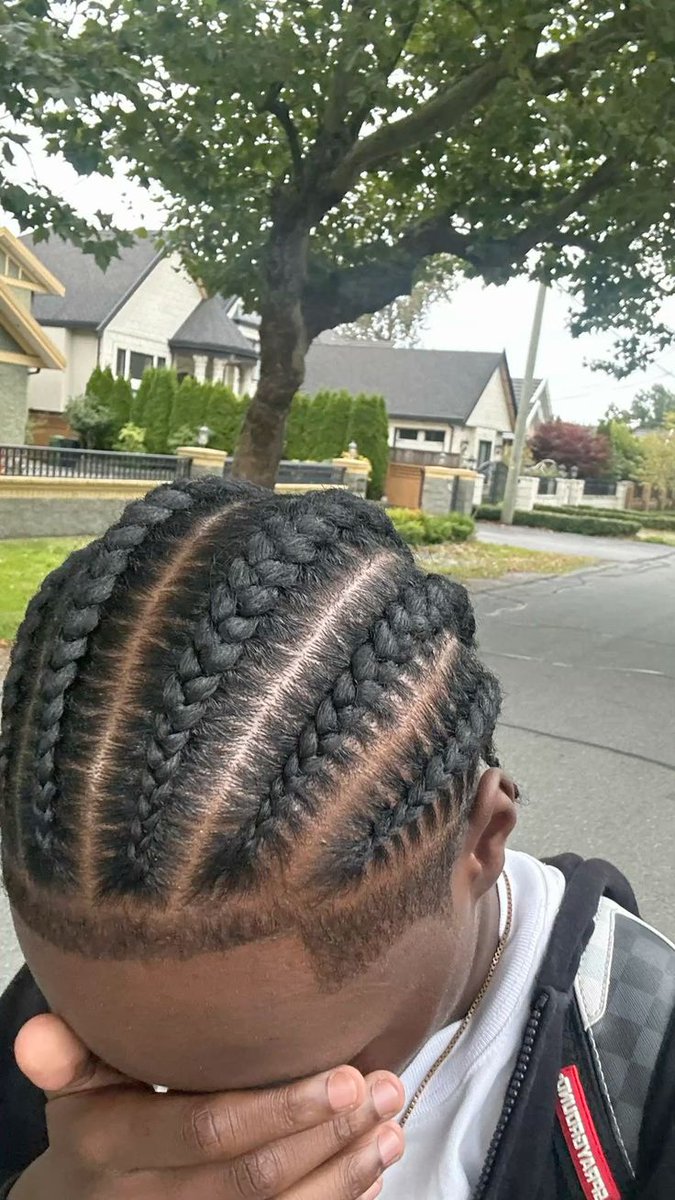
The Demonization of Male Hairstyles in Africa
There is a quiet but very deep contradiction in African societies.
African men are told to be confident, dominant, original, proud of their roots.
But the moment a man expresses himself physically outside a narrow template, he is punished.
Hair is one of the biggest examples.
1. African Hair Is Treated Like a Crime
Cornrows, dreadlocks, twists, braids, afros.
These are not foreign ideas.
They are indigenous African hairstyles with centuries of history tied to age, status, spirituality, warfare, royalty, and community.
Yet today, an African man with long hair is instantly suspected.
He is called:
irresponsible
unserious
unsermonious
criminal
unserious academically
unserious professionally
In some places, he is searched more often. In others, denied jobs. In others, openly mocked by elders who themselves grew up around these same hairstyles.
So the question becomes:
When did our own hair become evidence of moral failure?
2. Colonial Discipline Never Left Our Heads
This did not start naturally.
Colonial rule did not only control land.
It controlled appearance.
Short hair, neat cuts, military style grooming became associated with:
obedience
discipline
intelligence
civilization
Anything else became “wild”, “pagan”, “rebellious”.
Mission schools enforced it. Colonial armies enforced it. Post-colonial institutions inherited it without questioning it.
So today, African men still unconsciously obey a grooming code written by people who believed Africans needed to be visually controlled to be civilized.
That’s not culture. That’s conditioning.
3. The Masculinity Trap
Here’s the irony.
African masculinity praises strength, dominance, leadership, fearlessness.
But the same society panics when a man does something as simple as grow his hair.
Why?
Because control is safer than confidence.
A man who looks exactly like everyone else is predictable. A man who styles himself differently forces people to confront the fact that masculinity does not require permission.
So instead of asking: “Is this man responsible?” “Is this man competent?” “Is this man disciplined in action?”
We ask: “Why is his hair like that?”
That is intellectual laziness disguised as morality.
4. Why Women Are Allowed and Men Are Not
Another uncomfortable truth.
African women can experiment endlessly with hair. Wigs. Braids. Colors. Lengths.
It’s called beauty.
When men do even a fraction of that, it becomes rebellion.
Why?
Because men are expected to be tools, not expressions. Workers. Providers. Structures.
Once a man starts expressing identity visually, people subconsciously feel he is stepping outside his assigned role.
And societies that struggle economically hate men who look like they are not suffering “correctly”.
5. The Criminalization Effect
This is where it gets dangerous.
In many African countries:
men with dreadlocks are policed harder
profiled more
associated with crime regardless of behavior
This creates a self-fulfilling loop.
Society excludes. Opportunities shrink. Resentment grows. Then society points and says, “See, we were right.”
But the origin was never crime. It was appearance.
6. What This Is Really About
It’s not about hair.
It’s about:
obedience vs autonomy
inherited colonial discipline vs self-definition
fear of difference in fragile societies
African societies did not have a problem with male hairstyles until authority decided uniformity was easier to manage than individuality.
And we never unlearned that.
7. The Quiet Question Nobody Asks
If an African man:
works hard
is disciplined
is ethical
contributes to society
Why should his hair matter at all?
And if hair matters more than character, what does that say about our priorities?
This topic always gets people angry because it exposes something uncomfortable:
Many African societies claim pride in heritage, but are deeply uncomfortable with the expression of it✅
I have spent the last 58 days searching for a way to get my sister the medical treatment she desperately needs. Please, we need your help to get her through a battle she never asked for. Any support, donations or even a retweet means the world to us.
Please help me save my sister.😭🤲
Help Marycynthia beat cancer!
This is not a scam, my DM is open to any questions. Please help me save my sister and my future lawyer!😭😭
1473988747
Okoro Marycynthia Chinaecherem
Access bank
https://t.co/BHTzlvXUXr
#HelpsaveCynthia
"YouTube just destroyed a person’s life"
Yes, someone is suffering day and night just to keep his father alive a little longer and save him, and YouTube took his last hope.
These AI bots have no emotions, they are evil.
So, Rony Dass (@sanjeebdas79) is a very good friend of mine. He does short-form content. He was doing YouTube Shorts really well he made $50k from them in just a few months.
And then his father got diagnosed with liver cirrhosis (Child C), and without thinking any second thoughts, he thought he had some money, so he took his father to a good hospital and spent his every single penny on his father’s treatment. The bills are insane one injection costs $200.
But then the termination wave came, and those cruel bots banned all his channels that were the only source of his income. Now he has no money for his father’s treatment. YouTube rejected his appeal in 2 minutes, something that took him years to build.
Because of no income sources left, he sold his land and his mother’s gold jewelry just to keep his father alive a little longer. And now the doctors are saying he needs a liver transplant, which will cost around $50K more.
And when he tried again to start his channel, YouTube killed his last hope without any second thought.
I cried hearing these things. Can you imagine how it feels for a son to see his family suffer day and night, and he can’t do anything for them but just watch them suffer? Never.
He even told me that he will donate his liver to his father. Man, I cried. He is a gem.
That’s why I donated to him as much as I can. And if someone can also support him to complete his donation goal, that will be such a relief for a son who can see his father healthy again.
Here is his PayPal: https://t.co/55AbMU7vCa
(Every donation will be helpful)
Here is his ID: @sanjeebdas79 — message him and give him some hope and your motivating words.
Let’s get together, YouTube community, and save his father.
@TeamYouTube — and if you guys have any humanity left, then please unban his channels and give him his last hope back, please!
Retweet this guys as much as possible, we can do this!
"You have your government, petition them."
The same government that has been captured and monopolised by the person that owns him.
Classic oyibo nonsense. Stab you with a serrated knife and then send your brother to tell you to "take responsibility" for the bleeding.
I have to catch a flight ✈️ for the next 9 hours I’ll leave https://t.co/WoAXnLaCp4 open
You simply have to retweet this tweet & join the community👆
Everyone in this channel, gets a free $5k challenge (as long as u rt and share)
xx #instantfunding
(Oh, and follow me)
What a shame, Nigeria was on a path to progress. The economy was being managed by people who were actually capable.
Anyone who followed the affairs of that period would remember how the United States vehemently refused to sell weapons to Jonathan at the height of the Boko Haram crisis and how it worsened the crisis.
He publicly criticized their refusal and stood firm on Nigeria’s sovereign right to make independent decisions, including his position on not signing pro-LGBT laws under Western pressure. While I personally didn’t support his attempt to criminalize LGBT rights, I also didn’t support America’s attempt to impose its values on us. It was the arrogance of their interference that bothered me, not the issue itself.
The West, particularly the US, exploited the Chibok girls tragedy to discredit Jonathan’s administration, making a global spectacle out of it. In the end, Jonathan had to look to China and Russia for military assistance. The Chinese gave us support without lecturing us about human rights or dictating internal policy.
One of Jonathan’s major “errors” in the eyes of the West was his attempt to shift Nigeria’s strategic alliances beyond the usual Western orbit. But for a sovereign nation trying to secure its future, it was a necessary move.
Since then, what has happened? The country has regressed in multiple ways. A nation once projected to become a trillion-dollar economy has seen its GDP effectively halved. We are poorer, more insecure, and more dependent than ever before. Whatever momentum Nigeria had then was lost, and in its place, we’ve inherited a broken system trying to patch itself with a succession of stupid reforms.
I’ve long understood the malevolent nature of US foreign policy when it comes to the Global South, but what they did to Nigeria was especially damaging. Sometimes I want to believe they didn’t intend for it to get this bad. Perhaps it was just another case of short-term American strategic thinking, intervening not to fix things, but to steer outcomes. And now we’re left with the consequences of that short-termism.
There’s a crucial lesson in all of this going forward, sovereignty is not just about holding elections. It’s about owning your direction as a people. It’s about resisting manipulation. And that’s why I shake my head at Nigerians who still waste time with petty tribal jabs, blind to the geopolitical games being played over their heads. You think the issue is Yoruba vs Igbo or North vs South? You have no idea how easily your entire country can slide from good to bad, and from bad to catastrophic.
Geopolitical awareness is a necessity. As citizens, we must be conscious of how our narratives are shaped and who shapes them. We must have the courage to define our own economic path and resist foreign actors who try to install leaders to serve their interests. We must learn to see the patterns of manipulation, and most importantly, we must hold our own elites accountable for the mess they’ve helped create.