I have received many requests to share the plug, and I will do that under this post.
1688 is a Chinese app, an app for Chinese manufacturers!!
Buying from 1688 gives you access to those manufacturers, instead of going to china.
One of the major challenges and fear people face is “how do I know who’s legit, and if the product is good”. As someone who’s been buying from the app since 2019. There are many ways to confirm the quality of the product and if the manufacturers are legit. But before we get into that, let’s talk about getting the app.
1688 is a app you can get on your App Store, either iPhone or android, it’s available. I have the app on both my iPhone and my android phone.
When you download and register the app, download Alipay also, because that’s the best way to pay manufacturers. Why is it the best tho, because there are other ways to pay, you can even send money directly to manufacturers?
When you pay with Alipay, you can request for a refund if your goods wasn’t delivered and Alipay will do automatic debit from the manufacturers account, that’s why I recommend it.
After registering Alipay, connect it with your 1688 acc..
Although there’s a new payment method where you can pay in naira, but I haven’t tried it myself, maybe when I do in my next shipment, I will write about it (check third and fourth picture).
👇🏽👇🏽👇🏽
TO WHOM IT MAY CONCERN,
Canadian Universities With No Application Fee 🇨🇦
1. Memorial University of Newfoundland
📍 St. John's, Newfoundland
🌐 https://t.co/WSuf2Vq7pe
2. University of Regina
📍 Regina, Saskatchewan
🌐 https://t.co/7cnMOM4FtK
3. University of Manitoba
📍 Winnipeg, Manitoba
🌐 https://t.co/NCo2Swp8vU
4. University of Winnipeg
📍 Winnipeg, Manitoba
🌐 https://t.co/2bEkVsH5Ib
5. Royal Roads University
📍 Victoria, British Columbia
🌐 https://t.co/81QkfwJYST
6. University of British Columbia (UBC) (waiver only for Chemistry graduate programs, or applicants from UN least developed countries)
📍 Vancouver, British Columbia
🌐 https://t.co/HFv0lYJoX0
7. University of Alberta (waiver only for selected graduate programs with specific funding)
📍 Edmonton, Alberta
🌐 https://t.co/ITJqfVfjXB
8. University of Guelph (waiver requires attending their webinar)
📍 Guelph, Ontario
🌐 https://t.co/UzADbmSxXQ
9. Mount Allison University
📍 Sackville, New Brunswick
🌐 https://t.co/mQi1qQEMxt
10. Tyndale University
📍 Toronto, Ontario
🌐 https://t.co/e91nUFs9Tl
If you understand these 10 AWS services,
you already know more cloud than most beginners ☁️
① EC2 → run servers
② S3 → store anything
③ IAM → control access
④ VPC → private networking
⑤ RDS → managed databases
⑥ Lambda → run code without servers
⑦ CloudFront → deliver content faster
⑧ Route 53 → DNS & traffic routing
⑨ CloudWatch → logs & monitoring
⑩ SNS / SQS → notifications & queues
That’s it.
Not 200+. Not everything.
`
Anuvaya Labs is hiring for Member of Technical Staff
Expected Salary: 15-25 LPA
Apply here: https://t.co/ir3fQmFEi5
JioStar is hiring for Software Development Engineer II (Frontend Web) - Creator
Expected Salary: 35-40 LPA
Apply here: https://t.co/OMYdquBksd
If your child is struggling with reading or you want to advance their skills this summer, https://t.co/7BRddBgOLD is what you need.
It helps kids develop reading, writing and maths skills, developed by teachers and based on the UK curriculum.
Python OOP looks complicated because most people explain it with unnecessary theory.
Here is Object-Oriented Programming explained with one simple example:
A bank account ↓
1/ What is OOP?
OOP is a way of organizing related data and functionality inside objects.
A bank account contains:
• Owner
• Balance
• Deposit logic
• Withdrawal logic
Instead of managing these separately, we group them together.
2/ Classes and objects
A class is a blueprint.
An object is something created from that blueprint.
class BankAccount:
pass
account1 = BankAccount()
account2 = BankAccount()
BankAccount is the class.
account1 and account2 are objects.
3/ The __init__ method
__init__ runs automatically whenever you create an object.
class BankAccount:
def __init__(self, owner, balance):
self.owner = owner
self.balance = balance
It gives every new account its starting data.
4/ What does self mean?
self refers to the current object.
account1 = BankAccount("Alex", 1000)
account2 = BankAccount("Sam", 500)
Now:
print(account1.owner) # Alex
print(account2.owner) # Sam
Each object stores its own data.
5/ Attributes
Attributes are variables stored inside an object.
self.owner = owner
self.balance = balance
Here:
• owner stores the account holder
• balance stores the available money
Different objects can have different attribute values.
6/ Methods
Methods are functions defined inside a class.
They describe what an object can do.
class BankAccount:
def __init__(self, owner, balance):
self.owner = owner
self.balance = balance
def deposit(self, amount):
self.balance += amount
Now the account can update its own balance.
7/ Using methods
account = BankAccount("Alex", 1000)
account.deposit(500)
print(account.balance)
Output:
1500
The data and the logic that manages it stay together.
That is the main purpose of OOP.
8/ Encapsulation
A class should control how its data is changed.
def withdraw(self, amount):
if amount <= 0:
return "Invalid amount"
if amount > self.balance:
return "Insufficient balance"
self.balance -= amount
The object prevents invalid withdrawals.
9/ Inheritance
Inheritance allows one class to reuse another class.
class SavingsAccount(BankAccount):
def add_interest(self, rate):
self.balance += self.balance * rate
A SavingsAccount is also a BankAccount.
It inherits the existing deposit and withdrawal behaviour.
10/ Method overriding
A child class can replace inherited behaviour.
class PremiumAccount(BankAccount):
def withdraw(self, amount):
self.balance -= amount
return "Premium withdrawal completed"
The method name stays the same, but its behaviour changes.
11/ Composition
Composition means one object contains another object.
class NotificationService:
def send(self, message):
print(message)
class BankAccount:
def __init__(self, owner, balance):
self.owner = owner
self.balance = balance
self.notifications = NotificationService()
The account has a notification service.
Inheritance means is a.
Composition means has a.
12/ Complete example
class BankAccount:
def __init__(self, owner, balance=0):
self.owner = owner
self._balance = balance
def deposit(self, amount):
if amount > 0:
self._balance += amount
def withdraw(self, amount):
if 0 < amount <= self._balance:
self._balance -= amount
def show_balance(self):
return self._balance
Usage:
account = BankAccount("Alex", 1000)
account.deposit(500)
account.withdraw(200)
print(https://t.co/qRduyn4pPO_balance())
Output:
1300
This small example teaches:
• Classes
• Objects
• __init__
• self
• Attributes
• Methods
• Encapsulation
Do not learn OOP by memorizing definitions.
Build small systems with it:
• Bank account
• Shopping cart
• Library system
• Employee manager
• Student record system
OOP becomes easier when you stop treating it as theory and start using it to model real things.
Looking for jobs in the UAE?
I've curated a list of UAE companies to make your job search easier.
🔗 https://t.co/j8iWrUrj06
Which city or country startup list should I build next? 👇
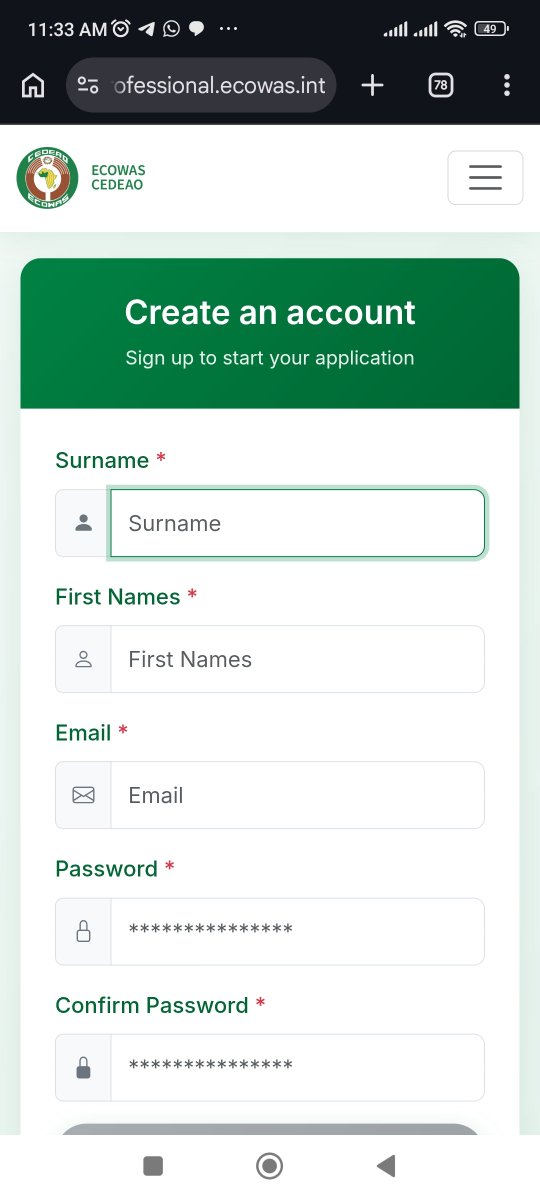
Ecowas is calling. Will you answer?
Applications are open for the @ecowas_cedeao Young Graduates Immersion Programme (Batch 2027).
Citizens of all 15 ECOWAS member states like Ghana, Benin, Senegal and NIGERIA within Age 18-32.
Duration: 12 months (full-time, in-person).
Last time if you were posted to your home country, you get $500 monthly and if it's outside, you get $800 plus a return flight ticket.
Note: The amount is not yet announced for Batch 2027.
Requirements: A Bachelor's degree or higher • CV, motivation letter, academic certificates, and valid ID/passport
Deadline: 31 August 2026
Apply:
https://t.co/hHamrBDVn4
Python becomes much easier when you understand these 20 core concepts:
Not just what they mean but why they matter.
① Variables
Variables store values that your program can use later.
name = "Alex"
age = 24
Think of a variable as a labeled container.
② Data Types
Every value in Python has a type.
name = "Alex" # string
age = 24 # integer
price = 19.99 # float
is_active = True # boolean
The data type determines what operations you can perform on a value.
③ Operators
Operators allow you to perform calculations and comparisons.
total = 10 + 5
remainder = 10 % 3
is_equal = 10 == 10
Common operator types:
• Arithmetic
• Comparison
• Logical
• Assignment
④ Conditional Statements
Conditionals help your program make decisions.
age = 20
if age >= 18:
print("Adult")
else:
print("Minor")
Your program checks a condition and chooses which code to run.
⑤ Loops
Loops repeat code without writing it multiple times.
for number in range(5):
print(number)
Use:
• for loops when iterating over items
• while loops when repeating until a condition changes
⑥ Lists
Lists store multiple values in an ordered collection.
skills = ["Python", "SQL", "AWS"]
skills.append("Git")
print(skills[0])
Lists are mutable, which means their values can be changed.
⑦ Tuples
Tuples are similar to lists, but they cannot be changed after creation.
coordinates = (10, 20)
Use tuples for values that should remain fixed.
⑧ Dictionaries
Dictionaries store information as key-value pairs.
user = {
"name": "Alex",
"role": "Developer"
}
print(user["role"])
They are useful for representing structured data.
⑨ Sets
Sets store unique values.
numbers = {1, 2, 2, 3}
print(numbers)
Output:
{1, 2, 3}
Sets are useful for removing duplicates and comparing collections.
⑩ Functions
Functions group reusable pieces of logic.
def greet(name):
return f"Hello, {name}"
message = greet("Alex")
Functions make programs easier to organize, test and maintain.
⑪ Parameters and Arguments
A parameter is defined inside a function.
An argument is the actual value passed to it.
def calculate_price(price, quantity):
return price * quantity
calculate_price(20, 3)
Here, price and quantity are parameters.
20 and 3 are arguments.
⑫ Scope
Scope determines where a variable can be accessed.
message = "Global"
def show_message():
text = "Local"
print(text)
• Global variables can be accessed across the program
• Local variables exist inside a function
⑬ List Comprehensions
List comprehensions create lists using shorter syntax.
squares = [number**2 for number in range(5)]
Instead of writing a complete loop, you can generate the list in one line.
Use them when the logic remains easy to understand.
⑭ Exception Handling
Exception handling prevents your program from crashing unexpectedly.
try:
number = int(input("Enter a number: "))
print(10 / number)
except ValueError:
print("Enter a valid number")
except ZeroDivisionError:
print("Number cannot be zero")
It allows your program to respond safely when something goes wrong.
⑮ File Handling
Python can create, read and update files.
with open("notes.txt", "r") as file:
content = https://t.co/7Lq2bba7UA()
Using with automatically closes the file after the operation is complete.
⑯ Modules
A module is a Python file containing reusable code.
import math
print(math.sqrt(25))
Modules help you avoid rebuilding functionality that already exists.
⑰ Packages
A package is a collection of related Python modules.
Examples:
• Requests for APIs
• Pandas for data analysis
• Flask for web applications
• FastAPI for backend development
Packages extend what Python can do.
⑱ Classes and Objects
Classes define the structure and behaviour of objects.
class User:
def __init__(self, name):
https://t.co/yopyPRDWfr = name
def greet(self):
return f"Hello, {https://t.co/yopyPRDWfr}"
user = User("Alex")
print(user.greet())
A class is the blueprint.
An object is an instance created from that blueprint.
⑲ Inheritance
Inheritance allows one class to reuse another class’s functionality.
class Employee:
def work(self):
return "Working"
class Developer(Employee):
def code(self):
return "Writing Python"
The Developer class inherits the work() method from Employee.
⑳ Iterators and Generators
Iterators return items one at a time.
Generators produce values only when they are needed.
def count_up_to(limit):
number = 1
while number <= limit:
yield number
number += 1
Generators are useful when working with large amounts of data because they do not load everything into memory at once.
Python is not about memorizing syntax.
It is about understanding how these concepts work together:
Data → conditions → loops → functions → objects → real applications.
Learn one concept.
Write a small program with it.
Then combine it with the concepts you already know.
That is how you actually become good at Python.
Here is a Compilation of a list of skills you can learn and links for you to learn them for FREE:
1. Cybersecurity
https://t.co/AqbC8neOnZ
2. Data Analytics
https://t.co/Qt62WA0nX8
3. Video Editing
https://t.co/yh7zgc59XU
4. UI/UX Designing
https://t.co/7JOkBc7MRk
5. Microsoft Excel
https://t.co/nD86dX4uNo
6. AI Automation
https://t.co/95fdO8Z4eK
7. Project Management
https://t.co/YW52jJIpw0
8. AI prompt
https://t.co/PzWkgZCHsA
9. Web Development
https://t.co/aNJweRO1Ex
10. SEO/Copywriting
https://t.co/eVdstBVbCN
Enjoy your weekend 😘
I found 500+ companies hiring remotely and put them in one sheet.
Inside this sheet you’ll find companies actively hiring for:
• Customer Service Representatives
• Appointment Setters
• Virtual Assistants (Executive, Medical, Legal, Real Estate)
• AI & Automation Assistants
https://t.co/DBvU2bs4tJ
A DEVELOPER TAUGHT GIT WITH A BOX OF CHILDREN'S TOYS AND ENGINEERS WITH TEN YEARS IN SAY IT'S THE FIRST TIME THE THING EVER ACTUALLY MADE SENSE
90 minutes, one table, a pile of Tinkertoys. No wall of jargon -- he builds a real Git repo out of plastic rods right in front of you.
-> The moment he snaps the first pieces together, Git stops being scary command-line magic and becomes what it really is: a chain of tiny objects pointing at each other.
Branches, merges, rebase, the staging area -- every concept that's ever burned you at 2am -- he rebuilds with toys until a four year old could follow. He calls Git a two-trick pony. After this you'll see exactly why.
Memorizing commands was never the skill -> holding the graph in your head is. And with an AI agent now committing and rebasing on your machine all day, that mental model is the only thing between you and a history you can't read.
Scroll the comments and you'll see the same thing over and over: this is the talk that finally made Git click and made people the one their whole team comes to when it breaks.
Bookmark & watch it today. It's the 1.5 hours that pays you back for the rest of your career ↓
A lot of students are now using their NSS year to prepare for fully funded scholarships abroad.
So immediately after NSS, they’re already on their way to the US, Canada, or Europe for Masters and PhDs.
That’s one of the reasons we built GoScholar AI. https://t.co/1vSMUjMZPm to guide you through the entire process.