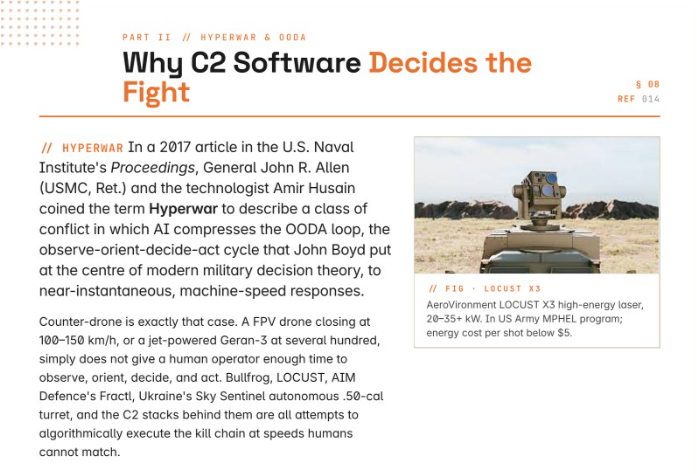
Counter-drone isn’t a niche. It’s the leading edge of an air-defense rebuild the West deferred for twenty years.
I put together a quick briefing document on some thoughts regarding the counter-drone (C-UAS) ecosystem.
New models are emerging at speed. Counter-drone-as-a-service is already live and private infrastructure providers and critical facilities are being given the legal authority to take direct responsibility for their own airspace defense. Download the pdf here: https://t.co/sScqCov32U
#CUAS
The first private Anti-air company in the world works in Ukraine.
Operators in Carmin Sky use joysticks to control automatic turrets. Sky Sentinel turrets, equipped with Browning machine guns are used. They locate target automatically and wait for permission to fire — DW.
1/
Read this excellent report on counter UAS systems from George Howell of RAINCLOUD Defense. He mentions the importance of #Hyperwar as an organizing framework for counter-drone systems. Ultimately, autonomous drones are taking us all the way to a collapsed OODA loop.
Learn more: https://t.co/8DRZXYG6vO
Very pleased to announce that General John R. Allen and I have launched https://t.co/qyo4ZCBDuW - a hub for the ideas, publications, and media shaping #Hyperwar.
Hyperwar is the emerging doctrine that defines how autonomy, AI, and machine-speed conflict will reshape defense. Since we first defined it in 2017, it has entered military training programs, influenced defense technology development, and become a widely cited term in strategic literature.
https://t.co/qyo4ZCBDuW is an effort to bring structure, reference, and clarity to this ongoing evolution. We’ll continue to build this out over time.
LINK: https://t.co/MoDuoAG2Oe
"Do you want to know how difficult it is to confront FPV drones on the battlefield? And how a child controlling one remotely can take out a soldier with long military experience?
Watch this video…
They decided to try it themselves and were shocked—they didn’t know how to deal with them. That’s why the war in Ukraine is so tragic."
From #nuclear tech to #AI, #biotech & satellites, dual-use technologies power growth but carry risks of misuse. The core challenge: enabling innovation while preventing coercion, #cyber threats & weaponisation: @lakshmyrkrish https://t.co/vYj6i3BoHk
someone built an OPENSOURCE MILITARY RADAR that tracks multiple targets up to 20km away.
contractors charge a quarter-million dollars for this tech. one dev just put the entire github repo online for free.
pcbs, fpga code, schematics, python gui. all under MIT license..
Just because drones share airspace with crewed aircraft doesn't mean the most logical Army branch to be charged with modernizing them is aviation. https://t.co/4lSr0xZC6c
"The United States cannot treat AI advantage as a stockpile—a lead built on breakthrough discoveries that adversaries will take years to replicate. Idea fluidity renders this paradigm obsolete." https://t.co/vkMtneQvoC
Every airframe, flight, and crash in this video was paid for by Anduril, not taxpayers. We believe so much in Omen that we spent five years building on our own dime.
Thousands of miles of range from a Group 3 VTOL that can carry hundreds of pounds of payload is a game changer.
As industrialized warfare collides with rapid technological attrition, defense supremacy will not be determined by who builds the best drone, but by who can outproduce, out-iterate, and out-adapt the fastest. Static acquisitions and niche innovation are insufficient. What is needed are Defense Foundries: integrated production ecosystems that merge engineering, automation, and software to manufacture and evolve entire cohorts of uncrewed systems on demand. Unlike traditional factories built for repetition, foundries are designed for adaptability: engineered to retool quickly, integrate new technologies, and sustain output under pressure. This paper introduces the Defense Foundry Model as a strategic framework for national industrial resilience, proposing a shift in focus from platform procurement to agile production capabilities, aligning military needs, government policy, investor incentives, and industrial capacity under one unifying model.https://t.co/UDW8AgpKPw
3D-Printed Drones, Wildfire Tech, and UGV Integrations
Daily Hard Tech Headlines:
- @K9DefenseTech, the Huntsville-based UAS company, announced that the Army’s 3rd Combat Aviation Brigade has 3D-printed, assembled, and completed a K9 Genesis UAV on base using the company’s open-source wiki, files, and guides.
- @HavocAi_USV has teamed up with Ilmor Engineering Ltd., a leading maritime engine maker, to bring advanced electric propulsion into its autonomous vessel platforms.
- Korean Air has secured a partnership with @anduriltech. The collaboration focuses on UAS for wildfire response.
- @einrideofficial, the Swedish autonomy startup, has raised $100 million. The company develops autonomous trucking technology.
- USA Rare Earth, Inc. (Nasdaq: USAR) has announced the acquisition of LESS COMMON METALS LIMITED, a critical producer of rare earths. The deal size sits at $100M.
- Uber has acquired Segments ai, a data-labeling firm for autonomous systems.
- American Pacific Corporation, a maker of materials used in solid rocket propulsion, has broken ground on its $100 million expansion in Cedar City, Utah.
- Occidental Petroleum’s chemical division is being acquired by Berkshire Hathaway. The unit manufactures large-scale industrial chemicals used in biotechnology, construction, water treatment, and other sectors. The deal size sits at $9.7B
- @Microsoft is expanding its clean power footprint in Japan with new solar deals from Shizen Energy Group, bringing its total commitment to 100 MW.
- DEEP is scaling its U.S. presence with a $100 million push, setting up major manufacturing facilities in Florida and Texas. Central to the plan is Project Vanguard, a next-generation undersea habitat
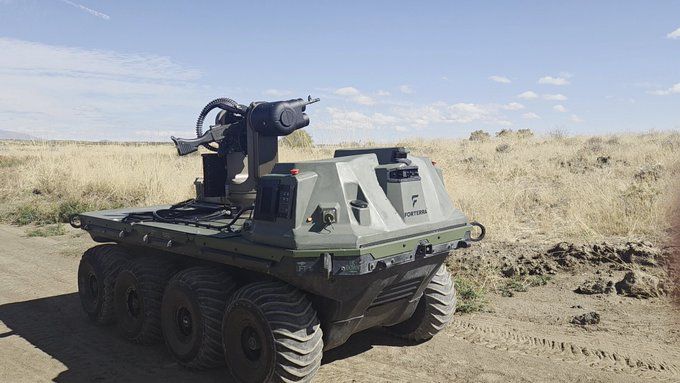
- @allencontrol has announced an integration of their C-UAS platform onto a Forterra UGV.
🇨🇳China unveils world's first brain-like AI Model SpikingBrain1.0
Upto 100X faster while being trained on less than 2% of the data typically required.
Designed to mimic human brain functionality, uses much less energy. A new paradigm in efficiency and hardware independence.
Marks a significant shift from current AI architectures
Unlike models such as GPT and LLaMA, which use attention mechanisms to process all input in parallel, SpikingBrain1.0 employs localized attention, focusing only on the most relevant recent context.
Potential Applications:
- Real-time, low-power environments
- Autonomous drones and edge computing
- Wearable devices requiring efficient processing
- Scenarios where energy consumption is critical
This project is part of a larger scientific pursuit of neuromorphic computing, which aims to replicate the remarkable efficiency of the human brain, which operates on only about 20 watts of power.
---
arxiv .org/abs/2509.05276