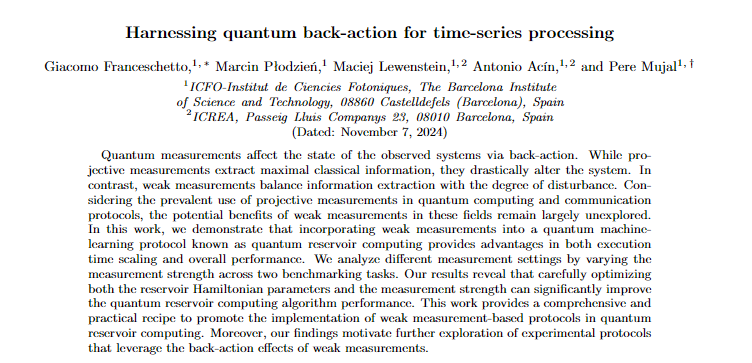
While quantum back-action is often considered a hindrance in #quantum reservoir computing, it can actually be leveraged to improve performance, a new study suggests. See how:
🔗 https://t.co/i5nI1BU80H
✨Considering a PhD at BSC? 👋Join us!
🔸With ”la Caixa” Foundation’s programme for doctoral #INPhINIT fellowships, you can carry out research at one of the best universities or research centres in Spain or Portugal
➡https://t.co/eEPsAjGA1G
#Fellowships#laCaixaFoundFellows
Check the paper for more details! And many thanks to my collaborators at @ICFOnians; @marcinplodzien, Maciej Lewenstein, Antonio Acín and Pere Mujal😊
https://t.co/GrmNQv7Nv0
Is quantum back-action necessarily a bad thing?🧐
https://t.co/GrmNQv8lky
Not always! In our recent work, we explore how the ability to tune the disturbance induced by observing a quantum system can be beneficial for the case of quantum reservoir computing (QRC)! 👇🧵
Moreover, we consider also the practical scenario where only a limited number of shots are available and show the combined effect of better scaling plus back-action enhancement.
Check the paper for more details! Huge thanks to @aricou6 and the amazing team at @Quandela_SAS, especially @AlexiaSalavra & @plussailleurs 🙌🙌
https://t.co/cs7v1IyAVB
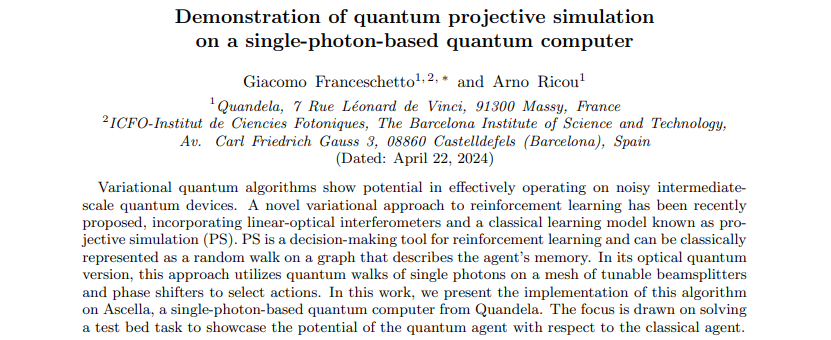
Can we use single particles of light to make decisions?🤔
https://t.co/cs7v1IyAVB
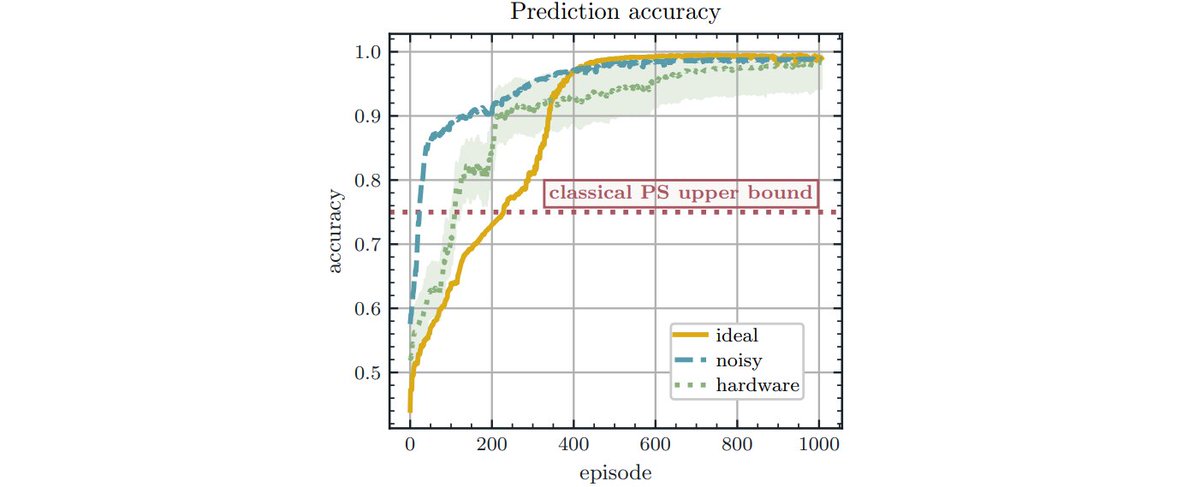
In our preprint, we borrowed some photons from @Quandela_SAS to tackle a test bed reinforcement learning (RL) task in which finding the optimal strategy is conditional to using quantum effects. 🧵