Launching what @t1llmann and I have built in the past 2 months → @lumenfall_ai 🚀
Lumenfall is an AI media model gateway for developers.
We’re starting with image generation & editing:
→ All leading models 🖼️
→ All major providers, with automatic failover 🔀
→ OpenAI-compatible API 🔌
→ Zero markup on model costs 💵
“How is this different from fal or replicate?”
They’re great and can even be used via Lumenfall as providers.
We focus on:
- normalizing behavior across models/providers
- reliability (routing/failover)
- working with your existing SDK (OpenAI SDK, Vercel AI SDK, LiteLLM, RubyLLM)
Sign up today and get $1 free credit to try with any model. 🪙
Which features do you want us to build next?
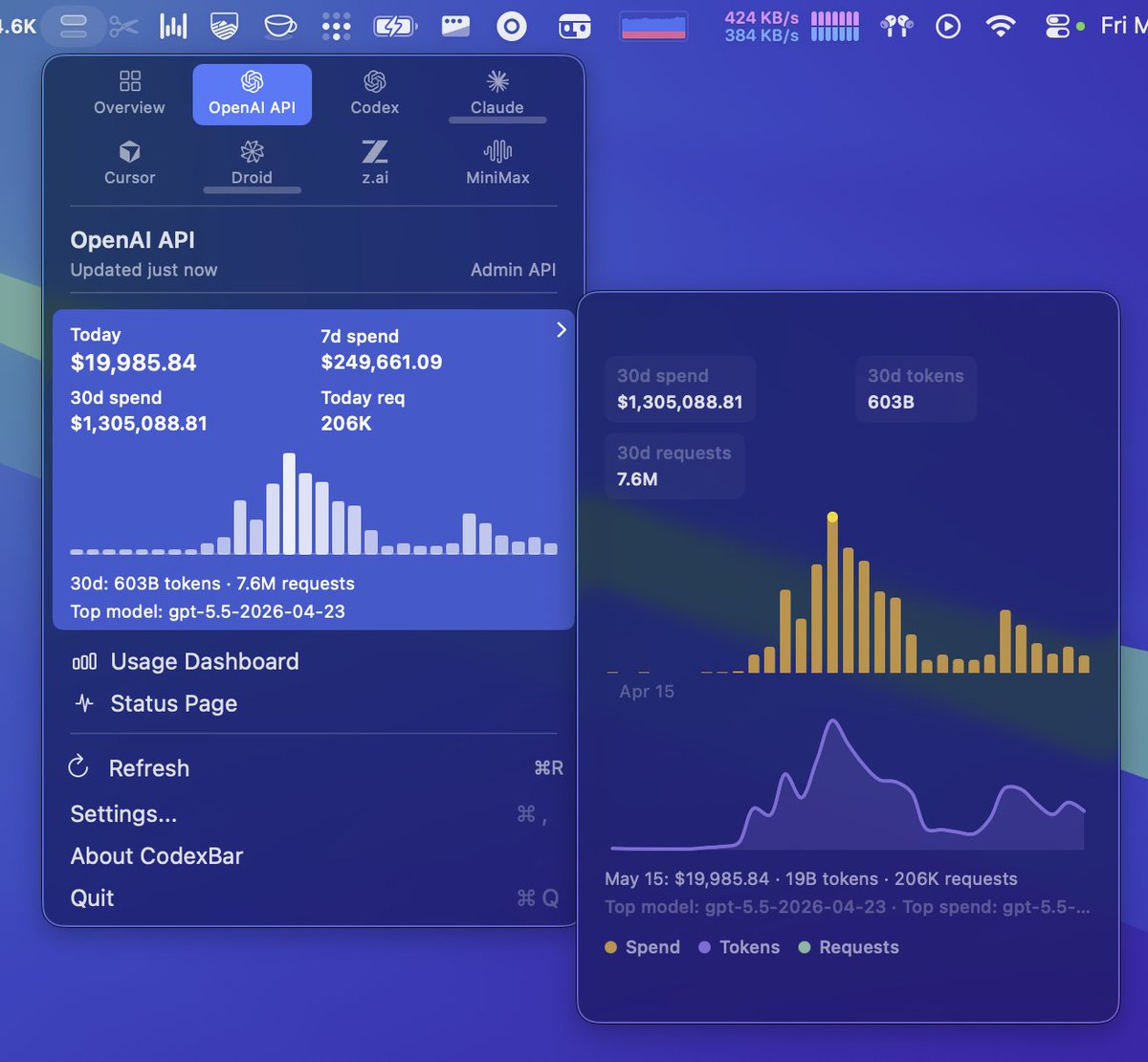
@signulll I was always wondering why the big companies don't optimize more for maintaining their market position and downsize engineering more. Maybe the engineering salaries are worth it for their wallstreet signalling power?
@ArtificialAnlys Recently you introduced a bug where some of the 4 quadrant charts don't show all models that are selected. See the example below where the Gemini models are selected but not displayed.
@kimmonismus What do you mean they are not using a lot of compute? Cursor is currently pretraining a model from scratch on Colossus 2 and xAI is doing supplemental training of Grok V9.
Considering this it‘s quite surprising that they‘re renting out the cluster.
@elonmusk@AnthropicAI@SpaceX The big question is, why does @xai still have unused capacity on Colossus 2, even though Cursor is pretraining a big model from scratch and xAI are doing supplemental training for Grok V9 on the same cluster?
https://t.co/0jfHbL1Xcm
@nottombrown@SpaceX@elonmusk The big question is, why does @xai still have unused capacity on Colossus 2, even though Cursor is pretraining a big model from scratch and xAI are doing supplemental training for Grok V9 on the same cluster?
https://t.co/0jfHbL1Xcm
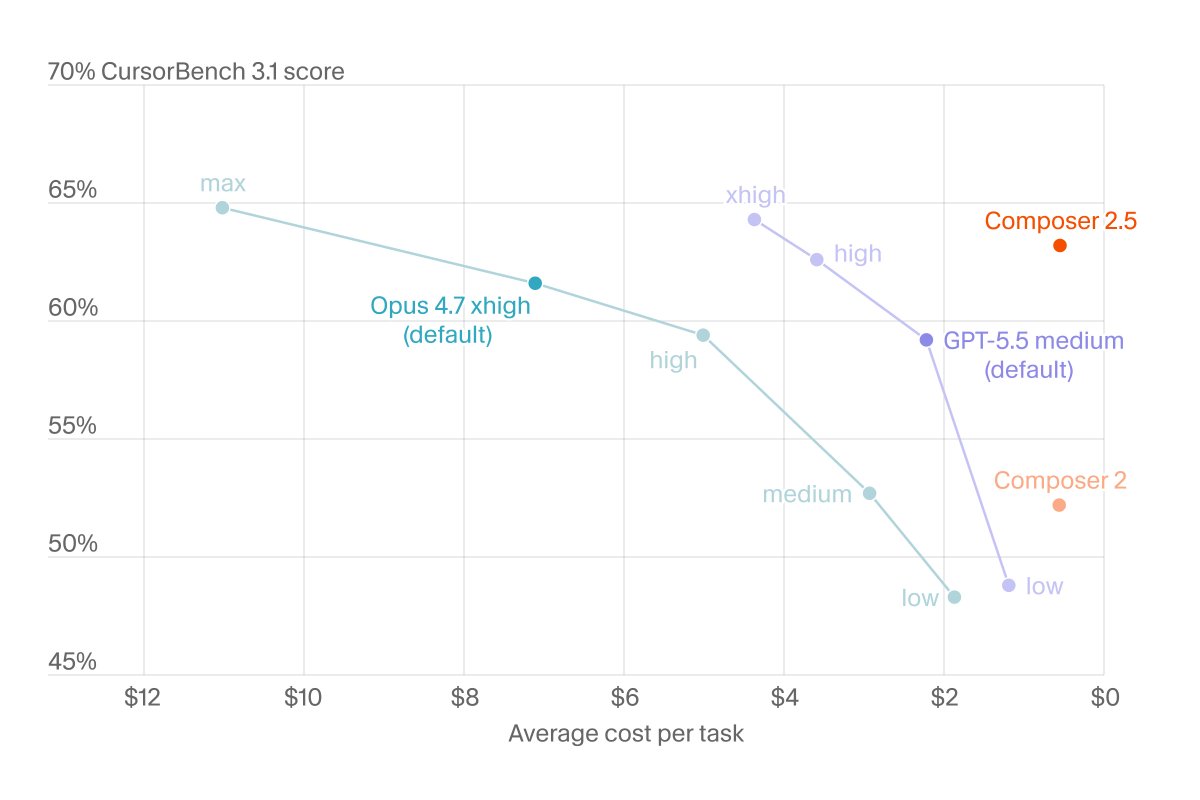
This is the real evidence we‘ve been waiting for that shows Composer 2.5 is really a surprising advancement. Claims in previous Composer releases were overblown, but it seems this time Cursor really cooked.
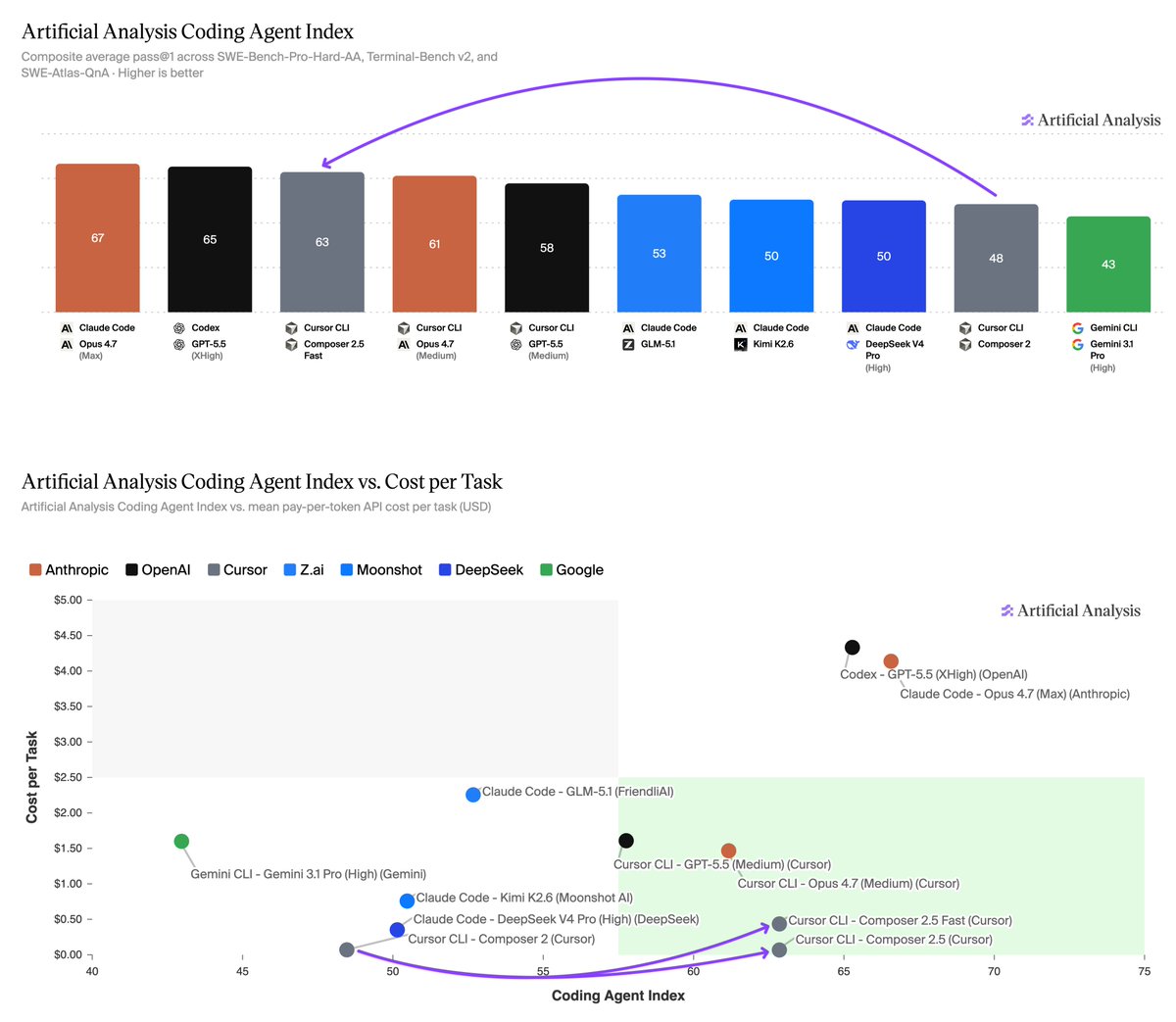
Cursor's new Composer 2.5 takes third on the Artificial Analysis Coding Agent Index and is ~10-60x lower cost than the higher-effort Opus 4.7 and GPT-5.5 variants above it. This release puts Composer among the leading coding agent models, something that wasn’t clear for past releases
@cursor_ai has released Composer 2.5, the latest model in its Composer line. Composer 2.5 scored 62 on our Coding Agent Index, a 14 point gain over Composer 2 (48). This puts it in third place of our tested agents, behind only Claude Opus 4.7 (max) in Claude Code (66) and GPT-5.5 (xhigh reasoning) in Codex (65). These cost $4.10 and $4.82 per task respectively, ~10x the cost of Composer 2.5 Fast ($0.44) and ~60x the cost of Composer 2.5 standard ($0.07).
Key results for Composer 2.5 in Cursor CLI:
➤ Cost-quality Pareto frontier: At $0.07 (standard) and $0.44 (Fast) per task, Composer 2.5 is cheaper than every other agent scoring above 60 on the Index. Medium-effort peers cost $1.24–$2.21 per task; higher-effort variants land 3-4 points above at $4.10–$4.82
➤ Per-benchmark gains vs Composer 2: +35 points on SWE-Bench-Pro-Hard-AA (12% → 47%), +2 points on Terminal-Bench v2 (64% → 66%), and +3 points on SWE-Atlas-QnA (69% → 72%). At 47%, Composer 2.5's score on SWE-Bench-Pro-Hard-AA is comparable to Claude Opus 4.7 (max) in Claude Code
➤ Among the fastest coding agents: Composer 2.5 Fast runs at an average wall time of 6.7 minutes per task, the third-fastest agent on the Artificial Analysis Coding Agent Index, behind only Claude Opus 4.7 (medium) in Claude Code (5.8m) and GPT-5.5 (medium) in Cursor CLI (6.2m)
➤ Fast mode enables better responsiveness at 6x pricing: Fast runs 30% faster than standard Composer 2.5, but is ~6x the cost per task ($0.44 vs $0.07). Token pricing is 6x higher for Fast: $3.00/$15.00 vs $0.50/$2.50 per million input/output tokens
Model details:
➤ Base model: Continued training on @Kimi_Moonshot's open weights Kimi K2.5 as with Composer 2, with Cursor reporting ~85% of total compute from its own additional training and reinforcement learning
➤ Pricing: $0.50/$2.50 per million input/output tokens for the standard variant; $3.00/$15.00 for the Fast variant (the default in Cursor)
➤ Available exclusively in Cursor: both Cursor IDE and Cursor CLI, an externally accessible API is not available
Congratulations @cursor_ai and @mntruell on the impressive release!
What are your favorite agent orchestration tools? 🤖Wishlist:
- Claude Code and Codex (Bonus: OpenCode)
- Agents running on my own VPS, not cloud agents
- Accessible from desktop and mobile (Kanban style web UI?)
- Pings me when it needs my input and otherwise keeps going, only stopping (and automatically continuing) for rate limits
@odd_joel@aarcamp Ahh wait, moshi is an app you built. I‘ll try it, seems to fit my setup. You should think about integrating with honeymux so the desktop experience is also good!
@aarcamp I‘ve been using hmx as my main window all of yesterday and today and was wondering if I‘m „using it right“. I run all my agents on a VPS so they keep running when I close my mac and so I can keep coding on my phone by attaching to the same tmux sessions.
My current hmx setup is macOS Warp-> mosh -> hmx.
Is this as intended or should it be hmx on my mac and then connecting through remote panes?
Also, once mobile support is there, will I be able to connect to the same hmx and keep working? When I open a second instance right now it asks me if I want to „replace“ the first one, which is not what I want. (I was too afraid to try it b/c I had a lot of sessions running.)
Thank you again for hmx!
@odd_joel@aarcamp I even use mosh instead of ssh on my mac so I can instantly get back to work. Also tap-to-tmux to get push notifications when an agent needs attention. It‘s more reliable than Claude /remote-control
https://t.co/wsZifmkuPP