There is literally no UK debate or serious coverage about this Chinese megatrend right now and it tells a tale of political will ignorance and media parochialism.
I am not happy about the Economist’s article, which feels like a hit piece. There is also a background to it, which is more troubling (as I will share at some point). I asked them to allow me to respond. I am waiting for their answer. If not in the magazine, I will share my response here.
This is so obviously wrong. Production of TVs is almost uniquely state-led.
High def TV R&D was conducted by U.S. govt-run DARPA in the 80s/90s.
50% of TVs are currently produced in China, largely by SOEs and supported by subsidy/macro policy.
This is right & the discourse of China squeeze has been strangely defensive. It’s not a moralistic point, it’s what’s happening in a world where China has huge economies of scale + automation in the sector that has been the only path to development in history.
I don't quite understand some of the pushback to the China squeeze argument. That's not to say that none of it is legitimate, but this point about the 'lump of consumption' fallacy is neither here nor there.
On the counterfactual story: the assumption that other EMs would have been more competitive had their institutions, policies, domestic conditions been more similar to China's seems perfectly consistent with the notion that they couldn't have gained a larger share of demand in lower-value sectors had China's own policies been less assertive. They had initially displaced existing industrial activity through lower unit costs, so had these not been so low in relative terms others could have gained a greater foothold.
But more importantly: if we are, as we should, talking not about counterfactuals but about future developmental paths for developing countries, then it's very plausible that much of the benefits of expanded consumption will still accrue to the country with the absolute advantage across much of the value chain.
"Can anyone with a straight face suggest that the main problems afflicting the development of South Africa or Nigeria, the great centers of mass underemployment in sub-saharan Africa, are cheap competition from China driven by Beijing’s industrial policy and an undervalued RMB?"
This is really beside the point and I suspect it's deliberately polemical. There is much reason to believe that if you're an EM and you get house in order you would not be able to compete simply because China's levelised cost advantages might well persist in most sectors whatever you do (unless you are like Vietnam a well-organised bordering country with an ideologically aligned political system).
This still begs the question what happens to these countries' developmental prospects when almost all of the world's merchandise trade ends up concentrated in one part of the world and when, historically, export-led growth is the way countries get out of poverty.
https://t.co/J2e3kxPXp0
https://t.co/7Ipc1JuTYg
Far more poverty has been alleviated by growth than by any RCT type aid or poverty alleviation program. Like orders of magnitude. Compare China to sub-Saharan Africa.
Couscous and curried veggies for the win. Note multiply-reused takeout containers offering a radical synthesis of mixed provisioning modes with low-cost synergistic spinoffs.
A real coup. All the way back to his role under Gordon Brown in 2008 @Ed_Miliband deserves huge credit for driving one of the most effective renewable energy programs in the world, centered on offshore wind.
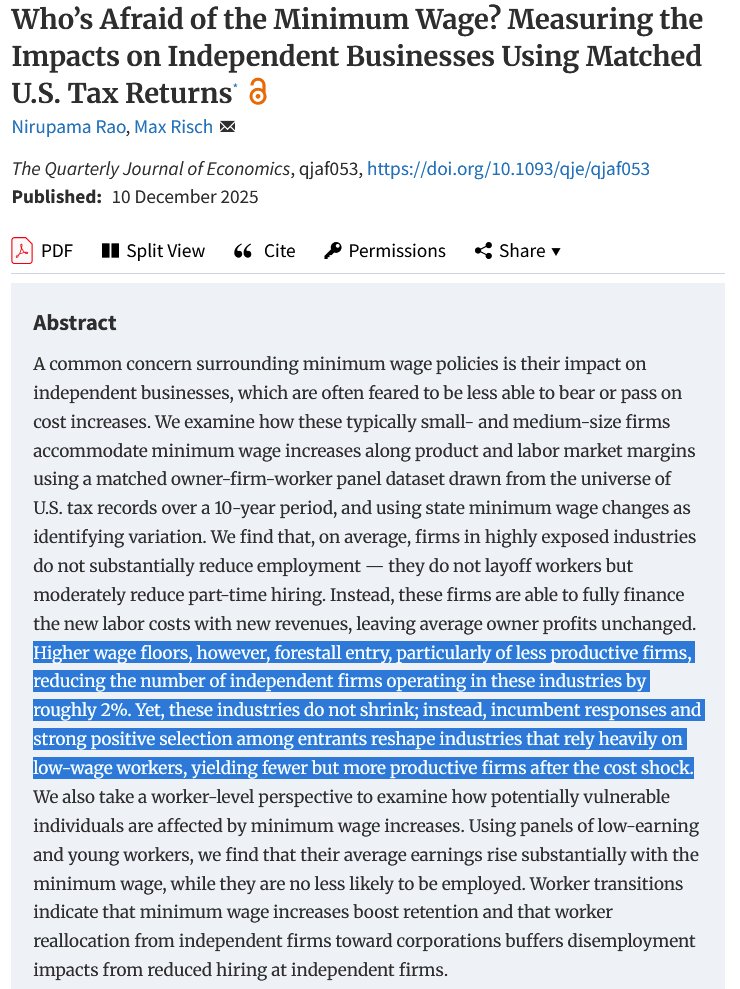
A few months ago, I said that a higher minimum wage can lead to creative destruction.
Today, a new QJE paper shows exactly that: a higher MW yields "fewer but more productive firms".
High wages often improve economic efficiency! It's a crucial part of the Nordic model.