Surveying Indonesian villagers on how well off they are and how much a modest cash transfer would help them, from @rema_nadeem, @emilybreza, @ben_olken, Abhijit Banerjee, Arun G. Chandrasekhar, and @GideonMoore https://t.co/CiqwfyBozR
Targeting government transfers to the lowest-consumption households can miss those who would benefit most--three-quarters of them in the Indonesian context @rema_nadeem, @emilybreza, @Ben_Olken, Abhijit Banerjee, Arun Chandrasekhar, and I focus on in our new paper. A 🧵 (1/12)
Bottom line: traditional targeting methods encode normative beliefs. Right now, this does *not* include that households who benefit the most should get transfers. Paper below. Thanks to @WorldBankGroup, @dfat, and @3ieNews for supporting this project.
https://t.co/MUuif8ABEh
Surveying Indonesian villagers on how well off they are and how much a modest cash transfer would help them, from @rema_nadeem, @emilybreza, @ben_olken, Abhijit Banerjee, Arun G. Chandrasekhar, and @GideonMoore https://t.co/CiqwfyBozR
Targeting government transfers to the lowest-consumption households can miss those who would benefit most--three-quarters of them in the Indonesian context @rema_nadeem, @emilybreza, @Ben_Olken, Abhijit Banerjee, Arun Chandrasekhar, and I focus on in our new paper. A 🧵 (1/12)
Moreover, the MSV-PMT requires preferences to be transferable out-of-sample. Training an MSV-PMT in Indonesia and applying it in Tanzania is likely to be completely off.
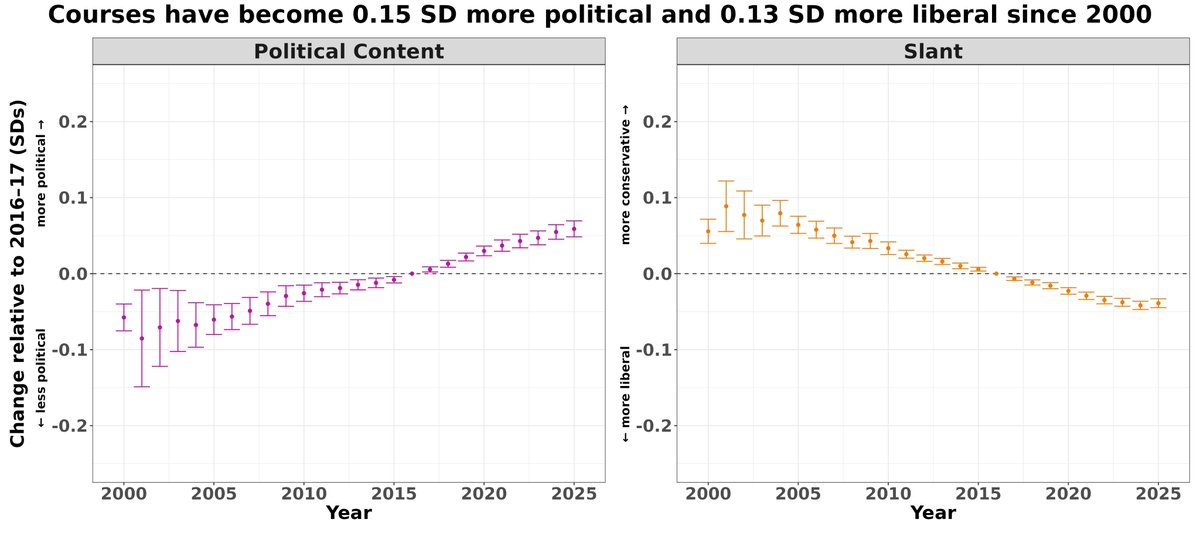
In a new @SIEPR WP, @GideonMoore, Sam Thau, and I document a modest but broad-based shift towards more political, more liberal courses across nearly 1,000 US colleges and universities since 2000. We then study how students and faculty shape political content. A thread: (1/N)
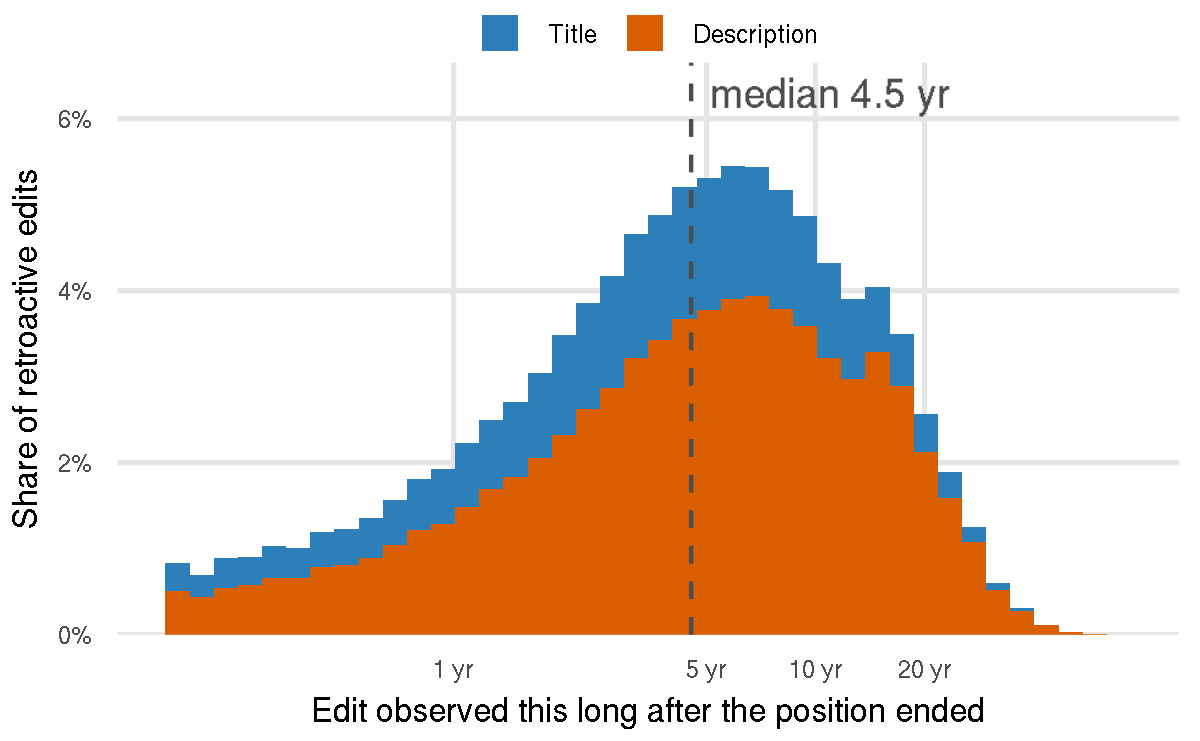
1 in 5 US LinkedIn users edit job descriptions well after leaving the position. In a new WP with @I_Am_NickBloom, Lisa Simon, & Caelan Wilkie-Rogers, we argue this contaminates work using profiles as employment histories—but enables us to track skill demand over time. 🧵 (1/16)
1 in 5 US LinkedIn users edit job descriptions well after leaving the position. In a new WP with @I_Am_NickBloom, Lisa Simon, & Caelan Wilkie-Rogers, we argue this contaminates work using profiles as employment histories—but enables us to track skill demand over time. 🧵 (1/16)
@gc_jordan_@I_Am_NickBloom Ran the numbers (back of the envelope, so worth what you pay for them). 2022-26, ~8% users retro-add a job, ~3% remove. Mostly short stays, median ~1 year. Adds/strikes are similarly senior to other jobs, so less "making up seniority" more marginal in/exclusions. Thx for asking!
1 in 5 US LinkedIn users edit job descriptions well after leaving the position. In a new WP with @I_Am_NickBloom, Lisa Simon, & Caelan Wilkie-Rogers, we argue this contaminates work using profiles as employment histories—but enables us to track skill demand over time. 🧵 (1/16)
1 in 5 US LinkedIn users edit job descriptions well after leaving the position. In a new WP with @I_Am_NickBloom, Lisa Simon, & Caelan Wilkie-Rogers, we argue this contaminates work using profiles as employment histories—but enables us to track skill demand over time. 🧵 (1/16)
1 in 5 US LinkedIn users edit job descriptions well after leaving the position. In a new WP with @I_Am_NickBloom, Lisa Simon, & Caelan Wilkie-Rogers, we argue this contaminates work using profiles as employment histories—but enables us to track skill demand over time. 🧵 (1/16)