Neural CAs are amazing, but they've never scaled past low resolution.
We propose a simple solution that allows an ~8x resolution boost with minimal extra parameters.
The core idea: Treat cells as local neural fields instead of pixels.
Try the demo: https://t.co/Nnq8VFOGbB
��
Plasma is better in colour! Watch one of our latest #plasma pulses in our ST40 tokamak, filmed using our new high-speed colour camera at an incredible 16,000 frames per second.
Each pulse lasts around a fifth of a second. What you’re seeing is mostly visible light from the plasma’s edge, glowing pink. The core is simply too hot to emit visible light.
In this footage, lithium is dropped into the plasma. As it interacts, it glows red when excited, then turns green as it becomes ionised, losing an electron. From there, it traces the magnetic field lines, revealing the plasma’s path around the tokamak.
Lithium is the focus of our $52 million ST40 upgrade programme, in partnership with @ENERGY and @energygovuk. This builds on pioneering work at @PPPLab and others that has shown that lithium can significantly improve plasma performance.
This video comes from ongoing research into X-point radiator (XPR) regimes, a promising operating mode for future #fusion power plants that aims to cool the plasma before it reaches plasma-facing components (PFCs), helping to reduce wear without compromising performance.
Fusion research just got a lot more colourful!
👇
https://t.co/o92is4lXBq
#Fusion #FusionEnergy #EnergyTransition #Innovation
🌍 From earthquake prediction to robot navigation - what connects them? Eikonal equations!
We developed E-NES: a neural network that leverages geometric symmetries to solve entire families of velocity fields through group transformations. Grid-free and scalable!
🧵👇
Huge congratulations to my former PhD student @rohansawhney1 for winning the @siggraph Outstanding Doctoral Dissertation Award! 🥳
Rohan's thesis develops a whole new class of Monte Carlo methods for solving physical equations, without needing to break the world up into a mesh.
Paper summary for ...
Stochastic Interpolants, Flow Matching [Lipman et al. 2023], Rectified Flows [Liu et al. 2023], I-Conditional Flow Matching [Tong et al. 2024], Inversion by Direct Iteration [Delbracio and Milanfar 2024], and Iterative α-(de)Blending [Heitz et al. 2023]
Here's a nice "proof without words":
The sum of the squares of several positive values can never be bigger than the square of their sum.
This picture helps make sense of how ���₁ and ℓ₂ norms regularize and sparsify solutions (resp.). [1/n]
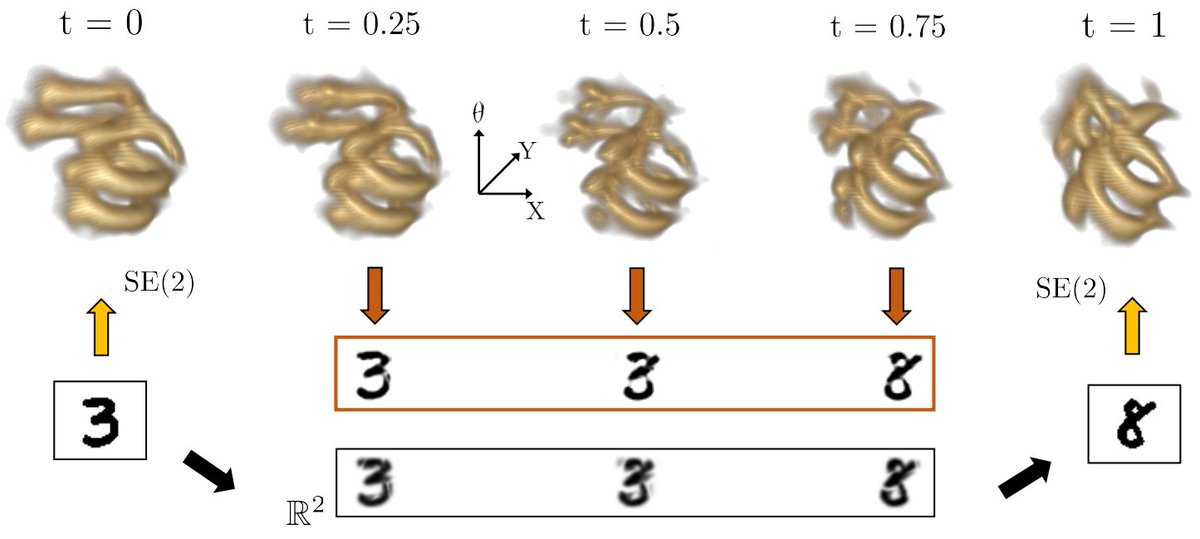
Happy to share that: *Optimal Transport on the Lie Group of Roto-translations* will appear soon in SIAM-Journal on Imaging Sciences. Preprint: https://t.co/tkra7kKPJ4
Project Lyra explores the possibility of sending a spacecraft to chase 'Oumuamua using an Earth gravity assist to reach Jupiter, which robs the craft of almost all its speed, causing it to drop to the Sun for an Oberth maneuver.
Thanks @hibberdadam994 for the trajectory data!
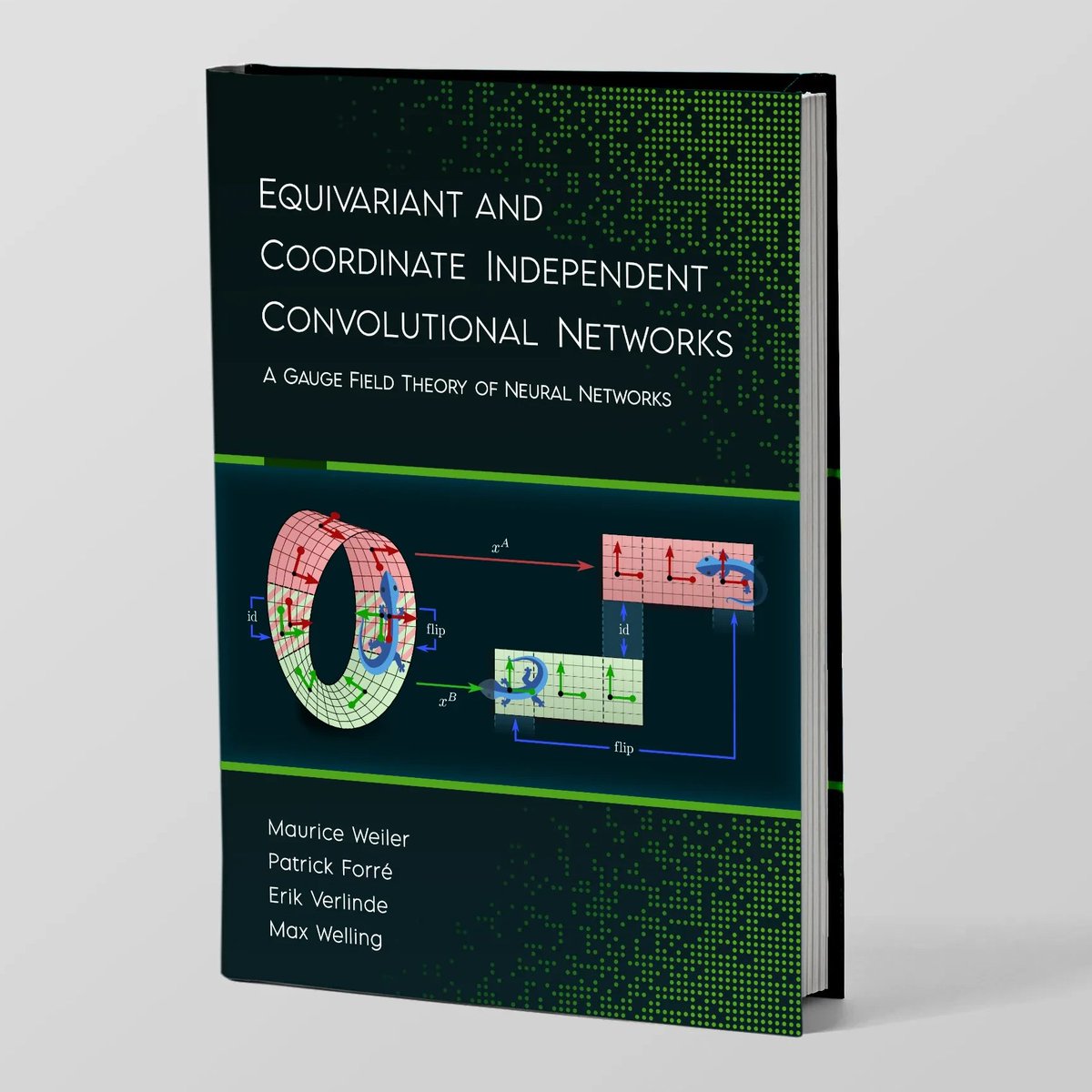
We proudly present our 524 page book on equivariant convolutional networks.
Coauthored by Patrick Forré, @erikverlinde and @wellingmax.
https://t.co/y9YBpqhyLG
[1/N]
A perfect alignment, and I couldn't be happier with how it turned out. I decided to release this image as a limited edition print, which you can find here: https://t.co/sxd3fl9He3
Zooming around a bacteria cell. It's so cool
I just got the cell imported (including lipids) and rendering correctly with the new rendering engine (it's called Angstrom). 3x performance boost! So much detail (too much?!)
#screenshotsunday#gamedev#scicomm#xcode#swiftlang
PDE-based neural architectures with inf/sup convolutions like this have nice practical properties: lesser parameters and trainable with fewer data. Ongoing work with @GijsBellaard, Bart Smets, and Remco Duits at TU/e: https://t.co/cXIfWPUxFk
Morphological Operations like Erosion & Dilation are computed using inf/sup convolutions. Extendable to homogeneous spaces of Lie Groups, like SE(2) or the group of roto-translations by max/min pooling over geodesic Riemannian balls. See PDE-G-CNN's https://t.co/iuwyOBvT5X
Soon @ @icmlconf !
🌪️Normalizing flows for rigid bodies and the rotation group SO(3)! 🌪️
We found a way to design smooth normalizing flows for rigid body systems, like ice 👇
Joint work with amazing @inve_michele@pimdehaan and @FrankNoeBerlin
1/
https://t.co/FJIGsajwrb