"You can never tell what a thought will do
In bringing you hate and love
FOR THOUGHTS ARE THINGS, and their airy wings,
Are swifter than carrier doves.
Thread ⏬
@ACInvestorBlog It s a Loris Karius situation again...Poor guy the keeper,terrible mistakes,possibly top football career ending. That being said, Tudor showed weak man management traits with the sub, he also does not belong to top football and he shows it consistently on every bench he sits..
I DON'T UNDERSTAND WHY PEOPLE DON'T USE GROK FOR STOCKS.
Most traders are looking at charts from 3 months ago.
Grok analyzes real-time sentiment on X to predict tomorrow.
Here are 8 prompts to find the next 10x stock:
With all the buzz lately, peace of mind is underrated Alpha.
A Few Reminders :
1. You only need a few Outliers per year to make it big.
Outliers never emerge by selling massively into strength ,they’re born by waiting through weakness, even when it feels uneasy.
2. Waiting for weakness means sitting through volatility and Drawdowns from your Peak Capital. It's inevitable.
3. Never treat your Peak Capital as money you truly own...It’s the market’s money. What you truly own is your principal plus the potential gains you hold through weakness.
4. Volatility from Peak Capital doesn’t always translate into damage. It isn’t always registered. Don't freak out
A few days can pass and you might still be up more than before.
Sometimes you win that battle.... sometimes the market takes back what’s theirs. Either way, stick to your core principles.
5. Understand your portfolio’s dynamics to thicken your skin against that volatility.
Some periods you’ll have a Portfolio ADR of 8.5%, others 5%.
It all depends on your holdings , even if you follow the same exact system.
6. More aggression should come with more defense.
In times like these, it’s easy to go full degen mode, just as easy as becoming overly conservative and missing out. Balance is everything.
Take your shots, cover, assess, then decide what’s next.
7. Don’t deviate from your principles. Bend your rules when needed but follow your core truths.
Accept the realities and normalities that come with them and be prepared for scenarios. Visualize but not expect. That’s how you build mental resilience.
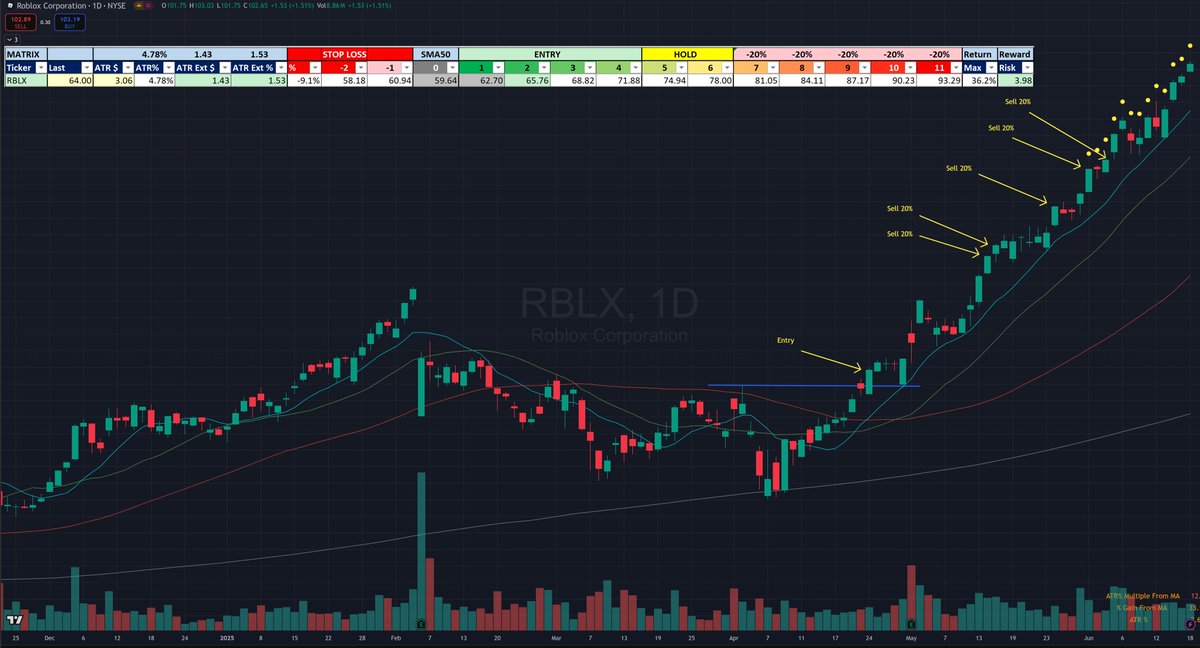
"ATR Matrix" - Explained
This post is designed to explain how to use/read the "ATR Matrix". It is intended to be understood by all levels of traders so I will try to explain this clearly and as simply as possible.
Summary
The ATR Matrix is a representation of a stocks price relative to to its 50-Day Simple Moving Average (SMA50). This is a concept/approach that is taught and used extensively by the ever excellent @jfsrevg and @RealSimpleAriel . These are the two Legends I learnt this from so all credit to them. 🙌
What is Average True Range (ATR)?
ATR simply stated measures volatility of a stock i.e. how much the price of a stock typically (on average) is expected to move, in either direction, in a specific period (in this case day).
It is typically expressed as either a percentage or dollar amount for example, $PLTR ATR is $6.31 meaning, on average PLTR is expected to move +/- $6.31 per day. The current price $139.96, giving it a ATR% of 4.51%.
Average Daily Range (ADR) can be used instead of ATR with the main difference being ADR does not take into account overnight gaps, averaging only the high–low range.
I use "Wilder 14-Day ATR" directly from Finviz where available otherwise I calculate it using Python. You can probably find it in your scanners, chart software or other websites.
The higher the ATR, the faster (more volatile) the stock moves. Traders who want to compound their money quickly will focus on stocks with high and above average ATR's (currently 3%+). The legendary @Qullamaggie in his streams has said "High ADR is Gold, low ADR is 💩".
For my Qullamaggie inspired scanner, I set the threshold as "above average ATR" but from his streams I think he preferred ADR of 5%+ to "move the needle".
Caution should be exercised with very high ATR's though. If the stock has an ATR of 10%, it is not uncommon for stocks to move 2x or more the ATR at least some days throughout the year and the movement is in any direction so that could be a -20% to +20% move, with greater risks if held over multiple days.
One approach would be to take your maximum permitted loss and divide that by 1.5 or 2 to determine the maximum ATR%.
For example, if using 1.5x you set your stop-loss at -9%, this would mean the maximum ATR% for a stock would be 9/1.5 = 6%. You don't want to trade the slowest stocks so using the "above average ATR" to the"ATR Max" means you are focusing on stocks between 3% and 6% ATR.
Entry Tactics (0-4x ATR)
New positions can be initiated when the price is between 0-to-4x ATR from the SMA50. Stocks below the SMA50 are ignored.
I would recommend strongly looking for stocks where Price >= MA20 >= MA50 >= MA100 >= MA200 and the price of the stock is above rising EMA10/SMA20 and SMA50.
The tactics for entry could be "Darvas Breakout" upwards, Power Earning Gappers (PEG), an uncut-and-rally (U&R), Minervini VCP or whatever you choose to enter.
I recommend watching the excellent @traderlion entry tactics video below if you don't have a preferred entry method. The entry method should suit your personality and trading style.
https://t.co/HTd5xk9q1Z
Stop-Loss (-1.5 to -2 ATR from Cost)
Once a position has been initiated, the stop-loss should be no more than "1.5x to 2x ATR from Cost" and no more than 1/3 your average gain.
If you average gain is 21% on winners, losers should be capped at -7% (21/3) assuming a 50-50 win-rate*. This should also feed directly back into the "Max ATR %" threshold discussed earlier since you should not trade stock above 4.6% ATR (recall we were setting the Max ATR% at 1.5x). This should also be taken into account with your win-rate (how many trades have positive outcomes vs how many have negative outcomes).
Active traders with more experience may look to enter on a Opening Range Break (ORB) and building a cushion during the day, setting the stop-loss at Low of Day (LoD) but this lies beyond the scope of this post.
The key point, regardless of how you implement the stop-loss, is to ensure the stop-loss is predefined prior to entering the trade and the reward-to-risk is asymmetric (ideally 3R reward or greater to 1R risk) taking into account your trading stats (win-rate, average gain, average loss). You may decide "I will use -1.5x ATR has my stop from cost and will target 4.5x ATR or greater profit".
Winning Trades (5-7x ATR)
Once you are in a winning position, it is important not to choke off the trade. "Cut losers short and let winners run" as many market wizards state (such as Paul Tudor Jones).
Provided your stop has not been triggered and the stock is less than 7x ATR from the SMA50, stay in the trade. If the stock closes below the MA10 or MA20 then the position can be reduced or closed as Qullamaggie mentions on his streams.
Winning Traders (7x ATR and Above)
Once a stock is 7X ATR from the SMA50, the stock is becoming extended and more prone pulling back or going sideways and letting the moving averages catch up.
This is the time to lock in some gains and it is personal preference has to how much.
Personally I like to sell 20% of the quantity at each integer from 7x to 11x ATR so I am fully out at 11x ATR. For example, if I have 100 shares, I sell 20 at 7x, 20 at 8x, 20 at 9x, 20 at 10x and the final 20 shares at 11x.
@RealSimpleAriel I believe prefers to sell 20% of the remainder at each integer at/above 7x (20% of 100 then 20% of 80 then 20% of 64 etc.) giving himself the opportunity to capitalize on potential parabolic moves.
The key is to start scaling out as the stock becomes 7x or more extended from the SMA50. The more extended, the more you should reduce the position.
Example $RBLX
Using $RBLX as an example, the trade is initiated on the 24th April 2025 when it breaks the pivot from the 2nd April and crosses $64. ATR% is 4.78% and SMA50 is $59.64 with the stock 2.12 ATR's from the SMA50 (within the 0-4x ATR entry range).
Stop loss set at 1.5x ATR from cost would be $59.41 which would be -7.2%
14th May, the stock closes at 7.51x ATR at a price of $79.45. 20% of the position is sold, leaving 80%
15th May, the stock closes at 8.16x ATR at a price of $80.77. 20% of the position is sold, leaving 60%
27th May, the stock closes at 9.18x ATR at a price of $85.43. 20% of the position is sold, leaving 40%
2nd June, the stock closes at 10.9x ATR at a price of $89.95. 20% of the position is sold, leaving 20%
4th June, the stock closes at 11.927 ATR at a price of $91.07. The final 20% of the position is sold.
The average selling price is $85.33 giving a return of 43% in 41 calendar days, giving a reward-to-risk ratio of 6-to-1.
P.S. Link to Jeff & @DumbleDax excellent ATR-to-SMA50 indicator
https://t.co/pKNZAvsqQu
Good Morning
The first time I realised my brain was not built for trading, I was staring at a red candle that felt like it was staring back. My chest tightened. My mouse hand twitched. Somewhere inside, the old caveman who once ran from tigers started yanking at the steering wheel. Get out. Now. Survive.
That part of you is loud. It is ancient. It is ninety five percent emotional and it does not care that this is only a chart on a screen. Loss is loss. To your nervous system, money leaking from an account feels a lot like status leaking from a tribe. Power slipping away. Safety threatened. So the emotional brain floods the system. The rational voice gets pushed to the corner, hands up, pretending it is still in charge.
If you are a non trader trying to become profitable, this is the fight you are actually in. Not against the market. Against the wiring. You do not out argue that wiring. You retrain it.
Good news. Brains change. New connections start forming within hours of new practice. You can feel small shifts in four to six weeks. Give it three to nine months of repetition and those new routes start to feel like home. Give it one to three years of real work and you can become consistently profitable. Give it two to five and you can become the calm one in the storm, the trader people think was born with ice in their veins. You were not. You built it.
Here is the usual arc I see and lived
Zero to six months
You build the basics. Market structure. Risk. Position sizing. You learn why the stop goes where it goes. You discover that journaling is not homework. It is the mirror that keeps you honest. You still flinch at every flicker on the screen. That is fine. You are laying track.
Six to twelve months
You start to see patterns in your own behaviour. You catch yourself moving a stop and you write down exactly why you did it. You trade small or you trade demo because the point is not to make money yet. The point is to train responses. Reps over results. You begin to notice that some urges can be watched without being obeyed. That is neuroplasticity at work even if you never say the word.
One to three years
Consistency starts to show up. Not perfect days. Boring days. Rule following days. Days where you exit because the plan said exit, not because fear screamed and you obeyed. You size correctly. You skip the trade that does not fit. You lose and you do not spiral. Your identity shifts from outcome chaser to process keeper. That is when the equity curve quietly begins to bend.
Two to five years
Mastery is not fireworks. It is stability. You have a playbook and you keep it tight. You add slowly. You know which environments are yours and which ones you let pass like a bus you were never meant to catch. You can watch price run without you and feel nothing more than a note to self. You become the trader who looks lucky because their preparation is invisible.
How do you speed it up
Tell the truth on paper
Every trade. Entry. Exit. Emotions. Triggers. Lies you told yourself in the moment. The journal is where you see the wiring you are trying to change.
Use rehearsal like an athlete
Replay charts. Speak your rules out loud. Walk through the what ifs before the bell. Your brain needs thousands of stress free repetitions so it has somewhere safe to go when the heat turns up.
Trade small enough that you can think
If the size makes your heart rate climb, you are not training your rational brain. You are feeding the caveman.
Automate decisions that emotions love to hijack
Hard stops. Predefined risk per trade. A fixed number of trades per day. The more you can move from willpower to structure, the faster the rewiring sticks.
Study your own tilt
Everyone has a signature mistake. Revenge trading. Moving stops. Taking profits too early. Name it. Build a specific counter for it. One rule. One alarm. One accountability partner. Target the glitch.
Accept the timeline
You would not try to deadlift twice your body weight after four weeks in the gym. Treat trading with the same respect. Early wins happen. They do not mean you are done. Early losses happen. They do not mean you cannot do this. The brain is plastic but it is not instant.
If you are a non trader starting today, budget one to three years to become truly consistent. Some will do it faster. Many will need longer. The variable is not your intelligence. It is your willingness to practice the boring parts long after the excitement wears off.
Your caveman is not your enemy. He just needs a new job. Give him rules to guard. Give him a routine to enforce. Give him a journal to patrol. Over time he stops grabbing the wheel in panic and starts pointing at the dashboard, reminding you what the plan said.
You will know you are rewired the day you close a losing trade on plan, feel almost nothing, and quietly log it with the same care you give to your winners. That is not cold. That is freedom. That is the brain of a trader you built on purpose.
@markminervini Perhaps the best words ever heard regarding trading! Ever since i adopted the teachings from your books and also your insights here on X, my performance exploded! And that would be an understatement.
Thank you for everything!!! And keep cutting losses swiftly!!!!
@RealSimpleAriel True dat.. Chopfest at it's finest lol. Tried to be a $CHEF yesterday on the breakout just to get brutally reversed today...oh well, this too shall pass i guess.
Big names are waking up.
We scanned for stocks breaking out of Weinstein’s Stage 1 accumulation into Stage 2 uptrends, the classic sign of a new trend.
These setups could lead the next leg higher. 🧵