Nassim Taleb: pick two people at random
If their combined height is 4.1m, it's basically 2.05 + 2.05.
If their combined wealth is $36M, it's almost never 18 + 18 - it's ~$1,000 and ~$36M.
Height lives in "Mediocristan," where the average tells you everything.
Wealth - and markets - live in "Extremistan," where one event dominates the whole picture.
Ruin there never comes from a string of bad days.
It comes from a single one.
~1hr lecture, free. The Black Swan author at Cambridge on why the statistics you were taught break exactly where it matters.
Being right on average means nothing if one tail empties the account.
En 1984, un homme assis face à une caméra a décrit notre époque avec une précision qui glace.
Yuri Bezmenov n'était pas un espion de roman. Journaliste soviétique, homme de l'agence Novosti et du KGB, il avait passé sa carrière à fabriquer de l'influence avant de faire défection en 1970. Ce qu'il est venu dire à l'Ouest tient en une phrase : la vraie guerre que menait l'URSS n'avait presque rien à voir avec les missiles ou les espions. C'était une guerre psychologique, lente, patiente — la « subversion idéologique ». Selon lui, l'essentiel de l'effort des services y était consacré. Pas pour voler des secrets. Pour modifier la perception du réel de tout un peuple, au point qu'il ne puisse plus, même face aux faits, défendre sa propre survie.
Il décrivait quatre phases.
1️⃣ La démoralisation. La plus longue : 15 à 20 ans, le temps d'éduquer une génération. On ne détruit pas un pays par la force, on le retourne contre lui-même. On travaille l'école, l'université, les médias, la culture, jusqu'à ce qu'une génération entière grandisse en méprisant son histoire, sa nation, son héritage, ses pères. Le détail terrifiant : une fois la chose accomplie, elle est irréversible. Ces gens sont « programmés ». Exposez-les à des faits authentiques, des preuves : ils refuseront de les voir. Ils continueront à se croire vertueux en démontant ce qui les protège.
2️⃣ La déstabilisation. 2 à 5 ans. On attaque les fondations : l'économie, l'autorité, les rapports sociaux, la défense. Tout ce qui tenait devient « négociable ».
3️⃣ La crise. Quelques semaines. Un choc, un point de bascule, et une société désorientée réclame elle-même qu'on la « sauve ».
4️⃣ La normalisation. On installe un nouvel ordre, présenté comme une libération. Le mot est emprunté, avec ironie, à la « normalisation » de la Tchécoslovaquie écrasée après 1968.
Puis 1991 est arrivé. L'URSS s'est effondrée, l'Occident a fêté sa victoire, et on a rangé tout ça au rayon des vieilles peurs.
Mais on confond le lanceur et la charge. Ce qui est tombé en 1991, c'est l'État soviétique — la fusée. L'arme idéologique, elle, avait déjà été tirée des décennies plus tôt. Et une arme de démoralisation a cette propriété diabolique : une fois la première génération retournée, elle n'a plus besoin de Moscou. Elle s'auto-réplique. Le commanditaire peut mourir, le programme tourne tout seul.
Regardez où nous en sommes.
Le wokisme n'est pas une lubie d'étudiants. C'est la phase terminale du processus que Bezmenov décrivait. Une civilisation qui enseigne à ses propres enfants que son héritage est une honte. Qui transforme ses universités en tribunaux permanents contre elle-même. Qui réécrit son histoire en réquisitoire et culpabilise jusqu'à sa propre existence. La démoralisation devenue religion d'État. Le réflexe de survie d'un peuple — sa fierté, sa continuité, son droit à se transmettre — requalifié en crime.
C'est exactement le symptôme qu'il annonçait : des sociétés incapables d'évaluer un fait évident dès qu'il contredit le dogme. Montrez-leur les chiffres, les conséquences, le mur qui approche : elles applaudiront leur propre dissolution en la prenant pour du progrès.
Or une civilisation qui se déteste ne se défend plus. Elle s'excuse d'exister. Et un organisme qui a désappris à vouloir vivre est déjà à moitié mort.
Voilà pourquoi ce combat n'est pas « culturel » au sens décoratif. Il est vital, au sens propre. Réapprendre à aimer ce qu'on est, transmettre sans honte, défendre une continuité plutôt qu'organiser son repentir perpétuel — ce n'est pas de la nostalgie, c'est une condition de survie. Une civilisation vivante est une civilisation qui ne se hait pas. Le reste, c'est la mort, en version rassurante.
Bezmenov terminait sur un avertissement simple : il reste très peu de temps avant que le processus ne devienne irréversible.
If Strategy sells MSTR to pay the dividend, it's a ponzi.
If Strategy sells Bitcoin to pay the dividend, it's a death spiral.
If Strategy sells STRC to buy Bitcoin, the common stockholders are being "diluted".
If Strategy uses the USD reserve to pay off the debt, it's a "fatal error".
At some point you have to realize the bear thesis has become a Choose Your Own Adventure book for people who hate the ending.
The greatest tragedy of Bitcoin is the opportunity cost.
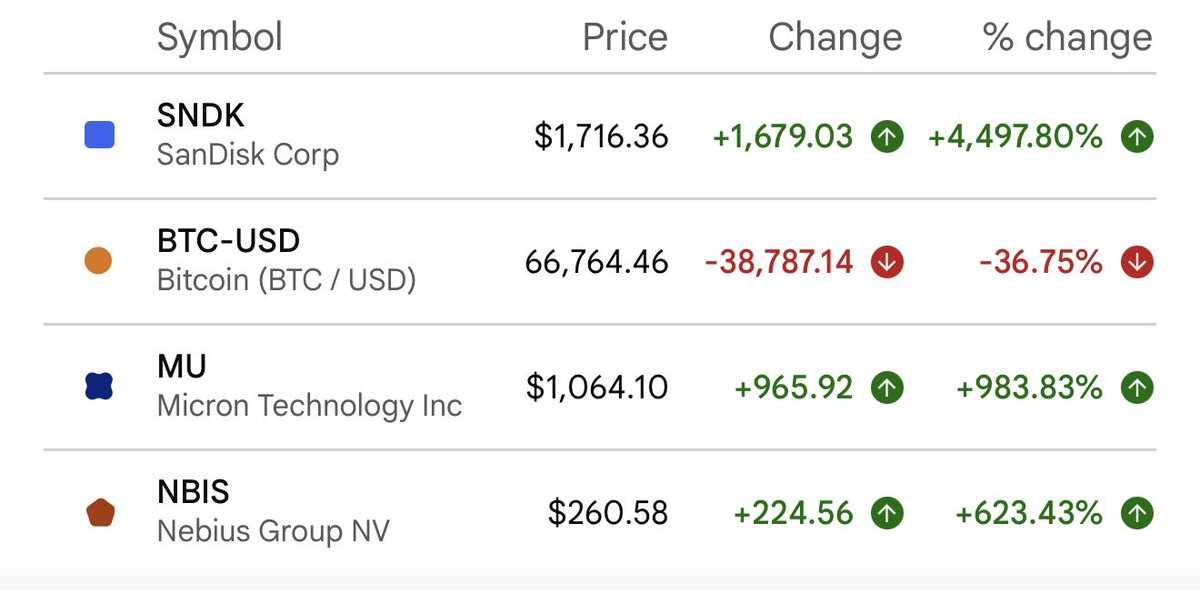
A generation of pro-tech, pro-future investors spent the past year holding Bitcoin for dear life, following it blindly even as every thesis except scarcity collapsed before their eyes.
The irony is that these were exactly the people who should have made the most money from the AI boom. They understood technology. They understood exponential change. They were looking in the right direction, but at the wrong asset.
While they stayed glued to Bitcoin, companies like $MU, $SNDK, $NBIS, and other AI infrastructure winners they understood better than most delivered life-changing returns.
The crowd loves the man who confesses weakness until his weakness makes them uncomfortable. Then they call him unstable. Do not outsource your healing to spectators. Build privately. Return with proof. Respect is easier to restore with evidence than explanation. Always. Prove it.
If you want to know whether someone respects you, watch what they do after you say no, because almost anyone can behave well when you are useful, available, or agreeable; some people pretend to respect you as long as they get to exploit you.
If you keep saving people from the results of their own choices, do not be surprised when they stop seeing you as generous and start seeing you as the fool who absorbs the cost of their recklessness. A favor given too often becomes a service they feel entitled to receive.
Elon Musk hasn't taken a vacation in 23 years. But that's not the part that should disturb you.
What should disturb you is that he doesn't want one.
His first wife Justine said she once booked a surprise trip to Paris for his birthday. He went. He brought three engineering textbooks. He spent the entire flight redesigning a rocket fuel injector on napkins. At dinner overlooking the Eiffel Tower he pulled out his laptop and started answering emails.
She said it was the loneliest she'd ever felt sitting across from another person.
But here's what most people miss when they judge this.
Elon isn't avoiding rest. He doesn't experience work the way most people do. His brain doesn't categorize rocket engineering as labor. It categorizes it the same way your brain categorizes your favorite hobby. He's not grinding. He's playing.
The question this should raise isn't "how does he work so much." It's "what would your life look like if your work felt like play."
Most people need vacations because they spend 50 weeks a year doing something their body is trying to escape from.
The real goal isn't more time off. It's building a life you don't need time off from.
The most powerful response to disrespect is not rage. Rage tells them they found the button. It is not a speech. Speeches tell them you still want approval. The most powerful response is a clean withdrawal. Less access. Less warmth. Less availability. No announcement. A new version of you they can no longer access.
Elon Musk fired his longest serving assistant after 12 years and it reveals something brutal about how he thinks.
Mary Beth Brown had been with him since the early SpaceX days. She handled everything. Scheduling. Emails. Logistics. She once said she worked 80 hours a week for over a decade. By all accounts she was irreplaceable.
After 12 years she asked for a raise. A significant one. She felt she'd earned it.
Elon told her to take two weeks off. He said he wanted to see if he could manage without her. When the two weeks ended, he told her he didn't need her anymore.
The internet destroyed him for this. Called him heartless. Ungrateful. Every article framed it as Elon being cruel.
But there's a detail nobody mentions.
He offered her a significant equity package in SpaceX instead of the salary increase. She declined. She wanted the cash.
That SpaceX equity would be worth over $200 million today.
This isn't a story about cruelty. It's a story about two completely different ways of thinking about value. One person optimized for security. The other optimized for asymmetry.
The hardest lesson in business isn't learning how to work hard. It's learning which form of compensation to accept.
Most people choose the paycheck. The ones who build wealth choose the equity.
Elon Musk's children don't go to normal school. And the reason why will change how you think about education.
He pulled his kids out of one of the most prestigious schools in Los Angeles. Parents were furious. Media called him arrogant. The school had a waitlist of thousands.
His response: "They're teaching kids to solve problems that already have answers. I need them to solve problems nobody's thought of yet."
So he built a school. Inside SpaceX. Called it Ad Astra. No grades. No tests. No subjects in the traditional sense.
A nine year old could take apart a rocket engine and present their findings to actual SpaceX engineers. Students didn't study history. They debated whether they'd make different decisions than historical leaders using the same information available at the time.
The school had no grade levels. A seven year old could work alongside a thirteen year old if they were interested in the same problem.
When asked why he structured it this way, Elon said something that stuck with me:
"I don't care if they know the answer. I care if they know which questions are worth asking."
Most people spend their entire education learning how to be right. Elon teaches his children how to be curious.
The system rewards answers. Life rewards questions.
Machiavel écrit dans Le Prince : "Les hommes oublient plus facilement la mort de leur père que la perte de leur patrimoine." 500 ans d'histoire n'ont jamais démenti cette ligne. Tant que vous générez de la valeur, la table est pleine. Dès que les ressources se raréfient, que le statut vacille, que l'intérêt s'émousse, les masques tombent. C'est dans le creux de la vague que vous découvrez qui était là pour vous et qui était là pour le festin. Ne confondez jamais la chaleur de quelqu'un avec sa loyauté. Ce sont deux choses qui coexistent rarement.
In dealing with fools you must adopt the following philosophy: they are simply a part of life, like rocks or furniture.
All of us have foolish sides, moments in which we lose our heads and think more of our ego or short-term goals. It is human nature.
Seeing this foolishness within you, you can then accept it in others.
This will allow you to smile at their antics, to tolerate their presence as you would a silly child, and to avoid the madness of trying to change them.
A small reversible mistake can reveal more than perfect performance. Watch who helps you save face and who enjoys making noise. Loyalty hides during competence and appears during inconvenience. Sometimes looking slightly foolish is the cheapest test of the room before trust forms
High-agency people have a fundamentally different model of where the boundaries are.
Consider the canonical example: the kid who wanted to learn from some famous person, cold-emailed them, and got a yes.
The lesson is usually framed as "you should cold-email people, the worst they can say is no." But this misses the point.
The point is that before the email was sent, the high-agency kid and the low-agency kid were living in different worlds.
In the low-agency kid's world, "I could just email this person" was not a thought that occurred, because the boundary between "people I can interact with" and "famous strangers" was drawn as a hard line, a wall.
In the high-agency kid's world, that same boundary was drawn as a customs checkpoint: annoying, sometimes guarded, but fundamentally passable if you have the right papers.
The skill isn't sending the email. The skill is seeing the email as a thing that exists in your option set.
Andrew Tate reveals how to deal with friends who are holding you back
“My father had a quote”
“You allow manipulation to find out where your enemy wants you to go, then you use your mind to break the trap and punish the perpetrators”