After a well-deserved break following the @per_ase meeting, let’s take a closer look at the Gianni Toniolo prize winning paper by @giu_marru . It sheds new light on how household resources were distributed in interwar Italy. 1/6
...and it's finally time for our 9th Annual Meeting! Some 60 economic historians meet today and tomorrow at @unito for two intense days of discussion. At this link the programme:
https://t.co/dX7JLv4mqX
And here (with some lag) will give you a taste of the discussion!
It's Monday morning, you are back from #EHS2024 and desperate to apply to new conferences...? Have a look to the open calls from our website:
13th IBEO Workshop Economic History Annual Meeting 🏝️- submit a paper or a 1,000 words abstract by April 15👇
https://t.co/O0QIloh3pn
CFP: 13th IBEO Workshop - Economic History Annual Meeting. Organised by @giu_marru, Paolo Di Martino and Alessandro Nuvolari, and supported by ASE. Submit a full paper or a c. 1,000-word detailed abstract by April 15 - full info and link to submission👇
https://t.co/O0QIlohBeV
I have a soft spot for this particular topic, which can feel grim at times, but it gets so close to the everyday lives of families from many years back that one cannot help but find it fascinating, I think ♥️ (3/3)
Happy to see this paper out on @RivStoriaEcon! It looks at the lives and livelihoods of rural families in 1930s Italy, and finds evidence that in tough times, scarce resources were funnelled to boys, leaving girls behind. (1/3)
1) @giu_marru G. Mancini, "Gender discrimination and intra-household inequality in rural Italy, 1920s-1930s
"...this paper documents the occurrence of gender discrimination in the allocation of resources within households in Italy" https://t.co/CreCd2TvlW
This project was a slow burn over a number of years. In the meantime, even more evidence has surfaced on the hardships faced by Italian girls and women in the (not-so-distant) past, thanks to many brilliant colleagues. 🤗(2/3)
Coming late due to travelling, but very excited about the news of the Sveriges Riksbank Prize in Economics to Claudia Goldin! As @Dr_JWestberg pointed out, several major contributions, not least on the relationship between education and development 🤓
Today's Nobel pick is inspiring in so many ways.
One of them is recognizing important *descriptive* work built painstakingly over decades. This is rare.
Two big examples are Fogel (C.Goldin's advisor) and Kuznets (Fogel's advisor). Few other examples (Stone, Deaton, Ostrom?).
Everyone should listen to the end of Claudia Goldin's interview with Orley Ashenfelter, in which she discusses her experience as a woman in economics. The whole interview is as wonderful as everything @PikaGoldin does, but start at 32:45:
https://t.co/jrphs7AS94
A good occasion to give a read to @giu_marru's work on Italian women's FLFP, published few years ago on our own @RivStoriaEcon: https://t.co/cLX50mmAkz
We need more and more of these works in Italian #econhist!
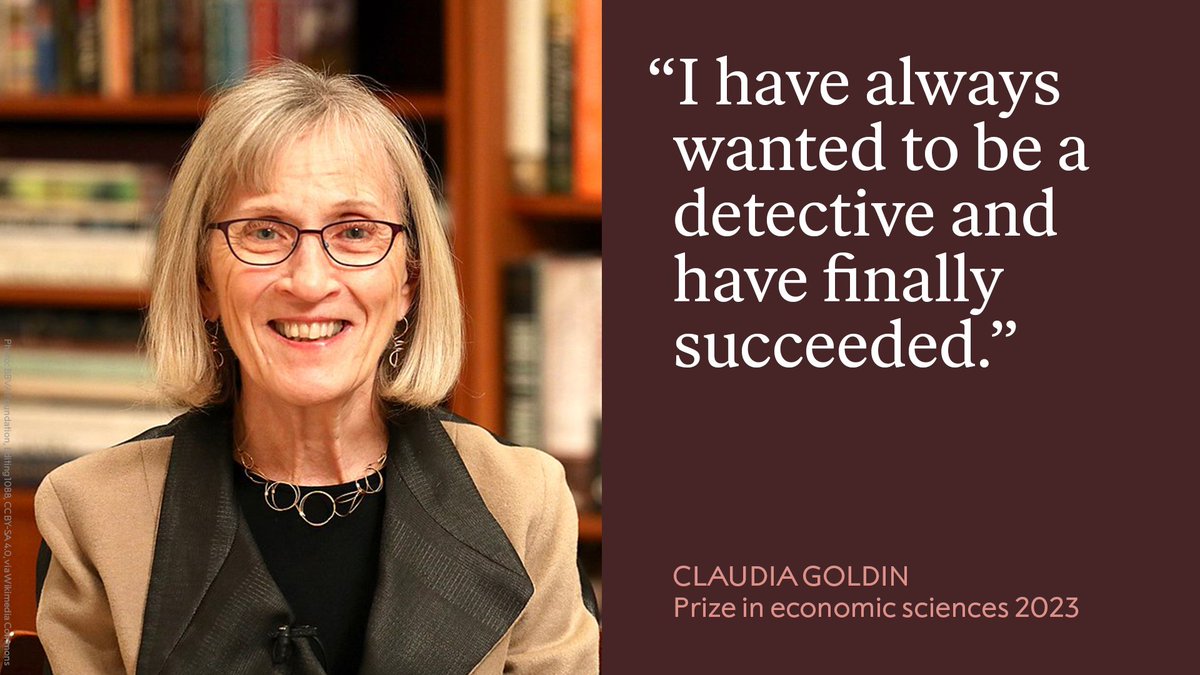
By trawling through the archives and compiling and correcting historical data, this year’s economic sciences laureate Claudia Goldin has been able to present new and often surprising facts. She has also given us a deeper understanding of the factors that affect women’s opportunities in the labour market and how much their work has been in demand.
The fact that women’s choices have often been, and remain, limited by marriage and responsibility for the home and family is at the heart of her analyses and explanatory models. Goldin’s studies have also taught us that change takes time, because choices that affect entire careers are based on expectations that may later prove to be false.
Her insights reach far outside the borders of the US and similar patterns have been observed in many other countries. Her research brings us a better understanding of the labour markets of yesterday, today and tomorrow.
#NobelPrize
Well deserved! 🤩👏🥳
Hugely influential work also for economic historians - honoured to have been privileged listeners of her Fifth ASE Keynote Lecture on these very topics: https://t.co/uXUwe7Nwze
Great news for economic history, and for the economic history of women in particular! Her work was my gateway into this field, and into the idea that historical evidence (and indeed any evidence) is as complicated and flawed as the humans who made it.♥️
BREAKING NEWS
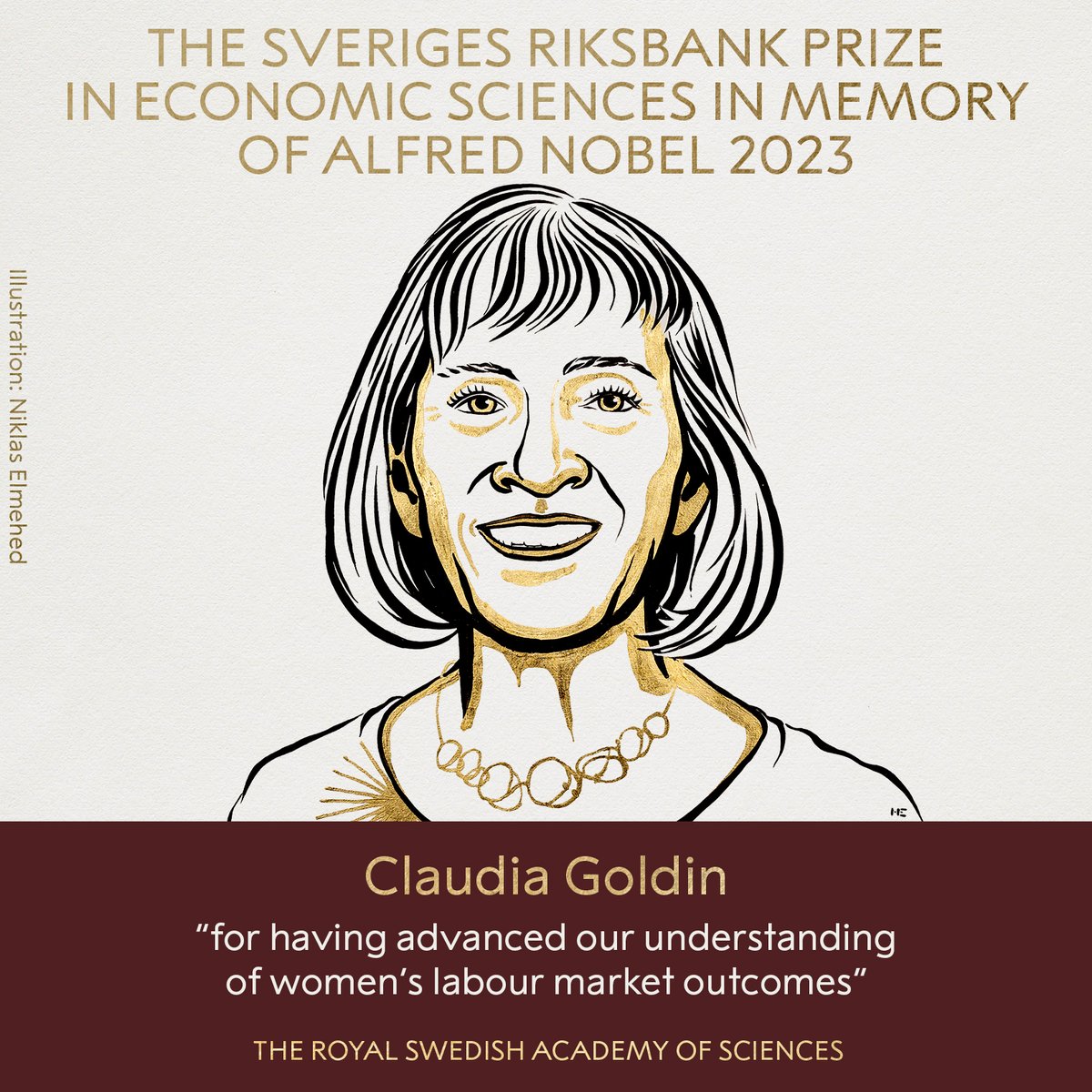
The Royal Swedish Academy of Sciences has decided to award the 2023 Sveriges Riksbank Prize in Economic Sciences in Memory of Alfred Nobel to Claudia Goldin “for having advanced our understanding of women’s labour market outcomes.”
#NobelPrize