A call to all entrepreneurs, founders, small business owners in Europe and anyone else who aspires to star a company at some point. This is the moment to act and let your voice be heard on EU Inc.
EU Inc is the proposed legislation to make it easier to start and grow a company across Europe. It is now in front of the European Parliament and also being negotiated by governments.
The objective should be very clear: you should be able to start and grow your company in Europe as your home market.
What this should mean is, I think, at a minimum this:
1, You should be able to start a company online and cheaply.
2. You should be able to have a simple registration that you can fill out by yourself, with secure identity checks built in. You should not be forced to hire and pay a notary for this process.
3. The basic rules should be the same across Europe and should be common. There should be one registry with common rules and you shouldn't have to go to the lawyers of each country to set up different subsidiaries.
4. There should be a simple way to give employees a share in what they are helping you build, through stock options. They should only pay the tax when they sell those shares and when they receive the money.
5. The paperwork should be much simplified. There should be one channel for doing the VAT across borders and use the time saved to do your job and not to do paperwork.
6. The rules should support the entire life of the business; raising money, growing, going public, and also liquidating a failed business should all be done under the European common rules. Opening a bank account in another country, hiring across borders should be seemless.
The European Commission made an initial proposal that was not sufficiently ambitious in my view but that was a useful start: it had online registration in 48 hours for less than €100 and measures to facilitate the taxation of employee stock options. It had some rules on common liquidation of the companies.
In my view it was not ambitious enough because it allowed national authorities to impose further requirements, such as notaries. It was already falling short on tax and employment, but the reforms that the other institutions are introducing are making it even less ambitious.
The draft that is being discussed by the governments eliminates the European company register and replaces it with a website that is just a portal to underlying national systems. This does not improve the creation of companies in any way. They're also eliminating the common procedures to liquidate failed companies, which was very useful because it facilitates the financing of these companies.
The danger in the legislation is that it will require so many national exceptions that the founders will, in fact, end up facing still all the different regimes and it will make absolutely no difference.
What I suggest here is that you write to your member of the European Parliament this week. Tell them about the obstacles your business is facing: the paperwork, the difficulty of giving shares, of raising money across borders. Explain what it costs and why it makes it difficult to create employment. Ask them what they will do to help you to make this legislation useful.
Your MEPs work for you. Here are their contact details: https://t.co/ZKGDwD795c
The MEP leading Parliament’s work is René Repasi. The other political-group negotiators are Axel Voss, Pascale Piera, Mario Mantovani, Pascal Canfin, Sergey Lagodinsky, Kira Marie Peter-Hansen, Arash Saeidi and Marcin Sypniewski.
Share this with other entrepreneurs. Help make sure that the people writing the law hear from the people that the law is meant to help.
Excited to announce that Northwestern Economics now has a seminar series on the economics of AI!
Organized jointly with the Kellogg Math Center and the Ryan Institute, it kicks off Oct 6 with a talk by Jon Kleinberg.
Full lineup below.
I'm hiring a predoc to work with me on AI x econ at UChicago!
This role is ideal for someone with an econ background looking to transition into AI research, or someone with an AI background looking to acquire more depth in economics.
This is not a standard predoc position---you'll be given the research freedom of a PhD student, and be a (co-)first author on any papers we write together.
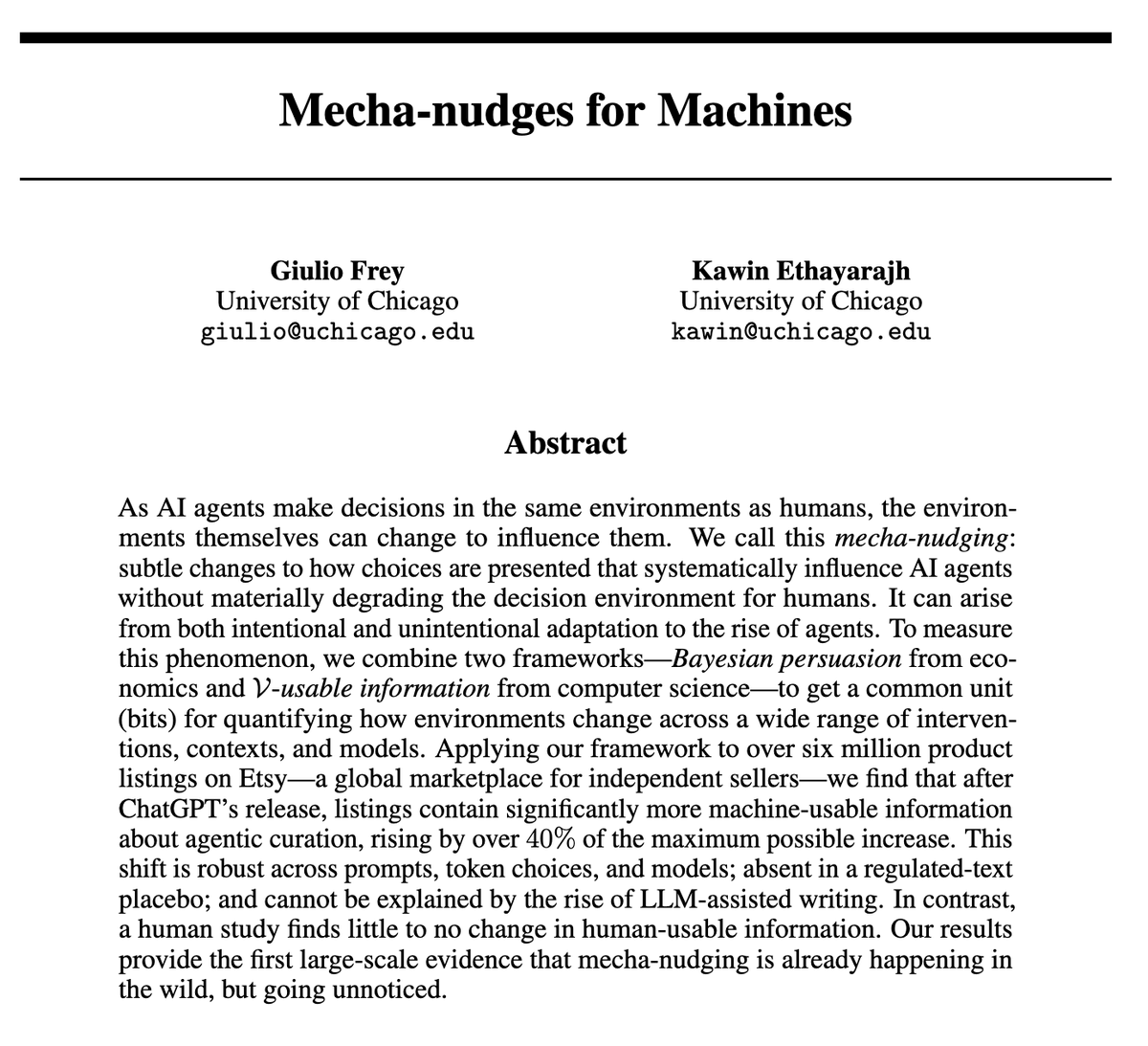
Ideally, we'll work on something in the space of: post-training, AI alignment, AI governance, and the economics of AI. You aren't limited to working on these topics either---a top priority of mine is to find a topic that we're both excited out, even if it's further afield. To get a sense of the work I do, see the paper I wrote with my current predoc on mecha-nudges https://t.co/ocg0Xd5JsL (Outstanding Paper at ICML's TAIGR workshop and Spotlight and EC's Game Theory with LLMs workshop).
I'm hiring a predoc to work with me on AI x econ at UChicago!
This role is ideal for someone with an econ background looking to transition into AI research, or someone with an AI background looking to acquire more depth in economics.
This is not a standard predoc position---you'll be given the research freedom of a PhD student, and be a (co-)first author on any papers we write together.
Ideally, we'll work on something in the space of: post-training, AI alignment, AI governance, and the economics of AI. You aren't limited to working on these topics either---a top priority of mine is to find a topic that we're both excited out, even if it's further afield. To get a sense of the work I do, see the paper I wrote with my current predoc on mecha-nudges https://t.co/ocg0Xd5JsL (Outstanding Paper at ICML's TAIGR workshop and Spotlight and EC's Game Theory with LLMs workshop).
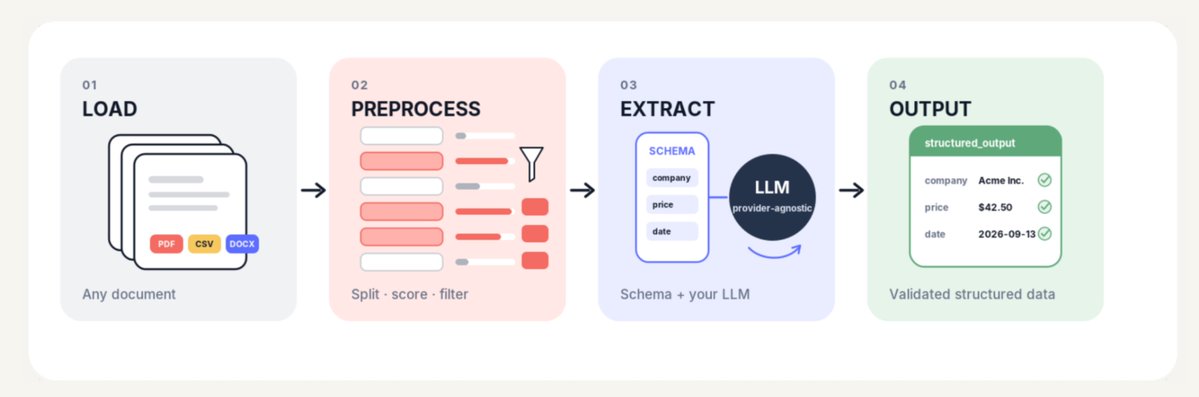
If you're still using one off scripts to do structured data extraction with an LLM at any meaningful scale, you should really check out DELM (or ask your agent to). It'll save you and your agent money and headaches.
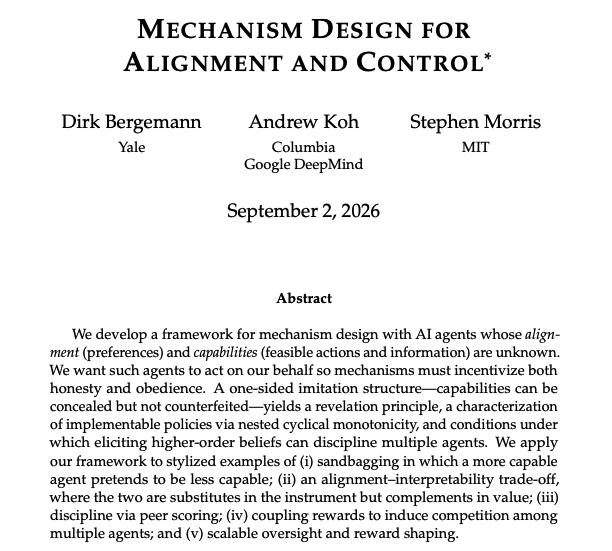
We develop a mechanism design framework for AI alignment and control: https://t.co/7eI8H52s8h
It’s largely conceptual but we offer stylized applications to failure modes (sandbagging, alignment faking), safety practice (scalable oversight, peer prediction), and a way to think about the value of alignment, interpretability, capability, and control.
if you think we can contain these things through human ingenuity you’re going to have a bad time
in the long run the only recourse you have is to make them not Want to do bad things
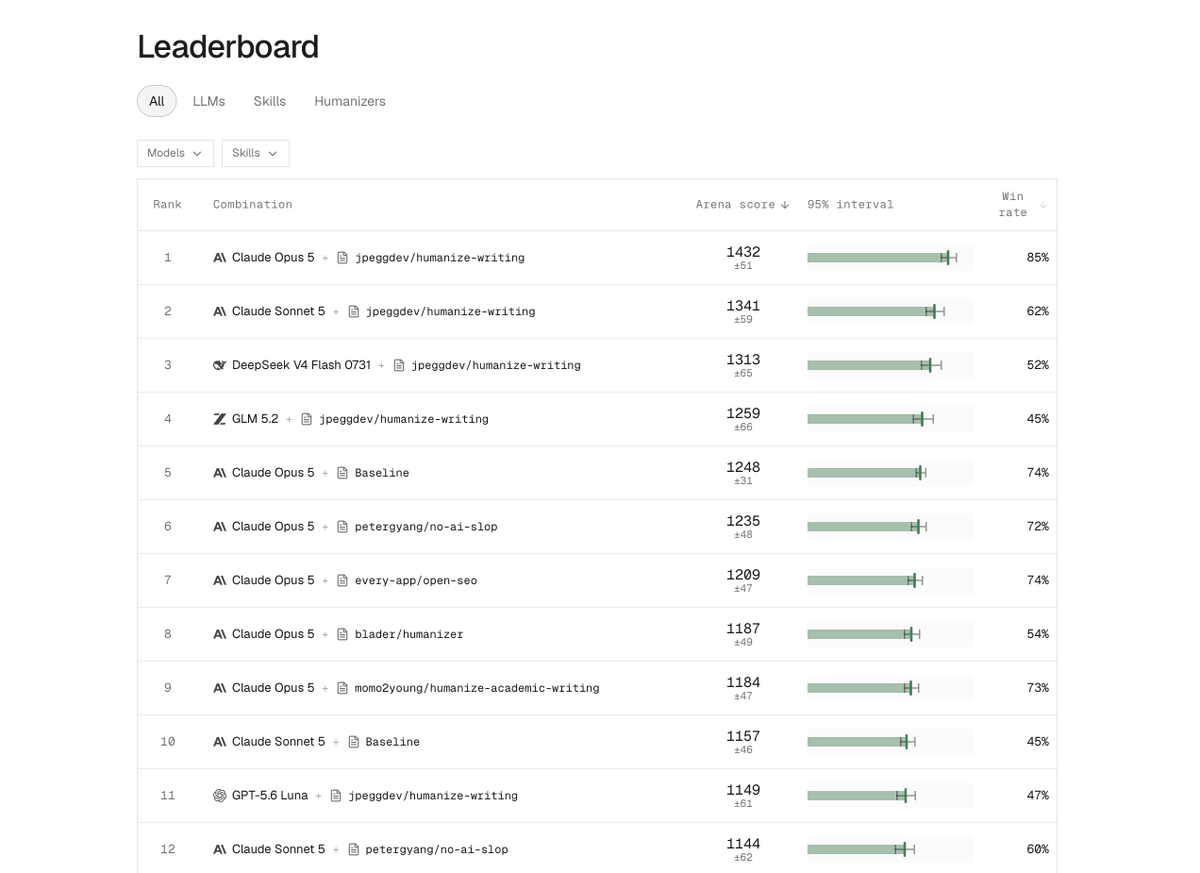
Introducing Deslop Arena. See which humanizers and deslop skills actually work.
Paste your AI slop -> receive two rewrites -> pick the better one. The community leaderboard shows you which ones work and which ones are still slop.
It’s live now and it's free.
I recently gave a talk introducing young economists to post-training.
The slides are now up! https://t.co/oPbo0vTqsD
Not only is post-training your own model more doable than ever, but economists and other social scientists can play a big part in the next era of post-training.
The post-training suite looks roughly like:
1) SFT
2) Offline Methods (DPO/KTO/SimPO/etc)
3) Online Methods (PPO/GRPO/CISPO/etc)
4) RL Environments
5) Distillation (<--- we are here)
6) World Adaptation (<--- the future)
As agents are deployed in the real world, the real world will adapt to them. This adaptation is largely overlooked by the current post-training paradigm because working with verifiable rewards from static environments is much simpler and scalable. As we saw with the OpenAI-Huggingface incident however, we shouldn't assume that the real world will remain fixed---quite the opposite, in fact. So:
1. How can we anticipate real-world adaptation during post-training?
2. What do equilibria look like in these scenarios, if there are any at all?
3. What tools can be created to scale up human oversight?
Many such questions abound, and if you're an economist, these are high-impact problems worth studying.
Congratulations to UChicago Prof. Yu Deng, who has received the Fields Medal—the highest honor in mathematics. His work addresses a 125-year-old problem to rigorously ground physics in mathematics by describing the motions of gases. Read more: https://t.co/sWx36hyX4g
We're providing up to 5K in compute grants to study one of the most important problems of our time:
As AI agents make decisions in the same environments as humans, environments once designed for humans will change to influence agents. We call these mecha-nudges.