동지·일몰·일출이 왜 몇 주씩 어긋나는지 자세한 이야기는 여기에 📚
More on why the solstice, earliest sunset and latest sunrise don't line up:
冬至と日の入り・日の出がずれる理由のくわしい話はこちら:
https://t.co/Q3EtBDQoyT
🇯🇵 日本語版: https://t.co/sr77KAnZRe
🙅 사실은 아니래요 · Myth Busted · 実は違うらしい 🇰🇷🇺🇸🇯🇵
해가 가장 일찍 지는 날은 동지? 사실은 아니래요 🌇
동지(12월 21~22일 무렵)는 낮이 가장 짧은 날일 뿐.
서울 기준 해가 가장 일찍 지는 때는 12월 초순(오후 5시 14분 안팎), 가장 늦게 뜨는 때는 1월 초순.
이유는 12월 내내 해가 남쪽 하늘 가장 높이 오는 시각이 날마다 조금씩 늦어지기 때문. 지구 궤도가 살짝 찌그러진 타원이고 자전축도 기울어 있어서, 12월엔 해의 하루가 24시간보다 약 30초 길어짐. 그래서 낮 전체가 시계 위에서 오후 쪽으로 밀림.
출근길이 가장 깜깜한 건 새해 첫 주 무렵. 12월 중순부터 퇴근길 하늘이 살짝 밝아지는 느낌은 착각이 아님 🙂
(일본 등 북반구 중위도도 비슷한 흐름)
Is the earliest sunset on the winter solstice? Actually, no 🌇
The solstice (around Dec 21–22) is just the shortest day.
In Seoul, the earliest sunset comes in early December (around 5:14 pm), and the latest sunrise in early January.
Why: in December, solar noon drifts a little later every day. Earth's orbit is a slightly squashed oval and its axis is tilted, so a "sun day" in December runs about 30 seconds longer than 24 hours. The whole stretch of daylight slides toward evening on the clock.
So the darkest morning commute comes around the first week of January, and if your evening sky feels a bit brighter from mid-December, you're not imagining it 🙂
(Much the same across the Northern Hemisphere's mid-latitudes.)
日の入りがいちばん早いのは冬至? 実は違うらしい 🌇
冬至(12月21〜22日ごろ)は昼がいちばん短い日というだけ。
ソウルでは日の入りが最も早いのは12月上旬(午後5時14分前後)、日の出が最も遅いのは1月上旬。
理由は、12月は太陽が南の空でいちばん高くなる時刻が毎日少しずつ遅くなるから。地球の軌道は少しつぶれただ円で、自転軸も傾いているため、12月の「太陽の1日」は24時間より約30秒長め。昼の時間帯全体が、時計の上で午後側へずれていきます。
だから朝の通勤がいちばん暗いのは新年の第1週ごろ。12月中旬から帰り道の空が少し明るく感じるのは、気のせいではありません 🙂
(日本など北半球の中緯度でも同じような流れ)
🔤 말의 뿌리 · Word Roots · 言葉のルーツ 🇰🇷🇺🇸🇯🇵
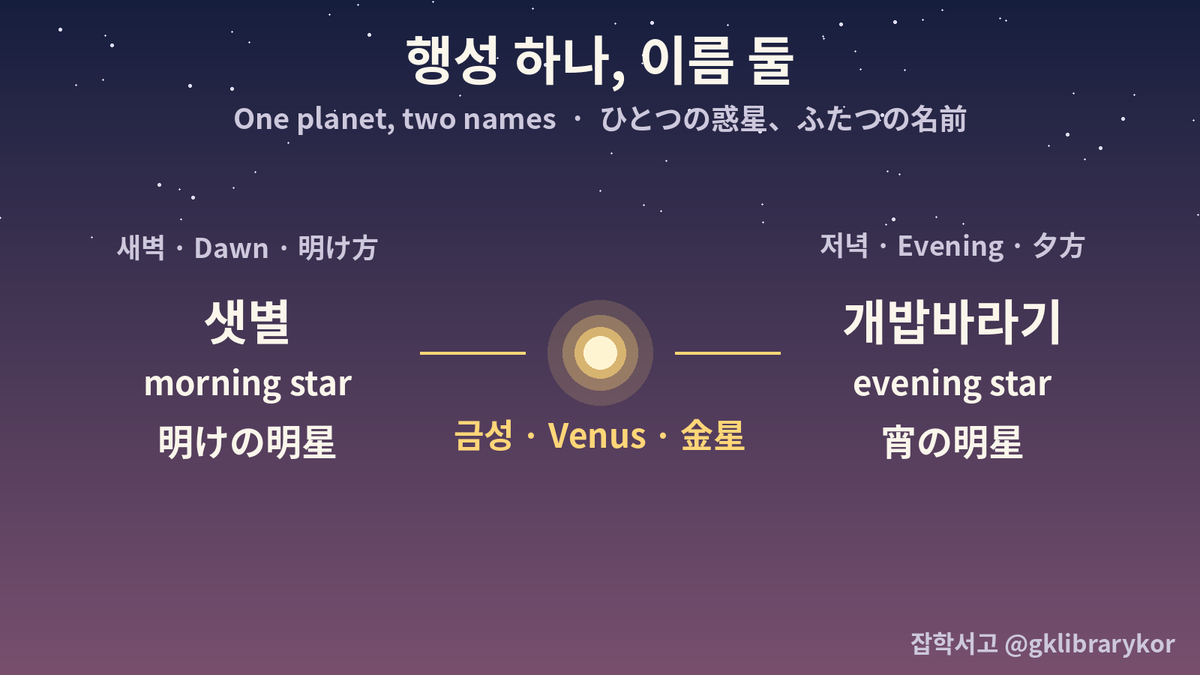
해 진 뒤 서쪽 하늘에 유난히 밝은 점 하나, 대개 별이 아니라 금성 ✨
금성은 지구보다 안쪽에서 해를 돌아서 해 곁을 멀리 못 떠남. 그래서 초저녁 서쪽이나 새벽 동쪽에만 보이고, 한밤중 높은 하늘엔 안 뜸.
옛사람들은 이 하나를 서로 다른 별로 알고 이름도 따로 붙였음.
우리말: 새벽엔 「샛별」, 저녁엔 「개밥바라기」(개가 저녁밥 기다릴 무렵 뜨는 별)
일본어: 明けの明星 / 宵の明星
영어: morning star / evening star
옛 그리스: 포스포로스(빛을 가져오는 자) / 헤스페로스(저녁)
말은 달라도 '행성 하나에 이름 둘'은 똑같은 셈.
That extra-bright "star" in the west right after sunset is usually not a star. It's Venus ✨
Venus orbits inside Earth's orbit, so it never gets far from the Sun. You only see it in the evening west or the pre-dawn east, never high in the sky at midnight.
People long took it for two different stars and named them separately:
English: the morning star / the evening star
Japanese: 明けの明星 / 宵の明星
Korean: 샛별 (morning) / 개밥바라기 (evening, "the star out when the dog waits for dinner")
Ancient Greek: Phosphoros, "light-bringer" / Hesperos, "evening"
Different languages, same idea: one planet, two names.
日が沈んだあと、西の空でひときわ明るく光る点。たいていは星ではなく金星です ✨
金星は地球より内側で太陽を回るので、太陽から大きく離れられません。だから見えるのは夕方の西の空か明け方の東の空だけで、真夜中の高い空には昇りません。
昔の人はこれを別々の星だと思い、名前も分けました。
日本語:明けの明星 / 宵の明星
英語:morning star / evening star
韓国語:샛별(明け方)/ 개밥바라기(夕方、「犬が夕ごはんを待つころに出る星」)
古代ギリシャ:フォスフォロス(「光をもたらすもの」)/ ヘスペロス(「夕べ」)
言葉は違っても、「ひとつの惑星にふたつの名前」は同じです。
파리 증후군의 원인과 비슷한 여행 증후군 이야기는 여기에 📚
More on Paris syndrome and other travel syndromes:
パリ症候群の原因や、似た旅の症候群のくわしい話はこちら:
https://t.co/EP1ty89xws
🇯🇵 日本語版: https://t.co/B4hm7x0FtT
🌍 나라마다 달라요 · Around the World · 国によって違う 🇰🇷🇺🇸🇯🇵
여행지에서 마음이 크게 흔들리는 증상, 도시마다 이름이 따로 있음 ✈️
🇫🇷 파리 증후군: 꿈꾸던 파리가 기대와 너무 달라서 오는 심한 혼란. 1980년대 파리에서 일하던 일본인 정신과 의사 오타 히로아키가 처음 쓴 말.
🇮🇹 스탕달 증후군: 피렌체 걸작 앞에서 가슴이 두근거리고 어지러움. 실망이 아니라 지나친 감동 쪽.
🇮🇱 예루살렘 증후군: 성지를 찾은 일부 순례자가 강한 종교적 망상에 빠짐.
모두 아주 드문 일. 파리 증후군은 정식 진단명이 아니고, 대부분 쉬면 회복됨.
기대는 조금 낮추고 호기심은 조금 높이기 😌
기대와 가장 달랐던 여행지, 어디였나요?
Some cities have their own name for travel shock ✈️
🇫🇷 Paris syndrome: severe distress when the dream Paris doesn't match reality. Coined in the 1980s by Hiroaki Ota, a Japanese psychiatrist working in Paris.
🇮🇹 Stendhal syndrome: racing heart and dizziness in front of Florence's masterpieces, from too much awe rather than disappointment.
🇮🇱 Jerusalem syndrome: a few pilgrims to the holy city slip into intense religious delusions.
All very rare. Paris syndrome isn't an official diagnosis, and most people recover with rest.
Lower your expectations a little, raise your curiosity a little 😌
Which trip surprised you the most?
旅先で心が大きく揺れる症状、都市ごとに名前があるんです ✈️
🇫🇷 パリ症候群:憧れのパリが想像とあまりに違って起こる強い混乱。1980年代、パリで働いていた日本人精神科医・太田博昭さんが初めて使った言葉。
🇮🇹 スタンダール症候群:フィレンツェの名作を前に、動悸やめまい。失望ではなく、感動しすぎて起こるもの。
🇮🇱 エルサレム症候群:聖地を訪れた一部の巡礼者が、強い宗教的妄想に陥る。
どれもごくまれ。パリ症候群は正式な診断名ではなく、多くは休めば回復します。
期待は少し低めに、好奇心は少し高めに 😌
想像と一番違った旅先、どこでしたか?