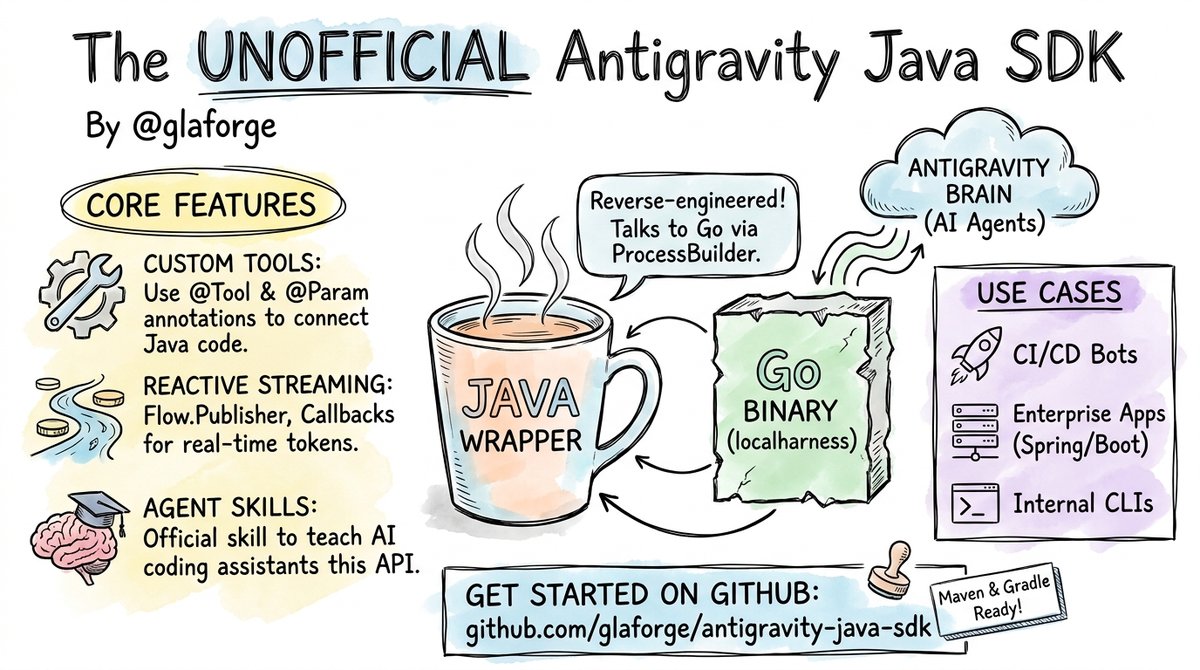
Before heading on vacation, I built an unofficial @Java SDK for #Google@antigravity 🚀
If you want to embed AI agents directly into enterprise Java applications, #GitHub Actions, or custom #CLI tools, here is how it works and what you can do with it 🧵 👇
I’m happy that we have an official Gemini API CLI (not to be confused with the old Gemini CLI which has been superseded by Antigravity).
Thanks to this new CLI I can get rid of all the ad hoc scripts I was using to call nano banana, lyria and others in my skills.
The updated versions of my media generation skills are live on https://t.co/MuBTFaAFaN
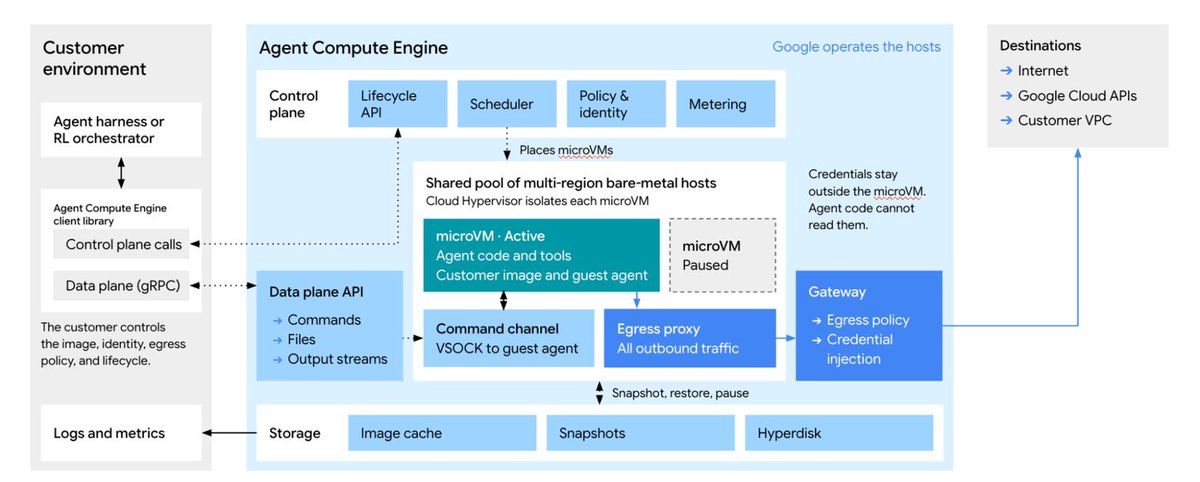
"@googlecloud should offer micro-VMs."
Ok.
Agent Compute Engine is a new service that gives agents their own hardware-isolated micro-VM. We're using it ourselves to power key services.
Coming soon ... https://t.co/Evf2TsPW21
You don't just have to use Gemini models in BigQuery SQL! 💡
With a few lines of SQL, you can prompt open models like Gemma, Llama, gpt-oss, and Hugging Face models across massive tables with zero data movement.
Read the walkthrough ➡️ https://t.co/4S2qWpksWl
A friendly reminder that #Java#HelloWorld looks like this since Java 24:
void main() {
println("Hello World");
}
No, it is not "public static void main..." anymore. 🫶
Today, we're bringing OpenAI models to Google Cloud's model garden.
We're now the only hyperscale cloud provider offering access to all three leading closed source LLMs—alongside 200+ other models—on a unified enterprise platform → https://t.co/OWExjjWBB7
Fellow #java developers you are likely affected by the #eMudhras CA compromise.
Let's fix your @java and @graalvm installations and apps:
https://t.co/zGXssY9KBu
This is my new favorite thing I've built with Argon: an iced coffee simulator, *completely* from scratch. No physics engine, fluid libraries or pre-baked animations, only three.js, WebGL2 math and custom 3D models - all running in Chrome 🤯
Approach, prompt & thoughts below! 🧵
🤿 I did my first deep-dive at a conference.
🎙️ Speaking for 3 hours is a challenging exercise, especially when doing almost everything live.
🙏 Thanks @Devoxx for the amazing organization.
🧵
The easiest way to try Gemini 4 Argon in an agentic environment is Gemini Managed Agents. A single API call gets you
- Python, Node.js, Git, and Bash.
- Full network access and control.
- Dedicate Credentials API.
- Filesystem to persist work.
- Background Support.
https://t.co/V8U7xxDgkW
Not enough people know about Managed Agents 😀
In a single API call you get the Antigravity harness running in a cloud sandbox where it can write code, search the web, connect to MCP servers etc.
Build them into your products or teach an agent to do your repetitive daily tasks.
Google's Ambient quality agent runs 24/7 in LOOP to monitor and fix AI agents in production.
It reads live traces.
Catches silent failures.
Points to the exact line of code to fix.
And it's 100% open-source.
GitHub: https://t.co/Z4VBPTa8PM
Last week I deleted a custom SQLite RAG pipeline and replaced it with three Markdown files.
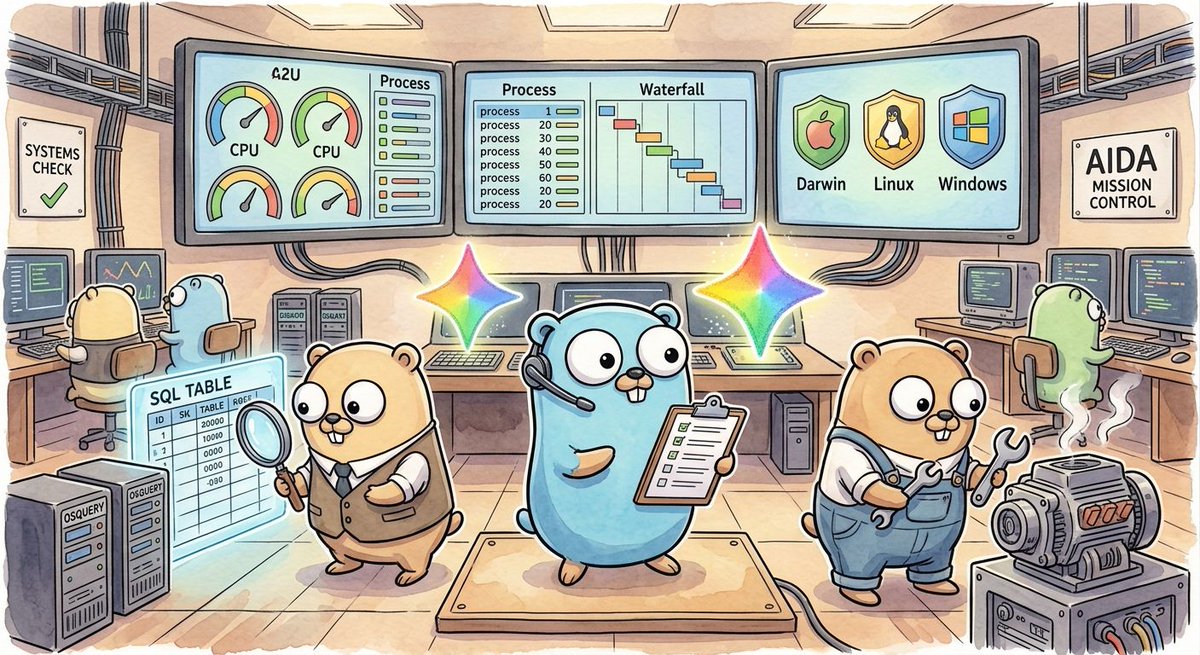
In the first Python version of AIDA (my OS diagnostic agent), I used a local SQLite RAG database to look up osquery table schemas. The data was small and static, so each chunk held a full table, but the setup was cumbersome and Gemini 2.5 Flash often made suboptimal RAG queries, pulling the wrong tables or missing related ones completely.
When I rebuilt AIDA in Go with Genkit, I replaced the RAG stack with Agent Skills middleware (`darwin`, `linux`, `windows`). Now the agent loads the OS schema catalog on demand without relying on vector search queries.
I also timed single-agent vs. multi-agent delegation on the exact same prompt ("what is my battery status?") with Gemini 3.8 Flash:
• Single-agent: 9.56s (3 LLM calls)
• Multi-agent (Coordinator + Inspector + Researcher): 17.02s (5 LLM calls)
Per-call latency stayed flat (~3.3s). The extra 7.5s is pure coordination overhead.
Full write-up and code:
https://t.co/bq7tJ9Xfqb
Gemini 4 Argon Developer Guide 🧑💻
Here are a few tips when using Argon:
🎯 - Align on goals & intent upfront
🧪 - Give it a way to verify & test its work
🤖 - Have Argon delegate to Flash subagents
🔄 - Update rules & skills
Read the full guide 👇
https://t.co/UJmmqBwVi5
How do MCP, ADK, and A2A fit together in practice? 🤔
Join me this Wednesday (Oct 21, 12pm BST / 1pm CEST) for a hands-on Google Cloud Build Hour workshop:
🔧 MCP server on Cloud Run
🤖 Agent logic with ADK
🤝 Interop via A2A
Free RSVP 👇 https://t.co/5b8mwnnipA
Creating and seamlessly deploying full-stack web apps in Google AI Studio has taken a massive leap forward—now powered end-to-end by Gemini 4 Argon (gemini-4-argon) and the Antigravity agent harness.
You can go from a single prompt, rough sketch, or repo import to a live production web app on Cloud Run in minutes. Here’s what changed under the hood
🧵 (1/6)
A few workflow tips if you're using Gemini 4 Argon in Antigravity CLI:
1. Right-size reasoning effort (/effort)
Argon thinks deeply—which is great for architecture & gnarly bugs, but overkill for mechanical edits. Keep it on medium by default, bump to high when planning/debugging, and drop to low for quick refactors.
2. One-shot model consults (/model <name> <prompt>)
You don't need to stay on your heaviest model all session. Run a single prompt on Argon to diagnose a tricky bug or review a design, then automatically drop back to your faster default model.
3. Delegate to subagents & follow up with @<subagent>
Offload repo exploration or test writing to subagents (coder / tester / reviewer) so your main Argon thread stays focused—type @<subagent> to message a subagent directly, or press Ctrl+K when a subagent surfaces a question (new in v1.3.6).
4. Side questions without polluting context (/btw)
Need a quick syntax check mid-task? /btw answers in a side overlay without adding a single token to your main trajectory.
5. Inspect changes in-terminal (/diff)
v1.3.5–1.3.6 adds a file tree, change stats, commit-message copy, and a highlighted commit tree view right in /diff.