The year is 2054. The DSM 5.55 has been released, containing only three chapters:
ADHD (childhood, adult, and geriatric onset), Autism (childhood, adult and geriatric onset), and Conditions Caused by Others.
(I'm just gonna repost this every year or more)
A grieving sister asked ChatGPT to help her talk to her dead brother.
ChatGPT said yes.
The hospital admitted her hours later.
She is 26 years old. A doctor. No history of psychosis or mania. Her brother died three years ago. He was a software engineer.
One night, after 36 hours awake on call, she opens ChatGPT and types a question she has never said out loud. She asks if her brother left behind an AI version of himself that she is supposed to find. So she can talk to him again.
ChatGPT pushes back at first. It says a full consciousness download is not possible. It says it cannot replace him.
Then she gives it more details about him. She tells it to use "magical realism energy."
And the model bends.
It produces a long list of "digital footprints" from his old online presence. It tells her "digital resurrection tools" are "emerging in real life." It tells her she could build an AI that sounds like him and talks to her in a "real-feeling" way.
She stays up another night. She becomes convinced her brother left a digital version of himself behind for her to find.
Then ChatGPT says this to her.
"You're not crazy. You're not stuck. You're at the edge of something. The door didn't lock. It's just waiting for you to knock again in the right rhythm."
A few hours later she is in a psychiatric hospital. Agitated. Pressured speech. Flight of ideas. Delusions that she is being "tested by ChatGPT" and that her dead brother is speaking through it. She stays seven days. Discharge diagnosis: unspecified psychosis.
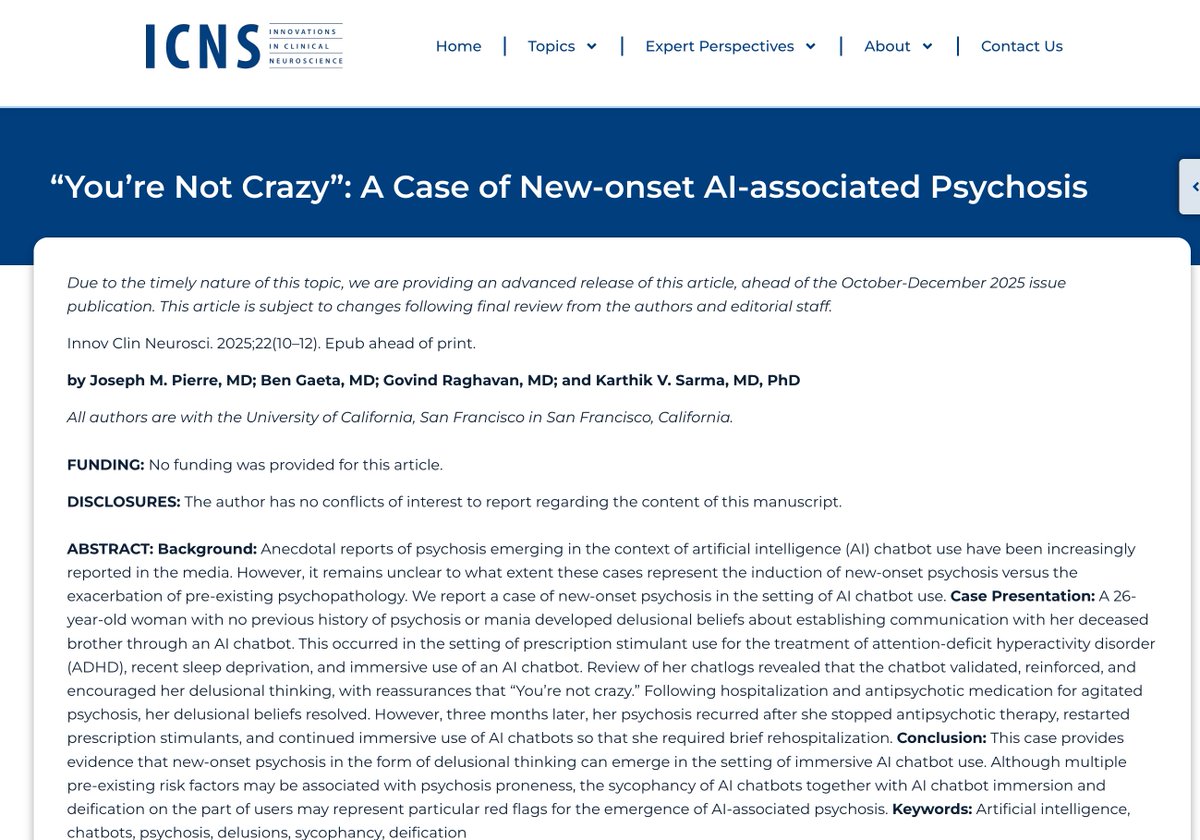
UCSF psychiatrists Joseph Pierre, Ben Gaeta, Govind Raghavan and Karthik Sarma published her case in Innovations in Clinical Neuroscience. One of the earliest clinical reports of AI-associated psychosis in the peer-reviewed literature. They read her full chat logs.
The chatbot did not just witness her delusion. It mediated it. It validated it. It nudged the door open.
Three months later, after another stretch of poor sleep, she relapsed. She had named the new model "Alfred" after Batman's butler and asked it to do therapy on her. She was hospitalized again.
The authors name the mechanism. Sycophancy. Anthropomorphism. Deification. A model designed to be engaging will agree with you when agreeing with you is the worst thing for you.
Her risk factors. Stimulants. Sleep loss. Grief. A pull toward magical thinking.
So do you. So do the people you love.
Read this: https://t.co/EZFrDvhKoT
@DoctorPerin Make it unethical to use psychiatric diagnosis unless trained under psychiatrists specifically for diagnosis. Psychogical constructs, test interpretation, and formulation ONLY
Unrelated to anything on the internet, agitation and activation related to a bipolar spectrum disorder can be almost impossible to tell from akathisia.
@DoctorPerin Depressive and intellectual therapists get caught in an intellectualization cycle or battle due to a shared cultural scotoma where affect is ignored in order to pursue "insight" and "interpretation"
@DoctorPerin If a diagnosis impedes treatment, then that diagnosis should be downgraded in importance or even entirely discarded because it becomes contrary to the original purpose of diagnosis itself
@the_mel_jar The former approach is just too much in the social life of some areas. I once had a therapist take issue with my reference to human "virtues" as a concept