Zaluzhnyi literally says that NATO will need around 12 years to reach even half of Russia's current military level.
Meanwhile, top Russia analysts in leading international outlets are baffled as to why "weakened Russia" keeps fighting. Putin's delusions, what else could it be?
The Western reliance on and promotion of East European ultranationalism over decades would have always boomeranged back. You pretend you are fighting Putin, but you nourish a myriad of Putinoid forces in post-communist countries and facilitate Putin-styled securocraric state capture in your own major Western states, to sum up what neocons and neolibs have been doing during this century.
After this absolutely meaningless war, longer than was WW2 for the Soviet Union, launched light-heartedly by Putin, but with unnecessary tensions and unfriendly moves leading to the war made by both sides, Russia and Ukraine will (if the war ends w/o the use of nuclear weapons) boast at the end of the war the following results.
● About 2 million killed and disabled citizens in total, mostly males which will additionally destabilize gender balance that was already bad.
● Destroyed large parts of infrastructure (heating plants, refineries, warehouses, roads, bridges), and also hospitals and schools, Most of it inherited from socialism which did build things that current regimes have a pleasure to destroy.
● Openly crazy nationalist regimes whose main educational task is to twist history in a pro-fascist direction--while, unlike socialist education, not providing any uplifting and positive message re. the future: ideologies of gloom and hopelessness, of soil and blood.
● In addition to the military losses, both countries will lose millions of citizens who will emigrate for good.
● They would lose best actors, physicists, writers, AI specialists, doctors. In many areas the damage will take two or three decades of peace just to be fixed.
● Ukraine will remain an armed camp, with half of its pre-war population only, and with most of its valuable assets owned by foreigners. It will be part of the EU with constant fights there arguing that no economic aid will ever be a sufficient compensation for Ukraine's human sacrifice.
● Its ideology & art will be extremely nationalistic, with probably being the only country in Europe officially celebrating Nazi fighters.
● Russia will remain for a long time totally cut off (economically, politically and culturally) from Europe which is its natural cultural milieu. It would produce art of ersatz nationalist quality compared to which socialist realism could be considered a top artistic creation.
● Its proponents will mouth-off nonsensical things about Christian values while murder rates, domestic violence, abortion and alcoholism will be at all-time European and Asian peaks.
● Both countries will decline demographically, economically, politically and culturally. And given low population growth rates, it does not seem that they would recover any time soon (I am speaking of half-a-century or more and assuming no new wars).
So enjoy the continued war!
Wij maken ons ernstig zorgen over het lot van onze zeer gewaardeerde collega Pieter Rambags, die met anderen ontvoerd is door IDF.
Help mee om te protesteren tegen deze volstrekt illegale daad!
@MinBZ moet alles in werk stellen om te zorgen dat deze NL burgers veilig terugkomen!
"D’Anieri argues that the typical approaches to understanding the conflict contradict each other: on the one hand we have a focus on Russian revanchism. Others focus on the war as a result mainly of the domestic logics of autocracy. A third ‘school’ blames the West for expansion of NATO, and partly Ukrainian nationalism."
I would offer a different classification. Most belong to one of the three camps above, each tending to deny or severely downplay the evidence produced by the other camps.
There are also those who try to combine arguments and evidence, but in a rather eclectic way. Susan Watkins's article "Five Wars in One" is an example — it is not clear where to stop enlisting all the relevant conflicts. D'Anieri's book, and your summary of it, also falls into this category.
A third approach — still a small minority — attempts to offer an integral argument, incorporating the most important evidence generated by the dominant camps into a theoretically coherent explanation. My own, admittedly still draftish, argument about post-Soviet class conflict is one such example. But there will be, and should be, more attempts. A good sign of progress in this direction would be a diminishing reliance on "contingency" and "agency" as explanatory moves.
I spent the last 24 hours digging into the economic impact of the Iran war. Here's what I found (brace for a long post): The Hormuz Shock: Economic Repercussions of the Iran War.
Key insights:
👉Optimistic scenario: War ends within two weeks. This is painful but might be still manageable in advanced economies. However, even the record release of 400 million barrels of oil did not calm markets.
👉Pessimistic scenario: Strait of Hormuz stays closed past March: massive global inflationary pressure and recession, a 1970s-style stagflation becomes likelier day by day.
👉Biggest economic victims outside Iran: Iraq and Lebanon. Energy and financial crisis in many Global South countries is already imminent.
👉Gulf countries will weather the storm in the short term, but their diversification plans were built on the image of stability, and that image received a blow.
👉Biggest economic winner so far is Russia, but US arms manufacturers and LNG exporters also profit through higher LNG prices.
Staring Into the Abyss
Twelve days into the U.S.-Israeli war on Iran, the global economy is experiencing its most severe supply-chain disruption since the 1973 oil embargo. The effective closure of the Strait of Hormuz has removed not just a fifth of the world’s oil and LNG from the market, but a third of global fertilizer exports, nearly a quarter of the world’s aluminum outside China, and a third of global helium production, a vital component in semiconductor manufacturing.
We are not only talking about an energy crisis in the conventional sense. We are looking at the making of a global commodity shock transmitting simultaneously through energy, industrial, agricultural, and chemical supply chains. These are ingredients for an inflationary perfect storm.
Every major energy crisis of the past half-century has been geopolitically driven: 1973, 1979, 1990, 2022, and now 2026. What distinguishes the current shock from its predecessors is its breadth. In 1973, it was oil. In 2022, the disruption was primarily gas. In 2026, the chokepoint disrupts a range of commodities at once. We are not in a major crisis scenario yet, though we’re approaching it rapidly.
The Most Recent Predictions
The economic trajectory depends almost entirely on how long the Strait of Hormuz remains closed. We can identify two scenarios, and the window for the optimistic one is narrowing fast.
Optimistic scenario: If the war ends within one to two weeks, not dragging beyond March, and Hormuz begins reopening at the latest by early April, the economic damage is contained, at least for advanced economies, though Global South countries might still suffer. Based on existing research on energy price shocks, this scenario would shave half a percentage point off global growth and add up to one percentage point to global inflation.
Reserves exist in the system, winter has just ended, and there is no immediate gas crunch in Europe. In this scenario, a Goldman Sachs report released on March 11 predicts oil averaging roughly $100 per barrel through March and April. On gas, Goldman projects the European benchmark price (TTF) reaching €55–74 per megawatt-hour, which is very painful but manageable, roughly the level that triggered demand responses during the 2022 crisis. Summer gas storage refilling becomes more expensive but feasible.
Even in this best case, however, the effects outlast the war: shut-in oilfields take weeks to restart, damaged infrastructure at Qatar’s Ras Laffan complex and Saudi Arabia’s Ras Tanura needs physical repair, and gas prices remain elevated for months, with the benchmark gas price lower floor shifting permanently upward from the pre-war €25–30 range to €45–55. This means elevated gas prices throughout energy-importing countries.
As of March 12, the optimistic scenario’s window is shrinking. Brent surged ten percent back above $101 overnight, despite the IEA’s record reserve release the previous day. Two tankers were attacked in Iraqi waters. Oman cleared all ships from its key export terminal as the country’s oil depots were hit. Hundreds of tankers are stranded on both sides of the strait, we no safe passage at sight.
Pessimistic scenario: If the Strait remains closed beyond March, the economic disruption gets out of hand. Recession in Europe and Japan, severe slowdown in the US, China and India, and deep crisis across the energy-importing Global South.
Goldman’s modeling suggests benchmark oil price (Brent) reaching $150 per barrel as inventories hit critically low levels. The gas dimension makes this scenario even more dangerous. Industry-related analysts predict European gas prices reaching €85–92 per megawatt-hour under a prolonged ninety-day closure.
A Bank of America analyst calculates that each month of lost Gulf LNG supply removes approximately ten percent of total European gas storage, meaning ten weeks of disruption could push first-quarter 2027 gas prices above the 2022 highs. Goldman Sachs also warns that a disruption lasting more than two months would push European gas above €100 per megawatt-hour, at which point industrial demand begins shutting down across the continent.
At $150 oil combined with gas at €85–100+, we’re entering major economic crisis terrain. Research consistently shows that fossil price spikes of fifty percent or more above trend have almost always preceded recessions, and at $150 we would be well past double that threshold. The global economy is already weakened by tariff wars and post-pandemic fragility, leaving far less cushion than usual.
A Historic Release of Oil Reserves
The International Energy Agency's decision on March 11 to release 400 million barrels of oil from member countries' strategic reserves represents the largest emergency intervention in the agency’s fifty-two-year history. It represents roughly a quarter of total IEA strategic reserves and signals the depth of governmental alarm.
The market calm it was designed to produce lasted approximately twelve hours. By the following morning, Brent was back above $100. Three limitations deserve emphasis.
First, strategic reserves are a psychological instrument, and psychology breaks down when the physical disruption is accelerating rather than stabilizing. There is no overland alternative to oil shipping through the Strait. Saudi Arabia can divert some crude through the East-West pipeline to the Red Sea, but at a fraction of Hormuz’s capacity. Iraq, Kuwait, and Qatar have no such option.
Second, there is a logistic mismatch. The world is losing over twenty million barrels per day through the Hormuz closure, but IEA stock releases have historically never exceeded approximately two million barrels per day. The reserves therefore only provide a long-term supplement; they cannot replace Gulf flows.
Third, and critically, the reserve release is for oil only. It does nothing for gas, LNG, fertilizers, aluminum, or petrochemicals. The oil market receives psychological intervention; every other disrupted commodity market is on its own.
The Unintended Beneficiary: Russia
European Council president António Costa stated it with unusual bluntness: “So far, there is only one winner in this war: Russia. It gains new resources to finance its war against Ukraine as energy prices rise.” Russian crude is now selling at approximately $90 per barrel, up from roughly $50 before the war. The United States has already granted India a thirty-day waiver to purchase stranded Russian oil at sea. Sanctions enforcement is loosening under the pressure of the price spike.
The structural irony is difficult to overstate. The United States launched this war partly to reshape the Middle Eastern balance of power, but the immediate economic beneficiary is Moscow. To defend against Iran’s economic weapon (the Hormuz closure) Washington is loosening its own economic weapon against Russia. The two geopolitical objectives are in direct contradiction.
The political consequences within Europe are already visible. Hungary’s Viktor Orbán has written to EU leaders demanding that sanctions on Russian energy be suspended. Slovakia’s Robert Fico has echoed similar rhetoric. Putin is already threatening to cut remaining gas supplies before Europe’s own phase-out deadline, attempting to weaponize the crisis. If sanctions are not enforced, Russia replenishes its war budget, which could fundamentally alter the Ukraine war dynamics.
It’s worth noting that the United States is not a straightforward loser either. While American consumers will face rising fuel costs, the country’s LNG exporters stand to profit handsomely as Europe and Asia scramble for non-Gulf supply, and the defense industry is experiencing a surge in demand as the US and Israeli military refill their depleted munitions and Gulf states also rush to replenish their missile stocks and upgrade air defenses.
Impact on Europe
European officials have insisted that the continent is better positioned than during the 2022 energy crisis, having diversified supply sources and built new LNG infrastructure. This is partly true and partly complacent.
The upside: Germany built floating LNG terminals in record time after 2022, supply chains are more diversified, gas consumption has fallen, and renewables, especially solar in southern Europe, are more prominent. Direct EU dependence on the Middle East is limited. The G7 and IEA coordination this time has been faster and more decisive.
The risks: Europe entered 2026 with gas storage at critically low levels. Germany and France are at thirty percent, the Netherlands at twenty-three percent. This is the worst starting position in years, precisely at the beginning of the season when storage must be refilled. The EU has a legal obligation to reach eighty percent capacity by November. If Qatari cargoes remain offline and Asian buyers outbid Europe for available LNG, that eighty-percent target becomes extremely difficult to reach, and gas prices are bound to skyrocket.
The macroeconomic context compounds the difficulty. In 2022, the European Central Bank could raise rates aggressively because growth was still recovering from the pandemic. Now Europe faces an energy shock on top of American trade war, with already sluggish growth. Before the war, the ECB was worried about inflation undershooting its two-percent target. The war has inverted the entire calculus overnight. Rate cuts are off the table; hikes become likely if oil stays above $100. The next ECB meeting on March 18 will be critical. ECB President Christine Lagarde has already signaled that the bank will “do everything necessary to keep inflation under control.” If that means a rate hike, it could freeze Europe’s fragile economy.
Impact on the Gulf Economies
For the Gulf Cooperation Council states, this crisis arrives at a uniquely inopportune moment. Their “Vision” economic diversification strategies aim to transform oil-dependent economies into hubs of aviation, tourism, finance, technology, and human capital. However, these visions are built on a single foundational premise: the perception of stability. The attacks on Gulf countries attacked that premise too.
In the short term, GCC economies face a counterintuitive problem: global oil prices are elevated, which should mean revenue windfalls, but they cannot export because the Strait is closed and domestic storage is filling. They are experiencing the costs of a war economy without the windfall that high prices would normally deliver. According to the Financial Times, several Gulf states are already reviewing their Western investment commitments and exploring force majeure clauses in existing contracts to alleviate anticipated economic strain.
In the medium term, the costs of restarting damaged and shuttered infrastructure will be substantial. Qatar’s energy minister warned that restoring LNG production could take weeks or months even after the conflict ends. Aluminum smelters, which depend on imported alumina arriving by sea through the Strait, typically hold only three to four weeks of feedstock inventory; prolonged closure means production shutdowns that take up to a year to fully reverse. Airspace closures have grounded airline fleets across the region. These are the world’s biggest aviation hubs; it will take months to clear the backlog.
The long-term damage may be reputational, and therefore structural. When Amazon Web Services data centers are hit by drone shrapnel, when ports are burning, when hotels are struck by Iranian missiles, these are not just temporary inconveniences. They alter the region’s perception. GCC countries have worked hard to attract foreign investors, multinational corporations, and a global talent pool projecting themselves as oases of modernity in a desert of instability. The big question is how to recreate that image.
Middle East Economic Damage
Iraq is arguably the worst-hit country outside Iran itself. Oil production has plunged roughly sixty percent, because tankers simply cannot load at the country’s ports. Iraq exports almost all of its oil through the Strait of Hormuz; it has essentially no alternative route. Oil accounts for close to fifty percent of GDP and ninety-nine percent of total exports. Unlike Saudi Arabia or the UAE, Iraq has no sovereign wealth fund and no budgetary rules for managing oil revenues. The oil shutdown costs the country an estimated $128 million per day.
An analyst at the Royal United Services Institute warned that a prolonged suspension of oil revenues and any delay in paying public-sector salaries could “turn the country into a powder keg.” Compounding the catastrophe, Iraq imports more than thirty percent of its electricity generation from Iranian gas, and Iran’s own energy infrastructure is being systematically destroyed. Iraq faces an energy import crisis and an energy export crisis simultaneously, without having fired a single shot.
Lebanon, already in economic collapse, is another major casualty of this crisis. The country now faces renewed Israeli strikes on Hezbollah targets, destroying whatever fragile stabilization had taken hold. Egypt’s president declared a “state of near-emergency” citing growing inflation. The Suez Canal accounts for roughly fifteen percent of the country’s foreign currency receipts, and transit revenues have still not recovered from the Red Sea crisis. Higher oil import bills on top of lost canal revenue represent a fiscal nightmare for a country already under IMF supervision. Jordan’s three economic pillars (tourism, phosphate exports, and trade through the Port of Aqaba) have been serially disrupted by successive crises since COVID-19.
The Global South: Already In Crisis
When analysts describe the optimistic scenario as “contained and manageable,” they mean manageable for rich countries. For much of the developing world, the crisis is already acute.
Pakistan imports forty percent of its energy and relies heavily on Qatari LNG that has been completely cut off. Long queues have formed at fuel stations as supplies dwindle. Pakistan’s central bank will likely have to raise interest rates despite economic fragility; the worst of both worlds. India, which sources half its crude imports from the Gulf, has more than 400,000 metric tons of basmati rice stuck at ports because shipping lanes are disrupted.
The Philippines sources ninety-six percent of its oil from the Gulf; its currency is depreciating and oil supply is severely affected. Pacific Island states spend five to fifteen percent of GDP on energy imports; for them, even a temporary spike at $100 per barrel is an existential budget crisis. Across Africa, Bloomberg estimates that every twenty-dollar-per-barrel increase in oil prices reduces South Africa’s GDP by roughly one percent and the Democratic Republic of Congo’s by approximately three percent.
The crisis is not abstract. In India, restaurants are warning of possible shutdowns as the government redirects gas supplies to households. Thailand has suspended overseas travel for civil servants and instructed them to take stairs rather than elevators to conserve energy. The Philippines has introduced a temporary four-day work week for some government agencies. Vietnam is encouraging people to work from home. This is what “contained and manageable” looks like outside the advanced economies, twelve days into a conflict that may not end for weeks.
The compounding mechanism makes the Global South’s position particularly precarious. Energy prices spike, currencies depreciate against the dollar as investors flee to safe havens, and dollar-denominated energy imports become even more expensive in local-currency terms: a vicious cycle. Financially fragile countries like Laos, Sri Lanka, Pakistan, and Bangladesh face simultaneous capital flight and renewed debt distress.
The fertilizer-to-food transmission channel adds another layer: a third of global fertilizer exports come from the Gulf shipped through the Strait. If farmers cannot afford fertilizer, yields drop and food prices spike months later. The 2008 and 2010–11 food price shocks contributed directly to political instability across the Middle East and North Africa.
The distributional asymmetry is the point that deserves the sharpest emphasis. The countries that initiated this conflict are the most insulated from its economic consequences. The United States, now a modest net energy exporter thanks to the shale revolution, even benefits slightly from higher global energy prices in aggregate. The poorest, most energy-import-dependent countries that had no voice in the decision to go to war bear the heaviest costs.
This asymmetry is the structural injustice at the heart of every geopolitically driven energy crisis since 1973. The pain is distributed in inverse proportion to the power to inflict it.
#Iran #Crisis #Recession #Inflation @GUQatar
sinds wanneer heeft DNB 'bijdragen aan geopolitieke veiligheid' in haar mandaat staan? zelfde vraag die je bij het klimaatactivisme van DNB kon stellen, kan je ook stellen bij dit Atlanticistische activisme... Wees consequent, en wijs deze extra wapengelden af...
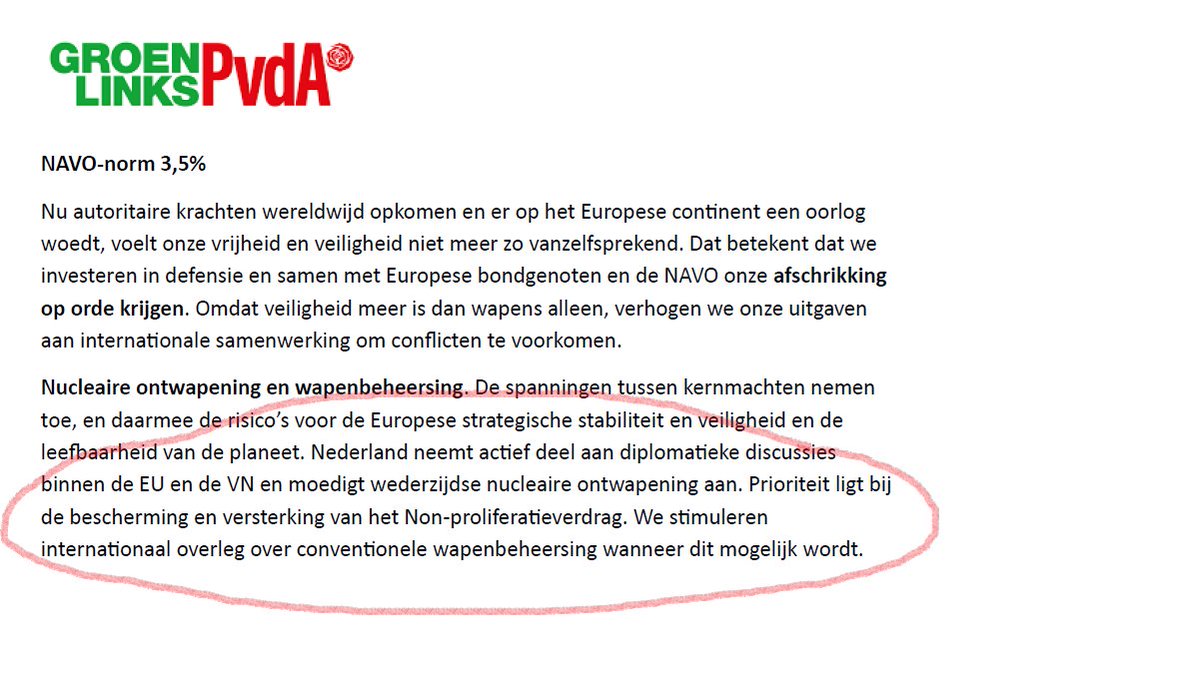
Eerlijke verhaal lijkt me: @gl_pvda steunde Trumpnorm v 5%; te verwachten was dat extra's voor defensie (19 miljard) uit potten voor sociaal& zorg zouden komen, zoals Rutte ook aanbeval.
Door geen werkelijke oppositie te voeren is ook GL-PvdA verantwoordelijk voor dit resultaat
US Abraham Lincoln carrier strike group with multiple destroyers reaches Middle Eastern waters - Its presence reinforces at least three F-15 squadrons already stationed nearby, along with additional US air defense batteries deployed in recent weeks https://t.co/3Vce4WOMLp
@LeftLaser Die is in september 2024 begonnen met de opbouw van de Nieuwe @vredesbeweging_ , een breed platform van nu 28 vredesorganisaties. @LeftLaser is van harte welkom aan boord!
Meedoen? Meld je hier aan: https://t.co/xU5Dw5zUka