Equity manager and global strategist for over 30 years, managing private client stock & ETF portfolios. Portfolio manager of the Armatura Fund in Autopilot.
OK…now this is getting interesting for $LEU.
Just days ago I posted about Radiant signing a multi-year agreement with Centrus for HALEU—and actually PREPAYING Centrus to help expand the capacity needed to produce it.
Surprisingly, it’s happened again.
Antares Nuclear has signed its own multi-year HALEU contract with Centrus. Deliveries don’t even begin until before the end of the decade—yet, like Radiant, Antares is already making prepayments to help Centrus build additional enrichment capacity.
Think about the message that broadcasts.
Advanced-reactor companies aren’t simply saying, “We’ll need HALEU someday.” They’re essentially saying, “We need to make sure our fuel is there when our reactors are ready—and we’re willing to put big money down years ahead of time to secure it.”
One contract is encouraging, but two in a matter of days starts to look like a pattern.
And for $LEU, that may be the real story: demand for advanced nuclear fuel isn’t just showing up in projections anymore.
Customers are quickly reserving their place in line.
“It takes 10 years to double your money overnight.” One of my favorite sayings, but I don’t like waiting 10 years. I like watching the volume, waiting for the trend to accelerate…and THEN moving.
That’s exactly what I believe is happening right now with the AI data-center buildout.
Consider the scale:
Nearly 3,000 data centers are planned or under construction across the U.S.
Across North America, roughly 66 gigawatts of new data-center capacity is already under construction—and about 95% of it is already committed to customers.
Demand in the first half of 2026 was roughly 2X where it was a year earlier and 5X where it stood just two years ago.
This isn’t somebody’s 2035 forecast.
The buildings are going up now and that means somebody has to provide the processors, somebody has to move the data, somebody has to cool the facilities, and somebody has to provide an almost unimaginable amount of electricity.
That’s why two of my largest positions in the Armatura portfolio on Autopilot are ARM and Marvell exposure—roughly 10% each.
$ARM sits at the heart of the computing architecture increasingly being used across cloud and AI infrastructure.
And $MRVL caught my attention for a different reason:
As these AI systems become larger, moving information between thousands of processors becomes a bottleneck.
Marvell is one of the companies helping solve that problem with optical technology—moving enormous amounts of data with light instead of relying solely on traditional electrical connections.
Optical connectivity already represents roughly half of Marvell’s data-center business, and Marvell just expanded its manufacturing agreement with GlobalFoundries to secure additional production capacity.
That tells me something. They aren’t waiting for the AI infrastructure boom to arrive. They’re preparing for the demand that is already showing up.
The AI story is no longer just about Nvidia and GPUs. There is an entire infrastructure ecosystem being built around them—and the scale of that buildout may be one of the biggest investment stories of this decade.
$ARM $MRVL
Wall Street changed this week—and it may take some time for investors to fully realize what just happened.
For six months, my volume work has been showing persistent activity in crypto, $COIN, $HOOD, silver and gold. In May, it appeared to be money positioning for passage of the CLARITY Act and a friendlier crypto environment. When that legislation stalled, I wrote off this catalyst.
But it turns out I was watching the right stocks for the wrong reasons. The SEC just opened a five-year runway for certain tokenized U.S. stocks. At virtually the same time, the Nasdaq is preparing to extend trading hours to 23 hours a day beginning December 6.
My read? The administration made a brilliant pivot. If the legislative path wasn't there for the tokenized future, then the SEC was offering another path.
Put the pieces together: tokenized stocks, fractional shares, nearly around-the-clock trading, and platforms like $HOOD and $COIN increasingly bridging traditional Wall Street and the digital financial world.
This isn't my generation's stock market anymore.
When I joined AutoPilot as a portfolio manager in April, I could have taken the traditional RIA route—build relationships, gather assets and develop a book of clients. Instead, I made a bet that the next generation would be much different: more proactive, more technology-driven and far more willing to choose a portfolio manager based on a visible track record.
Less “I’ve known my adviser for 20 years, so I’ll trust the buy-and-hold plan.” More “show me how you intend to manage my money through BOTH bull and bear markets.”
I think the next generation of investors will demand more than a relationship. They’ll want transparency, a visible track record and the ability to choose a strategy that can actually adapt as markets change.
That's why what happened this week caught my attention.
I still don't completely understand why gold and silver keep appearing alongside this shift in my work. But something has been brewing for months, and now the pieces are finally beginning to fall into place.
This feels bigger than crypto. Bigger than extended trading hours.
We may be watching the architecture of investing itself change in real time.
This is much bigger than simply putting stocks on a blockchain.
These are real shares with the same dividends and voting rights—not digital tokens that merely copy a stock’s price.
If platforms such as $HOOD and $COIN can make this reliable and easy to use, stocks may eventually begin trading more like crypto: already with longer hours Dec 6, faster transfers and fewer barriers between markets.
The five-year exemption is the test. The real question is whether those conveniences can be delivered without sacrificing investor protection.
Is $RIOT really just a Bitcoin story anymore?
I’m noticing an interesting pattern.
Nadia Carlsten—who previously held leadership roles at Amazon Web Services and later helped launch a sovereign AI supercomputer with NVIDIA—recently took over $BIRD after the former Allbirds sold its shoe business and made a dramatic pivot into AI infrastructure.
Now look at $RIOT.
Riot doesn’t have to invent the infrastructure story. It already has something AI companies desperately need: massive amounts of POWER and the facilities built around it.
Now 241 MW is contracted to major AI customers, representing roughly $9.8 BILLION in long-term contracted revenue.
Bitcoin mining is still a major business for $RIOT today.
But I think the more interesting question is:
Are we watching another company discover that its future business may be worth considerably more than the one it was originally built for?
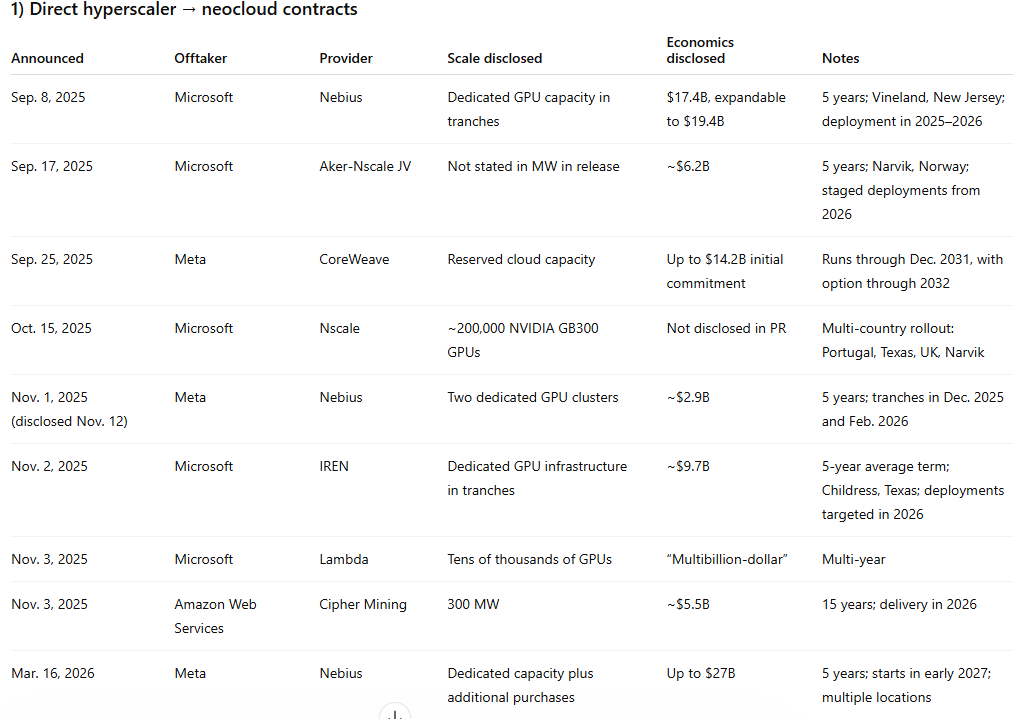
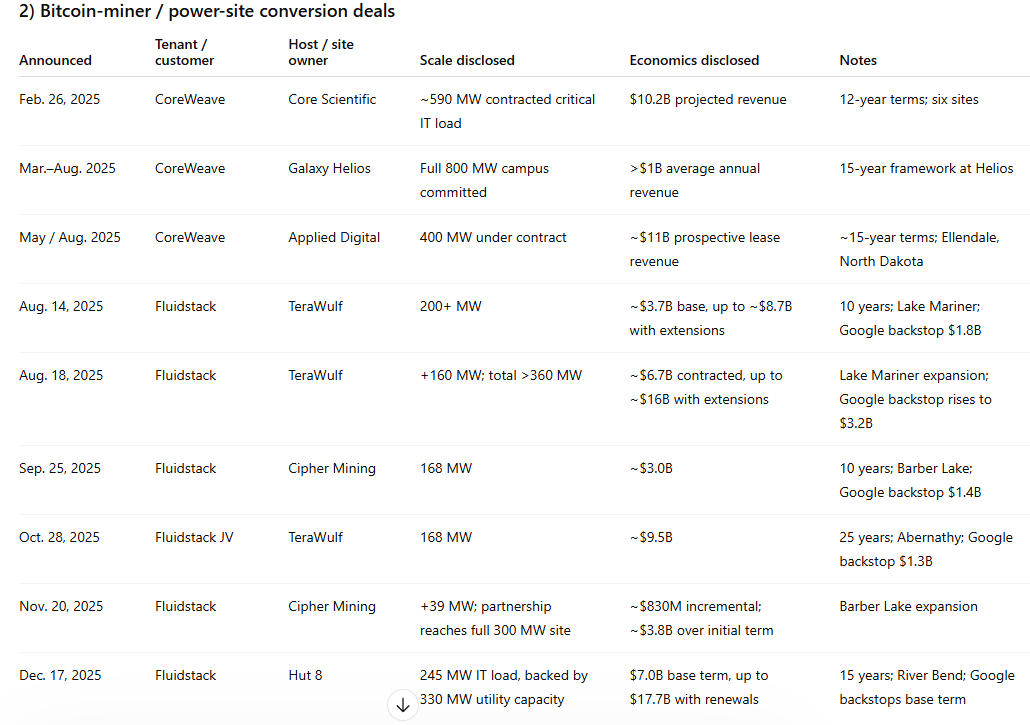
Updated view on the announced neocloud and bitcoin miner / power-site conversion deals, compiled from company filings and releases via ChatGPT
>On one side, hyperscalers are writing very large direct capacity checks to neoclouds like Nebius, CoreWeave, Nscale, IREN, and Lambda. On the other, AI clouds and hyperscale-adjacent tenants are converting bitcoin-era power campuses into AI infrastructure at scale.
>Direct hyperscaler -> neocloud deals: 9 signed deals; 7 with explicit values; $82.9B disclosed; median tenor = 5 years; average disclosed deal size = $11.8B.
>Bitcoin miner / power-campus conversion deals: deduplicated latest signed set = $48.2B disclosed and roughly 2.0 GW of contracted capacity, generally with 10-25 year tenors.
>Microsoft is the most aggressive disclosed buyer in the direct-contract set, while Fluidstack is the key intermediary in the conversion wave. Google often shows up not as the named tenant, but as the credit-support party behind several Fluidstack leases.
I think that’s a fair point. Before extrapolating the enormous future MWh potential — and therefore the potential demand for enriched uranium — we still need to see the next generation of nuclear prove itself in sizeable, real-world projects.
No question, these things can sound a lot better on paper than they ultimately perform in the real world. That’s why seeing these projects actually built, operating and delivering the economics being projected will matter.
$LEU has been sold off dramatically, but that doesn’t change the longer-term question surrounding enriched uranium: where will all the fuel come from if the nuclear buildout accelerates?
And today we got another clue.
Centrus announced a multi-year contract with Antares Nuclear to supply HALEU, with deliveries beginning before the end of the decade. Even more interesting, Antares is making prepayments to help Centrus expand domestic enrichment capacity. (Centrus Energy Corp.)
While investors debate how large the nuclear buildout eventually becomes, the companies actually planning these reactors are already putting money down and locking in future fuel supply.
And the attraction of nuclear becomes pretty obvious when you look at the numbers.
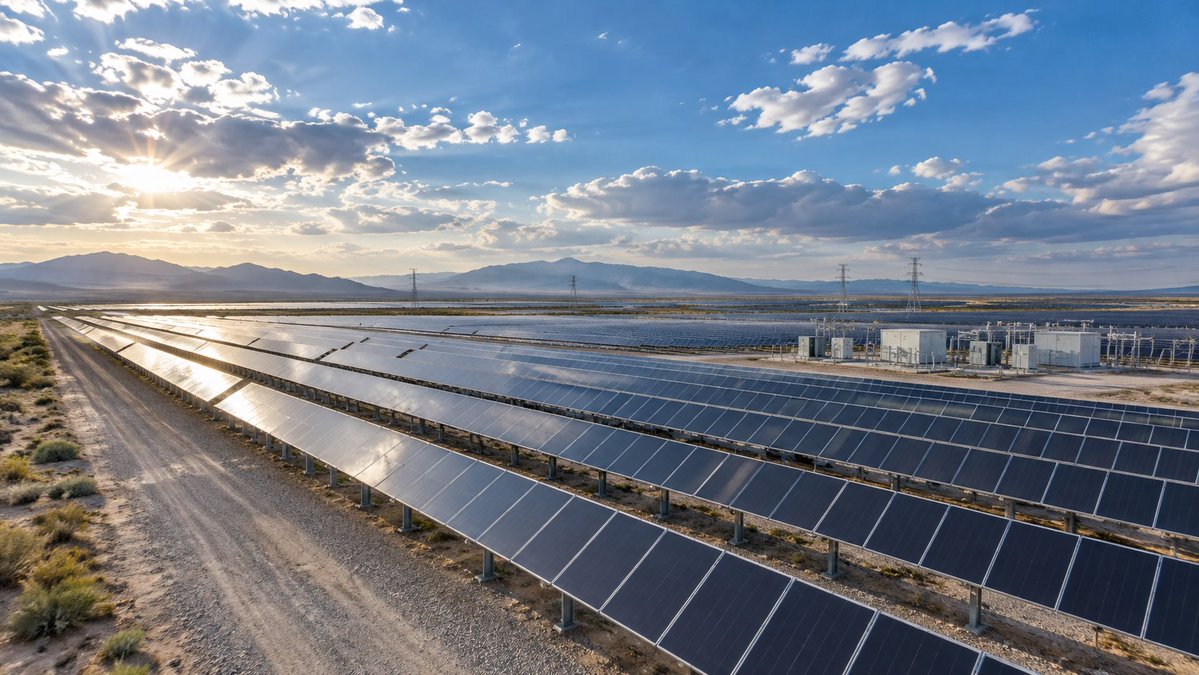
According to the U.S. Department of Energy, nuclear generates roughly 57,000 MWh per year per acre, compared with about 200 MWh for solar.
That’s roughly 285-to-1. (The Department of Energy’s https://t.co/O1v4fYhMtH)
Add nuclear’s ability to operate around the clock, and you begin to understand why it keeps moving higher in the discussion around data centers, the electric grid, defense installations and even space applications.
Antares itself is developing compact microreactors for defense and space missions, including programs involving the Army, Air Force and Space Force. (Centrus Energy Corp)
So while $LEU’s stock price can move dramatically in either direction, this is the part of the story I’m watching:
Customers aren’t just talking about future nuclear demand anymore. They’re putting money down today to make sure the fuel is there tomorrow.
$LEU
FOOD FOR THOUGHT: What comes after AI and robotics?
I keep wondering if the next enormous technological frontier is 3-D printing.
Remember George Jetson walking up to a machine, asking for an orange, and the machine simply producing one?
We are obviously nowhere near that today. But look at the direction:
🏠 We can already 3-D print houses.
✈️ We can print aerospace and defense parts.
🍽️ 3-D printers can already shape prepared food ingredients into finished foods.
🧬 Scientists can bioprint cells and relatively simple tissue structures for research.
⚛️ Researchers are even exploring manufacturing at the molecular and atomic level.
That’s where the question gets interesting.
Today, a 3-D printer generally takes an existing material and turns it into a shape or object.
But what happens if someday the machine can actually construct the material itself?
Give it the necessary molecular building blocks, download the “recipe,” and tell it what to make.
An orange assembled from its basic ingredients?
A replacement part made locally instead of shipped halfway around the world?
A medicine manufactured on demand?
Or, much farther into the future, fully functional replacement tissue—or even an organ?
Some of the companies already working around the edges of additive manufacturing include $DDD, $SSYS and $VELO, while companies like BICO/CELLINK are involved in bioprinting.
I’m not suggesting these are necessarily the future winners. I’m more fascinated by where the technology itself could ultimately lead.
Maybe AI isn’t the destination.
Maybe AI teaches the machines how to build everything else.
Too Jetsons… or eventually inevitable?
This is the part of yesterday’s decision that may be easy to miss: the Fed raised its short-term rate, yet longer-term bond yields moved down.
That can happen when investors believe a tougher move today may bring inflation under control later.
For rate-sensitive investments such as $TUA and mortgage-finance names such as $RWT, one calmer day isn’t enough. The real confirmation would be Treasury and mortgage rates continuing to fall over the next several weeks (just in time for the midterms)!
I’ve started digging into $FSLR, and this is becoming much more interesting than “just another solar company.”
First Solar is the leading U.S.-based utility-scale solar manufacturer, but what caught my attention is the amount of financial firepower it may have to stay ahead technologically.
For 2026 alone, $FSLR expects roughly $2.1–$2.19 BILLION in Section 45X U.S. manufacturing tax credits. Under current law, those credits remain at full strength through 2029 before beginning to phase down in 2030. (First Solar Investor Relations)
That gives First Solar several years and potentially billions upon billions of dollars to reinvest in manufacturing, R&D and next-generation solar technology.
And they’re already doing it.
Their proprietary thin-film technology is being improved through CuRe, while First Solar is investing heavily in perovskite and tandem solar cells designed to capture more of the sun’s available energy and potentially produce more electricity from the same footprint.
That’s what interests me.
The story may not simply be “more solar panels.” It may be whether $FSLR can use this unusually favorable cash-generation window to build the technology that keeps terrestrial solar competitive for the next generation.
Solar is growing rapidly. Electricity demand is exploding. First Solar has a huge backlog.
Now I want to see what they do with all that cash.
$FSLR ☀️
One thing I’m wondering about: we’re now only about seven weeks from the midterms.
Energy has been a big part of the inflation problem. If we suddenly saw progress toward ending the war and oil prices came back down, that could change the inflation picture pretty quickly.
That could also matter for rate-sensitive investments like $TUA and mortgage/housing names like $RWT.
Does falling energy inflation eventually give the Fed more room on rates—and bring longer-term rates down with it?
That’s the connection I’ll be watching as we head toward November.
This is the part of the $WPRT story I had been missing: 3 BILLION kilometers of HPDI already driven across 12,000+ trucks. HPDI 3.0 isn’t being introduced as a laboratory experiment—it’s the next generation of something already operating at scale. Now the question becomes how many OEMs follow Volvo.
I’ve been eyeballing $LTRX during the recent pullback in the drone space.
The real kicker for me?
Qualcomm.
Lantronix has worked with $QCOM for roughly 15 years — and Qualcomm is no ordinary technology partner. It’s one of the legendary leaders in mobile chips and wireless technology, with decades of experience figuring out how to deliver enormous computing power with very little energy.
That expertise now matters in drones.
Lantronix takes Qualcomm’s advanced, low-power AI processors and turns them into compact, NDAA-compliant computing platforms that can actually go inside the drone — allowing it to process cameras, identify objects and make more decisions onboard instead of requiring a human to control every movement.
And this is starting to become a real business.
Unmanned-systems revenue went from almost nothing in FY25 to $12.6M in FY26, while active engagements climbed from roughly 10 to 30+.
There’s another piece I’m watching too.
$LTRX is trying to move beyond being primarily a hardware company by adding higher-margin recurring software revenue. Its recent Nero acquisition brought about $4.5M in annual recurring revenue and pushed Software & Services above 10% of company revenue on a pro-forma basis.
So I’m starting to wonder:
Is Lantronix quietly building a much bigger platform — combining Qualcomm-powered drone computing with recurring software and remote management?
There are still plenty of unanswered questions, and Lantronix certainly isn’t Qualcomm’s only partner.
But the mechanics are there.
**15-year $QCOM relationship
growing drone exposure
Edge AI
recurring software revenue**
I’m not ready to declare a winner.
But this one has my attention. 👀
Disclosure: I currently own $LTRX call options.
One part of military AI that may be easy to overlook is the last step: getting useful information in front of the soldier quickly.
Cameras and AI can identify a threat, but somebody still needs a clear, lightweight display to act on it. That is where $KOPN could fit. The real confirmation will be whether today’s development work keeps becoming repeat production orders.
The 407% growth certainly gets attention, but the more important development may be that $ABAT’s recycling operation finally brought in more money than its direct operating costs.
That doesn’t mean the whole company is profitable yet—it isn’t. But it suggests the underlying business is beginning to work at a larger scale. Now I’m watching whether margins continue improving as more material moves through the facility.