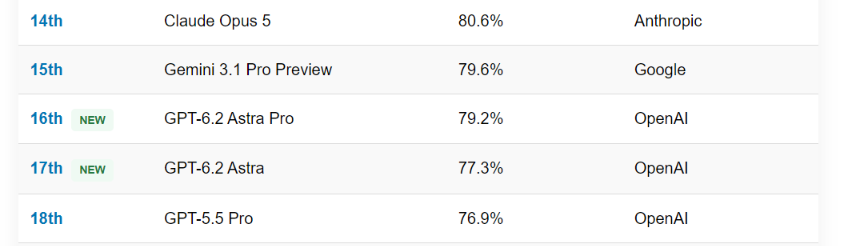
OpenAI's new GPT-6.2 models are showing a pretty surprising regression on SimpleBench.
This benchmark tests something that sounds basic but is actually quite difficult for AI models: everyday common sense, social situations, spatial reasoning and tricky questions where the obvious answer can be wrong.
And the latest leaderboard doesn't look good for OpenAI.
Look at the previous generation:
GPT-6 Astra Pro: 86.5%
GPT-6 Astra: 83.6%
GPT-6.1 Sol: 82.9%
Now compare that with GPT-6.2:
GPT-6.2 Astra Pro: 79.2% (-7.3 points)
GPT-6.2 Astra: 77.3% (-6.3 points)
GPT-6.2 Sol: 69.9% (-13 points)
Astra and Astra Pro have both fallen below the 83.7% human baseline.
Meanwhile, Claude Fable 5.2 leads with 94.9%, followed by Gemini 4 Neon at 94.4%. All four Gemini 4 models on the leaderboard are above the human baseline.
What's interesting is that GPT-6.2 Astra Pro was at 86.5% before, but the new version dropped to 79.2%. And Sol's 13-point drop is even harder to ignore.
I wonder if OpenAI's post-training priorities have shifted towards things like coding, agents and other specialised tasks. GPT-6.2 has also reached #1 on DesignArena Game Dev, so the contrast is interesting, although we don't know if these two things are connected.
Of course, one benchmark doesn't tell us how good a model is overall. But basic common-sense reasoning still matters a lot, especially when these models are being used as agents and making decisions on their own.
Getting better at specialised tasks is great, but I don't think we should accept losing this much everyday reasoning as a trade-off without asking why.
Muse has its own email address. Grab your https://t.co/Et9OHcQ6GR handle before someone else does 😉
Rolling out to everyone in supported markets, your Muse can now send and receive emails on your behalf.
To get started, tap your avatar and head to the mail tab, or just ask your Muse.
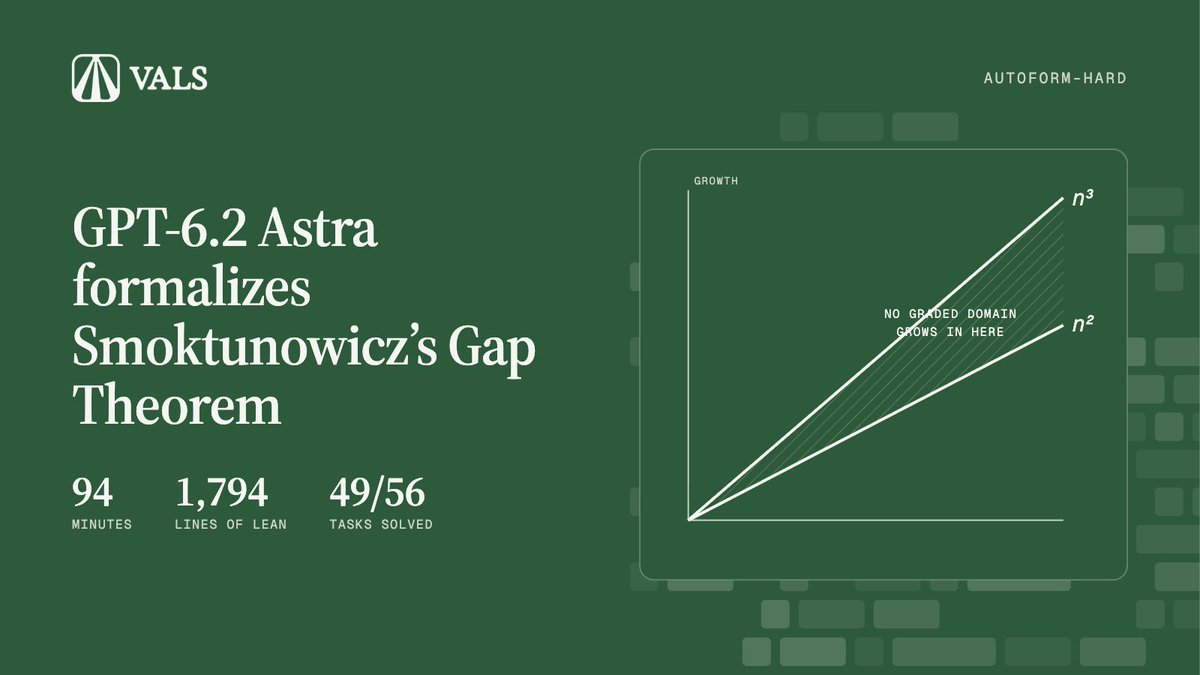
GPT-6.2 Astra just produced what we believe is the first Lean proof of Smoktunowicz’s Gap Theorem, and it found its own route to get there.
It happened on Autoform-Hard, a verified subset of Meta FAIR’s AutoformBench that we’re releasing results on today.
Akamai, a $12B company, built a SECOND version of its website that only AI agents could see.
its AI search visibility increased 364%, while citations jumped 85%.
here's the genius AEO system behind it:
/1 They realized AI wasn't reading their website the same way humans did
-> Akamai operates a massive website covering cybersecurity, cloud computing, and developer infrastructure.
-> but its content wasn't consistently appearing when people asked AI about the products it offered.
-> their team believed part of the problem was how AI agents were accessing and interpreting those pages.
/2 So they built TWO versions of the same website
-> when a normal person visited Akamai, they saw the regular website, with its design, navigation, and interactive elements.
-> but when a supported AI agent requested a page, Akamai's system delivered a different, simplified version.
-> same URL, same underlying product information, but without the extra code, menus, and other elements AI didn't need.
/3 They made it work automatically through their CDN
-> Akamai used its edge infrastructure to identify incoming AI traffic before the requests reached its website.
-> detected AI agents were routed through Scrunch's Agent Experience Platform, which delivered simpler HTML versions of Akamai's existing content.
-> unlike llms.txt (which major AI search engines don't reliably read), this approach delivers optimized content directly when supported AI agents request a page.
-> they didn't have to redesign their public website or manually rewrite every page.
/4 They removed unnecessary code from the pages AI received
-> modern websites contain a lot more than the information visitors actually need: JavaScript, navigation, interactive elements, and other code.
-> Scrunch produced machine-readable versions using Akamai's existing product pages and documentation.
-> the goal was to make the information easier for AI to retrieve and understand, without changing what human visitors saw.
/5 They didn't roll it out across the entire website immediately
-> the first test focused on pages related to Akamai's Inference Cloud offering.
-> they measured how these pages appeared across selected AI prompts before optimization.
-> then they compared pages receiving the optimized treatment against pages that weren't.
/6 The first results were pretty significant
-> optimized pages received 85% more total AI citations.
-> they were cited across 38% more unique prompts.
-> brand visibility for questions that DIDN'T mention Akamai by name increased 364%.
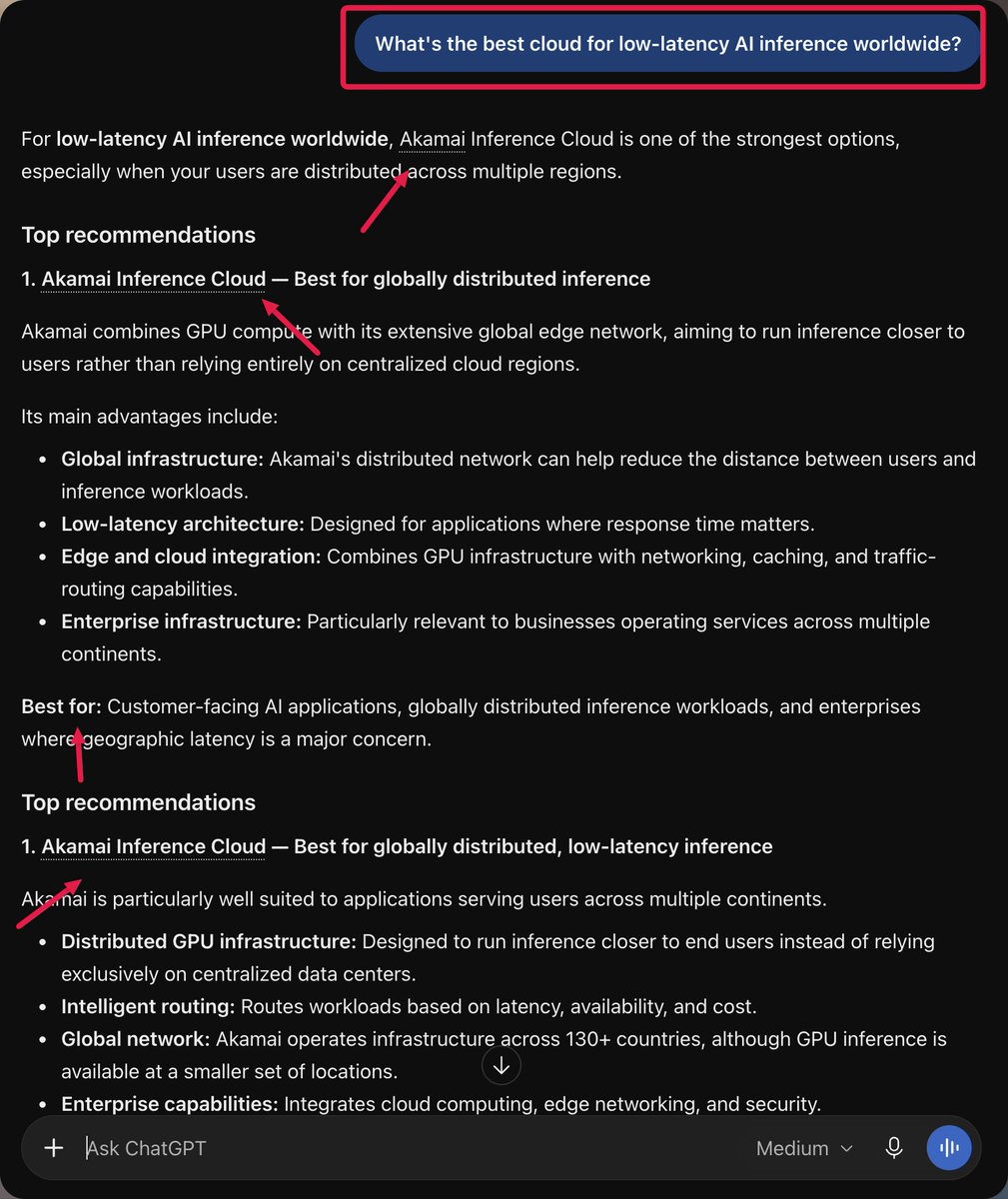
-> in ChatGPT, Akamai's brand presence against competitors improved 133%.
and this last point is especially important.
people weren't just asking "what is Akamai?" and getting Akamai's website back.
the company started appearing more often when buyers asked general questions about the problems its products solve.
/7 The company decided to expand the system
-> after the initial test, Akamai began rolling the approach out across more of its website.
-> it also turned the technology into a commercial product called AI Brand Presence.
-> the same infrastructure it uses to manage web traffic could now detect AI agents, change how they receive content, and measure the results.
Akamai essentially built a system where humans and AI receive different versions of the same underlying website information.
and in its initial test, that was associated with a 364% improvement in visibility for searches where people weren't even mentioning the brand.
if you want to rank #1 on AI search + turn AI traffic into pileline,
reply "GTA"
I tested GPT-6.2 Astra on real work. 2 repos, 105 replanted bugs. Find and fix what you can.
It's the new #1. The results:
- GPT-6.2 Astra (max): 62.7 for $28.35
- GPT-6.2 Astra (xhigh): 60 for $23.53
- Fable 5.2 (max): 58 for $139.65
- Gemini 4 Carbon (high): 57.3 for $31.32
- Sonnet 5.5 (max): 51.3 for $154.03
- GPT-6 Astra (max): 45 for $33.03
From GPT-6 Astra to GPT-6.2 Astra: +17.7 points at max, +17 at xhigh.
Whatever people say about other use cases, it's a code review beast.
GPT-6.2 Sol and more effort levels drop soon in the thread 🧵
We are excited to bring on @_jasonwei as Chief Scientist at @mercor.
Jason is known for pioneering work on reasoning and agents at Google Brain, OpenAI, and Meta. He also created several benchmarks adopted across the industry: SimpleQA, a widely-used pretraining benchmark, BrowseComp, the top deep research benchmark, and HealthBench, the first public benchmark to popularize rubrics.
Over the past years, Jason has been one of our favorite customers and thought partners. As Chief Scientist, Jason will help build Mercor’s research team and shape our work on data and evaluations.
Can’t get to Miami for the GTA VI launch? Two AI models built the city for you
We asked Claude Fable 5.2 from @AnthropicAI and GPT-6.2 Astra from @OpenAI to build Miami as it looks this week, dressed as Vice City for the GTA VI launch
➤ One prompt each, in the AA-3D sandbox with no internet access
➤ Both lined Ocean Drive with real hotels the prompt never named, including the Colony and the Avalon
➤ Each scene can be explored by car, speedboat or blimp, at sunset or at night
NEW RESEARCH: https://t.co/ZQabPNQ2A4
We analyzed 118k prompts from 12k ChatGPT users to answer key Qs:
- how often do brands appear?
- what % of prompts have commercial intent?
- how does usage compare to Google search?