I reposted this earlier and just said “interesting.” Let me tell you why this is actually interesting:
➡️Ryzen AI Max+ (and the new Halo mini-PC) now lets regular users & small teams run 100B–200B+ LLMs locally - no cloud, no per-token bill, full privacy.
➡️This drops exactly as OpenAI and Anthropic race to IPO.
➡️If open models (Qwen, DeepSeek, Llama, Gemma, etc.) keep closing the gap (and they are) the giant cloud API market these companies are pricing for starts to stall.
➡️One-time hardware cost vs endless subscription shock.
➡️Local AI AND Chinese cloud models are eating US cloud AI margins faster than expected.
No raw materials -> no further technological boom.
I feel like people are forgetting this a little?
-> Copper supply gap is getting wider -> $COPX, $TMQ
-> Aluminium supply gap is getting wider -> $AA
-> Gallium demand increasing 11% YoY -> $TECK, $FPLSF
-> Scandium demand is through the roof potentially because of $BE -> $SREMF
-> Silver has higher conductivity of any metal -> $HL $CTGO $SLV
This industrial revolution is being built on the sheer assumption that we have the raw materials and the critical metals.
Investing in domestic supply is really the only answer.
Simple enough?
Rape exploded after Europe imported the Third World.
UK 🔺 +692%
Germany 🔺 +380%
France 🔺 +465%
Poland 🔽 -53%
Poland didn’t. Notice the difference?
America… is this what we want?
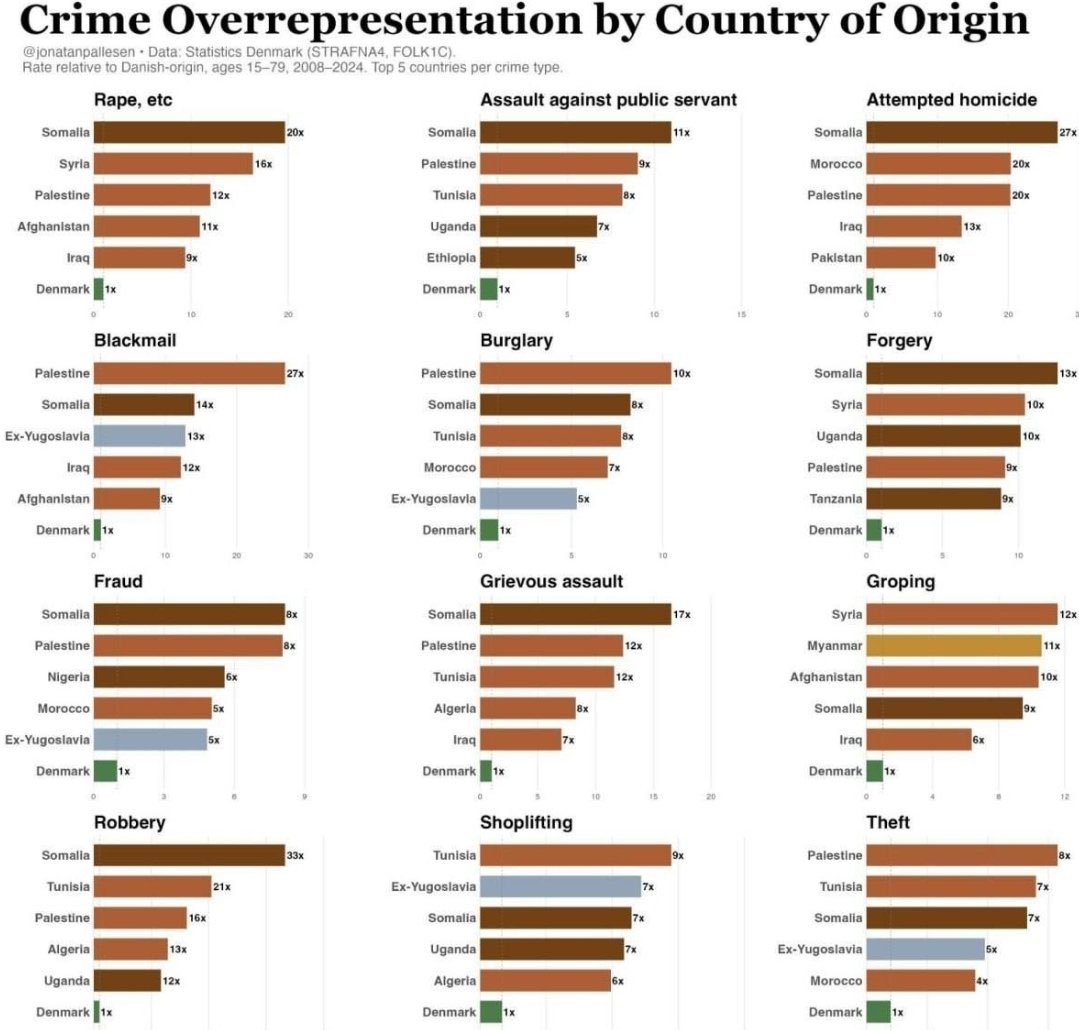
Denmark is one of the rare European countries to publish crime data by country of origin.
Somalis top the list when it comes to rapes, fraud, forgeries and grievous assaults.
Palestinians lead in burglaries, blackmail and theft.
Data: Statistics Denmark (STRAFNA4, FOLK1C), compiled by @jonatanpallesen.
🇺🇸 Tucker lays out the deepest critique of AI yet, and it's not about jobs...
His argument: writing produces thinking.
You can't formulate a thought without first articulating it.
If kids never write because AI writes for them, the quality of human thinking collapses.
That's the surface problem.
The deeper one is purpose:
"The point of living is to create.
That's the point of being a human being. It's necessary for joy.
There is no joy without creation."
If the machine creates everything and humans just consume, you don't get utopia.
You get despair, mass unemployment, and eventually political revolution.
I was in New York last week and for the first time I'm starting to hear senior investment professionals think seriously about the incremental utility of junior investment talent.
Agents are solving process bottlenecks that heretofore required the efforts of junior investment talent across modeling, meeting prep, and data analysis.
”I may not need to hire a junior after all”, It is a more common refrain. And it's widespread enough that I do think some concern is now warranted.
My response back is: what if you just fundamentally rethought the role of the junior investor? What if instead of updating models, updating weekly industry data drops, writing first cut earnings previews, and building out management question lists, the responsibility stack of a junior dramatically changed?
What if you simply challenged the junior investor to develop more accurate and timely revenue forecasts across three dozen names? And the apprenticeship role almost felt more like an AI enabled data scientist, while that person develops their own investor toolkit.
What if you challenged that junior analyst to be an in-house AI-enabled risk analyst? Building AI-augmented risk checklists, counter pitches on every idea in the portfolio & pipeline?
What if you challenged that junior to become the most AI-fluent person on the team, putting them through an intensive six-month AI self-study? Which, for your senior investors with portfolio responsibility, is very difficult to find the time.
The junior then, through the apprenticeship period, becomes a highly value-added generalist.
And during that apprenticeship period, where they're mostly a cost center, they develop into a true AI-augmented investor, and at year three will drive dramatically positive ROI to the firm. Same apprenticeship model, but rethought in specific structure.
The foundational reality still exists that your junior investor for a scaled investment firm is going to be a rounding error in terms of comp. The consideration of slowing down junior hiring isn't a cost consideration, it's an efficiency consideration. And while much of the traditional junior stack is quickly becoming abstracted into agents, I do think there is a real potential to rethink the role of junior investors to the effect of very attractive ROI.
I do think, to a large degree, we have some moral responsibility to do this as well. In a competitive business, it is absolutely imperative that we drive efficiencies and research quality with all the tools at our disposal. That definitionally will impact the existing role of juniors more than seniors.
I'm feeling a bit more of a mission to help firms rethink how they deploy junior talent. If you're doing the same, I'd love to connect and find creative ways to rethink the junior role in fundamental investing firms.
🚨 Iranian oil contamination has now reached the shores of Kuwait.
This is turning into an ecological disaster across the Persian Gulf.
A Saudi commentator summed it up bluntly: “Nothing is safe from the Islamic Republic’s evil, neither by land nor by sea.”
33% of U.S debt/ $13 trillion, matures and needs to be refinanced in the next year! 5%+ interest rates this is fully unsustainable.Volatility short term for #Gold#Silver = YCC/Massive Q.E incoming medium term.The bull case for monetary metals isn't broken.Its only just beginning
Anthropic CFO Krishna Rao talks about how his team uses Claude. Says Head of Tax is biggest power user working on tax policy engine.
Finance team built 70 specific skills, including automating financial statements and monthly reviews (says they are 90% done, then human reviews).
Ex Google CEO, Dr. Eric Schmidt: AI may hit a money wall before it hits a power wall.
"The real limit to AI is not energy; it is actually cash. When you add up the cost of these things, if you take round numbers, say $50 billion per gigawatt, then 10 gigawatts is half a trillion dollars.
How many companies, countries, and so forth can hand an industry a trillion dollars of capital? Very, very few. The Chinese could certainly do it. I do not know if they are doing it, but I am going to try to find out.
In America, there are people who hope that is going to happen. It is interesting that you can finance these things because the brilliance of the American capital market allows us to borrow that kind of money. For example, the Europeans cannot do this, which they are sort of sore about."
---
Full video from 'Special Competitive Studies Project' YT channel ( link in comment)
More White Europeans were taken as slaves by Muslims in North Africa, than Black Africans taken as slaves to the United States…
They don’t teach about that slavery though.
The Nasdaq is rallying because AI capex doesn't care whether the Strait is open today, but the bill lands 12 to 18 months out when Qatari helium for chip plants, Gulf naphtha derivatives for capacitor films and PCB epoxies, and specialty industrial gases reprice through the cascade, and hyperscaler dollars per megawatt of capacity step up 15 to 25%.
⚠️The AI arms race is destroying Big Tech's cash generation:
Combined free cash flow across Microsoft, Amazon, Alphabet, Meta, and Oracle peaked at ~$300 billion in late 2024 and is expected to fall to near ZERO in 2026.
As a result, free cash flow margins at Microsoft, Meta, Alphabet, and Amazon are expected to fall to ~16%, ~3%, 0% and -2%, respectively, by 2027.
Free cash flow is collapsing under the weight of ~$715 billion in combined 2026 capital expenditure, up more than +70% from 2025's already-record levels.
Free cash flow is simply the cash a company has left after paying for its operations and investments, and right now, AI spending is consuming nearly all of it.
To plug the gap, hyperscalers have turned to the debt markets at an unprecedented pace, with Bank of America forecasting around $175 billion in investment-grade issuance in 2026, significantly above pre-AI cycle levels.
At the same time, share buybacks have slowed materially from 2024–2025 peaks: Meta sharply reduced repurchases in early 2026, while Alphabet, Microsoft, and Amazon have all scaled back relative to prior years.
This creates a rising risk of a broader equity market selloff, as weaker free cash flow reduces valuation support while higher debt issuance and the loss of buyback demand remove major structural buyers of US equities.
The AI buildout is being funded by debt, not profits, and the bill is only getting bigger.
This is an email I sent earlier today to all employees at Coinbase:
Team,
Today I’ve made the difficult decision to reduce the size of Coinbase by ~14%. I want to walk you through why we're doing this now, what it means for those affected, and how this positions us for the future.
Why now
Two forces are converging at the same time. We need to be front footed to respond to both.
First, the market. Coinbase is well-capitalized, has diversified revenue streams, and is well-positioned to weather any storm. Crypto is also on the verge of the next wave of adoption, with stablecoins, prediction markets, tokenization, and more taking off. However, our business is still volatile from quarter to quarter. While we've managed through that cyclicality many times before and come out stronger on the other side, we’re currently in a down market and need to adjust our cost structure now so that we emerge from this period leaner, faster, and more efficient for our next phase of growth.
Second, AI is changing how we work. Over the past year, I’ve watched engineers use AI to ship in days what used to take a team weeks. Non-technical teams are now shipping production code and many of our workflows are being automated. The pace of what's possible with a small, focused team has changed dramatically, and it's accelerating every day.
All of this has led us to an inflection point, not just for Coinbase, but for every company. The biggest risk now is not taking action. We are adjusting early and deliberately to rebuild Coinbase to be lean, fast, and AI-native. We need to return to the speed and focus of our startup founding, with AI at our core.
What this means
To get there, we are not just reducing headcount and cutting costs, we’re fundamentally changing how we operate: rebuilding Coinbase as an intelligence, with humans around the edge aligning it. What does this mean in practice?
- Fewer layers, faster decisions: We are flattening our org structure to 5 layers max below CEO/COO. Layers slow things down and create coordination tax. The future is small, high context teams that can move quickly. Leaders will own much more, with as many as 15+ direct reports. Fewer layers also means a leaner cost structure that is built to perform through all market cycles.
- No pure managers: Every leader at Coinbase must also be a strong and active individual contributor. Managers should be like player-coaches, getting their hands dirty alongside their teams.
- AI-native pods: We’ll be concentrating around AI-native talent who can manage fleets of agents to drive outsized impact. We’ll also be experimenting with reduced pod sizes, including “one person teams” with engineers, designers, and product managers all in one role.
In short: AI is bringing a profound shift in how companies operate, and we’re reshaping Coinbase to lead in this new era. This is a new way of working, and we need to leverage AI across every facet of our jobs.
To those who are affected
I know there are real people behind these decisions — talented colleagues who have poured themselves into this company and our mission. To those of you who will be leaving: thank you. You’ve helped build Coinbase into what it is today, and I am sincerely grateful for everything you've done.
All impacted team members will receive an email to their personal account in the next hour with more information, and an invitation to meet with an HRBP and a senior leader in your organization. Coinbase system access has been removed today. I know this feels sudden and harsh, but it is the only responsible choice given our duty to protect customer information.
To those affected, we will be providing a comprehensive package to support you through this transition. US employees will receive a minimum of 16 weeks base pay (plus 2 weeks per year worked), their next equity vest, and 6 months of COBRA. Employees on a work visa will get extra transition support. Those outside of the US will receive similar support, based on local factors and subject to any consultation requirements.
Coinbase prides itself on talent density. Our employees are among the most talented people in the world, and I have no doubt that your skills and experience will be highly sought after as you pursue your next chapters.
How we move forward
To the team that is staying, I know this is a difficult day. We’re saying goodbye to colleagues and friends you've been in the trenches with. But here’s what I want you to know as we move forward together:
Over the past 13 years, we have weathered four crypto winters, gone public, and built the most trusted platform in our industry. We’ve made it this far by making hard decisions and by always staying focused on our mission. This time will be no different – nothing has changed about the long term outlook of our company or industry. And most importantly, our mission has never been more important for the world. Increasing economic freedom requires a new financial system, and we’re building it.
The Coinbase that emerges from this will be more capable than ever to achieve our mission.
Brian