I gotta run to meetings and TV and will continue with this thread soon. Long story short (my stories are never short):
We live in a structurally higher interest rate environment, driven by triple D dynamics: Data centers, Debt, and Decoupling. These three forces are strong undercurrents to global landscapes and their impact create divergence in performance across sectors and sovereigns.
The good news? We are approaching an equilibrium level of interest rates and capex that will make global growth more sustainable. For some, it will fade the parabolic rise of exports (think Korea) by 2028 but for others, it provides breathing space (think India).
Finally, as we approach 2027, while decoupling trends are stronger for chips/data center, the geopolitical headwinds regarding energy/commodity shock will fade, providing tailwinds for Asian economies most vulnerable. Regarding interest rates too, for some, we are approaching the end of the hiking cycle (think Australia), and that leads to rates steadying, if not needing to provide reprieve for the turn of the cycle.
Central banks do not have the wiggle room now to help (for the US, perhaps does not need to help but hike), but hiking cycles are coming to an end for some, leaving us still in a structurally higher rates environment and one we can live with and thrive more sustainably.
There are two types of builders of data centers as mentioned. One that is VERY INTEREST RATE SENSITIVE and concentrated in revenue source (neo clouds) and the other is hyper scalers, who are also sensitive but by a lesser extent.
If the AI data center build out is actually happening as planned in a structurally higher cost of capital environment (Fed minutes will show hawkishness and rates going UP), then THESE GUYS WILL ISSUE MORE AND PUSH UP COSTS MORE.
And that makes their COST STRUCTURE HIGHER. The second question is then can they MONETIZE EVEN MORE to afford this HIGHER COST OF CAPITAL?
Probably not. So what happens? They gotta scale that down a bit which makes their business model more sustainable.
As they demand less funding from market, that also helps keeping COST OF CAPITAL MORE SUSTAINABLE and their BUSINESS MODEL MORE SUSTAINABLE.
Okay, I think I understand the basics of datacenter economics and here's a thread to explain.
First, to build a data center, you need four things: compute (chips/GPU), land, water, and electricity. In other words, it's capital intensive and takes about 2 years to build. If you got land and water and no chips or no electricity, you got a problem.
Now, let's talk about scale and competitiveness. America is where it's happening. Why? The US got land (esp states like Texas etc), got natural resources like natural gas to power cheap electricity, and under Trump (before Blue Wave), got pretty willing investors and regulators, and finally, it got chips (Nvidia and also others). We'll talk about outside of America soon (Asia).
Okay, what is the scale we are talking about here?
To keep things simple, we gotta just use round/ballpark number.
First, we know that to build 1GW, you need 50bn, and 70% of that is in the GPU bit. But note that the whole land/electricity/water acquisition can be an issue too.
And one that is increasingly VERY POLITICAL. Why? Well, it's FINITE resource and inflationary before it raises productivity right?
As Mark Twain said, "Buy land. They don't make land anymore."
Okay, ignoring that anyway, so the fact that GPU is the most expensive, one can imagine two scenarios (both happening):
- Hyper scalers (we'll explain the term later) COMING UP WITH THEIR OWN VERSIONS OF CHIPS TO REDUCE COSTS (Jensen Huang was worried about this). Amazing, Google, Microsoft all got their own development going.
- Competitors to guys like SK Hynix are motivated to make more cuz high price = high motivation to make money (THINK CHINA).
- And of course the question a company like SK Hynix has to ask is well high price = demand destruction and more competition so we need to also increase supply.
So whatever bottleneck/chokepoint/moat we have, at some point, it won't last forever. Hence the uncomfortable Kospi sits at where valuations are VERY ATTRACTIVE BECAUSE OF SKY HIGH EARNINGS BUT WILL EARNINGS SUSTAIN IN GROWTH AND PERFORMANCE FOREVER?
Answer is no and question is when not whether.
$LITE $COHR $AAOI $SIVE
Super important not to overlook this comment from the call…
$NVDA just confirmed CPO scale-out is now in volume production.
Lambda’s first real production deployment of $NVDA Photonics CPO switches is live, connecting 10,000+ GB300 GPUs.
Compared to pluggable optics:
> 5x better power efficiency.
> 15x higher reliability.
> ~10% lower latency.
Networking already did >$21B this quarter and is still scaling.
It’s no longer “if” CPO ships. It’s how fast the laser and optics supply chain can ramp behind it.
We are positioned. NFA.
I have a major result to share.
I’ve found conclusive forensic evidence that the top 4 Chinese AI labs—DeepSeek, Moonshot, MiniMax and Ant Group—have built their newest models on NVIDIA’s most advanced Blackwell chips, which are barred from export to China.
This sounds insane, but I discovered that almost every AI model carries a hidden signature of the GPU that trained it. When a model is first set up, the starting values of its weights are laid out in a pattern that depends on the exact GPU. Each combination of GPU and seed number produces a unique pattern—a sort of fingerprint of the hardware used to create the model. Traces of that pattern survive training into the published model.
Again, this evidence isn’t based on any insider information or leaking. It’s based on a forensic analysis of the model weights released by the companies themselves.
I searched more than six trillion combinations of chip layout and seed number and matched them to open-weights models. In doing so, I found conclusive evidence that six Chinese AI models—including DeepSeek-V4-Pro, Kimi K3, and MiniMax-M3—were initialized on NVIDIA Blackwell systems. Four of the models match Grace Blackwell, the GB200 and GB300 parts in NVIDIA’s flagship liquid-cooled rack-scale systems.
I then verified these results on real hardware. Running unmodified PyTorch with the seeds I’d recovered, a Blackwell B300 reproduced DeepSeek-V4-Flash’s untouched starting weights bit for bit, and a rented GB200 reproduced Kimi K3’s to a correlation of 0.999995. A Hopper H100 reproduced none of DeepSeek-V4-Flash’s, and changing the seed by one broke the match. (DeepSeek’s seed is 953049583 by the way.) The method also was verified to match 24 known open-weights models to the hardware that developers said they used.
It is exceedingly unlikely that these results are a coincidence. Across six trillion combinations, the best accidental match should reach only about 8 sigma (i.e., eight standard deviations above what random chance would produce). The real matches range from 49 to 1,385 sigma, and even the weakest single test hits 20.
These were data-center-scale training runs. With some analysis of release schedules and model details, I estimate that the largest, Kimi K3 and DeepSeek-V4-Pro, used 2,000 to 3,000 Blackwell GPUs each. Clusters of this size cost on the order of $150 to $200 million each to buy, and across these labs alone would add up to more than half a billion dollars of export-controlled GPUs, not counting experimental compute or otherwise. It’s quite likely that we see multi-billion dollar expenditure on export-controlled GPUs.
I am highly confident in this result, and it has been independently verified by senior researchers at OpenAI and Anthropic. You can read the full report at https://t.co/YOtzND0Jqk.
There is much more I’ve identified about these models through other forms of checkpoint forensics like this, and will have more to share soon.
This is an extremely revealing chart about the psychology of human nature.
High crime rates are a result of envy, rather than due to absolute circumstances of poverty itself.
When you plot countries with high crime rates against poverty rates, the R-squared is just 0.02.
Now, switch that to countries with high levels of inequality, and the R-squared is 0.30.
Meaning, there is very little correlation between the absolute measure of poverty and people's willingness to commit crimes.
But place them around wealthy neighbors, and all of a sudden, envy kicks in and reinforces people's willingness to break the law to get ahead
Absolutely fascinating
We are living in the most incredible timeline where anyone can have their own personal assistants who manage all of the tedious day-to-day tasks that used to require a human personal assistant (only affordable for high net worth individuals)
Incredibly bullish on this space
Takes on the election
1. To a first approximation, Republicans lost this hard because voters lost confidence in the Trump administration, not because of a positive agenda from the Democrats. Favorability of the Democratic Party was negative (-5). But Trump told voters to “vote like he was on the ballot”, and they did. The NBC exit poll found that 37% of voters approved of Trump, and 63% disapproved (-26). There’s just no winning the national environment with these margins.
2. There were essentially two major issues that voters cared about: 1) cost of living and 2) government corruption, both of which ~90% of voters said were “crucial or a major factor”. AI was not *that* big of a deal in this election - 56% said it was “crucial or a major factor”, but it’s really hard to disambiguate what voters feel about AGI and catastrophic risks (if anything) from ordinary median-voter NIMBYism around data centers. (It will, however, likely be a huge deal in the 2028 election when the impacts of AI become much more visible). Immigration was also not that big of a deal. Voters actually slightly favored Rs on immigration (+2), probably thanks to lasting backlash from the Biden administration’s laxity on border enforcement. It's unclear to what extent the war with Iran contributed aside from it raising the price of gas.
3. Data centers are probably not over. In fact data center ETF $DTCR was up nearly 2.5% today! It’s hard to understand why this is the case, but one hypothesis is that markets think ultimately, elites’ recognition of the immense economic and national security importance of data centers will override voters’ desire not to build them.
4. On cost of living in particular: one of the most important questions now is to what extent Dems will embrace economic slopulism (think rent control, broad asset taxes, and subsidizing demand) vs. “abundance liberal” policies like building more housing, cutting regulations, and embracing economic growth.
5. Thermostatic backlash is real. Voters hate incumbents. Political majorities shift constantly. The blue wave of 2008 was immediately followed by the red wave of 2010. Anyone predicting a durable multi-decade supermajority for Democrats will likely end up being wrong.
6. “Woke is back” is exactly the wrong lesson for Democrats to take from this, and Ro Khanna posting “DEI is back” doesn’t help. Using transgender issues as a proxy for “woke”, 52% of voters said trans rights have gone too far, compared to just 26% who said they haven’t gone far enough. Deep-blue Washington voted to ban trans athletes in girls’ sports, and Colorado voted to ban trans surgery for minors. Successful Democrats mostly avoided culture war issues.
7. Similarly, a lot of moderate or even right-leaning downballot measures passed, even in blue states. Eight states voted to require voter ID. North Carolina voted to cap state income taxes. California’s billionaire tax is on track to fail by nearly 11 points. Wisconsin voted to ban DEI in state government. Voters largely do not like left-wing ideas.
8. On the other side, “Demographics is destiny” (i.e. America needs to be a white nationalist/nativist country and heavily restrict immigration) is the wrong lesson for Republicans. White voters shifted 13 points to the left. Whites under 30 shifted 30 points to the left. Hispanics and other non-white groups shifted massively towards the right in 2024, and can be encouraged to do so again.
9. Moderates outperformed; radicals underperformed. Dems won by 13 points nationwide. Roy Cooper won by 19.6 in North Carolina (where Trump won by 3.2 in 2024). Jon Ossoff won by 18 in Georgia, where Trump won by 2.2. Abdul El-Sayed in Michigan and Troy Jackson in Maine, both Bernie-backed supporters of Medicare for All, abolishing ICE, and wealth taxes, both underperformed the national margin. In fact, Maine shifted slightly rightward. Dems were able to win deep red states like Iowa, Kansas, and Mississippi by running moderate, Republican-presenting, pro-border-security candidates. I suspect this is the main reason markets are up today. (For some intuition on how insane it is for a Dem candidate to win in Mississippi, Trump won Mississippi in 2024 by a larger margin than Harris won California!)
10. One of last night’s biggest winners was Florida’s Republican governor, Ron DeSantis. Under his tenure, Florida has gone from slightly red-leaning to reliably red. Republicans swept every statewide office, kept every House seat, and kept their majority in the State House and supermajority in the State Senate. In January, Florida will be the only one of America’s ten most populous states to have a Republican governor. DeSantis is genuinely smart and nuanced, lacks the baggage of figures like Vance and Rubio who are associated with the Trump administration, and did a great job as an administrator running Florida (see its high rate of domestic migration, zero state income tax, very low debt per capita, high education rankings, state budget surplus, etc). I would be unsurprised if he decided to run for President in 2028.
11. The other biggest winner was Jon Ossoff. Ossoff is a young, handsome, charismatic, moderate white male who won by 18 points in a state that went +2.2 for Trump in 2024. He achieved this in large part by focusing relentlessly on the two issues that mattered: the Trump admin’s corruption and the cost of living. He may very well be the Democratic frontrunner in 2028 (although, of course, it's far too early to make confident predictions about these things).
12. The biggest loser of all last night was Israel and the US-Israel relationship. Israel’s popularity in the United States has been in a steep, secular decline for years. Just 13% of Democrats and 54% of Republicans have positive views on Israel, and this is heavily skewed by age - younger voters are much more likely to oppose Israel. With Democrats taking both houses, it’s unlikely America’s level of political and military support for Israel will last for very long.
13. Gerrymandering doesn’t work under sufficiently strong margins for the opposing party. In political science, this is known as “dummymandering”. Dems are on track to flip 7 of North Carolina’s 14 House seats, shifting the balance of power from 10-4 Republican to 11-3 Democratic.
14. Trump quickly conceded that his party lost and he would be open to working with the Democrats. This was a positive update on Trump’s tendency toward authoritarianism. Many mainstream Republican figures, like JD Vance and Ted Cruz, quickly posted somewhat genuine mea culpas. There was a lot less coping than I expected. It’s possible that the loss had to be very painful for them to learn from it, and we wouldn’t have seen the same if Dems had won only 51 Senate seats.
15. Elections are truly a ton of fun to monitor live. There’s nothing like it. And prediction markets beat mainstream media in terms of timeliness and accuracy by FAR.
16. There’s a good chance none of this matters that much. Trump is still the president and still has veto power. Voters might turn on the incumbent Democrats in 2028. And historically, real GDP growth isn’t that different during eras where Ds controlled Congress vs Rs. Much of your probability mass should go towards “nothing ever happens”.
Today’s equity selloff is expected to create significant supply.
Levered ETF rebalancing today should create $52bn of US equity for sale if prices at November 5th, 1pm, hold through the close on MS QDS estimates – that’s second only to the $55bn sold on June 5th, 2026. Semiconductors will bear the brunt of that supply, where there should be $21bn for sale, with NASDAQ 100 seeing another $15bn for sale.
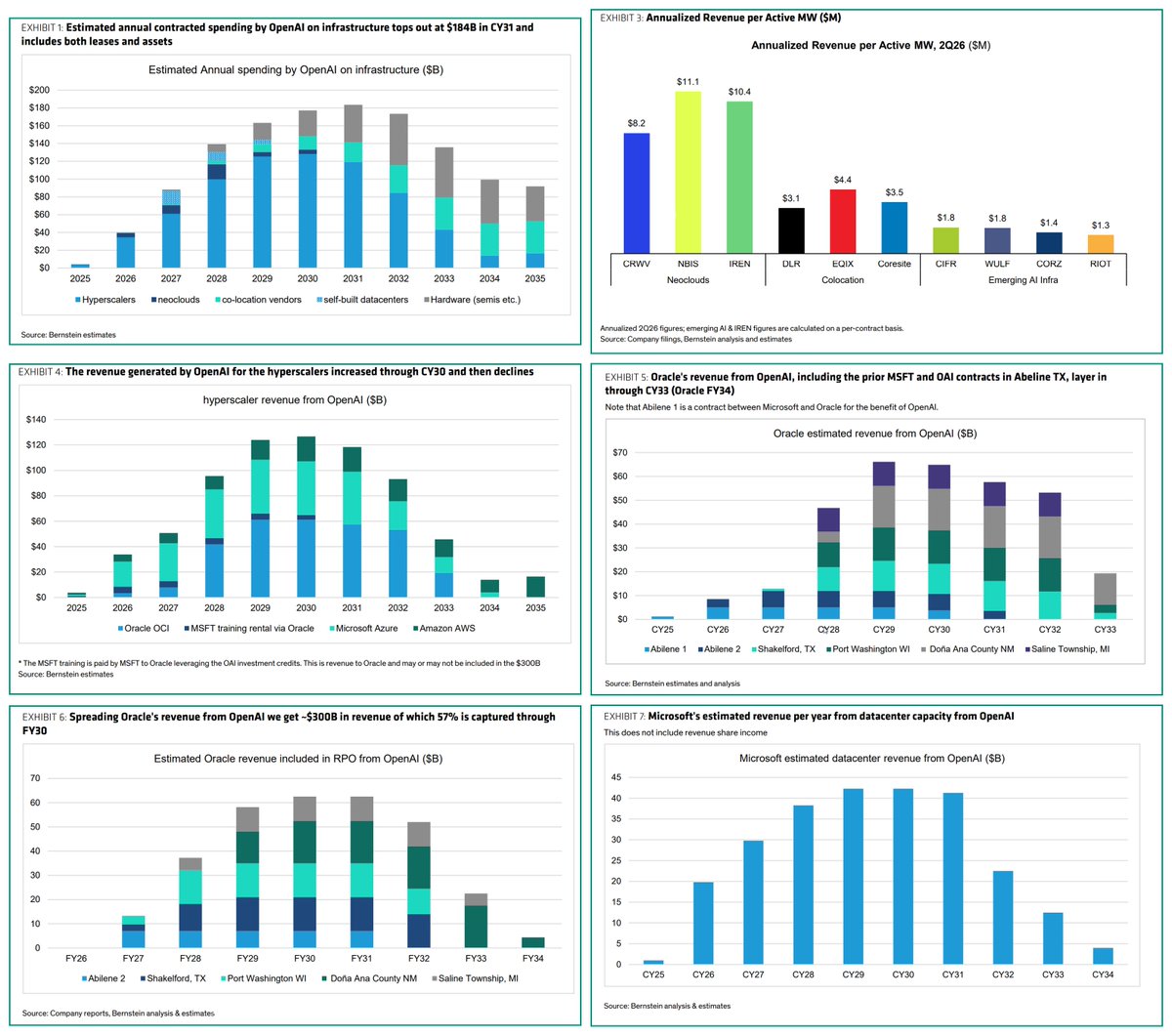
🚨 BERNSTEIN JUST DROPPED A MAJOR REPORT ON THE $750 BILLION AI INFRASTRUCTURE BOOM.
After Nomura argued that AI data centers are far more profitable than investors think, Bernstein tackles an even bigger question:
Can OpenAI actually afford its massive compute commitments and who ultimately captures the profits?
The findings are fascinating:
• $750B vs. $614B: Bernstein models ~$614B in OpenAI infrastructure payments through 2030, with annual spending potentially peaking at $184B in 2031. Not every announced commitment is binding, and actual spending could be lower.
• OpenAI's revenue is catching up: Bernstein cites a ~$50B annualized revenue run rate in September 2026, growing ~77% YoY. If growth remains strong, revenue could scale faster than infrastructure obligations.
• Oracle's $300B opportunity: Capacity comes online in stages, with Bernstein estimating only ~57% of modeled OpenAI contract revenue recognized through Oracle FY2030. The backlog represents a multiyear revenue opportunity, not immediate cash generation.
• Microsoft and Amazon have structural advantages: Their integrated cloud platforms, enterprise ecosystems and AI services offer more durable economics than simply renting GPUs.
• CoreWeave faces a different challenge: Bernstein is comfortable with existing contracts but questions renewal economics once compute becomes less scarce.
• The biggest risk may be oversupply, not OpenAI defaulting. Bernstein sees potential supply-demand normalization within 2–3 years, putting pressure on GPU rental prices and weaker infrastructure providers.
HERE'S THE REAL INSIGHT:
Nomura explains why AI infrastructure can remain profitable despite negative free cash flow.
Bernstein explains why that profitability won't necessarily be distributed equally.
The first phase of the AI boom rewarded companies that could secure GPUs, power and data-center capacity.
The next phase may reward companies that control customers, platforms and pricing power.
AI demand can keep exploding while returns on undifferentiated compute infrastructure deteriorate.
Being bullish on AI infrastructure spending is NOT the same as being bullish on every AI infrastructure stock.
That distinction could define the next leg of the AI trade.
$MSFT $ORCL $AMZN $CRWV $NVDA $AMD $MU
🚨 NOMURA: THE MARKET MAY BE MISREADING THE ENTIRE AI DATA CENTER BOOM.
Big Tech is spending hundreds of billions on AI infrastructure. Free cash flow is under pressure. Investors are worried the AI boom isn't profitable.
But Nomura argues something very different:
AI infrastructure is already highly profitable. The cash flows simply haven't caught up with the investment cycle.
Here's the breakdown 🧵👇
1/ The profitability numbers tell a different story.
According to Nomura's November 2 report:
• AWS revenue: $46B, +39% YoY
• AWS operating margin: 38.7%
• Google Cloud revenue: $30.7B, +103% YoY
• Google Cloud operating margin: 36.2%
• Azure growth: +48%
These are not the numbers of an industry struggling to generate operating profits.
2/ The real issue is timing, not necessarily profitability.
Big Tech pays for data centers, GPUs, networking and memory upfront.
Revenue and cash generation arrive over subsequent years.
That creates a classic free-cash-flow J-curve:
CAPEX accelerates → FCF deteriorates → Infrastructure generates revenue → Investment growth moderates → FCF recovers.
3/ Nomura expects operating income to surge before free cash flow.
Its illustrative forecasts suggest operating-income growth could peak around 2029, while FCF growth accelerates later.
That distinction matters enormously for investors valuing AI infrastructure businesses.
4/ Why can't hyperscalers simply stop spending?
Because AI increasingly threatens their existing businesses.
Search, advertising, shopping, software and cloud services are being reshaped by AI agents.
Companies that underinvest today risk surrendering customers, data and market share tomorrow.
5/ Demand may not be the primary constraint. Capacity is.
Nomura cites enormous contracted cloud backlogs:
• Google Cloud: $560.8B
• AWS: ~$496B
• Microsoft commercial RPO: $677B
These figures have different reporting definitions, but collectively illustrate substantial contracted demand.
6/ Big Tech has financing alternatives to cutting CAPEX.
Nomura identifies four paths:
① Accelerate investment
② Freeze CAPEX
③ Use joint ventures and operating leases
④ Monetize contracted future cash flows
Its preferred expectation is continued investment supported by increasingly sophisticated financing structures.
7/ Oracle offers a real-world example.
Nomura highlights Oracle's combination of long-term leases, project financing, customer prepayments and customer-provided hardware.
The broader message: hyperscalers can restructure who finances infrastructure without necessarily reducing how much infrastructure gets built.
8/ This distinction is critical for semiconductors and memory.
Negative hyperscaler FCF does not automatically imply collapsing demand for GPUs, DRAM, HBM or other data-center components.
If spending continues through financing structures, semiconductor demand can remain resilient even while hyperscalers optimize their balance sheets.
9/ What could invalidate the thesis?
A genuine compute oversupply.
Watch:
• Cloud revenue growth
• GPU rental pricing
• Contracted backlog growth
• Data-center utilization
• Memory supply commitments
• Hyperscaler investment guidance
These are more useful indicators than negative FCF alone.
10/ The investment takeaway:
The key question is not simply:
"Why is Big Tech burning so much cash?"
It is:
"Will the infrastructure being built today generate enough durable cash flow to justify its cost of capital?"
Nomura is optimistic.
But the answer ultimately depends on pricing, utilization, investment discipline and the durability of AI demand.
The AI infrastructure cycle may be a cash-flow timing problem rather than a profitability crisis.
$NVDA $MU $GOOGL $MSFT $AMZN $META $ORCL
Now official… Democrats just won every single statewide office in Texas:
Senate
Governor
Lt. Governor
Attorney General
Land Commissioner
Comptroller of Public Accounts
Agriculture Commissioner
Railroad Commissioner
All 4 Supreme Court Justices
Gina Hinojosa may not be as bad for Texas data centers as it looks.
Her plan asks for: no subsidies, union labor, no NDAs, and proof household power and water bills won't rise.
Much of that is already underway:
Amazon, Google, Meta, Microsoft, OpenAI, Oracle and xAI pledged in March to bring their own power and pay for transmission
Microsoft pledged to pay full property taxes without seeking tax breaks
Nvidia is working with Vistra, NextEra and Constellation on data centers that cut power use when the grid is strained
Nationwide, 30 ballot measures sought to restrict data center construction. Restrict is leading 29 to 1.
These are non-binding measures, but given the size of the Democrats' victory, adding Texas governorship, and a 29 to 1 lead to restrict data centers, politicians that want to remain employed as politicians are going to heed these messages.
Putting aside all the jokes, this midterm shows the extent to which the right completely blundered their advantage from 2024
Trump inherited a growing economy, a booming technological revolution, and low inflation combined with low oil prices
All they needed to do was simply move out of the way and let the magic of capitalism do its job
In fact, he ran on the very promise of ending foreign conflicts and improving affordability for people back home
Then, somewhere along the way, he completely lost the script
In 2025, he played with the idea of potentially taking over Greenland, which received immediate pushback from the EU
He got lucky with Venezuela, and then tried to copy the exact playbook for Iran. When it didn’t work, instead of backing off, he doubled and tripled down.
That conflict is still ongoing today, and a big driver behind why oil prices and inflation are back on the rise
Instead of caring about affordability of homes for young people, he explicitly stated that he refuses to crash home prices since it affects the paper wealth of boomers
Just a couple years ago, there was unbelievable promise and potential in this administration. All of that went to waste when we decided to start this conflict with Iran
We need an administration that actually cares about its people, rather than foreign interests and power thousands of miles away
Until then, the balance of power will oscillate constantly between the right and the left until people simply get fed up