This is a major step for @FlutonIO .
Combining FHE and ZK is interesting because they solve different problems: encrypted computation and proof of valid spending without exposing the deposit behind it.
Private transfers are live. Now the next phase gets interesting.
Today, we're Introducing Fluton.
Private transfers. Encrypted balances. Your existing wallet.
Powered by FHE & ZK.
Mainnet is now live on @arbitrum.
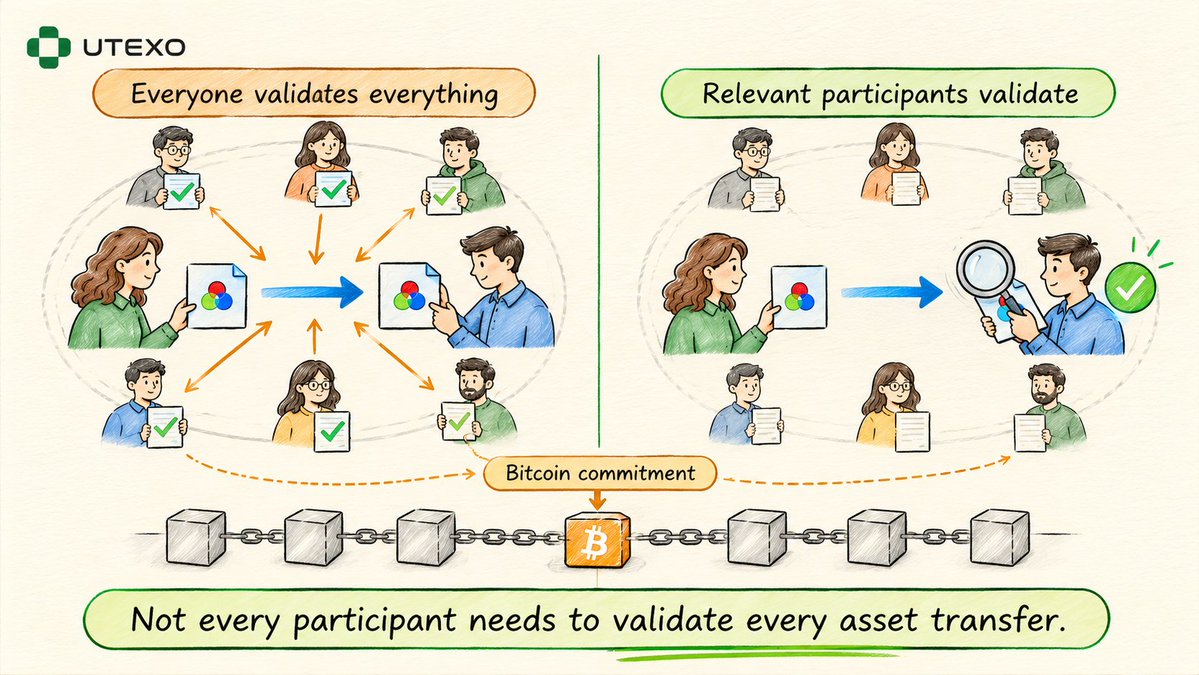
@utexocom RGB avoids making participant responsible for every asset transfer.
For Utexo, this architecture matters because Bitcoin-native asset activity can use client-side validation rather than depending on a globally replicated token ledger
It's a different way to distribute the work.
Imagine a network where every participant has to inspect every transaction involving every asset.
As activity grows, everyone carries more validation work, even when most of those transactions have nothing to do with them.
RGB takes a different approach.
How RGB Asset History Is Verified
A wallet can display an RGB balance, but how does the owner know that balance is valid?
The answer isn't simply checking a number. RGB relies on verifiable transaction history to establish how an asset reached its current owner.
@utexocom This doesn't mean RGB skips verification or that participants can accept arbitrary asset claims.
The relevant history still has to be available and validated.
The difference is who needs to perform that work, not whether the work happens.
Day 38 of saying gDlic till TGE 💙
A quick Web3 question!
Q: What are gas fees used for?
A) Processing blockchain transactions
B) Creating social media accounts
C) Buying internet data
What's your answer? 👇🏽
@FlutonIO What Comes Next?
The ceremony is complete, but that doesn't mean the entire system is automatically proven secure.
It is one important cryptographic milestone.
Fluton's next announced step is beta mainnet, where the broader system moves closer to real-world testing.
Privacy Needs More Than Encryption
@FlutonIO uses zero-knowledge proofs as part of its privacy architecture.
But before certain ZK systems can generate and verify proofs, they need special cryptographic parameters.
This is where a trusted setup comes in.
A trusted setup is only as strong as the participation behind it.
222 contributors have now helped complete this important milestone for Fluton.
Now the focus shifts to beta mainnet. The next chapter begins.
@FlutonIO Fluton's ceremony finished with 222 contributors.
The important point isn't just the number. It's the multi-participant process behind generating parameters for its zero-knowledge circuits.
One honest contribution is enough for the core security assumption.
Day 37 of saying gDlic till TGE 💙
Let's test your Dlicom knowledge!
Q: What is the core community role in Dlicom called?
A) Dliever
B) dcoded
C) DCO
Drop your answer! 👇🏽
@JimmyHope_@Isaacjohnibiam@discordflash@get_optimum What stands out to me is that Optimum is tackling a part of blockchain infrastructure that often gets less attention: how information travels between participants.
Consensus decides what the network agrees on.
But efficient propagation helps that information get there in time.
Optimum work goes beyond simply making data move faster.
With mump2p now live on Ethereum mainnet, I think it's worth looking at the networking idea behind it and why it matters.
Bro is still waiting for one missing packet while Optimum has already left the graveyard. 😭👻
Even ghosts can't stop the flow. 🎃
@get_optimum#BoostedMeme
@JimmyHope_@Isaacjohnibiam@discordflash@get_optimum The research behind this approach explores how network coding can support efficient, scalable peer-to-peer broadcasting.
The interesting question is how much unnecessary data transmission and waiting can be reduced under real network conditions.