@SEJeff@Xc1008Cui@wormholecrypto Thanks jeff! Hey @Xc1008Cui, down to chat and jam, we actually have a new developer product at wormhole that’s launching very soon and I’d love to show it around to you. :)
For those who are looking to join the $1.1 mil contest on @code4rena
Here is a bunch of zero-knowledge reading material that you can dig into
https://t.co/rBk7Vx2NXe
With all due respect Shaun, this is incorrect. Here's the problem: you sign up for LayerZero and use their defaults. The default is a centralized Google Oracle. (First off: isn't it weird that a supposedly decentralized protocol defaults to a centralized option.)
But ok, you're told you can switch oracles if you want. A regulator comes knocking and says "Google please stop being the oracle for this protocol". All of a sudden, your protocol is bricked and needs to switch oracles ASAP. Ok, should be easy right?
No, not easy. Switching oracles is a big deal. It's like Compound or AAVE switching oracles—it needs a robust decentralized process around this change, otherwise you have a major point of centralization. Switching oracles should take, at minimum, several days for a decentralized governance vote to go through.
If you use the "defaults" in LayerZero you are locked in and face a real risk of centralization and censorship. It feels misleading for you or LayerZero to say "Google is good at security" or "this is strictly better because you have more optionality". That is not the point. Using the Google oracle introduces a major vector for your protocol to get censored or shut down, and this is the opposite what a decentralized messaging layer should do.
In celebration of Gateway going to mainnet, what better way to celebrate @cosmos with a fun @badkidsart selfie matching app!
Head over to https://t.co/98KdOET9Jp, upload your selfie, and share with your frens!
Special thanks to Wormhole fellow @hmzakhalid for building this! 🔨
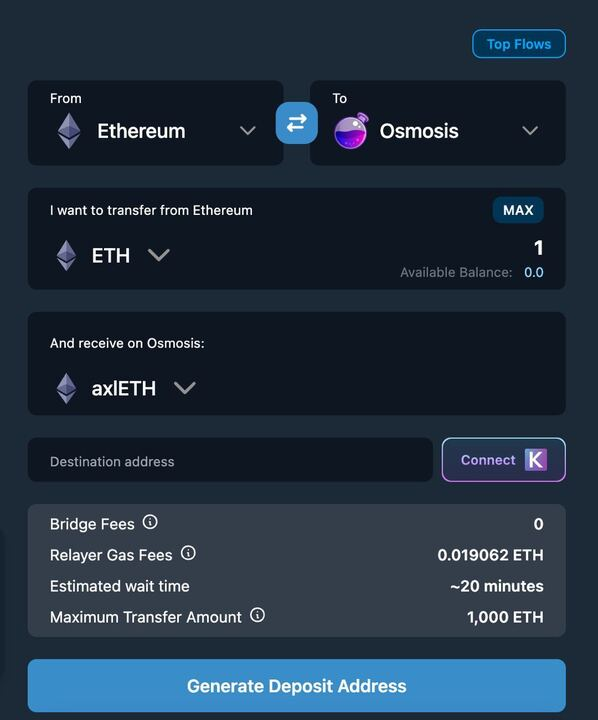
Just saying, @wormholecrypto is nearly 10x cheaper than @axelarcore in terms of cost of fees.
There will be a whETH / axlETH pool on @osmosis next week if anyone wants to take the cheaper route and then convert on Osmosis!
🌪️ 🤝 ⭕️
we’re excited to have a shared vision with circle and are glad to be an integral part of seamlessly bridging $USDC across every supported chain today.
@optimismFND is now live
https://t.co/XJxZdYxOex
Smart contract implementation risks remain the biggest unsolved problem of Defi. L2s are equally affected.
Let me pitch an idea: L1 Fork as the Court of Final Appeal.
First, why existing solutions don't work:
1) Time-locked upgrades are great for scheduled changes, but obviously don't work for emergency situations.
2) Converting to an alt L1s only adds more problems and solves nothing. Even though an alt L1 can be forked, assets bridged over from Ethereum cannot, and the fork choice resolution is no different than an upgrade problem. See this thread for example: https://t.co/lJSgaEuJcT
3) Security councils can mitigate the problem, but not solve it. Any gov multisig empowered with emergency upgrade rights poses regulatory and security risks of a different kind, rendering a Defi system immature (@ChrisBlec won't let us forget about it).
4) Combined gov mechanisms are better: a security council could only freeze the contract temporarily, requiring a token governance approval for an emergency upgrade. But now a malicious majority of undercollaterized stakers could perform an evil take-over upgrade and steal all the assets.
L1s don't face the same problem because they are forkable: any user can opt-in into the fork branch which they subjective believe to be correct and canonical. This doesn't work for L2s and Defi protocols, unfortunately, because we can't fork underlying native assets bridged from L1 (such as ETH).
Or can we? What if we forked the L1 itself and let the L1 social consensus resolve an issue for a specific protocol?
This is tempting and perfectly possible technically, but creates two problems. First, it would only work for large protocols – for the smaller ones, L1 users will likely not bother to take any action. But second, even with the big protocols, we run into a risk of overloading L1 social consensus, which Vitalik has explicitly warned against: https://t.co/vB5LWySIrq
Now, hear me out. What if we built a hierarchical system of onchain courts similar to the real-world judiciary?
Every protocol will have its own governance with normal and emergency upgrade mechanisms defined. The protocol must also designate a special contract that serves as an instance of appeal. We'll need a standard ERC interface for it.
For an emergency upgrade there must be an appeal period, during which anyone can submit a challenge to the higher court. They will have to put a pre-defined bail deposit.
This court can then cancel the emergency upgrade (and do nothing else). Different courts will have different members, prices and reputation, in a completely decentralized manner.
Each court will also have to specify the a higher court where any decision can be appealed – until at some point we reach the Ethereum Supreme Court. The decision of this smart contract can only be determined by a (technically soft) fork of the L1.
Of course, anyone can deploy a contract like this, and there is no guarantee that the users will bother to soft-fork. So the idea is to form a social consensus argound this idea, and deploy a "canonical" instance of the court that be configured to be so expensive to use, that only truly extrodinary cases will be brought before it, and thus will likely be worthy of the attention of the entire Layer-0 (the social consensus) of Ethereum. Think of a bug in @Uniswap, a major L2, a Defi protocol with a systemic risk, etc.
The most important function of such a system will be to protect protocols against political inference from the outside. It will serve as a great deterrence mechanism, and will elevate the role of Ethereum as a powerful network state.
What do you all think? Is anyone working on something like this already? We at @zksync will be more than happy to fund such a research.
i wish there wasnt such a heavy lift to go from building on evm to building on @solana
i guess what we're building at @wormholecrypto is gonna change all of that