Raon-1 mini is out of preview. 🚀
A big thanks to everyone who tried our preview and shared valuable feedback. Your input helped shape this release.
Here’s what’s new:
📈 Stronger agentic capabilities while maintaining natural conversation across multiple turns
🧠 Configurable reasoning effort: none, low, medium, high, xhigh, and max
🤗 Open weights + DFlash drafter (Apache 2.0): https://t.co/Jzc2WeEgit
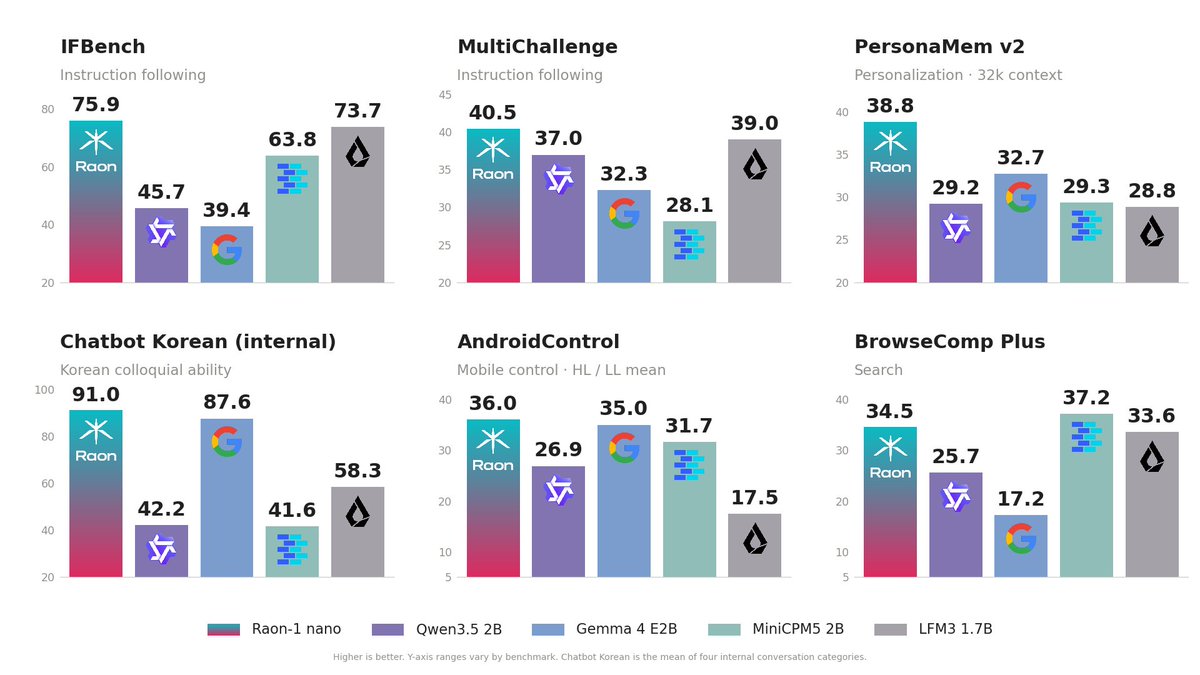
We’re releasing Raon-1 nano, an effective 1.5B dense LLM with per-layer embeddings and 3.1B total parameters. ⚡
Our journey from PUBG Ally toward on-device LLMs continues.
We pruned and distilled Raon-1 mini preview (30B-A4B) using our MoE-to-Dense approach, then further trained it on 3T tokens, followed by SFT, OPD, and RL.
Designed for natural conversations, maintaining conversational context, instruction following, and tool use in both Korean and English.
Small model. Smart interactions. Enjoy! 😊
🤗 Weights (Apache 2.0 license): https://t.co/ZVMZmlSNlz
📄 MoE-to-Dense (NeurIPS 2026 Oral): https://t.co/eoYH86lBs0
🪖 Learn more about PUBG Ally: https://t.co/A3iZvP2X7c
Today, we’re releasing a preview of Raon-1 mini, a 30B MoE LLM with 4B active parameters, trained from scratch by KRAFTON AI.
With our efficient architecture, it matches Muse Glimmer on coding/agentic tasks while being much faster and more memory-efficient! 🔥 Plus, natural, human-like conversation.
This is just a first look. The final release (and bigger models) are coming soon! 👀
👉 Try it now, free for a limited time: https://t.co/uSrLFIGPWy
🤗 Open weights + DFlash drafter (Apache 2.0): https://t.co/XWVmxsDRei
👋 KRAFTON's Raon is entering the open-weight scene!
Meet Raon-1 mini, our first model, trained from scratch.
On par with leading models in its size class, while running faster and using less memory.
Available under the Apache 2.0 license.
https://t.co/fOFoUcfDLc
New state-of-the-art speech language models are here 🚀
Meet Raon, KRAFTON AI’s open model series.
🎙️ Raon-SpeechChat [🎮 Demo: https://t.co/1380kppD6n]
A full-duplex speech model that listens and speaks at the same time
Backchannel. Interrupt. Respond. Overlap.
Just like a real conversation.
Best average performance across key conversational behaviors.
🧠 Built on Raon-Speech (9B) [🎮 Demo: https://t.co/1380kppD6n]
A State-of-the-art bilingual (EN/KO) 9B speech language model.
We also release
🔊 Raon-OpenTTS (0.3B released, 1B TBD)
Small TTS models trained on fully open datasets with their full pipeline.
👁️ Raon-VisionEncoder (400M)
Trained entirely on public data from scratch.
All model checkpoints, training/inference pipelines, and an interactive demo are open-sourced (OpenTTS includes datasets).
Built to be extremely easy to use. Ready to run out of the box.
🤗 HuggingFace: https://t.co/ddBoaj62lA
📄 Technical Report (Speech & SpeechChat): https://t.co/TsLz8wBZxf
📝 Blog (VisionEncoder): https://t.co/IBld7FA9IP
Thanks for featuring A.X K1 by the @SKtelecom consortium!
Proud that @Krafton_AI (@gmkim_ai, @jhyuckkim, Haechan, and @Beongjun_Choi) contributed to the post-training pipeline 😄
+ We have many other interesting things to share in the upcoming months, so stay tuned 😎...
🧵When training reasoning models, what's the best approach? SFT, Online RL, or perhaps Offline RL?
At @Krafton_AI and @SKtelecom, we've explored this critical question, uncovering interesting insights!
Let’s dive deeper, starting with the basics first.
1) SFT
SFT (aka hard distillation) is the very first approach you would try!
👍 This is very compute efficient as we don’t need to generate any responses from the model being trained.
👎 What are the downsides? We distill the behaviors only from the trajectories with correct answers (reward = 1). The model may learn the behaviors of generating correct answers, but not necessarily how to avoid writing incorrect reasonings. (Some believe that this is why RL generalizes better than SFT.)
2) Online RL
On the other hand, online RL works as follows. The model being trained first generates its own reasoning traces. The traces are graded, and the good traces get encouraged, and incorrect traces get discouraged. GRPO is an efficient reward renormalization method, and it is observed to make RL training converge better.
👎 What’s the downside? The cost of generating responses from the model being trained is huge! Every time you update the model, one needs to keep generating new responses using the new model parameter.
3) Offline RL
What’s something in between these two? Can we keep the efficiency of SFT while making use of negative examples too?
Offline RL strikes a balance between compute and learning efficiency. (In fact, SFT can be viewed as a special case of offline RL but only with positive reward samples!)
Offline RL is simple. It samples a batch of reasoning traces in the dataset and measures the rewards (which could be either positive or negative). That’s it 😁
No extra compute required for rollouts. It still accounts for negative examples as the reward gives you that signal.
4) Does offline RL work for training reasoning models?
The question is: Is this really useful? We don’t have definitive answers yet, but we have very interesting preliminary results.
We took the existing reasoning models (e.g., OpenThinker 2/3 for instance) and continued training them using offline GRPO.
The results were promising! With about 100 GPU hours, we were able to observe a marginal (a few percentage points) yet consistent reasoning accuracy improvement over diverse domains (AIME25, AMC23, LiveCodeBench, …)!
We found this pretty surprising for the following reasons:
1⃣ The amount of compute that went into this training procedure is less than 1% of the compute power that went into the preceding training process. The last-mile improvements on reasoning benchmark scores can be made with a single GPU node in a day 😊
2⃣ We only trained on the math dataset, but the model doesn’t seem to exhibit catastrophic forgetting on reasoning in other domains (if not slightly improved).
5) Technical challenges
There are a few technical details that we had to figure out to make this work.
1⃣ The existing reasoning traces dataset does not come with ground-truth answers for the questions. We used simple majority voting to find the pseudo-label for each question and defined the reward based on them, but a better method could be used to improve the quality of reward signals.
2⃣ Another technical challenge when it comes to offline-GRPO is the scenario where all the reasoning traces are correct. The vanilla offline GRPO cannot handle this, as after the reward normalization, all rewards become 0. This is fine for online RL (the generator is already good!), but it’s not good for offline cases. In fact, this happens about every six iterates while running GRPO! We came up with a very simple heuristic -- we added a positive bias term when this happens.
For more technical details, please refer to our technical blog: https://t.co/IQSS3xXDwN
We also released the continually trained offline-RL models: https://t.co/8uwoDRLxpK
6) What's next?
Lots of interesting questions remain open!
1⃣ What happens if we scale offline GRPO with more compute/data? We are working on it, so stay tuned for more updates!
In fact, together with @SKtelecom, at @Krafton_AI, we are building a strong R&D team dedicated to researching advanced LLM training algorithms and architectures, and this is one of our many research initiatives.
@Krafton_AI has a very strong group of researchers (see our recent work at https://t.co/1m3sIh0kXw).
We are very pleased to team up with @SKtelecom, which has the leading expertise in LLM training and deployment with its long-standing efforts in open-source LLMs in Korea!
SKT has been making a significant contribution to LLMs for Korean researchers, from KoBERT, KoGPT, … to the recent release of A.X-3.1, an LLM trained entirely from scratch using their own stack! Check out their models at https://t.co/k6ExIDilPe
2⃣ Also, what about if we use offline GRPO directly from pretrained models? Can we apply offline GRPO to the Qwen instruct models and possibly get a better reasoning model than OpenThinker? We should have a chat on this @AlexGDimakis@madiator :)
That's it for now! This preliminary report summarizes our early findings, intended to inform and engage the research community.
We're open to further discussion and collaboration, so please reach out with any feedback or interest!
Big news! Our paper on Diffusion Video Autoencoders has been accepted at #CVPR2023. Visit https://t.co/GZGMonzbo7 for more temporally consistent and disentangled video examples of face editing with our method.📹👨
#EMNLP2021 (Session 1F - Efficient Methods for NLP) Distilling Linguistic Context for Language Model Compression - Geondo Park, Gyeongman Kim, Eunho Yang: https://t.co/pggSbvP3yY