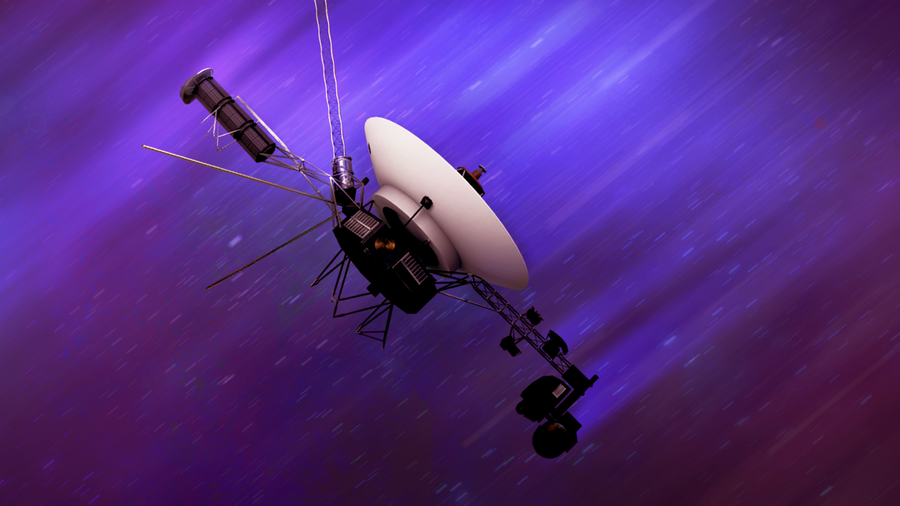
Sister ship Voyager 1 is currently ~23h 31m 53s of light travel time from Earth, or 25,396,000,000 km / 15,781,000,000 mi / 169.764 AU (2026:120:120000:1L)
To conserve power, engineers at @NASAJPL have turned off an instrument on Voyager 1 – but the science continues!
Voyager 1 has two remaining science instruments – one that listens to plasma waves and one that measures magnetic fields. Learn more: https://t.co/sqOXjiSdaL
On this day in 2016, sister Voyager 1 turned off her Ultraviolet Spectrometer (UVS), saving 2.5 W of power.
The UVS was used to determine the scattering properties of lower planetary atmospheres, the distribution of constituents with height (including the hydrogen corona), to observe airglow and auroras, and to look at rings in the UV.
The UVS was one of the few differences between V1 and V2: the gratings used to scatter light were slightly different between the two spacecraft. The V1 grating covered 53.5 to 170.2 nm, while V2's grating covered 51.3 to 168.0 nm.
Two very different modes were used for this instrument: one while looking directly at an object (emission lines), and an occultation mode while the Sun was passing through/behind the object (absorption lines). The occultation mode allowed data collection through increasing depths of the occulting body's atmosphere. To avoid having all the instruments on the arm pointed at the Sun, an offset mirror was used for the UVS in this mode.
The radio signal itself was also used as an occultation sounder as the Voyagers passed behind targets from Earth's point of view, and this is the reason for a lot of the detailed trajectory planning: soundings of Saturn's moon Titan, the only known moon with an atmosphere at the time, were a primary objective for the Voyager program, and the reason for V1's post-Saturn trajectory out of the solar system.