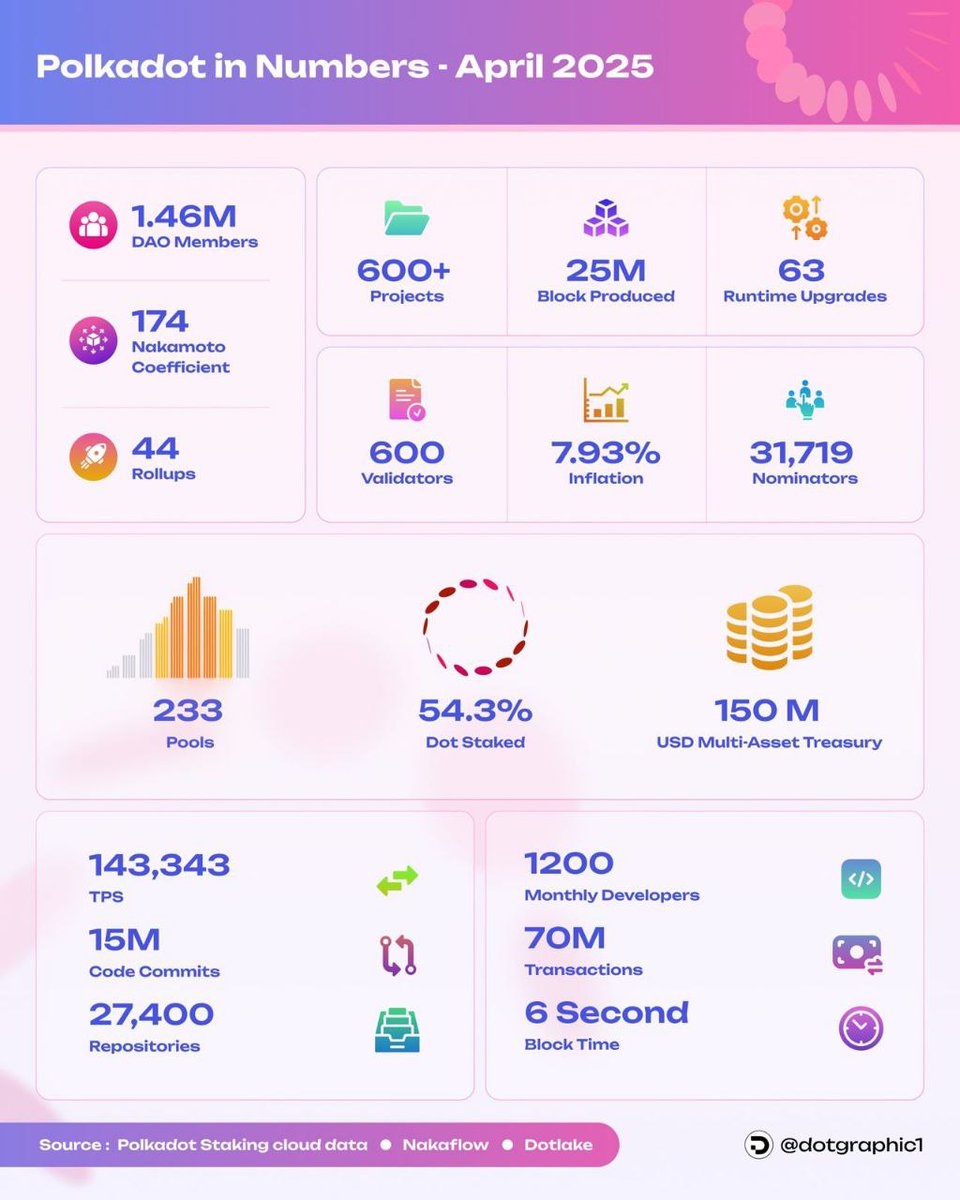
The number of DOT staked in @Polkadot nomination pools continues to grow steadily. With around 233 active pools, approximately 21 million DOT has been bonded.
Over 39,000 members are using nomination pools to contribute to Polkadot’s security and earn staking rewards.
The minimum amount to join a pool is just 1 DOT, making staking more accessible.
There’s still a long way to go, but these numbers are promising.
🔥 HOT: Polkadot Technical Fellowship Member Could Have Been Removed
A community member has initiated Referendum 508 on Kusama, proposing the removal of a Technical Fellow from the Fellowship.
Here’s Why It Matters 🔥
Let’s dive into the Polkadot Technical Fellowship, its role, and why this referendum is a big deal. 🧵👇
With Elastic Scaling set to launch and a Polkadot ETF in motion, the protocol is making waves in early 2025.
It now hosts 10 of the 20 active rollups, leads in stablecoin adoption, and holds the highest Nakamoto Coefficient among major blockchains.
Let’s take a look at @Polkadot by the numbers
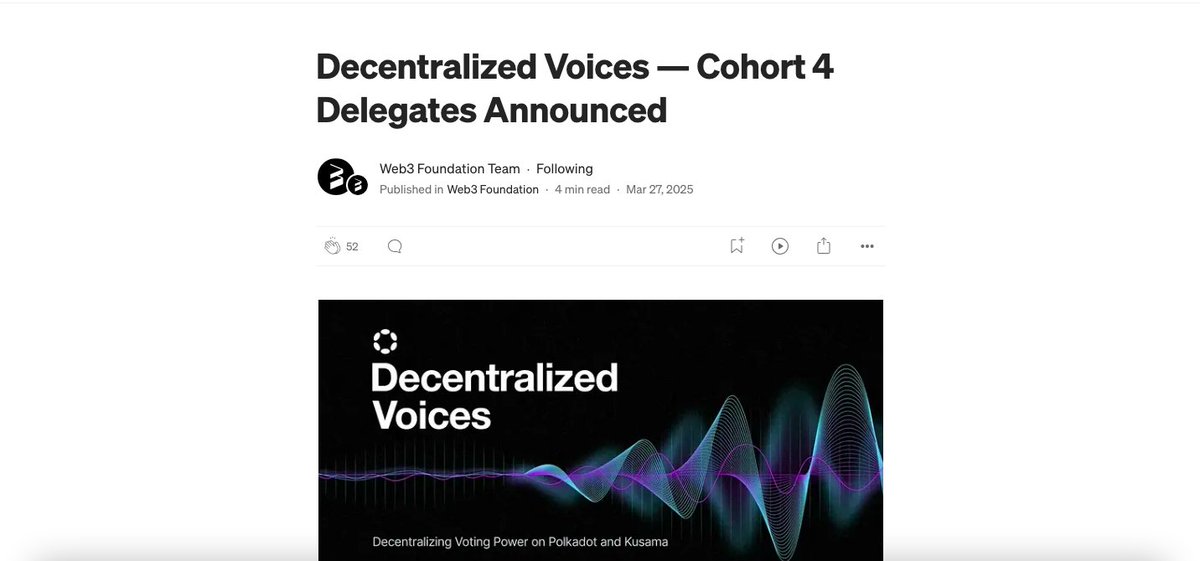
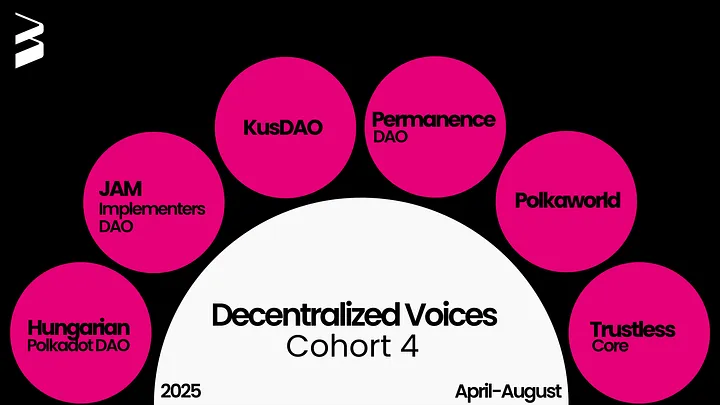
@TheKusamarian@PolkadotHungary@javajam_io@PermanenceDAO@polkaworld_org@trustlesscore What’s New in Cohort 4?
For this cohort, the Web3 Foundation selected delegates by looking beyond just on-chain activity. This time, they considered:
- Active participation in OpenGov discussions.
- Contributions and visibility on social media and
community platforms.
What is the Decentralized Voices Program?
It is an initiative by the Web3 Foundation aimed at increasing community participation in Polkadot and Kusama OpenGov.
It works by delegating tokens to active community members, giving them voting power to represent the wider community.
Did you know?
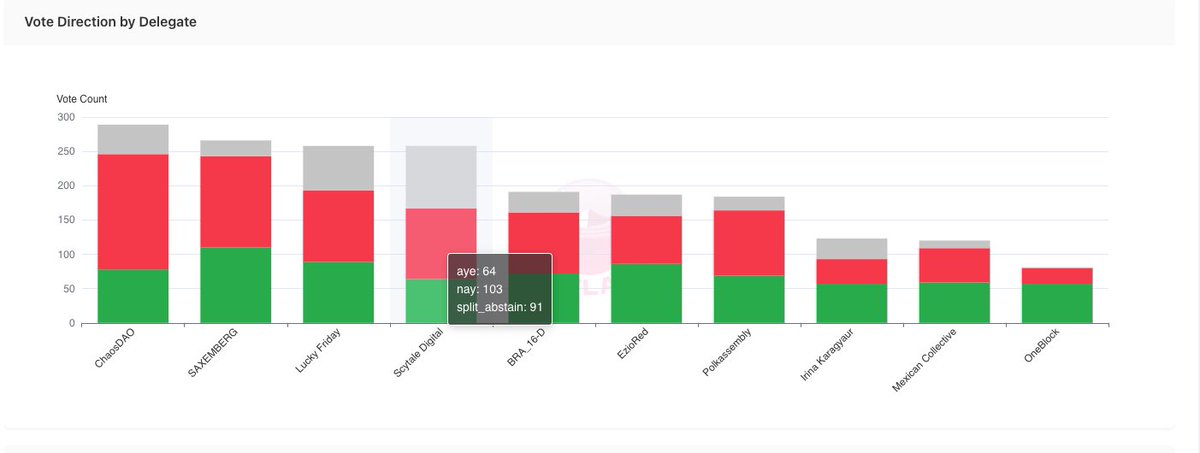
Since launching the Decentralized Voices (DV) program, DV delegates have changed the outcome of 128 referenda across @Polkadot governance.
@ChaosDAO consistently ranks among the top participants, and earlier this week, the @Web3foundation officially passed the baton to the new Cohort 4 delegates.
Let’s dive in and understand what the DV program is, the role it plays in OpenGov, and what’s new this time around.
A thread 🧵
The @paritytech team is following the roadmap schedule, and the launch of elastic scaling is just around the corner in Q2.
While writing this post, a new upgrade has just been released, allowing Nomination Pool holders to participate in OpenGov.
Besides this, major technical upgrades are set to happen in @Polkadot throughout 2025.
Let’s take a look. A thread
[1/13]
Do you know?
Polkadot has undergone 63 upgrades through on-chain governance since its launch—two of them just this year.
In traditional networks, these would have required hard forks. But on @Polkadot upgrades happen seamlessly & continuously with no disruptions.
Serving the blockchain ecosystem since 2020, Polkadot has had 0 seconds of downtime.
Key Network Insights – February 2025
In this thread, I will share the latest updates on development, OpenGov activity, GitHub developer engagement, rollup metrics, research, and community engagement.
These metrics highlight the continued growth and progress of the Polkadot ecosystem.
A thread
[1/12]
February has been a bullish month for the @Polkadot ecosystem. As we move forward with JAM, I want to share the @Web3foundation research papers published this month. Let's dive in and decode these insights.
🔹 Trustless Bridges via Random Sampling
Researchers Bhargav, Alistair, and Fateme from Web3 Foundation have published a paper titled "Trustless Bridges via Random Sampling." They propose a trustless bridge design that eliminates the need for third-party intermediaries, relying solely on Byzantine Fault Tolerance (BFT).
These bridges leverage cryptographic techniques to ensure secure and reliable connections (trust in code), allowing users to transfer assets between networks without trusting a centralized entity. The paper introduces a random sampling method specifically for PoS blockchains.
🔹 Candle Auction Mechanism on Polkadot &
Kusama
Researchers @GehrleinJonas , Samuel, and Jörg have analyzed the candle auction mechanism used in Polkadot and Kusama parachain slot auctions. Their study examined 70 auctions (15 on Polkadot and 55 on Kusama) conducted between June 2022 and August 2024.
They found that the mechanism achieved high efficiency and revenue generation levels, with 97.4% efficiency on Polkadot and 89.9% on Kusama.
These research efforts are key to network development and I want to thank you for reading this post.
A Photo to Remember
Eleven years ago, he introduced the term Web3.0, and Seven years ago he launched @Polkadot . In this pic, @gavofyork is seen deploying a blockchain using Substrate.
He has introduced the first decentralized supercomputer. At the moment, he is running PolkaJAM, a JAM client by @paritytech. We had the privilege of witnessing it live.
A huge shoutout to @pala_labs, @PolkadotNow, and @0xblocsoc for organizing this incredible event.
The JAM Tour Experience
Had an unforgettable day at the JAM Tour in New Delhi Attended the session at @iitdelhi by @pala_labs & @0xblocsoc and @PolkadotNow a event that opened my eyes to the future of Web3.
The event was nothing short of amazing.
Here’s a recap of the event
[1/13]
Key Insights on @Polkadot Network – January 2025
In this thread, I will share the latest updates on OpenGov activity, GitHub developer engagement, Coretime, Staking, etc. These key metrics showcase the ongoing growth and progress of the @Polkadot ecosystem.
A thread!🧵
[1/9]


![its_ravii's tweet photo. Key Insights on @Polkadot Network – January 2025
In this thread, I will share the latest updates on OpenGov activity, GitHub developer engagement, Coretime, Staking, etc. These key metrics showcase the ongoing growth and progress of the @Polkadot ecosystem.
A thread!🧵
[1/9]](https://pbs.twimg.com/media/GjNGr2PaQAESON0.jpg)








![its_ravii's tweet photo. The @paritytech team is following the roadmap schedule, and the launch of elastic scaling is just around the corner in Q2.
While writing this post, a new upgrade has just been released, allowing Nomination Pool holders to participate in OpenGov.
Besides this, major technical upgrades are set to happen in @Polkadot throughout 2025.
Let’s take a look. A thread
[1/13]](https://pbs.twimg.com/media/GnmtDPoXUAA7Yg2.jpg)

![TheDotsTalks's tweet photo. Key Network Insights – February 2025
In this thread, I will share the latest updates on development, OpenGov activity, GitHub developer engagement, rollup metrics, research, and community engagement.
These metrics highlight the continued growth and progress of the Polkadot ecosystem.
A thread
[1/12]](https://pbs.twimg.com/media/Gl7eVskbYAIhT0t.jpg)


![its_ravii's tweet photo. The JAM Tour Experience
Had an unforgettable day at the JAM Tour in New Delhi Attended the session at @iitdelhi by @pala_labs & @0xblocsoc and @PolkadotNow a event that opened my eyes to the future of Web3.
The event was nothing short of amazing.
Here’s a recap of the event
[1/13]](https://pbs.twimg.com/media/GjxwEiwacAAedge.png)