"Short the HUL stock and Nestle stock" . These will goto zero.
TBCG will end FMCG.
What is TBCG ? Trust based consumer goods.
This is not an investment advise but provocative title to grab your attention.
here the is the link to the full article.
https://t.co/JPZqJoWyqX
I LOVE chatting about India. I nannied for an Indian family for years during my undergrad and learned so much. The food, culture, etc. it’s one of my favorite cuisines. Every time I talk to someone Indian they are shocked about my knowledge. The girl I met today said “are you sure you aren’t Indian?” I was dying 🤣😭
While the proposed deal is a major shift from the recent period of escalation and closure, Iran has already made clear that it will not cede control or management of the Strait. This suggests that any reopening may come with new conditions rather than a full return to the pre-crisis status quo.
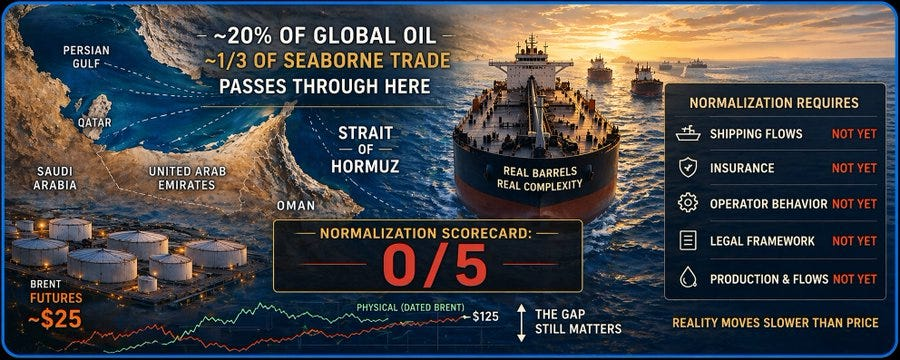
Even with a deal in place, the real test will be how quickly physical conditions improve. Track our Normalisation Scorecard to see whether this deal translates into actual crude movement or remains limited to announcements.
Full framework here:
https://t.co/rHbUIfmXcb
#Hormuz #Oil #Geopolitics
@nikitabier@elonmusk
is there a way to solve
that people don't have to write
.com as dot com
It is annoying to read as well as write but more importantly it does not put the user of X at the centre. It is just bad user experience.
The Hormuz disruption is now showing up in sovereign balance sheets, starting with foreign exchange rates.
The weakest economies are holding together largely through IMF support. Mid-tier importers are managing the shock through varying channels, while a smaller group of exporters is gaining tangible fiscal and current-account benefits that are real and accelerating.
Full note here: https://t.co/IYf00Vp0Vz
#Hormuz #Oil #FX #Geopolitics
On April 24 we said:
“Inventories can absorb a shock for a while. They cannot absorb it indefinitely.”
Today, Neil Chapman, Senior Vice President of ExxonMobil, publicly echoed the same warning.🧵
Even as attacks and counter-strikes escalate, one fact remains unchanged:
Iran built a chokepoint authority.
The US escort plan collapsed in days.
The Saudis declined to help.
A chokepoint became an invoice.
The Persian Gulf Strait Authority is still fully operational — with its own logo, Vessel Information Declaration form, and reported tolls up to $2 million per transit.
Nothing has normalized yet . Understand why via the video
#Hormuz #Chokepoint #Oil #Geopolitics
@thesamparr For some reason , i listened to this pod again...
I come from the boring world of finance and needed some inspiration ..
https://t.co/1lO90TcuhG
So many important lessons x the most important being think of a trend and how do you see it in 10 years ..
Five things to know
A chokepoint became an invoice. On May 18, Iran’s Persian Gulf Strait Authority went live on X. The toll regime — reportedly up to $2 million per transit, settled in yuan or Bitcoin to IRGC-linked wallets — is now an operating administrative body with a logo and a Vessel Information Declaration form.
The US naval escort plan collapsed in days. Project Freedom launched May 4. NBC reported on May 7 that Saudi Arabia had denied airspace and access to Prince Sultan Air Base. Trump paused the operation. Days later he called the talks “on life support.”
The UAE left OPEC on May 1. The exit is institutional, not tactical. Capacity utilization in 2025 ran at 66% — below Saudi’s 77% and Kuwait’s 84%. The mathematics had not worked for years. The Hormuz crisis was the trigger, not the cause. . OPEC’s second-largest swing producer is gone.
Central banks have stopped pretending. The Fed held 3.50–3.75% on April 28–29 on an 8–4 vote — the largest dissent since October 1992. The ECB is pricing better than 80% odds of a June hike. This is no longer a cut cycle deferred. It is a hike cycle re-entering.
The scorecard is not failing. It is being replaced. Shipping flows are not back. Insurance is not back. Operators are not back. The legal framework has moved the wrong way. Production is not back. Five out of five conditions are still failed — but the reason has changed. Each “no” on the scorecard is now an institutional fact, not a stress response.
The system is not waiting to normalize. It is normalizing — somewhere else
https://t.co/HJYVLAA014