What is veBTC and veMEZO??
Do you have an idea of what they are?
Go over to taskify follow the steps and get a chance to earn from the reward pool.
https://t.co/nSpak8fwNX
Taskify is the bounty board for @MezoNetwork.
A platform built to actively contribute to the Mezo ecosystem by turning participation into action.
Through Taskify, users can:
Discover and complete Mezo-related tasks
Earn mUSD rewards
Learn how Mezo connects Bitcoin to the broader DeFi ecosystem
Contribute to the growth and awareness of Mezo
The goal is simple: more tasks, more contributors, more users, and a stronger Mezo ecosystem.
Welcome to Taskify.
Valor is back, so is Gooddollar with the Celo network
Claiming and identity verification are live again.
The team acted fast, and the issue has been resolved.
Thank you for your patience. We hope this doesn’t happen again. Play on.
Day 48/100 of ZK 🔐
Today we focused on the verification side of Groth16: the exact pairing checks the verifier performs and how public inputs are incorporated.
The Core Verification Equation
After receiving the three proof elements π_A, π_B, and π_C, the verifier uses the verification key to check a pairing equation of the following form:
e(π_A, π_B) = e([α]₁, [β]₂) · e(public_input_terms, [γ]₂) · e(π_C, [δ]₂)
In expanded form this checks that:
A(τ) · B(τ) = αβ + public_input_contribution + C(τ) + H(τ)·Z(τ) · δ-related terms
The left side comes from the product of the first two proof elements. The right side reconstructs the expected value using the verification key and the public inputs.
How Public Inputs Are Handled
Public inputs are not hidden. The verifier knows them and therefore can compute a linear combination of the corresponding verification-key elements. This combination is inserted into the pairing equation so that the public values are correctly accounted for without the prover having to hide them.
If the public inputs are wrong, or if the prover used inconsistent private values, the equation fails.
Why Blinding Terms Cancel
The random blinding factors the prover added on Day 47 are carefully constructed so that they cancel out on both sides of the pairing equation when the proof is honest. A malicious prover who tries to forge a proof without a valid witness cannot make the blinded terms cancel correctly, so the pairings will not match.
Result
If all pairing checks pass, the verifier is convinced that the original R1CS constraints were satisfied for the given public inputs, without learning anything about the private witness.
Day 49/100 of ZK
Today we focused on how Groth16 becomes non-interactive through the Fiat-Shamir transformation.
The Interactive Starting Point
In the pure interactive version of the protocol the verifier sends random challenges at several points. These challenges are used to bind the prover to specific polynomial evaluations and to prevent the prover from adapting the proof after seeing the questions.
An interactive proof is fine for theoretical analysis, but it is impractical for most real applications. We need a single message that anyone can verify offline.
The Fiat-Shamir Transformation
Fiat-Shamir replaces every verifier challenge with a hash of the entire conversation so far (the transcript).
Instead of waiting for the verifier to send a random field element α, the prover computes:
α = Hash(transcript || previous_proof_elements)
The prover then continues exactly as if that α had been chosen by the verifier. Because the hash function is assumed to behave like a random oracle, the resulting α is unpredictable to the prover before the previous messages are fixed.
When the verifier later checks the proof, they recompute the same hashes from the transcript and confirm that the prover used the correct challenges.
Why This Works for Groth16
All the random points that appear in the QAP evaluation, the blinding factors, and the final pairing checks can be derived from the transcript. The final proof remains three group elements plus the public inputs. No interaction is required.
The security argument moves to the random-oracle model: as long as the hash function is secure, the non-interactive proof inherits the soundness of the original interactive protocol.
Practical Notes
Correct transcript construction is critical. Missing a message or hashing in the wrong order can break security. Domain separation (including a protocol identifier in the hash) is also standard practice to avoid cross-protocol attacks.
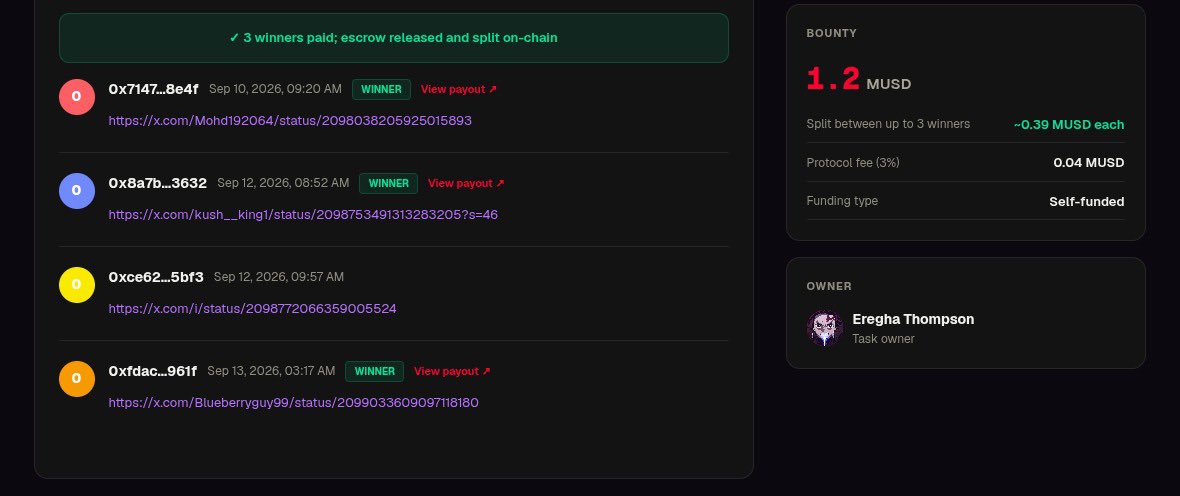
Yesterday Taskify released payment on the first completed community tasks, all winners got rewarded musd or mezo sent to their wallet addresses.
You could be part of the next winners on taskify, register now: https://t.co/6U7SeNMaBp
CT hunting the next farm.
While someone already applied on Taskify, shipped the work, and got paid in MUSD.
Bounties are live on https://t.co/itHPV8uhuO
@Taskifyhq
400+ ACTIVE VERIFIED WARRIORS 🚀📍
The Valor warriors are unstoppable. We've crossed over 400 real, fully verified humans actively playing and claiming G$
No bots, just pure real-world velocity.
Get on the locked in on https://t.co/WIwtbSBNHs







![Marvysmind's tweet photo. Day 48/100 of ZK 🔐
Today we focused on the verification side of Groth16: the exact pairing checks the verifier performs and how public inputs are incorporated.
The Core Verification Equation
After receiving the three proof elements π_A, π_B, and π_C, the verifier uses the verification key to check a pairing equation of the following form:
e(π_A, π_B) = e([α]₁, [β]₂) · e(public_input_terms, [γ]₂) · e(π_C, [δ]₂)
In expanded form this checks that:
A(τ) · B(τ) = αβ + public_input_contribution + C(τ) + H(τ)·Z(τ) · δ-related terms
The left side comes from the product of the first two proof elements. The right side reconstructs the expected value using the verification key and the public inputs.
How Public Inputs Are Handled
Public inputs are not hidden. The verifier knows them and therefore can compute a linear combination of the corresponding verification-key elements. This combination is inserted into the pairing equation so that the public values are correctly accounted for without the prover having to hide them.
If the public inputs are wrong, or if the prover used inconsistent private values, the equation fails.
Why Blinding Terms Cancel
The random blinding factors the prover added on Day 47 are carefully constructed so that they cancel out on both sides of the pairing equation when the proof is honest. A malicious prover who tries to forge a proof without a valid witness cannot make the blinded terms cancel correctly, so the pairings will not match.
Result
If all pairing checks pass, the verifier is convinced that the original R1CS constraints were satisfied for the given public inputs, without learning anything about the private witness.](https://pbs.twimg.com/media/HR9AbV5acAEtY52.jpg)