I'm going all-in on AI this year.
Here I'll share:
→ AI tools I actually use (and which are just hype)
→ Workflows that save hours
→ Honest takes on AI, tech & careers
No fluff. Follow along if that's your thing 🤝
@zachlloydtweets Love seeing real numbers on this. It matches what I found benchmarking RAG: the fancier pipeline often costs more and does worse. Did quality change at all for the extra 40%?
@olgaostrovskiy Interesting. Equal RRF hurt on my set (scientific claims) but worked on yours. My guess is the share of name-driven questions: novels are full of character and place names, my set mostly wasn't. That's the real lesson: the right weight depends on your queries.
I tested 3 "RAG upgrades" on 300 real questions.
The boring one won.
With a weak embedding model (all-MiniLM):
→ Alone: 64.9
→ + Hybrid search: 69.3 (+4.4)
→ + Reranker: 69.5 (+4.6)
With a good embedding model (bge-small):
→ Alone: 71.3
→ + Hybrid search: 71.7 (+0.4)
→ + Reranker: 69.9 (−1.4) ❌
Just swapping the embedding model: +6.4. Both models are small and free. It's one line of code.
The lesson: hybrid search and rerankers fix weak retrievers. They barely move good ones, and can make them worse.
Before adding tricks, upgrade the base 👇
@olgaostrovskiy 66/68 is a great result. Names are exactly where keyword search earned its keep in my test too: all 20 questions only BM25 found hinged on exact names. Did you weight both retrievers equally?
I tested 3 "RAG upgrades" on 300 real questions.
The boring one won.
With a weak embedding model (all-MiniLM):
→ Alone: 64.9
→ + Hybrid search: 69.3 (+4.4)
→ + Reranker: 69.5 (+4.6)
With a good embedding model (bge-small):
→ Alone: 71.3
→ + Hybrid search: 71.7 (+0.4)
→ + Reranker: 69.9 (−1.4) ❌
Just swapping the embedding model: +6.4. Both models are small and free. It's one line of code.
The lesson: hybrid search and rerankers fix weak retrievers. They barely move good ones, and can make them worse.
Before adding tricks, upgrade the base 👇
Everyone says "add a reranker" to fix RAG.
I tested it on the same 300 questions from my hybrid search benchmark.
It made the best setups worse.
Retrieval quality (nDCG@10), before → after reranking:
→ BM25: 64.4 → 67.5 ✅
→ Vector search: 71.3 → 69.9 ❌
→ Hybrid 50/50: 68.4 → 69.1
→ Hybrid tuned: 71.7 → 70.0 ❌
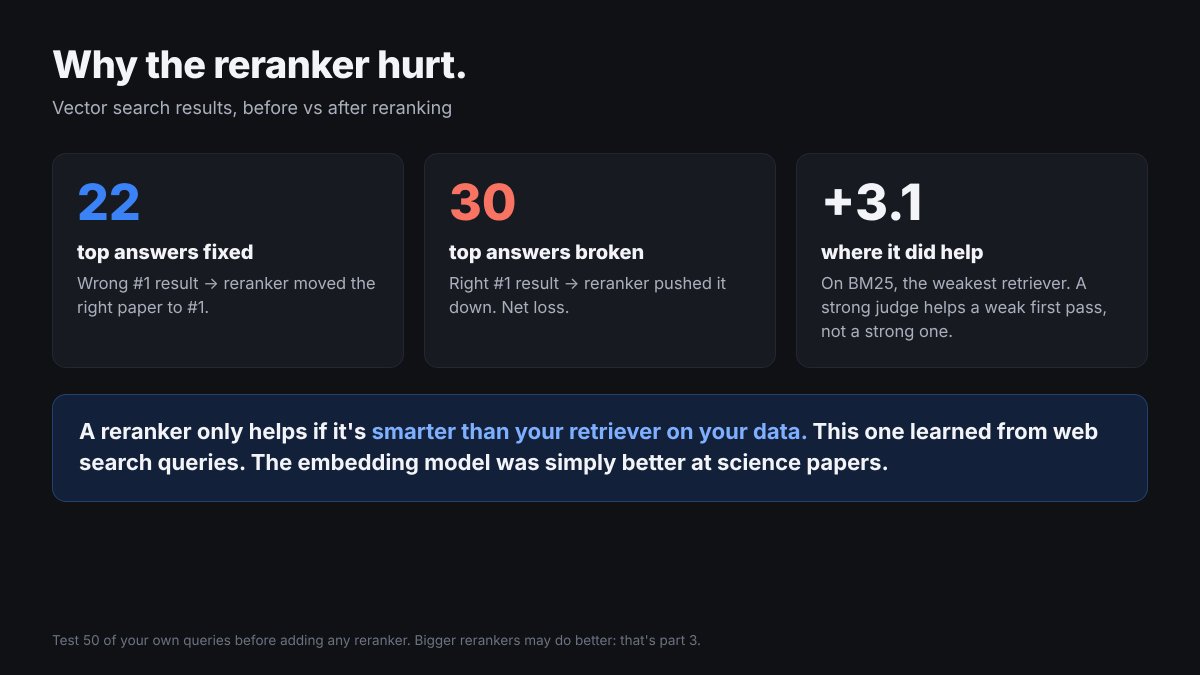
On vector search it fixed 22 top answers and broke 30.
The reason: a reranker only helps if it's smarter than your retriever on your data. This one learned from web search. The embedding model was simply better at science papers.
Where it did help: the weakest retriever.
Test 50 of your own queries before adding one 👇
Everyone says "just add hybrid search" to fix RAG.
I benchmarked it on 300 real questions across 5,183 research papers.
The default setup made retrieval worse.
Retrieval quality (nDCG@10):
→ Keyword search (BM25): 64.4
→ Vector search: 71.3
→ Hybrid, 50/50 RRF: 68.4 ❌
→ Hybrid, tuned 30/70: 71.8
The twist: they fail on completely different questions.
BM25 alone caught 20 that vectors missed, all exact names like PPM1D, CCL19, Ivermectin.
Vectors alone caught 37 that BM25 missed, all paraphrased, concept-level questions.
Always pick the right retriever per query and top-5 misses drop from 22% to 15%.
So the real win isn't "add hybrid." It's knowing which retriever each query needs.
@techyoutbe The box missing from most RAG diagrams: an eval set. In my benchmark, adding a reranker made the best pipeline worse. Without evals you’d never know.
@ajambrosino Performance work is the least celebrated and most felt kind of release. Every second shaved off the agent loop compounds across a whole day.
@kaggle@Eigent_AI Incident benchmarks are the right direction. Writing new code is easy to grade; diagnosing why something broke is where agents still guess.
@sashikantsingh_ The 17 MB is the easy part. Real streaming pain is DRM, adaptive bitrate on bad networks, and player bugs across hundreds of TV devices. That’s where the engineering lives.
@riteshpatel1884 Solid size for a first eval. Worth splitting them by query type next: exact names vs paraphrases. That’s where retrievers diverged most in my runs.