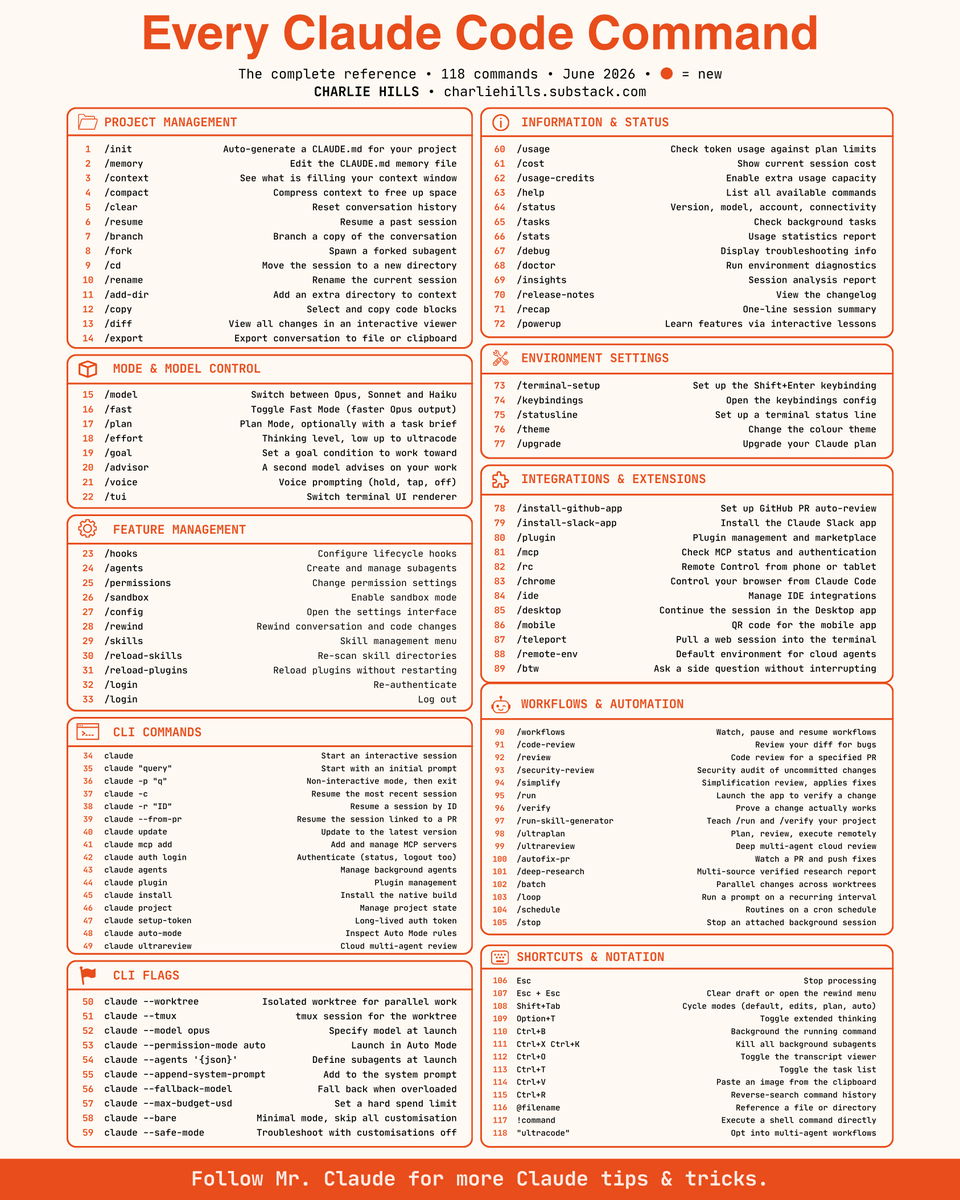
Claude Code has 118 commands now, and most people are still only using about ten of them.
Project management covers the basics people already know, like /init and /clear, but also the ones that get skipped: /branch to fork a conversation, /rewind to undo code changes and not just chat, /diff to view every change in one interactive viewer instead of scrolling a terminal.
Mode and model control decides how Claude actually works on a task, not just which model answers. /plan separates thinking from doing, /effort sets how hard it thinks, /goal sets a condition to work toward instead of a single instruction, and /advisor brings in a second model just to critique the first one's work.
Feature management is where the infrastructure lives: /agents to create and manage subagents, /hooks to configure lifecycle behavior, /sandbox to isolate what Claude can touch, /skills to manage what it can reuse.
CLI commands and flags are the version of all of this you script instead of type interactively: claude -p for non-interactive runs, claude --worktree for isolated parallel work, claude --max-budget-usd to cap spend, claude --agents to define subagents at launch instead of after.
Information and status is how you stop guessing what Claude is doing: /usage and /cost track spend against your plan, /doctor runs environment diagnostics, /insights gives you a session analysis report instead of just a transcript.
Integrations connect Claude to everything around it: /install-github-app for PR auto review, /chrome to control your browser from Claude Code, /teleport to pull a web session into the terminal, /mcp to check what is actually connected and authenticated.
Workflows and automation is where Claude stops being a single session: /code-review and /security-review audit your diff automatically, /loop runs a prompt on a recurring interval, /schedule runs routines on a cron schedule, /ultrareview kicks off a deep multi-agent cloud review.
Shortcuts round it out: Shift+Tab cycles modes, Ctrl+B backgrounds a running command, @filename references a file directly in the prompt, and ultracode opts into multi-agent workflows entirely.
Credit to Charlie Hills for compiling the full reference.
Bookmark this. You will not remember all 118, but you will remember this exists the next time you need one.
Today, we’re partnering with Nscale to deploy up to 100,000 GPUs on the NVIDIA Vera Rubin Platform
We're committing $3.5 billion initially, with plans to scale beyond $6 billion
Bringing a robot into every home demands compute at an unprecedented scale
Exciting use of robotics beyond industrial automation. The combination of AI, natural movement, and real-time interaction could transform entertainment and hospitality.
🚨 BREAKING:
A Boston Dynamics spinout just emerged from stealth, and it's building something no one else in robotics is focused on.
Dynamic Creatures was co-founded by Marc Theermann, former Chief Strategy Officer at Boston Dynamics, and Farbod Farshidian, former research leader at the RAI Institute.
Their mission? To build interactive character robots that create genuine moments of wonder for people.
Characters that move naturally through guest environments, understand the context of an encounter, and respond to an individual in real time.
Dynamic Creatures is @BostonDynamics' official entertainment and hospitality partner, and is already working with a major theme park and retailer on guest-facing character experiences.
The technology stack is called SnowJay, an integrated AI and robotics platform combining learning-based control, real-time perception, behavioral programming, character design and costuming into a single operating system for interactive characters.
The business model is smart too. Platform-based characters deploy in months rather than years, with leasing options that remove the large upfront capital requirement for operators.
The company is backed by Eniac Ventures, Kindred Ventures, Heliad Sunshine Lake and Bluegrass Ventures.
😇 I am also a proud angel investor in Dynamic Creatures alongside one and only Marc Raibert.
This is exactly the kind of company I want to back in robotics!
🔗 Here's the news: https://t.co/EOpa3W4Jrj
~~
♻️ Join the weekly robotics newsletter, and never miss any news → https://t.co/GoA3ZuwoPB
Robots are ready to take on complex environments. 🌍
See how AI, simulation, and accelerated computing are redefining what’s possible in robotics at #NVIDIAGTC Berlin.
View sessions 👉 https://t.co/KuuYG9io52
Microduck makes reinforcement learning and advanced robotics widely accessible. An open-source, sensor-packed biped for under $400 could inspire a new generation of robotics developers and enthusiasts.
We have a huge news to share today!
Today we are unveiling the first truly accessible RL robot - welcome Microduck
A 25 cm tiny open-source biped with 15 actuators and packed with sensors (camera, speaker, LiDAR, NFC, bluetooth, wifi, etc) that you train yourself with reinforcement learning.
It's also playable out of the box with more than half a dozen fun and playful pre-trained policies to have it walk, sit, crouch, roller-skate, pick up objects with its articulated beak, and recover on its own.
And all for less than $400.
See all the details, play with the simulator and order it at: https://t.co/n1Btgs6vKw
(video with sound on 🔊)
@pollenrobotics Great to see an affordable biped robot like this. Microduck could make robotics development, experimentation, and education far more accessible. Looking forward to seeing what the community teaches it.
Introducing NVIDIA Jetson Orin Nano 2 👏
Built to bring frontier intelligence to entry-level edge AI, this robotics computer will deliver:
• 2x the inference performance of Jetson Orin Nano Super
• 40% lower power consumption at the same performance in 15W mode
• The same compact form factor
Read the press release 👉 https://t.co/d3nGTlFPBD
Bringing capable robotic arms below the $1,000 threshold could unlock a new wave of experimentation and commercial applications.
Open-source hardware, 3D printing, and Python integration make robotics increasingly accessible to developers and smaller businesses.
You can now build a robot arm for under $1000.
With actuators you find on arms costing 2x of that.
> 3D printed, fully opensource
> 1.5 kg payload
> Robstride QDD actuators
> python SDK and integration with lerobot
order yours here: https://t.co/nW4CSzN4lp
Teams put dexterous robotic hands to the test in a bean-picking competition at Beijing's World Humanoid Robot Games, as developers seek to move the technology closer to practical, real-world applications
While Figure, Tesla, Apptronik and 1X chase living rooms and fulfillment centers…
@personaaiinc is shipping industrial humanoids for the dirtiest, highest-paid skilled trades on earth. First customer:
HD Hyundai, the world’s largest shipbuilder.
Prototype delivery: end of 2026.
Commercialization: 2027.
They are already ahead of schedule.
A good leap toward making robotics accessible to everyone. Affordable, open-source humanoids could accelerate innovation among startups, students, and developers.
Open-source humanoid for under $5,000! 😳
UC Berkeley released Berkeley Humanoid Lite, an open-source humanoid robot that costs under $5,000 and can be built on a desktop 3D printer.
Every component is either 3D-printable or available on Amazon. There's no need of specialized manufacturing, nor exotic materials.
This breaks the $ 50K-$100K barrier that locked humanoid robotics behind university labs and big companies.
Design uses cycloidal gears, optimal for 3D-printed actuators. They extensively tested the plastic components for durability because 3D-printed parts are weaker than metal.
The tests validated they're reliable enough for research. Check the demos! It plays with Rubik's cubes, writes its name with a marker, walks on two legs, or manipulates blocks.
Zero-shot sim-to-real transfer using reinforcement learning.
Everything is open, including hardware designs, code, and even training frameworks.
Democratizing robotics and lowering the entry point is probably my favourite sentence :)
🔗 Here's the project page (build it!!!): https://t.co/Skfp2eHfpT
~~
♻ Join the weekly robotics newsletter, and never miss any news → https://t.co/GoA3ZuwoPB
Unitree Robotics shares rose 542% in early trading Wednesday as the Chinese humanoid robot maker made its stock market debut in Shanghai.
The Hangzhou-based robot maker, whose backflipping and dancing machines have drawn global attention, raised about 6.1 billion yuan ($905 million) in its IPO, according to its prospectus. Shares rose to 968.1 yuan apiece, after hitting as high as 1,100 yuan earlier.
Read more on CNBC: https://t.co/ayLqb5CmD2
Welding, grinding, blasting, painting, assembly und inspection...
Bring the robot inside the structure where no normal robot fits.
Like what?
Ballast tanks.
Double hulls.
Penstocks.
Pressure vessels.
Refinery and chemical tanks.
Boilers.
Offshore structures.
Nuclear facilities.
Oh, and did I mention >15 kg payload at 0.1 mm acc???
Places where sending a human in doesn't just mean expensive labor.
It means confined-space procedures, ventilation, scaffolding, safety crews, rescue plans, shutdowns and sometimes hours of lost production.
That's exactly where Aru from Nio Robotics starts to get really interesting.
It can enter through small hatches, move across steel structures, climb walls and ceilings, and bring the actual tool to the job.
Not just inspect the problem... work on it.
I've been working with the Nio Robotics team for the past few months, and we've already deployed Aru at a customer site.
So if you're reading this and thinking:
"Yeah... we have exactly that problem."
Shoot me a message.