When I was with the St. Louis Cardinals, I saw Matt Carpenter do one of the strangest things.
He always had a bat in his hand.
Before the game.
In the clubhouse.
In the tunnel.
Walking around the stadium.
And he was constantly taking swings.
No baseball.
No tee.
No pitcher.
Just swing after swing after swing.
We call them dry hacks or dry swings.
One day I finally asked him about it.
I said,
"Carp, why do you take so many dry swings?"
His answer surprised me.
He said:
"I'm visualizing success."
That was it.
I remember standing there thinking about that for a second.
Because I had always viewed dry hacks as physical work.
Matt viewed them differently.
Every swing was a confidence rep.
He wasn't just moving a bat.
He was seeing himself drive a fastball into the gap.
He was seeing himself stay on an off-speed pitch.
He was seeing himself compete and succeed before the game ever started.
That's when a light bulb went off for me.
Think about it.
Every player wants confidence.
But most players wait for a hit before they allow themselves to feel confident.
Matt was doing the opposite.
He was building confidence before he ever stepped into the batter's box.
By the time the game started...
He had already seen himself succeed hundreds of times.
So I decided to try it myself.
When nobody was around, I'd grab a bat and take dry hacks.
But this time, I wasn't just swinging.
I was visualizing.
I saw myself driving balls into the gaps.
I saw myself competing with two strikes.
I saw myself getting big hits in big situations.
And over time, I noticed something.
I felt different on the field.
More confident.
More relaxed.
More prepared.
And the results started improving too.
Not because I magically became a better hitter overnight.
But because I stopped waiting for confidence to show up.
I started building it before the game ever started.
So if youre struggling with confidence...
Here's my "Confidence Booster Plan" I'd Do Tonight:
1. Dry Hacks (10 Swings)
Visualize yourself driving a line drive into the gap.
2. Dry Hacks (10 Swings)
Visualize yourself battling with two strikes and winning the at-bat.
3. Dry Hacks (10 Swings)
Visualize your next game. See yourself stepping into the box confident, aggressive, and ready to compete.
30 swings.
30 confidence reps.
One thing I've learned from Matt Carpenter:
Most players practice their swing.
Elite players practice confidence.
Thank you for reading,
Jermaine Curtis
P.S. - If you enjoyed this and thought it was helpful, please share it.
(When you share it, it tells me you want more content like this.)
San Diego's @ChazMcRoberts packs a punch as a <6'0" D1 arm. 💪
Check out the rising junior's new "Baby Kick Change" he mixed into a bullpen at Tread HQ. 👟
He ultimately averaged 7.3" IVB and 15.5" HB at 80.7 mph in this bullpen session. 📈
Sleep is the only recovery tool that actually matters. Everything else I do after a start exists for one reason: to get me into deep sleep faster.
Here's the full system, because it all stacks.
I split recovery into active and passive.
Active = what I do with my body.
Forearm flexion and extension, radial and ulnar deviations, pronation and supination with a mace ball, waiter carries for the scap, eccentrics for the bicep, tricep, and rotator cuff.
Every single exercise targets the exact structures that got hammered during the game. Nothing random.
Passive = what I do to my body.
BFR (blood flow restriction) for about 25 minutes on and off. 20 grams of protein immediately post-game, more protein throughout the night. Clean carbs, but not too many if it's a night game — because carbs late will wreck your sleep.
An hour of Normatec on the legs. Mark Pro on the arm during that same session. Breathing drills running the whole time.
The breathing work is not optional. After a start, your nervous system is locked in fight-or-flight. Your body is running hot. You have to force the switch from sympathetic to parasympathetic before you can actually recover.
Breathing drills do that faster than anything else I've found.
But here's the hard truth: none of this is the thing.
Sleep is the thing. By a mile. It's not close.
Every other item on this list is just clearing the runway so sleep can land and do its job.
Treat sleep like the tool it is and everything else becomes maintenance.
Top Dog of The Game!!!
Rochester native Nick Bowron went OFF in Iowa.
3-for-5 | 1 HR | 4 RBIs | 3 Runs scored | 1 Walk
#RochesterHonkers#FunForTheWholeFlock
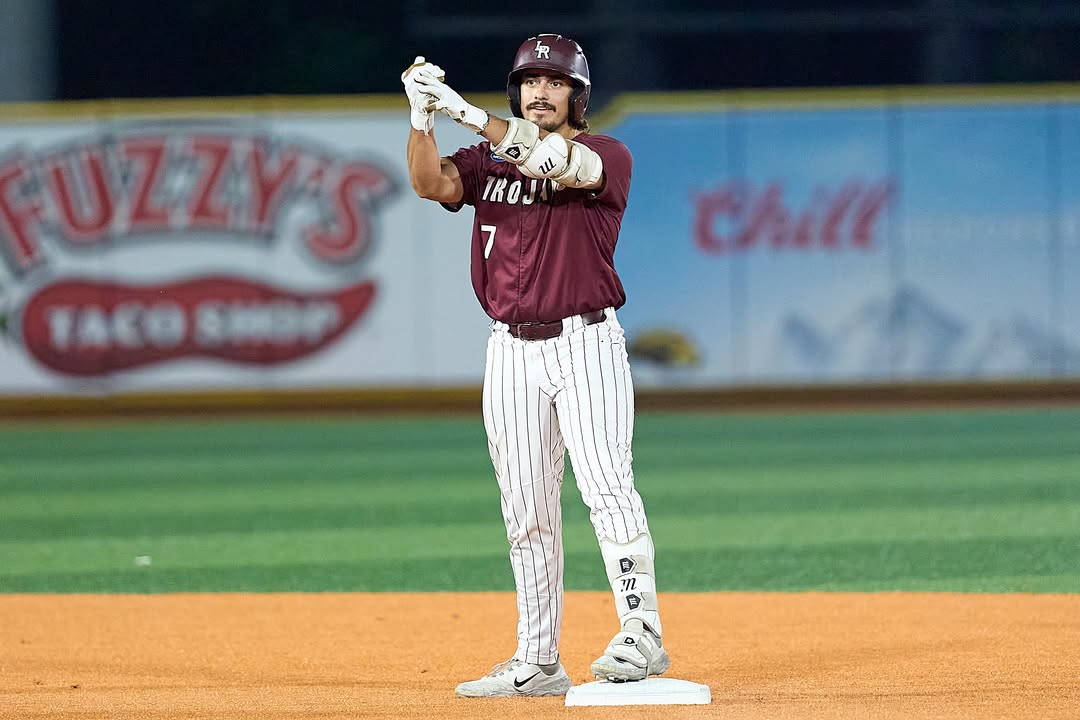
Me and my 4 year old son made the trip to Troy, AL today to witness one of the best super regional atmospheres I’ve ever been to.
The Troy admin went above and beyond for the fans. One of the many reasons why the college baseball postseason is the best
Here's the profile of a player I know:
- Played very little varsity baseball in high school
- Despite not playing much, he continued to work hard and improve.
- He had an intense desire to play college ball and found an opportunity at a small college.
- He continued working hard and earned some varsity playing time during his freshman season.
To reiterate, this player DID NOT get much varsity playing time in high school, but DID earn playing time in college.
Here's what sets him apart:
- Desire
- Resilience
- Love for the game
Players - If you want it bad enough, you can make it happen.
Young athletes.
DO NOT listen to adults who tell U the odds of making it.
If U want it bad enough & willing to do what it takes, you can do it.
Screw the percentages.
Skill > Talent.
U know what % U should worry about?
99% aren't willing to do what it takes to reach your goals
Most pitchers panic when they're getting hit. I run a four-step diagnostic instead.
Step 1: Am I giving up hits in hitter counts or pitcher counts?
If they're hitting me in hitter counts, I'm losing the at-bat before they even swing. The fix is simple — work ahead. Get into pitcher counts. If they're squaring me up in pitcher counts, that's not a count problem. Move on.
Step 2: Am I actually executing?
Am I hitting my spots? If I'm missing my locations, nothing else matters. Fix the command on my fastball first. If I'm hitting my spots and still getting lit up, move to step three.
Step 3: Is my sequence backwards?
The rule is most hittable early, least hittable late — for both location and pitch shape. Early in the count I can afford to throw something more hittable and take my chances. But in 0-2 and 1-2 counts, a ball in play can hurt. That's when I need my nastiest pitch in my nastiest spot. If I've got it flipped — throwing my most hittable stuff with two strikes — that's exactly where they're getting me.
Step 4: They've figured out my pattern.
If I'm clean on steps one through three and they're still squaring me up, they're sitting on my approach. So I look at what's getting hit hard versus soft, in versus out — and I flip it. If they're punishing hard stuff late, I start hard and finish soft. If they're punishing soft stuff late, I start soft and finish hard.
The second you flip the pattern, they have nothing to sit on.
When I was with the St. Louis Cardinals, I saw Troy Glaus doing a drill I'd never seen before.
The tee was set ridiculously deep.
Almost under his belly button.
Honestly, it looked weird.
When he swung, it looked like he was letting the ball get way too deep.
But every ball he hit was a line drive back through the middle.
So I asked him:
"What are you working on?"
He said:
"My front hip is flying open."
Then he pointed to the tee.
"This keeps me closed."
That was it.
Simple.
The drill forced him to let the ball travel.
It forced him to stay closed longer.
It forced him to keep his direction through the baseball.
At the time, I wasn't struggling with that issue.
But I logged it away.
A few weeks later, I started noticing the same thing in my own swing.
My front hip was leaking open.
I was getting pull-happy.
I was cutting myself off.
I wasn't letting the ball travel.
So I went back to the Troy Glaus drill.
Deep tee.
Middle of the field.
Line drives.
And almost immediately things started cleaning up.
I was staying through the baseball.
I wasn't rushing to pull everything.
I was letting the ball travel deeper.
One thing I've learned:
The best hitters I've ever been around didn't panic when something broke.
They had a tool for the problem.
That's why I always tell players:
Don't just collect drills.
Understand what problem the drill solves.
Because when the problem shows up...
You'll know exactly what tool to pull out of the toolbox.
If your front hip is flying open...
Try setting the tee deeper than normal.
Your goal isn't to pull the ball.
Your goal is to drive line drives back through the middle.
You might be surprised how quickly it cleans things up.
Thank you for reading,
Jermaine Curtis
P.S. - If this was helpful, share it. That tells me you want more content like this.
The biggest mistake I made when learning to hit a curveball...
I treated every curveball like it was my pitch.
So every time I saw spin, I swung.
I'd swing and miss.
I'd roll over weak ground balls.
I'd get myself out on pitches I had no business swinging at.
For years, I thought I had a curveball problem.
I didn't.
I had a decision problem.
Because every curveball isn't equal.
Some are mistakes.
Some are strikes.
Some are traps.
Once I figured that out, everything changed.
The goal isn't to hit every curveball.
The goal is to identify the mistakes and attack those.
Then let the others go.
So if I were learning to hit a curveball today, here's exactly what I'd do.
First, I'd put a glove on my top hand.
Then I'd have a coach or pitching machine throw different types of curveballs.
- Hangers
- Curves below the zone
- Curves off the plate
- Curves that start as strikes and finish as balls
- Curves that stay up
My job wouldn't be to swing.
My job would be to catch the ones I'd want to hit.
And let the others go.
Why?
Because before you can hit a curveball...
You have to identify it.
This slows the game down and teaches your eyes what a hittable curveball actually looks like.
Then I'd level it up.
Now I'd grab a bat.
Still no swings.
If it's a hanger or a curveball I can damage:
"I crushed it."
If it's a bad pitch:
"I'm taking."
Now we're training the mind.
We're learning to separate good curveballs from bad curveballs.
Then I'd move to the final step.
Now we swing.
Same game.
Same thought process.
Only now we're actually hitting.
Good one?
Attack it.
Bad one?
Take it.
One thing I've learned from 25 years of playing baseball:
Most hitters don't struggle with curveballs because they can't hit them.
They struggle because they keep swinging at curveballs they should never be swinging at in the first place.
Try this tonight:
✅ 10 catches
✅ 10 call-outs
✅ 10 swings
Record a video of yourself doing it.
I'd love to see it.
Thank you for reading,
Jermaine Curtis
P.S. - If you enjoyed this, and it helped, share it. This tells me you want more content like this.