The abduction of former Kampala Lord Mayor Erias Lukwago has taken Uganda's political crisis to a chilling new level.
Only moments after security operatives seized Lukwago, Chief of Defence Forces Muhoozi Kainerugaba took to social media with remarks that have left many Ugandans stunned. In a post widely shared online, Muhoozi appeared to boast about capturing what he called "a fool," claiming he had been taken to the infamous "basement" — a place Muhoozi himself has repeatedly referenced as a torture dungeon. Even more disturbing, he suggested that photographs would be released after the victim had been tortured.
If these statements are anything to go by, Uganda is witnessing something that should terrify every citizen regardless of political affiliation.
How did we get here?
How did a country reach a point where the commander of its armed forces can openly joke about abducting political opponents, threaten torture, and taunt the public about it on social media?
The timing raises even more troubling questions. Just last week, Lukwago, acting as one of Dr. Kizza Besigye's lawyers, sued Muhoozi over threats made against Besigye's life. Now, days later, Lukwago himself is reportedly abducted by security operatives.
Is this a coincidence, or is it a warning to anyone daring to challenge power?
For years, Ugandans have watched as opposition figures, activists, journalists, and critics disappeared into unmarked vehicles, resurfacing days later with horrifying stories of torture and abuse. What was once denied is now being openly celebrated by some of the country's most powerful officials.
This is what makes the situation so frightening. The masks are no longer even being worn.
A government that abducts its critics is dangerous. A government that tortures its critics is terrifying. But a government whose top military commander appears proud of it has crossed into territory that should alarm every believer in democracy, justice, and human dignity.
Today it is Lukwago. Yesterday it was Besigye. Before them it was countless others.
The question every Ugandan should be asking is simple: if those with national profiles, lawyers, and public visibility can be treated this way, what protection remains for ordinary citizens?
Uganda is increasingly looking less like a democracy and more like a state where power operates without fear of accountability. A country where the law bends before the wishes of powerful men. A country where critics are hunted, courts are mocked, and fear is becoming a tool of governance.
We are watching institutions crumble in real time.
And unless this trajectory is reversed, history may remember this period as the moment Uganda ceased pretending to be governed by the rule of law and openly embraced the rule of power.
YouTube - https://t.co/PWn98KnSyk
The cost of fighting for freedom, we wish to inform the general public and all freedom-loving Ugandans that our executive chairman Counsel Erias Lukwago has been abducted by state operatives and taken to an unknown destination.
Our teams are on ground to follow up on this development.
We shall Never Surrender
#FreeLukwago
#FreeKizzaBesigye
#FreeHajjiObeid
#FreeSamMugumya
#FreeSamuelMakokha
#FreedomForAll
The mask of "justice" has completely fallen. Monday's court proceedings in the high-profile, politically motivated treason case against our leaders, Dr. Kizza Besigye and Hajji Obeid Lutale have made one thing clear that this has never been a prosecution but a weaponized persecution and the court is acting as an active accomplice.
Justice Baguma had previously ordered the prosecution to provide full disclosure by Friday last week. The state deliberately disobeyed this order. It was only yesterday, inside the courtroom that they were finally forced to serve the defense with the identities of previously concealed witnesses.
In a shocking display of bias, despite the state taking months to orchestrate this sham case which carries a potential death sentence, Justice Baguma gave the defense a mere 7 days to review, reply, and exhaust all witnesses and evidence before the June 8th preliminary hearing followed by the main trial on June 11th. How can a fair defense be prepared in just one week for a capital offense?
Our defense lawyers argued passionately that this ridiculous timeline violates Article 28(3)(c) of the Constitution regarding the right to adequate time for preparation. Dr. Besigye rightfully sought a Constitutional Court review to challenge these anomalies. Shamefully, Justice Baguma flatly declined the reference.
The judge ironically complained about "delays" in the case but who has caused these delays besides the state itself? The state spends weeks hiding witnesses and breaking rules, yet the defense is penalized and rushed into a legal ambush. When the court accommodates every act of state impunity while silencing every plea from the defense, it ceases to be a temple of justice and becomes a tool of regime oppression.
The People’s Front for Freedom maintains that these charges are entirely politically motivated. The regime is desperately using the judiciary to silence leaders who stand for the liberation of Uganda.
Our defense team is battle-ready, steadfast, and fully prepared to confront this injustice head-on. The spirit of true freedom will never be subverted.
#FreeKizzaBesigye
#FreeHajjiObeid
#FreeSamMugumya
#FreeSamuelMakokha
#FreedomForAll
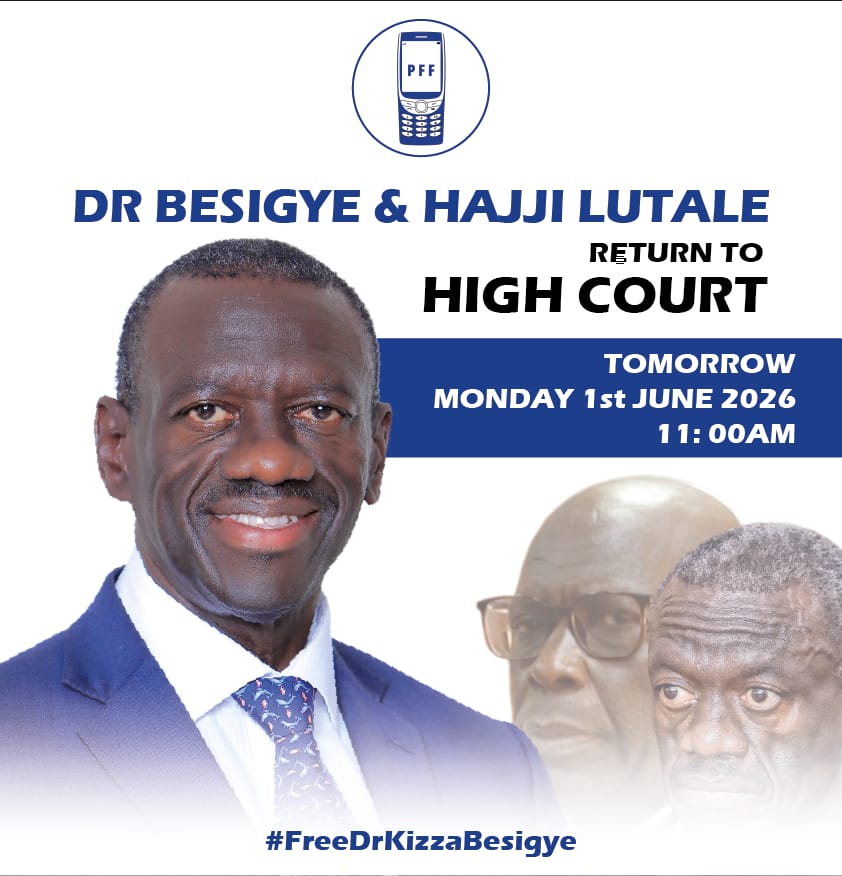
Tomorrow, Monday, 1st June 2026, our leaders Dr. Kizza Besigye and Hajji Obeid Lutale return to the High Court for pre-hearing before Justice Emmanuel Baguma.
After the state’s cowardly attempt to hide witnesses collapsed and they withdrew their application, Justice Baguma ordered that they make full disclosure by last Friday. Will they play more games tomorrow? We are ready for them!
This is trial for Uganda’s democracy. We call upon all change seeking Ugandans, comrades and freedom fighters to pack the High Court tomorrow morning. Let’s stand shoulder-to-shoulder with our leaders.
#FreeKizzaBesigye
#FreeHajjiObeid
#FreeSamMugumya
#FreeSamuelMakokha
#FreedomForAll
What we are witnessing is politics masquerading as law enforcement – as fighting corruption. In truth, AAA is facing a political witch-hunt. (I know, she deserves it, but it has to be narrated as such).
The entire series is an internal NRM wrangle where dialogue failed – and her yesterdays enablers and co-conspirators leveraged their more powerful positions.
One more time, AAA’s crimes are neither unique nor exceptional. She is the absolute embodiment of NRM flesh and spirit.
The sustainable fight against corruption will be by building institutions (not individuals) and letting them do their job. The current celebration can be understood. Naturally, we celebrate the ongoing action against AAA because of the anger we have towards her displayed insensitivity, with on-camera extravagance, theft, and impunity. Her biggest fault is rubbing it in our faces and persecuting critics/opponents, otherwise corruption per se is normal now. The moment is also used as an outlet for the accumulated frustrations in the public. In a place where corruption is hardly ever genuinely fought, this isolated action had to be exciting - no matter its political intentions.
But, knowing what we know, including that Mawanda is a big PLU official, we need to come back to our senses after the AAA downfall excitement. Other bizarre things are passing in the dust of this dance. We need to remain cynical because many other known corrupt people who are still in good books are walking heads high. There is no new beginning being announced with regard to integrity; it is more of an announcement of the might of a new power base. We need to continue demanding that illegality is not fought with illegality and arbitrariness.
We naturally didn’t care who sorts the irritating AAA, but we should know that if relevant institutions were allowed to do their job and also checked, the AAA phenomenon wouldn’t have taken this long to be brought to order. We know why the IGG and Auditor General developed cold feet during the earlier Parliament Exhibition, as they often do around big political darlings. We watched Parliament become the casino that it is. Government can’t act shocked, except in announcement of incompetence. We know why many relevant bodies can’t do their job.
We can also see that the AAA issue has been choreographed and performed in a way that politically channels credit to an individual who shouldn’t have been at the center of it in a healthy system. That is why it came along with announcement of his preferred replacement - an early patronage sign that the cycle is likely to be repeated.
We have not failed to stop corruption because of lack of individuals who care. It is because of a political system that thrives on corruption and only affords an occasional performance of fighting it where some political interests are at risk or when we want to politically manufacture credit and power for special individuals. A more sustainable fight should be institutional, constitutional and non-selective.
Why are we staging this as though President Museveni is being sworn in for the very first time? Like some grand liberation from imaginary colonial masters? Strip away the theatrics and the truth is this spectacle is nothing more than a cash‑grab. The real headline isn’t the ceremony, it’s the billions that will vanish into the pockets of those orchestrating it.
Whenever the President takes center stage at a national ceremony, Uganda is treated to the same grotesque financial theatre: prices rigged sky‑high through shameless direct procurement. It’s not economics; it’s organized theft. In any rational market, bulk buying drives costs down. Here, government “negotiations” magically push them upward which is a perverse Ugandan anomaly that mocks logic and law alike.
It’s a deliberate racket: suppliers and officials collude, inflate invoices, and carve up the loot. Later, when audits inevitably expose the absurd figures, the country is fed the ritual of fake outrage fiery debates in Parliament and media, headlines screaming scandal. But accountability never arrives.
Why? Because the stolen billions are recycled to bribe silence. Media houses, MPs, police, even auditors, all get their cut. The scandal doesn’t explode; it is smothered in cash. Uganda’s direct procurement circus is a system perfected for plunder.
The Ugandan Ambassador in Abuja called in police on his own staff who staged a peaceful protest after going months without pay despite funds reportedly sitting on the embassy accounts . We are being ashamed home and away .
"There is a tunnel at the end of the light for a nation whose rulers begin by promising transformation, then end up demanding eternity in power; when they begin with aspirations, then descend into explanations, and later transition into excuses. There is a tunnel at the end of the light for a nation whose rulers allege they need “more time.” More years. More terms. More amendments. More extensions. More patience from the suffering public. They insist history is still “under construction,” that the dream is not yet complete, that the revolution is unfinished, that the legacy is still loading. Like I said, just random thoughts," writes @gawayategulle
👉 https://t.co/SjNEAXgDPr
#MonitorUpdates
Jacob, I respect that you took time out to respond with data on this. It's a very rare approach for defenders of the M7/NRM record to do that, so thanks. But, also, facts:
1. You say; M7 1986-2026 = 40 YEARS OF: PEACE: No war in Kampala since 1986:
•FACT CHECK: Yes, Central and Western Uganda, minus the Kasese region, have remained relatively stable, but the North & Northeast (1987–2006) saw various wars, including the Lakwena and the Lord’s Resistance Army (LRA) that lasted 20 years.
At its peak, over 1.8 million people were forced into Internally Displaced Person (IDP) camps, which were described by the UN as having some of the highest mortality rates in the world. And there has been the ADF war (on-going but inside DRC with the UPDF). In all, between 200,000 to 400,000 are estimated to have been killed in these wars.
2. UPE: 8.6M children in school FREE.
•FACT CHECK: Yes, enrolment went up considerably, but the problem with UPE is the the dropout rate is approximately 60-70% before reaching Primary 7.
Many children "in school" fail basic literacy and numeracy tests (Uwezo reports consistently show that a significant percentage of P.3 to P.7 students cannot perform P.2 level tasks).
3. USE: 2M students in secondary FREE.
•FACT CHECK: Only about 1 in 4 students who start primary school actually make it to secondary school.
Compared to Kenya, which has a secondary school transition rate of over 90%. Uganda’s secondary system struggles with high hidden costs (fees for lunch, uniforms, and building funds) that exclude the poorest.
4. PDM: 10,594 parishes getting 100M each:
•FACT CHECK: This was no doubt an important injection of development money at the grassroots level, but the programme has been marred by "ghost" SACCOs and officials arrested for diverting funds.
More critically, after years of decline, the poverty rate has stagnated or risen in specific Ugandan regions. Uganda's poverty rate reached 26.4% in 2023/2024, with rural poverty at 30.2%. In the North and East, poverty levels remain as high as 34-39%.
5. ROADS: Entebbe Expressway, SGR coming.
•FACT CHECK: At a cost of $476 million ($9.2M per km), Entebbe Expressway was one of the most expensive roads per kilometre in the world.
Similar 4-lane highways in countries like Ethiopia (Addis-Adama Expressway) were built for roughly $5M per km (though yes, we have to provide for differences in terrain).
On the Standard Gauge Railway (SGR), it was first officially promised in the 2010/11 National Budget. It has been "coming" for 16 years. By comparison, Tanzania and Kenya have already built major portions of their SGR networks over the same period.
Overheard a boda-rider as a lead car shoved us off the road:
Had I been minister in UG, I would go about quietly – no lead cars, no sirens, no bodyguards. So, when you push people off the road, what do you tell yourself you are rushing to do in a country that looks like this?
Tell us, who had gotten Uganda into the doldrums? Did you expect to find a prosperous country after waging five years of war against it?
One of the warlords, Matayo Kyaligonza, writing in his book The Agony of Power, says that his role in the war was to make sure Kampala went to bed at 3pm.
An estimated half a million people were killed, and property worth millions of dollars was destroyed.
Mr Museveni and his warlords should be charged with crimes against humanity.
Garvey and Nyerere's Ghosts: Why the Young Museveni Would Have Been a Criminal Under His Bill Today
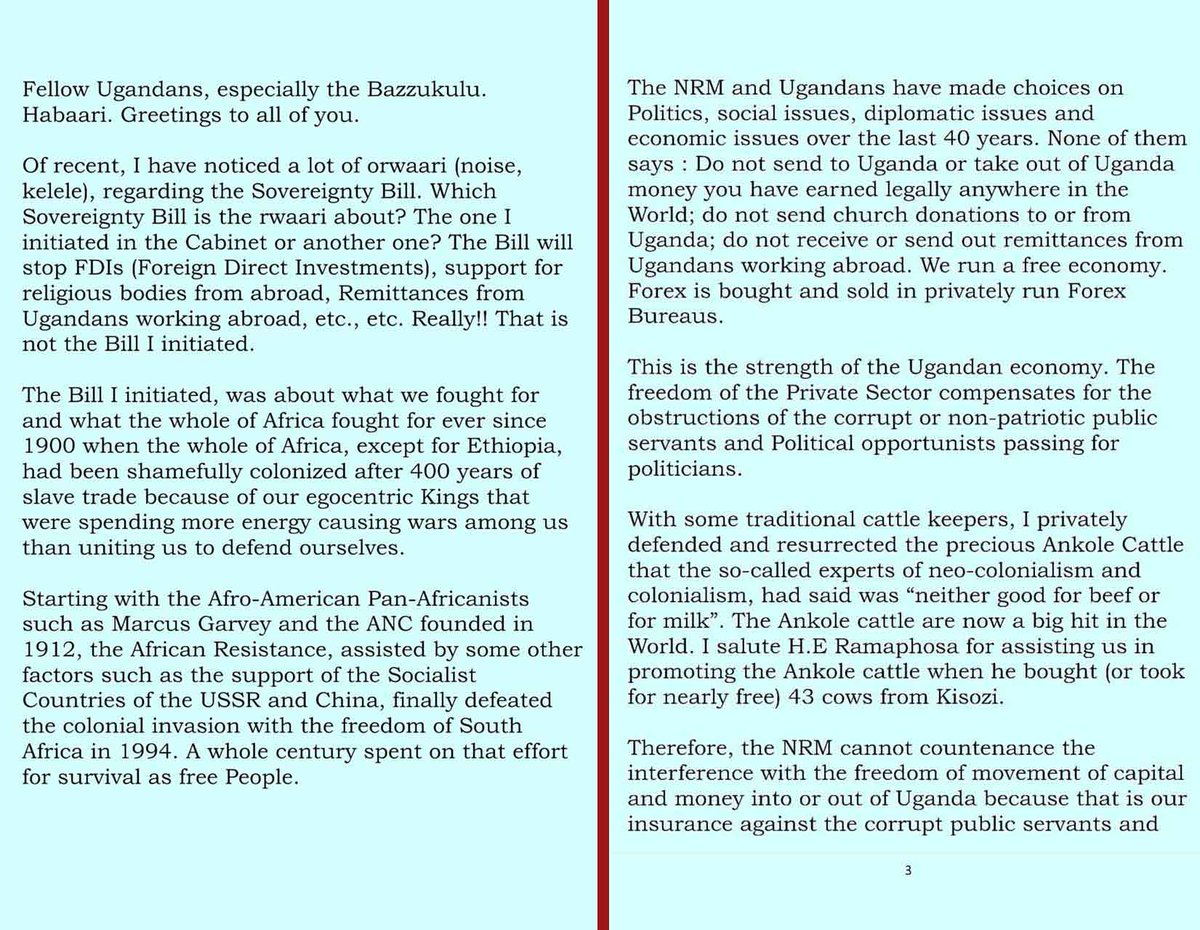
Amidst a storm of national and international backlash, the Ugandan government has deleted or diluted several of the more heinous clauses in its controversial Sovereignty Bill. These retreats were first signalled in a three-page letter from President Yoweri Museveni. Even so, the President defended the remaining text, claiming to channel the spirit of heroes like Marcus Garvey and Julius Nyerere, the struggles of the ANC, and two centuries of African anti-colonial resistance.
One might have let this pass, were it not for the glaring contradictions. Museveni is right to assert that African nations must guard their policy-making against external coercion to ensure the continent's future is determined by its own citizens. His acknowledgement of the long struggle against colonial exploitation rightly identifies the need for African agency. But a closer look at the Bill and the historical movements it invokes reveals deep-seated contradictions.
To begin with, Marcus Garvey's Universal Negro Improvement Association (UNIA) was the ultimate example of foreign political funding, powered by the remittances of the global Black Diaspora. While Museveni's letter claims to protect remittances, the Bill's broad language targets money with political intent. Since Garvey's entire financial model was built on political intent - the liberation of Africa - his work would be an illegal foreign influence under the strictures of this Bill. There is a fundamental disconnect in claiming Garvey as a hero while legislating to block the global African community's support (among others).
Similarly, the ANC's 1994 victory was won precisely because the movement ignored territorial sovereignty. The ANC built a globalised network that funnelled foreign money and political pressure into South Africa. A strict Sovereignty Bill in the 1970s would have been the Apartheid regime's greatest tool to silence the ANC's international allies.
Museveni should know this practically. In the late 1980s, he oversaw the relocation of the ANC and its armed wing, Umkhonto we Sizwe, to central Uganda. When they eventually won power in 1994, their massive parade in Kampala surprised many Ugandans who hadn't realised the sheer scale of the foreign presence on their soil (South Africa has repaid the favour by refusing to grant Ugandans visa-free access, while those Africans who actually even opposed their anti-apartheid struggle get it. Talk of treachery and ingratitude). Anyway, essentially, the Museveni of today is seeking to punish the progressive Museveni of decades past.
Furthermore, Museveni credits the USSR and China (and should have added Cuba) for assisting the African Resistance. This creates a logical trap: if the 20th-century liberation movements, including Museveni's own NRA, had operated under his proposed Sovereignty Bill, their external support would have been criminalised. Foreign weapons and training would have seen these freedom fighters labelled as mercenaries or traitors by the standing regimes.
Finally, Museveni blames egocentric kings for the disunity that invited colonisation. However, this Bill does exactly what those kings did: it concentrates power within a small executive Cabinet rather than the people. By invoking Garvey and Nyerere, Museveni is choosing heroes whose radical, pro-people philosophies offer the strongest arguments against his legislative agenda.
William Ruto: President Museveni called me and said he wanted to buy 50 shares in the Kenyan pipeline and did not mind the price, President Museveni, Just as you invested in the pipeline, Kenya will invest in your refinery and in the shared future of our resources.
The only good thing in this bill is the title, "Protection of Sovereignty Bill."
I also thought, finally, communism, nationalisation? Kumbe, waa. Politics.
In these 13 glorious minutes, dr @SarahBireete breaks down the absurdity of Kiryowa Kiwanuka's Bill. It is painful to imagine it passed their cabinet.
Dear @MKarekye what type of country are we cobbling together (or apart?) Eh.