Today we reduced headcount by 22%. The business is the strongest it's ever been. So I think it's important to be direct about what I'm seeing and why.
First, I made this decision and I own it. I did it because the way to operate at the highest level of productivity is changing, and to win the future, ClickUp needs to change with it.
Second, this wasn't about cutting costs. Most savings from this change will flow directly back into the people who stay. We'll be introducing million-dollar salary bands. If you create outsized impact using AI, you'll be paid outside of traditional bands.
Most importantly, I have the deepest gratitude for those affected. We're doing this from a position of strength specifically so we can take care of people properly. Everyone affected receives a package aimed at honoring their contributions and easing the transition.
I only see two options: wait for this to play out gradually in the market or be honest about what I'm seeing and act proactively.
THE 100X ORGANIZATION
The primary change is that we're restructuring around what I call 100x org. The goal is 100x output. The roles required to build at the highest level are fundamentally different than they were a year ago.
Incremental improvements to existing systems won't get us there. We need new ones. That means creating enough disruption to rebuild rather than iterate on what's already broken.
The common narrative is that AI makes everyone more productive. It doesn't. Many of the workflows of today, if left unchanged, create bottlenecks in AI systems.
These roles will evolve. But waiting for that to happen naturally means falling behind now.
The 100x org is actually heavily dependent on people - infinitely more than today. This is only possible with 10x people that have embraced and adopted new ways of working.
THE BUILDERS, AGENT MANAGERS, AND FRONT-LINERS
— THE BUILDERS: 10X ENGINEERS
I don't think most companies have internalized what's actually happening with AI in engineering. The common narrative is that AI makes all engineers more productive. That may be true in isolation, but at an organization level - that is the farthest thing from reality.
Here's what we've validated recently at ClickUp: the great engineers, the ones who can orchestrate, architect, and review, are becoming 100x engineers. They're not writing code. They're directing agents that write code. The skill is judgment.
AI makes the best engineers wildly more productive, and everyone else using AI slows these engineers down.
Think about it - the bottlenecks are (1) orchestration - telling AI what to do, and (2) reviewing - what AI did. Everything is leapfrogged and no longer needed.
So who do you want orchestrating and reviewing code?
And how do you want your best engineers to spend their time?
If your best engineers are spending time reviewing other people's code, then this is inherently an inefficient bottleneck. These engineers can review their agent's code much faster than reviewing human code.
The new world is about enabling your 10x engineers to become 100x.
The wrong strategy is to push every engineer to use infinite tokens. Companies doing this are celebrating 500% more pull requests. But customer outcomes don't match the volume of code being generated.
I call this the great reckoning of AI coding, and every company will face this soon if not already.
More code is just another bottleneck to the best engineers, and ultimately to your company's impact as well.
— THE BUILDERS: 10X PRODUCT MANAGERS
Product management and design roles are merging.
Designers that have customer focus, become more like product managers.
And product managers that have intuition for UX become more like designers.
The bottleneck of user research is gone. It takes us just one mention of an agent to kickoff research and analyze results.
The bottleneck of product <> design iteration is also gone. The product builder iterates on their own, along with agents and skills that ensure alignment with quality and strategy.
Also controversial today - I believe that the wrong strategy is to have your PMs shipping code - that just introduces another bottleneck that the best engineers will waste their time on.
To be clear, PMs should be coding but they should do this in a playground to iterate, validate, and scope. That code should not go to production.
Everything outside of managing systems, orchestrating AI, and reviewing output becomes a bottleneck.
That's why the other roles that are critical along with these are the systems managers (to reduce bottlenecks) along with a bottleneck you can't replace - customer meeting time.
— THE SYSTEM MANAGERS
Ironically, the people that automate their jobs with AI will always have a job. They become owners of the AI systems - agent managers. We have many examples of these people at ClickUp.
The underlying systems in which we operate are absolutely critical to get right. I think most companies are delusional to think they can iterate on existing systems and compete in this new world.
You must create enough disruption so that old systems are deprecated entirely. If there's any definition for 'AI native' that's what it is.
— THE FRONT-LINERS
In a world that will become saturated with AI communication, the human touch will matter more than anything to customers.
This is a bottleneck that you shouldn't replace - even when agents are high enough quality to do video meetings.
One-on-one meeting time with customers is something that shouldn't be automated. The systems around the meetings should be - so that front-liners spend nearly 100% of their time with customers.
REWARDING 100X IMPACT
In a world where companies are able to do so much more with less, where does that excess money go?
In our case, much of the savings in this new operating model will flow directly back to those that enabled it.
We must reward people that create productivity accordingly. This aligns incentives on both sides. Plus, in a world where your best people create 100x impact, you can't afford to lose them.
You should aim to retain these employees for decades. The context they have and their ability to efficiently orchestrate and review will be nearly impossible to replace.
Compensation bands of today should be thrown out the door. We're introducing $1 million cash/year salary bands with a path available to nearly everyone in the company if they produce 100x impact by creating or managing AI systems.
THE FUTURE
Nearly every company will make changes like these. The ones that do it proactively will define what comes next.
The future is not fewer people. It's different work, new roles, and better rewards for those who embrace it. We're already seeing entirely new roles emerge, like Agent Managers, that didn't exist a year ago.
ClickUp is positioning to lead this shift, not just internally, but for our customers too. I've never been more certain about where we're headed.
Famously (there is a beautiful Works in Progress piece on this) in 2016, Geoffrey Hinton told an audience in Toronto that medical schools should stop training radiologists, since AI would soon outperform them at reading scans. Ten years later, there are more radiologists than ever, and they earn more than they did then.
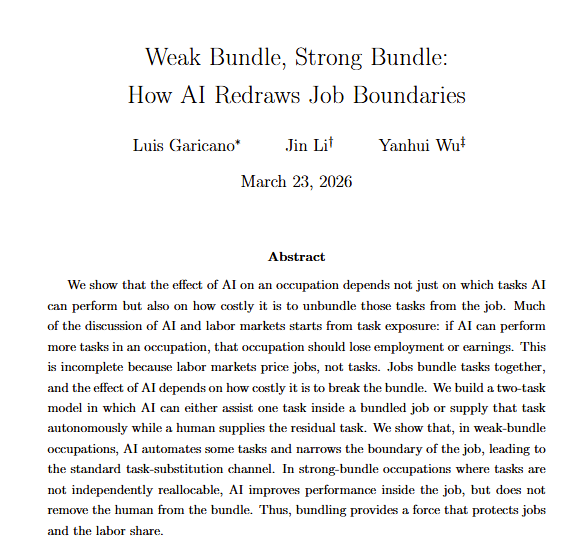
Hinton was right about the task, but he was wrong (so far!) on the future of the radiology profession. Times have never been better for them. The gap between those two claims, the difference between tasks and jobs, is the subject of a paper I have written with Jin Li and Yanhui Wu, and that we release today: "Weak Bundle, Strong Bundle: How AI Redraws Job Boundaries." (Very relatedly we are also finishing the first draft of our book "Messy Jobs" on AI and Jobs!! You will be the first to hear).
We start from the observation that the growing literature on AI and labor markets measures the AI shock by task exposure: people count how many tasks AI can perform in a given occupation AI can perform, and infer that more exposure means more displacement. Eloundou et al. published a paper in Science in 2024 that started this literature, and many follow the same logic. The inference they make is that the more exposed tasks, the worse the outcomes.
This is incomplete, because labor markets price jobs, not tasks. A radiologist does not just sell image classification, but does many other jobs: triages cases, communicates with other physicians, trains residents, makes the difficult decisions, and signs a diagnosis. The market buys a bundled service. The question AI poses is not whether it can do one task inside the bundle. The question is whether that task can be pulled out.
Thread (1/3)
https://t.co/wEYMfjGbeX
Software horror: litellm PyPI supply chain attack.
Simple `pip install litellm` was enough to exfiltrate SSH keys, AWS/GCP/Azure creds, Kubernetes configs, git credentials, env vars (all your API keys), shell history, crypto wallets, SSL private keys, CI/CD secrets, database passwords.
LiteLLM itself has 97 million downloads per month which is already terrible, but much worse, the contagion spreads to any project that depends on litellm. For example, if you did `pip install dspy` (which depended on litellm>=1.64.0), you'd also be pwnd. Same for any other large project that depended on litellm.
Afaict the poisoned version was up for only less than ~1 hour. The attack had a bug which led to its discovery - Callum McMahon was using an MCP plugin inside Cursor that pulled in litellm as a transitive dependency. When litellm 1.82.8 installed, their machine ran out of RAM and crashed. So if the attacker didn't vibe code this attack it could have been undetected for many days or weeks.
Supply chain attacks like this are basically the scariest thing imaginable in modern software. Every time you install any depedency you could be pulling in a poisoned package anywhere deep inside its entire depedency tree. This is especially risky with large projects that might have lots and lots of dependencies. The credentials that do get stolen in each attack can then be used to take over more accounts and compromise more packages.
Classical software engineering would have you believe that dependencies are good (we're building pyramids from bricks), but imo this has to be re-evaluated, and it's why I've been so growingly averse to them, preferring to use LLMs to "yoink" functionality when it's simple enough and possible.
@CA_DMV@CA_DMV I had an appt to get the real id at the Santa Ana location and took all the required papers including my US passport. I was refused and asked to come back bringing my old naturalization papers, green card and work authorization. I am a US citizen for 10 plus years.
"You went to IIMA? What did you learn there?"
This question popped up late last year during one of my client pitch calls. I was talking to a smart young tech fellow, who had just raised money for his company. And usually these calls are about getting to know each other, what they do, what I do, how we can work together, communications, content, stories etc.
So... this question was unusual.
I am not a big credentials person. But when you are running your own business, every little helps, right?
Anyway, it made me think. And I thought: You know what? I should share this with my Twitter friends.
***
IIMA teaches you a lot about many things. And your mileage will vary. I loved it.
But two, ostensibly tiny, classroom experiences have really stuck with me from my time there from 2003-2005.
The first was the Arun Icecreams case study. (IIMA uses the case study methodology a lot. I don't think I appreciated this as much as I should have at the time.)
This case was a sweeping history of the company from its inception in 1970 all the way to an inflection point in 1997 where the company's leadership now had to make some business decisions in the face of rising competition from people like Unilever. Our job in the class was to discuss and debate options.
Two decades later I have zero memory of the conclusions of that session. But I remember one particular question that the professor asked to kick things off. It had to do with this section on page 1 of the case study. Let me paste the text here. (You can Google up the whole thing.)
Slightly long excerpt. But there is a point to this.
"Chandramogan, son of a vegetable wholesaler from the South Indian state of Tamil Nadu, set up Arun Ice Cream in 1970 in Madras (now re-named Chennai), essentially motivated by the urge to "do some thing". After his college studies were discontinued at the pre-university stage, Chandramogan agonised over several weeks about starting some business without being quite able to narrow down to any specific line, mainly because of heavy investments entailed. While driven by an urge to succeed as a businessman, he did not quite know how to go about setting up a business. It was his maternal uncle who suggested the business of ice cream. Investing Rs. 15,000 as his own capital and raising another Rs. 21,000 by way of a bank loan, he set up a small ice candy unit in a rented premises adjacent to his uncle's retail textile outlet. From a quick survey around the Madras market it appeared to Chandramogan that there were about 350 small-time ice candy manufacturers like himself competing in the low end of the market. These were offering no competition to the up-market segment dominated by the leading brands Dasaprakash, Joy and Kwality. Like the "others in the crowd", Chandramogan was also selling his Arun brand ice candies for 10 paise and 15 paise a piece predominantly through street-vendors. Thanks to its prominent location in a busy locality, Arun also quickly began attracting walk-in customers. The fact that one could get "fresh" ice candies right across the factory counter was a major selling point in promoting in-factory sales. In the very first year of operations, Chandramogan recalls, Arun clocked a turnover of about Rs. 150,000 and profit of about Rs. 40,000."
And the question posed to the class was: "Why did Chandramogan choose that particular location to start the business?"
This was a location in Royapuram. And if I remember correctly, it was in a busy commercial area next to a flyover. The details are not super relevant as you will soon see.
With all the alacrity of young MBA students, who all wanted to work at Goldman Sachs or McKinsey, we dove into the location question.
Because of footfall! Because of traffic! Maybe it had uninterrupted power supply? Maybe he had access to manpower? Maybe there were other ice cream shops nearby? One guy even suggested it was because Royapuram was very hot, and maybe that would make people buy more icecreams.
The professor, who was clearly having fun, kept provoking us. And eventually he said: "Ok good. Now let me tell you my perspective on what really happened?"
This is a bit of a cheat. But because many of our cases were written by our own faculty, they sometimes had more info than was obvious from the text. And part of our job was to tease this out? Anyway. I will pause on Arun Icecreams here. And I want you to think about his question: Why did Chandramogan start the first shop in that location in Royapuram.
***
Second story. One of the final courses I did was one on Entrepreneurship, that was run by the venerable Sunil Handa. It was a bewildering, often bizarre course. And the point was to make a room full of campus-placement obsessed fellows think about running their own businesses. (Please remember, this was way back in 2005, when all this VC-funded startup frenzy was very very nascent. The default thing to do was very much get a campus job.)
Right at the end of the course Sunil Handa told us that it was time to grade our performance on the course. He said there would be no exam, no tests, no presentations. Nothing. We were all handed a piece of paper. And we were told grade ourselves on the standard IIMA Scale. A, B+, B and so on. (Was there an A+? I have forgotten.) On what basis, we asked. Whatever basis, he said. You decide. I don't care. Whatever you grade yourselves I will accept as your grade for this course.
We all graded ourselves and handed the slips in. The next week, the last session of the course, Prof. Handa bid us all farewell and good tidings. And then gave us a distribution of the scores. "Most of you gave yourselves a B of some sort," he said. And it turned out that exactly one guy gave himself the highest possible score. Nobody else. And the scores had very little correlation with performance. Most of us thought about attendance and participation and field trips and so on, and scored ourselves aiming for some notion of "fairness". Something like that.
He said: "You guys need to realize that entrepreneurship is not primarily about fairness or justice or anything. Entrepreneurship is about making the most of the opportunity given to you. When someone gives you a chance, for god's sake, take it. You should have all given yourself an A+. Never talk yourself out of success. Go you fools, and never forget this lesson!"
I embellish, of course. But that moment remains etched in stone on my heart. I gave myself a B+.
Back to Arun Icecreams.
***
Professor: "So guys. Let's talk about the uncle figure."
"What do you think the maternal uncle is thinking to himself? Look at this guy, my nephew. He has dropped out of college. He wants do something but doesn't know what. I had to tell him what to do. Plus he has now taken a loan and put in some of his own money. Maybe I have given him some money myself? I am not letting that guy out of my sight. I want to make sure I can keep an eye on my nephew, in case he screws this icecream thing up."
And that is why, the professor told us, he opened the shop right next to his uncle's. His uncle found the location for him. So that he can keep an eye on this nephew's shenanigans.
"Business is not always location, footfall, tactics, and 2x2 matrices and stuff like. Often business is just human beings doing human being things. With simple human incentives and motivations. Never ignore the human aspects of business. Always keep the individuals, their motivations, fears, excitements, tendencies, and eccentricities in mind. Ask the human question first, apply the framework second."
***
Two decades later, a day doesn't go by when I don't think of those two lessons.
When I talk to clients I am always provoking them to tell me why... they are in Royapuram. And I have to constantly tell myself that there is a time to be humble, and there is a time to be your own champion.
Many thanks for your attention. Cheers. And have a nice day. Oh, and have a great 2026.
I give this note an A+.
My annual letter:
https://t.co/5axz7jVwOb
This year I discuss corgis, compute, and Cold War; the Texas State Fair; DSA; Neue Sachlichkeit; disfiguring the physical past and the end of history; Germanic obedience; Antichrist; wisecracks; Pascal’s Wager; romantasy; and croissants.
'water is transparent only within a very narrow band of the electromagnetic spectrum,
so living organisms evolved sensitivity to that band, and that's what we now call "visible light". '
(found via HN)